
AI
SpaceX’s $1.77 Trillion IPO Hides a Cloud Computing Bet
SpaceX priced its $1.77 trillion IPO for Friday. Morningstar values it at $780B. The valuation rests on xAI’s neocloud pivot, not on rockets.

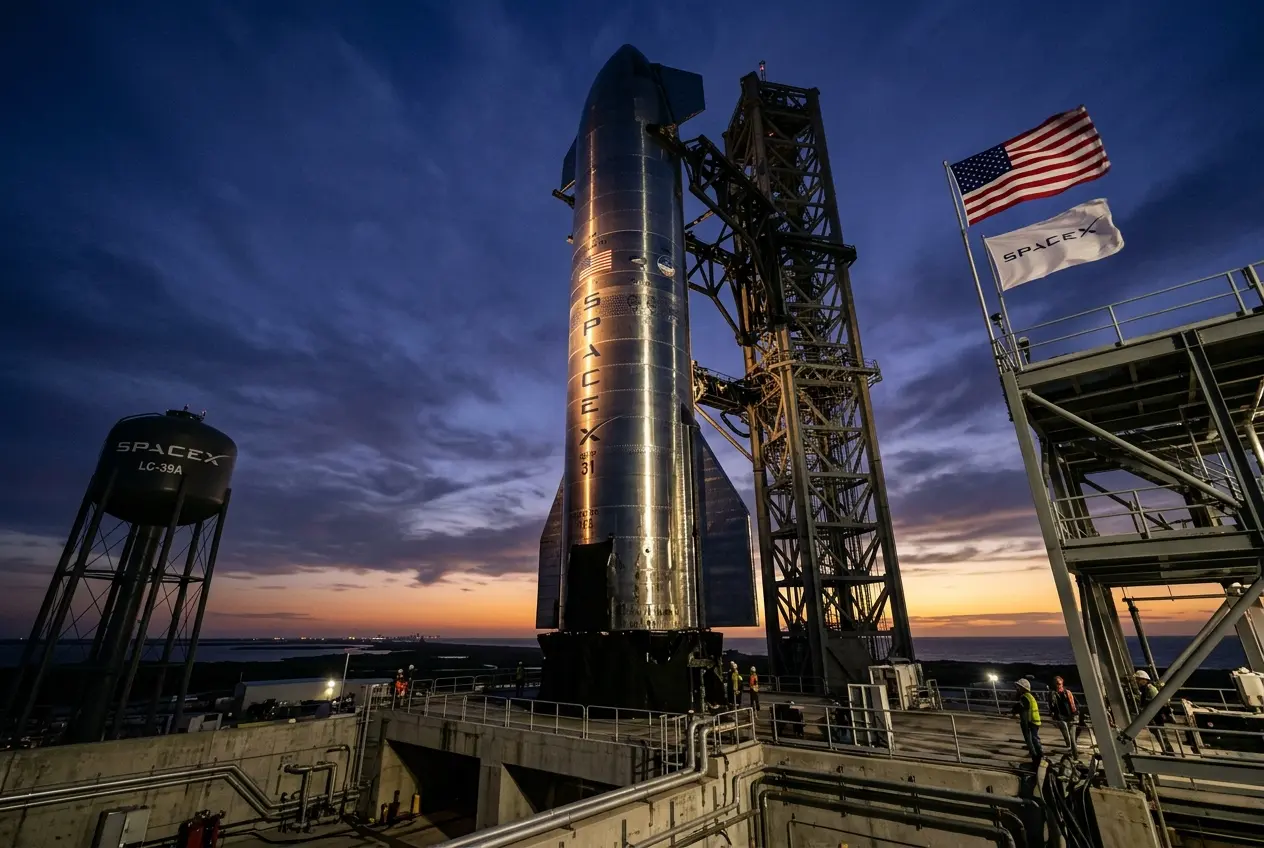
SpaceX priced its IPO at $135 a share on Wednesday, setting the stage for a Friday Nasdaq debut that values the rocket, satellite, and artificial intelligence company at $1.77 trillion. The company plans to sell about 555.6 million shares to raise roughly $75 billion, all of it primary, with no existing holders selling into the deal. Ticker SPCX begins trading Friday under the heaviest fixed-price IPO Wall Street has ever priced, more than double Saudi Aramco’s 2019 record raise of $29 billion.
Within hours, Morningstar issued a public fair-value estimate of $780 billion, about 55% below the IPO target, and Michael Burry, the hedge fund investor who called the 2008 housing collapse, posted a Substack note telling subscribers the S-1 justifies no trillion-dollar value. Investors who remember Musk’s 2022 pitch for Twitter, quintuple revenue to $26 billion and nearly quintuple the user base by 2028, see a familiar pattern. The real bet, hidden inside the rocket business and the S-1 itself, is xAI’s last-minute pivot from building frontier AI models to renting its Memphis data centers to Anthropic and Google.
The $1.77 Trillion Number Sets Up Friday’s Largest-Ever IPO
SpaceX will trade on Nasdaq under SPCX from Friday, June 12, with shares set at a single fixed price of $135 each. The fixed-price structure, laid out in the fixed $135 share price and $1.77 trillion valuation, is unusual for an offering this size and locks in the headline number before the first trade. Musk will retain more than 82% voting control through a dual-class share structure that makes SpaceX a “controlled company” under Nasdaq rules.
The deal would be the largest IPO in stock market history at the announced raise, more than triple Saudi Aramco’s 2019 record of $25.6 billion. The company will sell only about 3% to 4% of its shares to public investors, an unusually small float. At the ask, SpaceX would trade at roughly 94 times its 2025 revenue of $18.67 billion, a multiple that Nvidia, one of the most profitable companies in technology, currently carries at about 22 times trailing revenue.
Morningstar’s $780 Billion Dissent
Morningstar, the independent research firm, initiated coverage of SpaceX the same day the price was set, and analyst Nicolas Owens arrived at a fair value of $780 billion. The estimate, built on a discounted cash flow model and detailed in the $780 billion Morningstar fair-value note led by Nicolas Owens, broke the company into two pieces. SpaceX’s launch and Starlink businesses got a combined enterprise value of about $611 billion; the AI segment, valued through probability-weighted scenarios, added only about $170 billion.
The AI component is the disagreement. Morningstar modeled three scenarios for SpaceX’s plan to place data centers in space. The “moonshot” case, in which Starship becomes a fully reusable rocket and orbital AI compute proves out, gets a 7 percent probability and a $1.3 trillion valuation. A “no go” case, in which those projects fail, gets a 43% probability and would destroy more than $81 billion in value. “We think the company has been significantly overvalued and investors will have opportunities to buy the stock at more attractive levels after the IPO,” Owens wrote.
The S-1 itself supports the caution. SpaceX’s prospectus includes 38 pages of risk factors and states plainly that the company has “a history of net losses and may not achieve profitability in the future.” Q1 2026 revenue of $4.7 billion was up 15% year over year, the slowest growth rate the company has reported. The first quarter alone produced a net loss of $4.3 billion, per figures reported separately.
- $780 billion: Morningstar’s fair-value estimate, roughly 55% below the $1.77 trillion IPO target
- $611 billion: combined DCF value of SpaceX’s launch and Starlink businesses
- $170 billion: probability-weighted value assigned to the AI segment
- 7 percent: probability assigned to the “moonshot” case valued at $1.3 trillion
- 43 percent: probability assigned to the “no go” case that would destroy more than $81 billion in value
Burry, Gerber, and the Twitter Reckoning
Burry, who founded Scion Capital and was portrayed in “The Big Short” for his bet against the U.S. housing market, wrote on a Substack subscriber chat that the IPO filing tells a different story than the price does. “Any move up will be on hype and technicals,” Burry wrote, per Michael Burry’s Substack note that the S-1 justifies no trillion-dollar value. “Nothing in that S-1 suggests it is worth $1 trillion let alone $2 trillion.” Burry also took aim at Anthropic, the AI company whose Claude model competes with Musk’s Grok, calling its recent $965 billion valuation a likely overstatement.
Anthropic “is not even [likely to be] long-term worth anywhere near $1 trillion,” Burry wrote, arguing that the model-building business is “far too expensive, too much brute force” and that compute will eventually be commoditized. He quipped that before paying $1 trillion for Anthropic he would count to one trillion and “in 240,000 years I might reconsider.”
Any move up will be on hype and technicals. Nothing in that S-1 suggests it is worth $1 trillion let alone $2 trillion.
Michael Burry, founder of Scion Capital, in a Substack subscriber chat, May 2026.
Ross Gerber, chief executive of the investment firm Gerber Kawasaki and a long-time SpaceX shareholder, took a different tack in the NYT account of Ross Gerber’s alarm at the $1.77 trillion mark. He said he was alarmed by the headline number, which would be more than four times the $400 billion valuation the company carried just 13 months ago. “Investors are paying an extremely high price for this stock,” Gerber said.
The Twitter parallel haunts both critiques. When Musk bought Twitter for $44 billion in 2022, he told private investors the company would quintuple its revenue to more than $26 billion and nearly quintuple its customer base by 2028. Twitter, since renamed X, has not come close. Its ad revenue plunged 65% last year, and it was folded into SpaceX this year as part of the xAI merger. Gerber offered his own summary of the IPO when asked what investors were actually buying. “People are paying a trillion dollars for Elon,” he said.
The Hidden Stake of xAI’s Neocloud Pivot
Jim Chanos, the short seller who predicted the 2001 collapse of Enron, called the SpaceX IPO a “don’t look at the man behind the curtain” moment. The curtain Chanos is pointing at is xAI, the artificial intelligence lab Musk merged into SpaceX in February 2026. The S-1, Chanos argued, is selling a story about rockets while the actual revenue mechanism is a sudden pivot by xAI from building frontier models to renting computing capacity to other AI companies.
“xAI seems to be suddenly changing its business model from developing models like Grok to basically becoming a neocloud,” Chanos said, using the industry term for companies that provide computing power to other AI firms. A neocloud is a commodity business, valued far lower on the public markets than frontier model labs. “That’s crucial because the entire valuation rests on xAI’s progress,” Chanos said.
The deals that justify the pivot are real, and they are large. Anthropic, the Claude maker, agreed in May to rent the entire computing capacity of xAI’s Colossus 1 data center in Memphis, paying SpaceX $1.25 billion a month through May 2029, with 90 days’ notice to terminate, per the S-1 disclosure that Anthropic will pay $1.25 billion a month through May 2029. Google signed a separate arrangement disclosed on June 5, detailed in the Google cloud deal that turns SpaceX into a GPU landlord, to rent SpaceX capacity at $920 million a month for 32 months, a roughly $29.4 billion commitment covering about 110,000 NVIDIA GPUs. Together the two contracts represent more than $70 billion in contracted future revenue, and SpaceX’s S-1 says the company expects to enter into “additional similar services contracts.”
The pivot comes with a balance sheet under heavy strain. xAI lost $2.4 billion in the three months to March 2026 alone, up from $936 million a year earlier. SpaceX spent $7.7 billion on AI infrastructure in the first quarter, on top of $12.7 billion in 2025. The S-1 describes 1 gigawatt of “nameplate compute draw,” a figure that reflects installed GPU count, but the filing directly references only 330 megawatts of operating capacity, 130 at Colossus 1 and 210 at Colossus 2. In April, SpaceX also secured an option to acquire the AI coding startup Cursor for $60 billion, a deal the S-1 treats as further evidence of the AI thesis even though Cursor’s product, a developer tool, sits well outside the launch business.
The Math Behind the Rockets
Strip the rhetoric out of the S-1 and the segment math looks like a different business than the $1.77 trillion price suggests. SpaceX reports three segments, launch, Connectivity, and AI, in the full S-1 segment breakdown filed with the SEC. In 2025, Connectivity, which is almost entirely Starlink, generated about 61% of revenue; the launch business generated about 22%; and the AI segment, which now includes Grok, X, and the Memphis data centers, generated about 17%.
Starlink is the only profitable segment and the only one with the kind of growth the market typically rewards. The unit posted $11.3 billion in 2025 revenue, up 50% year over year, and operating income above $4.4 billion. Subscriber numbers climbed from 2.3 million at the end of 2023 to 10.3 million by the end of Q1 2026. The catch is that average revenue per user fell from $99 a month in 2023 to $66 in Q1 2026, a sign that growth is being subsidized by lower prices, not by margin expansion. The launch business, meanwhile, sent 83% of all mass to orbit in 2025 and cut launch cost per kilogram by more than 95%, an operational record that explains the moat but not the AI thesis.
The AI segment, the one the valuation is most exposed to, is the smallest and the most loss-making. xAI posted an operating loss of $6.36 billion in 2025, which pulled SpaceX’s full-year net loss to $4.94 billion. The combined company lost $4.3 billion in Q1 2026 alone, on revenue of $4.7 billion, and the AI segment is on track to consume roughly 76% of group capital expenditure in 2026.
| Segment | 2025 revenue share | 2025 trend | Profitability | What the $1.77T is really pricing |
|---|---|---|---|---|
| Space (launch) | ~22% | 170 launches; 2,213 metric tons to orbit | Loss-making; Starship in development | Reusability to cut cost further |
| Connectivity (Starlink) | ~61% | $11.3B revenue, up 50% Y/Y | Operating income above $4.4B | Sustained ARPU at 10M+ subs |
| AI (xAI, Grok, X, compute) | ~17% | $3.2B AI revenue in 2025 | xAI operating loss $6.36B | Anthropic and Google rentals; orbital data centers |
What the Banks Are Selling
The bull case for the $1.77 trillion is not coming from public investors; it is coming from the banks underwriting the deal. Goldman Sachs, the lead bookrunner, told a potential investor that it expects SpaceX’s total revenue to reach $474 billion by 2030, up from $18.7 billion in 2025, per the Financial Times. The same projection has SpaceX’s AI revenue rising to $322 billion by 2030 from $3.2 billion, a roughly 100-fold increase in five years. Morgan Stanley, also working the IPO, said in analysis shared with investors that it anticipates SpaceX revenue will hit $3.4 trillion by 2040, per the Wall Street Journal. None of those forecasts is filed as fact. Each is the named opinion of a bank or investor that benefits, directly or indirectly, from a successful offering.
Cathie Wood, the ARK Invest chief, has called the IPO target “grounded in a plausible trajectory” for Starlink, Starship, and orbital AI, projecting a $2.5 trillion enterprise value for SpaceX by 2030. Investors who want a cleaner read on the demand side can check Cathie Wood’s call of voracious demand for the offering.
The Post-IPO Clock
The price on Friday will not be the price that holds. The IPO is structured to manufacture short-term buying pressure, regardless of fundamentals. SpaceX is offering only about 3% to 4% of its shares to public investors, a small float that limits the supply available. Nasdaq’s fast-entry rules make SPCX eligible for inclusion in the Nasdaq 100 index just 15 trading days after the listing, which would force index funds to buy the stock automatically, regardless of valuation.
The selling pressure comes later. The lockup structure, the rules that prevent insiders from dumping their shares, is unusual. Rather than a single 180-day freeze, the prospectus allows existing shareholders to sell 20% of their holdings as early as the first quarterly earnings report, with stepped unlocks at 70, 90, 105, 120, and 135 days post-IPO. Musk has agreed not to sell his more than 40% stake for a year, but other early investors, including Space Capital founder Chad Anderson, have been open about planning to monetize. By early December, most of the standard lockup window will be over and a meaningful share of the float will sit in public hands.
SpaceX had $15.9 billion in cash and equivalents at the end of Q1 2026, but a $20 billion short-term bridge loan is due within six months of a successful IPO and will need to be repaid or refinanced. The Danish pension fund AkademikerPension has already placed SpaceX on its investment blacklist, calling the governance structure “catastrophic.” Investors who want in, Morningstar’s Owens wrote, will have opportunities to do so with more margin of safety than the initial offering is likely to provide.
- 3 to 4 percent: public float, smallest among modern mega-cap IPOs, limits immediate supply
- 15 trading days: timeline for forced Nasdaq 100 index fund buying
- First unlock window: 20% of insider shares can sell at the first quarterly earnings report
Frequently Asked Questions
What is the SpaceX $1.77 trillion IPO?
SpaceX priced its offering at $135 a share for a Friday June 12, 2026 debut on Nasdaq under the ticker SPCX, the largest IPO in stock market history. The company plans to sell roughly 555.6 million shares to raise about $75 billion, valuing the rocket, satellite, and AI company at $1.77 trillion. The fixed price is unusual for a deal this large, where most IPOs use a range negotiated in the days before trading.
Why does Morningstar value SpaceX at $780 billion?
Morningstar analyst Nicolas Owens built a discounted cash flow model that valued SpaceX’s launch and Starlink businesses at a combined $611 billion and assigned another $170 billion to the AI segment through probability-weighted scenarios. The $780 billion total is roughly 55% below the $1.77 trillion IPO target. Morningstar gives the optimistic “moonshot” case, in which Starship becomes reusable and orbital data centers work, only a 7% probability.
What is the xAI neocloud pivot?
Neocloud is the industry term for companies that rent high-density GPU clusters to AI model developers, sitting between chipmakers like NVIDIA and the general-purpose cloud platforms of Microsoft, Google, and Amazon. xAI, Musk’s AI lab, merged into SpaceX in February 2026 and is now selling access to its Colossus data centers in Memphis. Anthropic agreed in May to pay $1.25 billion a month through May 2029 for the full capacity of Colossus 1, and Google signed a separate $920 million a month arrangement in June.
When can SpaceX insiders sell their shares?
The lockup structure is more permissive than a standard IPO. Existing shareholders can sell 20% of their holdings as early as the first quarterly earnings report, with stepped unlocks at 70, 90, 105, 120, and 135 days post-IPO. Musk has agreed not to sell his more than 40% stake for one year. By early December 2026, most of the standard 180-day lockup window will be over and a meaningful share of the float will sit in public hands.
Should investors buy SpaceX stock at $135 a share?
That question is contested. Morningstar’s Owens has labeled the shares “overvalued in almost any scenario, at least in the near term” and recommends waiting for the post-IPO float to widen. Michael Burry wrote on Substack that any move up will be on hype and technicals. Cathie Wood of ARK Invest called demand “voracious” and projected a $2.5 trillion enterprise value by 2030. Public float is only about 3% to 4%, and Nasdaq 100 inclusion 15 trading days after the listing will force index fund buying regardless of valuation.
Disclaimer: This article is for informational purposes only and does not constitute investment advice. SpaceX’s IPO involves significant financial risk, and all figures cited are based on publicly available filings and reporting current as of publication. Consult a qualified financial adviser before making any investment decision.


South Korea Retail Investors Face Reckoning After KOSPI AI Rally Collapses

Surrey AI Maps Three Heart Attack Paths and Their Molecular Roots

Germany Locks Neutral Apple ATT Prompts Across Most of Europe

Apple’s 5% EU Fee Quietly Rewrites Alternative App Store Math

Apple’s EU Fee Truce Cuts Complexity but Leaves Rivals Fuming

Pixel 11 Pro Fold Trades Thinness for Durability and Seven-Year Stay

Mayo AI Flags HCM Obstruction From Everyday Ultrasound Videos

Indian Brands Quietly Scale Landmark Screens and Home Tech

Navin Vatsa Turns Grief Into a Lifetime of Quiet Seeing

Google Bets Pixel 11 Agentic AI Will Redefine Phones

Oracle Cuts 21,000 Jobs in a Year, Cites AI in 10-K Filing

Fable 5 and Mythos 5 Return as US Lifts Anthropic Export Controls

SpaceX’s Google Deal Turns a Rocket Company Into a Cloud Landlord

CD Projekt Red Co-CEO: Redemption Arc Isn’t Done, Witcher 4 in 2027

XPL Rallies 30% Ahead of Plasma One Card Tier Launch

Google Search Profiles Build a Follow Graph Inside Discover

DGO App Brings Rs 549 Mobile Pass for FIFA World Cup 2026 in Nepal

Moonshot AI Targets $30 Billion in China’s Fastest AI Funding Sprint

Oppo’s ColorOS 17 Eligibility List Leaves A-Series Buyers Behind

Microsoft Xbox Layoffs Start in July as Sharma Slams 3% Margin
-
 AI2 months ago
Oracle Cuts 21,000 Jobs in a Year, Cites AI in 10-K Filing
-
 AI2 months ago
Fable 5 and Mythos 5 Return as US Lifts Anthropic Export Controls
-
 AI3 months ago
SpaceX’s Google Deal Turns a Rocket Company Into a Cloud Landlord
-
 GAMING2 months ago
CD Projekt Red Co-CEO: Redemption Arc Isn’t Done, Witcher 4 in 2027
-
 CRYPTO3 months ago
XPL Rallies 30% Ahead of Plasma One Card Tier Launch
-
 NEWS3 months ago
Google Search Profiles Build a Follow Graph Inside Discover
-
 APPS3 months ago
DGO App Brings Rs 549 Mobile Pass for FIFA World Cup 2026 in Nepal
-
 AI3 months ago
Moonshot AI Targets $30 Billion in China’s Fastest AI Funding Sprint