COMPUTERS
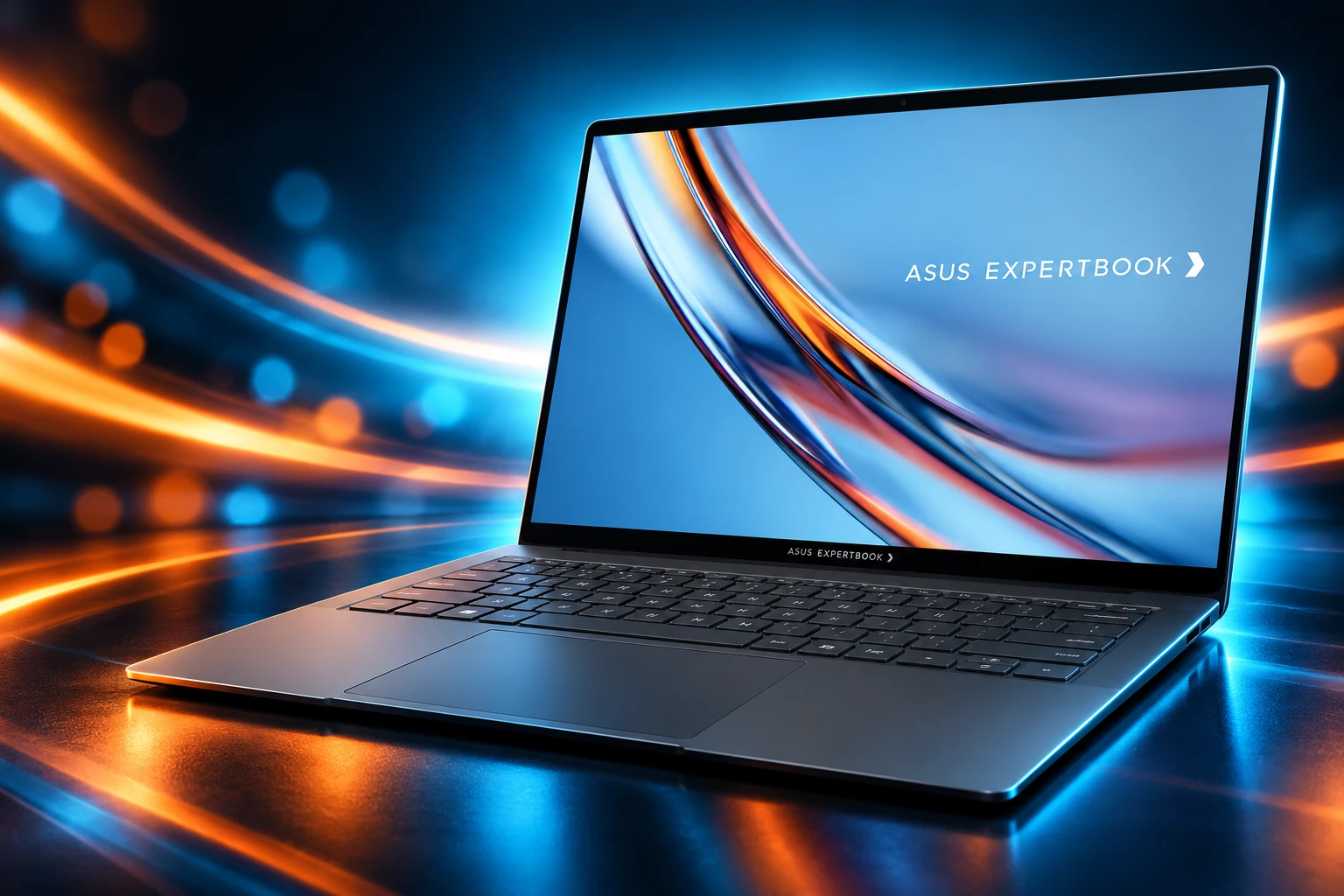
Asus ExpertBook Ultra Lands in US at $3,599 With Panther Lake
Asus just put a 990-gram laptop on sale in the United States for $3,599.99. That is roughly $1,100 more than a similarly configured Lenovo ThinkPad X1 Carbon Gen 14 and about $1,400 more than a Panther Lake Dell XPS 14. Same Intel chip. Same 32GB of memory. Same 1TB drive. The premium buys two things: a sub-one-kilogram chassis and a tandem OLED touchscreen. Whether that math works for a corporate procurement officer is now the only question that matters.
The ASUS ExpertBook Ultra (B9406CAA) launch announcement went live on May 7, 2026, ending a four-month wait for the price tag Asus refused to share when it unveiled the laptop at CES on January 6. Only the Jet Fog (black) finish is shipping. The Morn Grey color slips to late Q2. The Core Ultra X9 388H configuration with 64GB of RAM and 2TB of storage lands in Q3, and Asus has not confirmed how much higher that one goes.
The Price Tag Is The Story
Reviewers spent the first quarter of 2026 guessing. PCWorld pegged the laptop at “roughly around $2,500.” Other outlets penciled in $2,400. Asus itself, in pre-launch briefings, pointed at the ThinkPad X1 Carbon and Dell Pro 14 Premium as price comparisons, both of which sit near $2,500 when similarly equipped.
The actual sticker beat every single forecast by more than a thousand dollars. At $3,599.99 the ExpertBook Ultra is now the most expensive 14-inch Panther Lake business notebook on sale anywhere in the United States, and it is not close.
Here is what that money actually buys against the field shipping today:
| Laptop | CPU | RAM / Storage | Weight | Display | US Starting Price |
|---|---|---|---|---|---|
| Asus ExpertBook Ultra B9406CAA | Core Ultra X7 358H | 32GB / 1TB | 2.18 lb | 14″ 2.8K Tandem OLED, 120Hz, 1400 nits HDR | $3,599.99 |
| Lenovo ThinkPad X1 Carbon Gen 14 Aura | Core Ultra X7 Series 3 | 16GB / 512GB base | 2.17 lb | 14″ OLED options, up to 120Hz | $1,999 |
| Dell XPS 14 (Panther Lake) | Core Ultra X7 358H | 32GB / 1TB | ~3.7 lb | 14″ OLED option | $2,049 |
| HP OmniBook Ultra 14 | Core Ultra 7 356H | 32GB / 1TB | ~3.3 lb | 14″ OLED option | $1,549 |

What Justifies The $1,000 Premium
Two specs do almost all the heavy lifting on the spec sheet. The first is the chassis. At 990 grams, or 2.18 pounds, the ExpertBook Ultra is the lightest 14-inch business laptop currently sold in the United States that ships with a tandem OLED. The Lenovo X1 Carbon Gen 14 matches that weight at 2.17 pounds, but reviewers note the Lenovo gets there with a more conventional single-stack OLED.
The second is the display itself. The 14-inch tandem OLED runs at 2880 by 1800 pixels, refreshes at 120Hz, peaks at 1400 nits in HDR, and is laminated under Corning Gorilla Glass Victus with a Gorilla Matte finish. Asus’s published tech-spec sheet for the B9406CAA claims the dual-layer panel triples standard OLED brightness while cutting power draw by 40 percent. For a $3,600 laptop those numbers had better hold up, and review samples have largely backed them.
Everything else under the hood is what you would expect from a 2026 Panther Lake flagship. The Intel Core Ultra X7 358H product specifications page lists 16 cores (4 performance, 8 efficient, 4 low-power), an 18MB Smart Cache, a 25W base power rating, and a 50 TOPS NPU. Memory tops out at LPDDR5x-9600. The integrated Arc B390 GPU runs 12 Xe3 cores and is the same iGPU the X9 388H uses.
The Specs At A Glance
- Display: 14-inch 2880×1800 tandem OLED touchscreen, 120Hz, 600 nits SDR, 1400 nits HDR peak
- Processor: Intel Core Ultra X7 358H, 16 cores, up to 4.8GHz, 50 TOPS NPU
- Graphics: Intel Arc B390 with 12 Xe3 cores
- Memory: 32GB LPDDR5x-8533 onboard
- Storage: 1TB PCIe 4.0 NVMe SSD in M.2 2280 slot
- Battery: 70Wh, USB-C charging at 90W
- Ports: 2x Thunderbolt 4, 2x USB 3.2 Gen 2 Type-A, HDMI 2.1, 3.5mm audio
- Wireless: Wi-Fi 7, Bluetooth 6.0
Why The Math Probably Still Works In A Corporate Spreadsheet
Consumer reviewers will recoil at $3,600. Corporate procurement officers buying in fleets of fifty will not, and that is the audience Asus is hunting.
The ExpertBook Ultra ships with Windows 11 Pro instead of Home, a 3-year warranty instead of one, MIL-STD-810H certification, ASUS ExpertGuardian firmware protection built on NIST SP 800-193 guidelines, IR webcam Windows Hello sign-in, and a fingerprint sensor inside the power button. It also clears the Microsoft Secured-core PC bar, which is a baseline requirement at most banks and federal agencies in 2026.
Volume discounts close more of the gap. iFeeltech’s premium business laptop buying guide reports that fleet buyers ordering ten or more units typically negotiate 15 to 25 percent off list price from Lenovo, Dell, and Apple. Asus is new enough to top-tier enterprise procurement that its discounts can run higher. A 22 percent fleet rebate on a $3,599 sticker drops the real cost to about $2,808, which lands within $300 of a similarly configured X1 Carbon Gen 14 at retail.
“This is one of the finest thin-and-light PCs we’ve tested. The glass touchpad is perfectly smooth and flawless in tracking, the keyboard is precise, and the OLED display is genuinely class-leading. The premium is steep, but the build quality is here.”
That assessment came from Stuart Andrews in IT Pro’s full ExpertBook Ultra review, which clocked the laptop at 20 hours and 57 minutes in a video-rundown battery test. Other reviewers were less generous on battery. PCWorld called it “mediocre.” Notebookcheck noted the laptop throttles slightly when unplugged and falls short of other Panther Lake systems on the same bench. The hinge has been the other recurring complaint, with at least three review samples showing wobble at full tilt that Asus says will be tightened on retail units.
The Panther Lake Context Most Buyers Are Missing
The ExpertBook Ultra is one of more than 200 Panther Lake laptops Intel says are now shipping, per Intel’s Panther Lake by-the-numbers briefing. The platform delivers 180 total platform TOPS, of which 50 come from the NPU and 120 from the Xe3 iGPU. It is the first client SoC built on Intel’s 18A process at Fab 52 in Chandler, Arizona, with the GPU tile fabbed at TSMC on N3E.
Reviewers running 1080p gaming benchmarks have repeatedly clocked the Arc B390 trading blows with a 60-watt Nvidia RTX 3050 laptop GPU and pulling 15 to 20 percent ahead of AMD’s Radeon 890M. Phoronix’s Linux test on the same X7 358H chip in Michael Larabel’s Ubuntu 26.04 benchmark deep-dive recorded performance gains exceeding the AMD Strix Point competition with notable power-efficiency improvements over Lunar Lake.
Component cost pressure is also bearing down on this product class. Memory prices have spiked, OLED panels are scarce, and circuit boards are tight after the recent PCB shortage hitting China after the Saudi strike sent prices up 40%. Tandem OLED panels in particular are coming from a thin supplier base that also feeds Apple’s iPad Pro line and the new wave of Samsung’s 500 PPI sensor OLED panels. None of that justifies a $1,000 premium on its own. It does explain why the spread between premium and mainstream Panther Lake laptops has widened in 2026.
The Real Math On The Price Premium
- +$1,551 over the HP OmniBook Ultra 14 with the same 32GB/1TB Panther Lake setup
- +$1,551 over the Lenovo ThinkPad X1 Carbon Gen 14 Aura at retail entry pricing
- +$1,551 over the Dell XPS 14 with the Core Ultra X7 358H base config
- ~$300 after a typical fleet discount on a 50-unit order versus a similarly configured ThinkPad X1 Carbon at retail
What The X9 Variant Quietly Signals
The Q3 2026 refresh is the part of this announcement Asus did not headline. The Core Ultra X9 388H configuration will ship with up to 64GB of RAM and 2TB of storage. Asus has not posted that price.
If the X7 ships at $3,599, the X9 will almost certainly clear $4,000 and could approach $4,500 once Morn Grey, the higher RAM tier, and the larger drive are stacked. That puts a 14-inch business laptop squarely into MacBook Pro 16-inch M5 Max territory. Apple sells the M5 MacBook Pro 16 with 36GB and 1TB for $3,499.
Frequently Asked Questions
Should I wait for the Core Ultra X9 388H variant in Q3?
Probably not, unless you specifically need 64GB of memory or 2TB of storage. The X9 388H runs the same Arc B390 iGPU as the X7 358H and adds about a 300MHz boost on the top P-core. Independent benchmarks from Phoronix and Notebookcheck show single-digit real-world performance gains on most office and creative workloads. Expect the X9 to land between $4,000 and $4,500 in late Q3 2026.
Is the tandem OLED display going to burn in?
Tandem OLED reduces burn-in risk significantly compared to single-stack OLED because each pixel runs at lower brightness to hit the same total luminance. Asus rates the panel for typical office use without warranty exclusions for image retention. Set Windows to dark mode, enable the screen saver after 5 minutes, and rotate your taskbar position quarterly. Burn-in should not be a concern over the 3-year warranty period.
Can I upgrade the RAM or storage later?
RAM is no. The 32GB of LPDDR5x-8533 is soldered directly to the board, which is standard for sub-one-kilogram laptops in 2026. Storage is yes. The 1TB SSD lives in a standard M.2 2280 slot accessible by removing the bottom panel with a Torx T5 driver. Compatible PCIe 4.0 NVMe drives up to 4TB will work, though Asus only validates Western Digital and Samsung modules.
Does the 3-year warranty cover battery replacement?
The 3-year limited warranty covers manufacturing defects but not battery wear, which Asus treats as a consumable. Battery replacement runs roughly $180 to $240 at an authorized service center after year one. The 70Wh cell is rated to retain at least 80 percent capacity through 1,000 charge cycles, which translates to about three years of daily use for most office workloads.
How does this compare to the M5 MacBook Air for a corporate buyer?
Different machines for different reasons. The MacBook Air M5 starts at $1,099 and runs macOS, which means no Windows 11 Pro, no Active Directory native join, and limited fleet management through Microsoft Intune. The ExpertBook Ultra ships Windows 11 Pro, Secured-core PC certification, and ExpertGuardian firmware protection. If your IT shop runs on Microsoft Endpoint Manager, the ExpertBook fits the toolchain. If it runs on Jamf, the MacBook is the answer.
Asus has built a genuinely impressive 990-gram laptop and then asked the market to pay an unprecedented premium for it. Whether the corporate world says yes will be visible in Asus’s commercial sell-through reporting by Q4 2026. The X9 388H configuration arriving this fall will tell us whether $3,599 was the ceiling or the floor.
COMPUTERS
Inkjet Printing Can Cut OLED Laptop Panel Costs By 35 Percent
Inkjet printing can carve 30 to 35 percent off the cost of building OLED panels for laptops, monitors, and tablets, according to a new analysis from Omdia’s Display Dynamics research note on IJP cost competitiveness. The math runs through a 16.3-inch notebook panel. On a Gen 8.6 mother glass, an inkjet line yields 66 panels per substrate. A fine metal mask line yields about 60. That single-digit panelization win, stacked with cheaper equipment and roughly 90 percent material utilization, is what gets you to two-thirds the cost of a conventional OLED.
And the timing matters. Apple’s first OLED MacBook Pro is set to launch later this year on Samsung Display’s 8.6-Gen FMM line. The Korean incumbent is betting on the old recipe at bigger scale. China’s TCL CSOT is betting the recipe itself is wrong.
The Number Behind The 30 Percent
Charles Annis, Chief Analyst at Omdia’s Display Research group, framed the cost gap in plain language. “IJP machines provide higher productivity, and capital expenses are lower than those of FMM evaporation,” Annis said in the firm’s research note. “This is a key reason why IJP OLEDs can potentially be manufactured at two-thirds the cost of FMM OLEDs.”
The savings come from three places at once. Equipment is cheaper because vacuum evaporation chambers and the precision metal stencils they rely on cost more than industrial inkjet heads. Maintenance is cheaper because metal masks sag, get cleaned, and get replaced. And material waste collapses. TCL CSOT puts ink utilization near 90 percent against roughly 30 percent for vacuum evaporation, a number cited in the company’s own technical disclosures and confirmed in Omdia’s October 2025 brief on the world’s first Gen 8.6 IJP OLED fab.
Why Glass Size Is The Hidden Lever
FMM lines have a structural problem at Gen 8.6. The metal mask sags under its own weight when stretched across a full 2,290 by 2,620 millimeter substrate, so producers cut the glass in half before evaporation. That step generates particles, wastes glass at the cut edges, and slows the line.
Inkjet skips it. The substrate stays whole through pixel patterning. Omdia’s panelization math says that whole-glass advantage delivers 10 percent more 16.3-inch panels per substrate, with bigger gains possible on awkward aspect ratios that waste edge area in the half-cut process.

What This Means For The Price Of Your Next Laptop
The OLED IT panel is the most expensive single component in a premium ultrabook. Samsung Display already trial-produces tandem OLEDs at its A6 line with yields above 70 percent, climbing toward 80, ahead of Apple’s MacBook Pro launch. Those panels carry a fat bill of materials, which is why an OLED MacBook is expected to add a meaningful price premium over the LCD generation it replaces.
If a competing inkjet line can produce the equivalent panel at two-thirds the cost, that gap eventually shows up at retail. A 14-inch OLED laptop today sits at a roughly $300 to $500 premium over its LCD twin in Asus and Lenovo lineups. A 30 percent panel-cost cut does not pass through one-for-one, but display analysts see a path to OLED reaching mainstream sub-$1,000 notebooks by 2028 if inkjet ramps to volume.
The MacBook Question
Apple is locked into Samsung Display for the 2026 launch through an exclusive supply deal covering both 14-inch and 16-inch models. That contract is FMM, not inkjet. The interesting question is what happens at the 2028 refresh, when TCL CSOT’s T8 line is scheduled to be live and Samsung will face genuine alternative pricing for the first time since OLED IT panels existed.
Who Is Actually Building These Lines
Four companies are scaling Gen 8.6 OLED for IT, and they have picked four different strategies. The split tells you who believes in the cost story and who is hedging.
| Maker | Fab | Patterning | Capacity (sheets/month) | Status |
|---|---|---|---|---|
| Samsung Display | A6 (Asan) | FMM + tandem | 15,000 | Mass production Q2 2026 |
| BOE | B16 (Chengdu) | FMM + LTPO tandem | 16,000 | Pilot H1 2026 |
| Visionox | V5 (Hefei) | ViP photolithography | 32,000 (8,000 phase 1) | Full production Q1 2027 |
| TCL CSOT | T8 (Guangzhou) | Inkjet printing | 22,500 | Mass production 2027 |
Three of the four are walking away from FMM at full Gen 8.6 scale. Samsung is the holdout, and even Samsung is buying inkjet research equipment from Semes, the Korean equipment maker shipping 8.6-Gen QD inkjet systems, against the day the cost math forces a switch.
The Lifetime Problem That Refuses To Die
Inkjet’s cost story has been told for fifteen years. It has not commercialized in volume yet. The reason has a name: blue.
Soluble OLED materials, the kind you can dissolve into ink and jet onto a substrate, have always lagged evaporated equivalents on the blue emitter. TCL CSOT’s blue lifetime in 2020 was 40 hours. By late 2025 the company had pushed it to 400 hours, a tenfold improvement, with power consumption down a third. Useful, but still short of the multi-thousand-hour lifetimes that evaporated blues deliver in a Samsung phone panel.
Although inkjet printed OLEDs have historically and continue to face a variety of challenges, particularly regarding ink efficiency and lifetime, continuous incremental improvements in equipment, materials, and process technology mean that inkjet printing is now closer than ever to being widely commercialized.
That assessment from Annis carries a quiet warning inside the optimism. “Closer than ever” is not “ready.” Inkjet’s history is a graveyard of confident timelines. JOLED, the Japan Display–Panasonic–Sony joint venture that pioneered the technology, filed for bankruptcy in May 2023 after failing to bring costs down at its Nomi 5.5-Gen line. TCL CSOT bought JOLED’s equipment and kept going.
The Coffee Ring And The Yield Wall
Two physics problems sit on top of the lifetime gap. The coffee ring effect makes inkjet droplets dry unevenly, leaving thicker rings around pixel edges and thinner centers. That kills luminance uniformity across a 16-inch panel. And the precision required to land picoliter droplets into millions of pixel wells without splatter or skip is brutal at 200-plus pixels per inch.
Kateeva, the California equipment maker that essentially invented production-grade OLED inkjet, addresses both with its YIELDjet platform, which runs the print chamber under pure nitrogen and has reduced particle contamination tenfold versus open-air alternatives. Even with that, Samsung Display tested Kateeva’s latest QD-OLED printers and rejected them, sticking with Semes systems that the company itself describes as underperforming. The technology works. Making it work at production yield is the open question.
The TCL Bet
TCL CSOT has put roughly $4.15 billion on the table at its Guangzhou T8 site, with construction breaking ground in October 2025, a month ahead of schedule. The line is sized at 22,500 sheets per month, putting it among the largest single OLED fabs in the world. Mass production is targeted for 2027, with low-volume consumer-grade IJP OLED already passing functional verification at the existing 5.5-Gen line and limited production scheduled for July 2026.
The procurement is already moving. TCL CSOT issued 17 equipment bidding announcements covering four inkjet printers, one deposition system, eight sputtering tools, 17 PECVD reactors, twelve dry etching systems, and two ion implanters. Korea’s YAS won the evaporation contract for the layers that still need vacuum deposition. Not every layer in an inkjet OLED is printed. The emissive layers are. The common layers, including encapsulation, often stay evaporated.
Why Guangzhou And Not Korea
The geography of inkjet is itself a story. Korean firms invented commercial OLED. Chinese firms are building the next generation of the technology. Beijing has subsidized the T8 project through Guangzhou municipal support, which is why TCL CSOT can absorb a four-billion-dollar capex bet on a process that has never run at this scale.
Korean trade press has been blunt about the implication. If T8 hits its cost targets, Samsung Display and LG Display lose their structural advantage in the IT panel category that was supposed to underwrite their next decade of profitability.
Where The Cost Curve Goes Next
Omdia’s view is that the FMM-to-IJP cost gap will stay roughly constant for the next three years even as both technologies improve. That is a meaningful framing. It means inkjet does not have to keep gaining ground to win. It just has to commercialize at acceptable yields. The 30 to 35 percent advantage is already baked in by physics, not by future R&D.
Display analysts watching the 2026-2028 period are tracking three signals. First, TCL CSOT’s blue lifetime as it approaches July’s low-volume launch. Second, whether Samsung Display orders new inkjet tools beyond its current research footprint. Third, whether brands like Apple, Dell, and Lenovo write second-source contracts for inkjet panels at the 2027 design cycle.
You can also track the technology in OLED-adjacent product news. Samsung’s 500 PPI sensor OLED for biometric phone displays shows where evaporated OLED is still pushing density. The IT panel category is a different fight entirely, one where size beats density, and where inkjet’s whole-glass advantage finally gets to matter.
Frequently Asked Questions
When Will Inkjet OLED Laptops Actually Ship?
TCL CSOT begins low-volume IJP OLED production in July 2026 at its 5.5-Gen Wuhan line, with the first consumer panels likely going to mid-tier Chinese laptop brands. The high-volume Gen 8.6 T8 fab in Guangzhou targets mass production in 2027. Expect inkjet OLED panels in mainstream laptops from Lenovo, Honor, and Xiaomi by late 2027, with Western brands like Dell and HP following in 2028 once second-source supply contracts settle.
Will My OLED Laptop Get Cheaper Because Of This?
Not immediately. Apple’s 2026 MacBook Pro and the current crop of Asus and Dell OLED notebooks all use FMM panels from Samsung Display or LG Display, locked in through 2027 contracts. The price impact starts at the 2028 refresh cycle, when TCL CSOT’s inkjet output gives brands real second-source leverage. Analysts expect 14-inch OLED laptops to drop into the sub-$1,000 mainstream by 2028 if T8 yields hold.
Is Inkjet OLED As Good As Regular OLED?
For brightness and color it is competitive, especially with TCL’s oxide backplane that boosts efficiency. The honest gap sits in blue pixel lifetime, which still trails evaporated OLED by a meaningful margin even after TCL’s tenfold improvement to 400 hours. For laptop and monitor use cases, where panels run intermittently rather than continuously, that gap is acceptable. For televisions running eight hours daily, it is not yet.
Why Did JOLED Go Bankrupt If Inkjet Is So Good?
JOLED could not get costs down at the small 5.5-Gen scale where it operated. The economics of inkjet only work at Gen 8.6, where whole-glass processing and high panelization compound the savings. JOLED also launched into a soft tablet market and could not generate enough revenue to fund the next-generation fab. TCL CSOT acquired the equipment in the 2023 bankruptcy proceedings and is now building the scale JOLED never reached.
What Is Apple Doing About Inkjet OLED?
Apple is locked to Samsung Display’s FMM-based A6 line for the 2026 MacBook Pro and the iPad Pro lineup through at least 2027. Cupertino has not publicly committed to any inkjet-supplier roadmap, but Apple’s history of dual-sourcing displays once a technology hits volume suggests it will evaluate TCL CSOT’s T8 output in 2027. Watch for analyst reports from Ross Young at DSCC for early signals on Apple-CSOT panel qualification.
The bigger picture is that the OLED industry is splitting in two. Korea is doubling down on FMM at Gen 8.6 because that is the technology its supply chain is built around. China is leapfrogging to inkjet because the cost math demands it and Beijing is willing to subsidize the bet. Both can be right for a few years. Only one will be right at the end of the decade, and the answer probably gets decided in a Guangzhou cleanroom sometime in 2027.
COMPUTERS
PCB Shortage Hits China After Saudi Strike Sends Prices Up 40%
A 40% jump in printed circuit board prices in just four weeks. China’s PCB makers logged the steepest single-month spike the industry has tracked in years during April. The trigger sat 1,500 kilometers away in eastern Saudi Arabia.
An April 7 missile strike on the Jubail petrochemical complex froze SABIC’s production of high-purity polyphenylene ether resin, a niche material the Saudi giant supplies for roughly 70% of the global market. Lead times for related epoxy resin have stretched from three weeks to fifteen. Copper foil prices are up 30% year to date.
The Strike That Cut Off 70% Of A Critical PCB Material
Iran fired 11 missiles toward Jubail on April 7, and Saudi air defenses intercepted every one. Falling debris still ignited the SABIC complex and forced partial worker evacuations.
SABIC declared force majeure on five chemical product lines exported from Jubail and filed a war-damage disclosure with the Tadawul exchange on April 8, the first legally binding war-loss notice from a listed Saudi company since the conflict began. Production of high-purity polyphenylene ether, known in the trade as PPE resin, hasn’t restarted.
PPE resin sits in the unglamorous middle of the chain. Refineries crack petrochemicals into precursors, specialty plants polymerize them into PPE, and laminate makers in East Asia bond the resin with glass fiber and copper foil to make the rigid sheets PCB fabricators etch into circuit boards. Pull the resin out and five steps stop at once.
Saudi Aramco and SABIC have offered no public timeline for restart. Analysts cited by Reuters say a return to full output is unlikely before Q3 2026.
- 70%: SABIC’s share of global high-purity PPE resin supply.
- 5 product lines: covered by SABIC’s force majeure declaration.
- 15 weeks: current epoxy resin lead times, up from 3 weeks before April.
- 30%: 2026 year-to-date jump in copper foil prices.

From Saudi Arabia To Shenzhen In Four Weeks
The price shock moved fast. PCB makers in Guangdong and Suzhou were already running thin inventory ahead of the AI server build-out. The strike turned a tight market into a broken one.
By mid-April, copper-clad laminate suppliers had begun rolling out broad price hikes. Mitsubishi Gas Chemical raised CCL and prepreg prices by 30%, effective April 1. Mitsui Kinzoku, which controls more than 90% of premium-grade copper foil supply, lifted MicroThin foil prices by 12% from April 20.
Goldman Sachs analysts described the result bluntly in their 2026 commodity outlook on the power race and supply waves: PCB spot prices in China were as much as 40% higher in April than in March. The Reuters wire that broke the story cited industry sources confirming five-fold lead-time extensions on epoxy resin.
Copper compounded the squeeze. London Metal Exchange copper hit a record above $13,300 per tonne in January, climbed another 2.3% in February, and remains central to PCB cost structures. Victory Giant Technology, Nvidia’s leading Chinese PCB supplier for AI servers, says copper alone accounts for around 60% of raw material costs.
South Korean fabricator Daeduck Electronics has opened price-renegotiation talks with Samsung, SK Hynix, and AMD, according to Digitimes’ April 2026 reporting on CCL and fiberglass cloth demand. Lead times the company once measured in weeks now stretch into months. The lost margin has to come from somewhere.
The Shortage Stack Hits Number Three
This is the third major component shortage in five years. Each one has reshaped how electronics companies plan inventory.
The 2020 to 2022 chip shortage halted car production from Detroit to Wolfsburg and pushed lead times for automotive microcontrollers past 52 weeks. The 2025 to 2026 memory shortage, driven by AI server demand for HBM and DDR5, has DRAM contract prices climbing through every quarter.
PCBs make the trio. The pattern is structural rather than incidental. AI infrastructure refreshes every 18 to 24 months, but new petrochemical capacity, fiberglass capacity, and copper foil capacity all take three to five years to build, qualify, and certify, according to Plastics News’ 2026 volume resin price outlook.
And unlike chips and memory, PCB substrates depend on a thin slice of specialty chemistry concentrated in a small number of plants. Concentration looks efficient on a balance sheet. It’s catastrophic when one plant goes offline.
Who Pays First In The AI Server Pipeline
Hyperscale AI builds will absorb the first wave. Multilayer PCBs designed for high-density GPU clusters were already retailing near 13,475 yuan per square meter before April, and that price is climbing.
Nvidia’s GB200 platforms and successors rely on extreme high-layer-count boards using the high-frequency PPE-based laminates SABIC supplies. Substitute materials exist on paper. Qualification cycles take six to twelve months at minimum, and AI customers won’t accept second-tier substrates without retesting every signal-integrity spec.
| Hardware Tier | PCB Layer Count | Material Sensitivity | Likely Retail Price Window |
|---|---|---|---|
| AI servers (GB200 class) | 26 to 30+ | High-purity PPE laminates | April 2026 onward |
| High-end smartphones | 10 to 14 | Modified PPE / high-frequency FR-4 | Q3 2026 |
| Mid-range laptops | 8 to 12 | Standard FR-4 | Q3 to Q4 2026 |
| Consumer IoT and hobbyist | 2 to 6 | Generic FR-4 | Late Q4 2026 |
Consumer hardware sits further down the queue. Phone makers, PC OEMs, and industrial buyers compete with hyperscalers for the same constrained substrate stream. They pay margins material suppliers find easier to deprioritize when allocation gets tight.
Wedbush analyst Dan Ives put the timing into plain language. “If it stays at the current rate, we can see shortages into the Fall on certain products,” Ives said in client commentary on the Iran-Saudi disruption.
IDC semiconductor supply chain analyst Galen Zeng told industry reporters the pass-through to average consumers won’t happen overnight, but to “expect it to materialize within the next few months.”
That points to summer and autumn 2026 as the period when retail prices begin to bend. Smartphones, TVs, and entry-level laptops are the most likely first carriers.
Why Substitution Won’t Be Quick
Asahi Kasei and AGC are retooling Japanese fiberglass plants to chase AI substrate demand. Mitsubishi Gas Chemical’s BT laminate product page already serves some of the same niches as SABIC’s PPE feedstock. None of these companies can scale fast enough to fill a 70% hole in a single quarter.
Panasonic complicated the picture by setting a March 31, 2026 final-order deadline for several CCL products built on E-glass fabric from Nittobo, Asahi Kasei, and Asahi-Schweibel Taiwan. Long-term qualification disruptions of this scale move slowly even when the headline price doesn’t.
Material suppliers report order backlogs extending 20 to 30 weeks, compared to typical 8 to 12 week lead times just two years ago.
That assessment, published in the European Institute of Printed Circuits Q1 2026 supply-chain update, predates the April strike. The Jubail event has stretched those backlogs further.
A 1990s Echo Worth Remembering
Older engineers recall the IC encapsulation resin shortage of the mid-1990s. A handful of Japanese suppliers controlled the molding compound used to seal silicon chips. A typhoon and fire combination knocked capacity offline, and prices ran for nine months before settling. Substitution and capacity adds eventually closed the gap.
Plenty of buyers spent that nine-month window panic-buying at peak prices. The market normalized in a year. Several companies that signed long-term contracts at the top never recovered the margin.
Industry researcher Prismark Partners’ printed circuit board market report projects the 2026 global PCB market will exceed $100 billion, partly driven by these shortages pulling unit prices upward. The bigger question is whether the reshuffle leaves AI hyperscalers permanently first in line and everyone else permanently second.
For hobbyists and small-volume buyers, the immediate news is mostly inventory dependent. Most low-layer-count FR-4 stock at JLCPCB and PCBWay was procured before the strike. Pricing pressure on basic two-layer boards is likely to lag the AI substrate spike by two to three quarters.
Frequently Asked Questions
Will My Next Phone Or Laptop Cost More Because Of This PCB Shortage?
Probably yes, but not immediately. IDC analyst Galen Zeng expects pass-through to consumers within a few months, which puts smartphones, TVs, and entry-level laptops in the summer-to-autumn 2026 window. High-end Android flagships and premium MacBooks are the most exposed because their PCBs use modified PPE laminates closer to AI server specifications. Budget devices on basic FR-4 should hold pricing longer.
Should Hobbyists Stockpile PCBs From JLCPCB Or PCBWay Now?
No major panic-buying is needed. Two-layer FR-4 boards used in hobby projects sit on inventory bought months before the strike, and Chinese fab pricing for basic prototypes hasn’t moved meaningfully yet. If you have a multi-layer impedance-controlled design queued, place that order in May. Single-layer and standard two-layer can wait until Q3 without significant price exposure.
When Will SABIC’s PPE Resin Production Restart At Jubail?
No public restart date exists. Reuters-cited analysts pointed to Q3 2026 as the earliest realistic window. SABIC declared force majeure on five product lines and filed a war-damage disclosure with Tadawul on April 8, neither of which carried a timeline. Jubail’s restart depends partly on the broader Gulf ceasefire status and on damage assessment that hasn’t been published in detail.
Why Does One Saudi Plant Supply 70% Of A Critical PCB Material?
Specialty petrochemistry concentrates around feedstock and economies of scale. Saudi Arabia hosts cheap natural-gas precursors, and SABIC built integrated polymer capacity over decades. PPE resin is a low-volume, high-margin specialty product, and the market consolidated to a small number of plants because qualification cycles for downstream laminate makers run six to twelve months. Buyers stuck with proven suppliers rather than diversifying.
Are There Substitute Resins That Can Replace PPE In PCB Laminates?
Yes, but with tradeoffs. Mitsubishi Gas Chemical’s BT laminates and modified epoxy systems work for many high-frequency applications, and Asahi Kasei is expanding into adjacent fiberglass cloth supply. The catch is qualification time. AI server makers like Nvidia won’t approve substitute substrates without six to twelve months of signal-integrity testing, which guarantees a multi-quarter lag before any substitute meaningfully relieves the squeeze.
The Jubail strike turned an obscure resin into the most-watched PCB input on the planet, and a single missile-debris fire into a price story that touches every device buyer eventually. The 1990s IC encapsulation shortage settled within a year. Whether this one moves on the same arc depends on how quickly the Gulf cools, how fast the substitutes qualify, and how much margin AI hyperscalers are willing to hand back to everyone else.
-
CRYPTO4 days agoAndreessen Horowitz Bets $2.2B on Crypto’s Quiet Cycle
-
APPS4 days agoGoogle’s Buried Page Reveals 500 Niche Websites Still Making Cash
-
GAMING4 days agoAsha Sharma Reshuffles Xbox Leadership In Race To Project Helix
-
COMPUTERS3 days agoPCB Shortage Hits China After Saudi Strike Sends Prices Up 40%
-
NEWS3 days agoSEBI Names Claude Mythos, Sets Up cyber-suraksha.ai Task Force
-
AI4 days agoSubquadratic Launches A 12-Million-Token AI Model And Says The Wall Is Gone
-
NEWS3 days agoSamsung’s 500 PPI Sensor OLED Reads Pulse And Blocks Snoopers
-
CRYPTO4 days agoWells Fargo Says Circle Is Crypto’s Underappreciated Winner