
GADGETS
Samsung Bets Mini LED at Rs 42,990 in India
Samsung Mini LED TVs start at Rs 42,990 in India, a 43-inch door on a four-rung stack aimed at Chinese Mini LED sets.

Samsung priced its 2026 Mini LED TVs in India from Rs 42,990, the tag on a 43-inch M71H. Viplesh Dang, vice-president of Visual Display at Samsung India, called the launch a decisive step toward “democratising premium home entertainment.”
The stack under that badge is four series. Only the M80H carries the NQ4 AI Gen2 chip and 144Hz panel the launch copy put on the whole range, and by September 2026 the 65-inch M70H was already listed at Rs 59,990.
The Rs 42,990 Mini LED Is a 43-Inch Door
Samsung’s India newsroom on 13 May 2026 put Mini LED TVs starting at Rs 42,990, with screen sizes from 43-inch to 100-inch. That floor is the M71H, a 43-inch set. It is not a 65-inch living-room panel and it is not the 144Hz M80H.
The company is marking 30 years in India and, per Omdia, 20 years as the world’s No. 1 TV brand by revenue, a run that began in 2006. Omdia gave Samsung 29.1% of global TV revenue in 2025, and 54.3% of the slice priced over $2,500, a band built on Neo QLED, OLED, and lifestyle sets. Mini LED is the tool for the band below that.
Dang’s line about making advanced displays “more accessible” is the wager in plain words. The hardware behind the Rs 42,990 door is a small VA LCD with Mini LED backlights, HDR10+, and One UI Tizen. Buyers who want the processor named in the press note have to step up a rung.
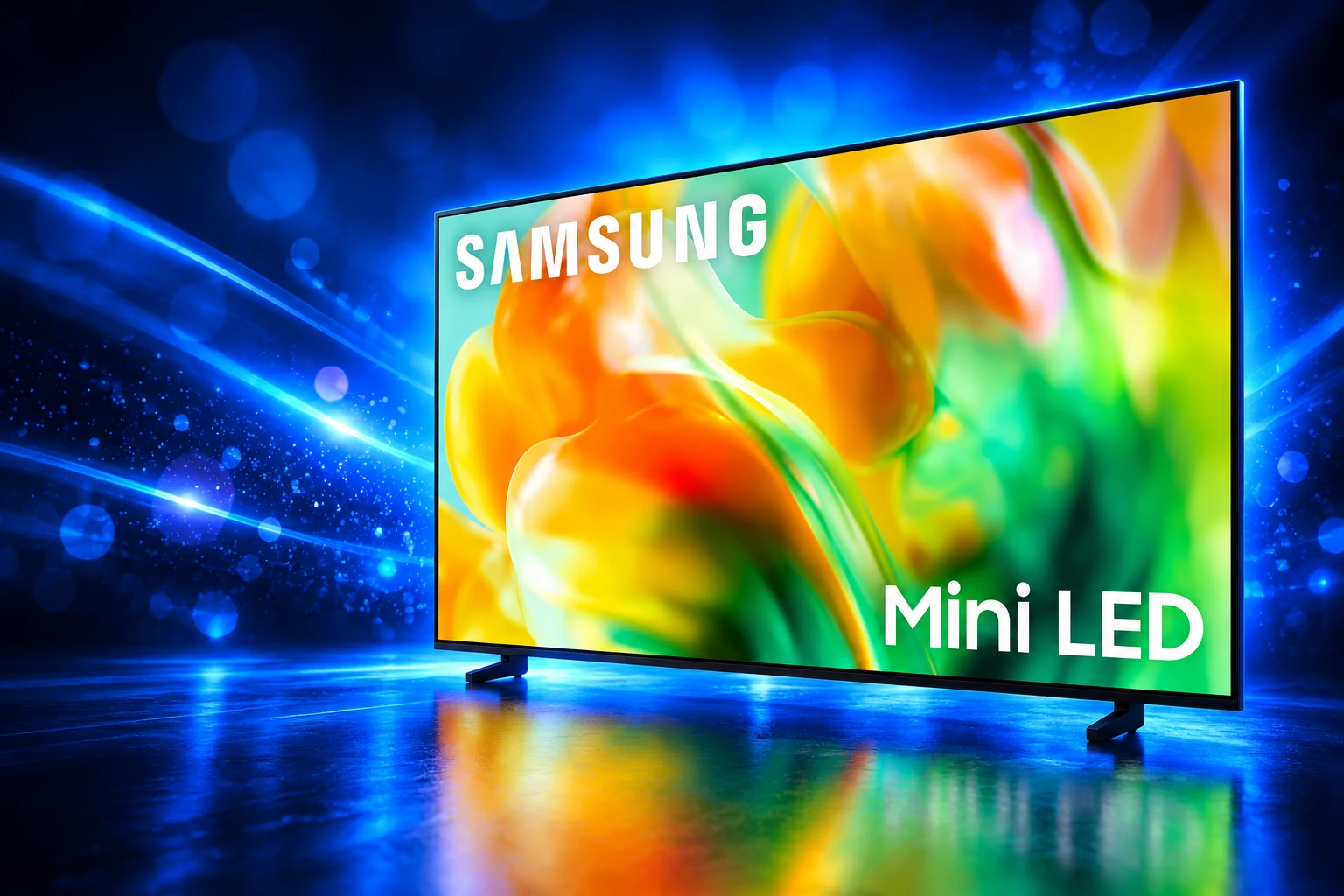
Four Names Sit Under One Mini LED Badge
India shops listed four Mini LED series after CES 2026, where two of the sets first appeared. Samsung’s 26 May lineup note named only M70H and M80H as the two distinct Mini LED models. The India price sheet also carried a cheaper M2EH and the 43-inch-only M71H that owns the official floor.
LAUNCH PRICES FOR SAMSUNG MINI LED IN INDIA
| Series | 43-inch | 55-inch | 65-inch | 75-inch |
|---|---|---|---|---|
| M2EH | Rs 33,990 | Rs 44,990 | Rs 77,990 | Rs 1,02,990 |
| M71H | Rs 42,990 | n/a | n/a | n/a |
| M70H | n/a | Rs 60,990 | Rs 88,990 | Rs 1,17,990 |
| M80H | n/a | Rs 67,990 | Rs 99,990 | Rs 1,44,990 |
The M70H also launched as a 50-inch at Rs 49,490 and an 85-inch at Rs 2,14,990. Samsung’s Mini LED pages list sizes from 43 inches to 100 inches. The 100-inch class is the M90H in other markets. The May India MRP sheet stopped at 85 inches.
All four use 4K VA LCD panels, Mini LED backlights, and HDR10+. They do not use a quantum-dot film. That coating stays on QLED and Neo QLED, which is why Samsung can park Mini LED under those lines without collapsing the premium ladder.
What the M70H Leaves on the Table
Launch copy treated NQ4 AI Gen2, Motion Xcelerator 144Hz, and Pure Spectrum Color as lineup traits. The India spec sheets split the stack. The M70H is the volume set. The M80H is the one that matches the brochure.
M70H VERSUS M80H ON THE INDIA SHEET
- Picture chip: The M70H uses a Mini LED Processor 4K and plain 4K upscaling. The M80H uses NQ4 AI Gen2, a 20-neural-network chip for picture and sound.
- Motion: India listings put the 55-inch M70H on a 50Hz panel. The M80H is rated at 144Hz with VRR, the figure Samsung sold as Motion Xcelerator 144Hz.
- Backlight: Lower Mini LED models use edge-lit Mini LED. The M80H uses full-array Mini LED dimming, which is the control that makes the smaller LEDs matter in dark scenes.
- Colour tools: Both get Pure Spectrum Color and a claimed wide colour gamut over 90%. Color Booster Pro and Auto HDR Remastering sit on the M80H.
- Sound: Both list 30W speakers, OTS Lite, Q-Symphony, and Adaptive Sound. The M80H adds Adaptive Sound+ and Active Voice Amplifier.
Samsung’s own 75-inch M80H page is the clean primary for the upper rung: NQ4 AI Gen2 and 144Hz motion, Mini LED HDR, Supreme Mini LED Dimming, and Filmmaker Mode. Gaming extras on that set include ALLM, HGiG, and VRR. The M70H lists the same three letters on a 50Hz panel, so the window is narrow.
Mini LEDs are half the size of ordinary backlight LEDs, Samsung says, which allows finer control than a basic LED TV. On an edge-lit 50Hz set that control is limited. Buyers who read “Mini LED” as local dimming on every size will not get that on the cheap rungs.
Neo QLED Starts Only Rs 10,000 Higher
On 26 May 2026 Samsung rolled out 72 Vision AI TV models in India, spanning Micro RGB, OLED, Neo QLED, The Frame, Mini LED, and UHD. The floor prices show how tight the mid-band is.
SAMSUNG 2026 TV FLOOR PRICES IN INDIA
- UHD: from Rs 36,990, Rs 6,000 under the Mini LED floor.
- Mini LED: from Rs 42,990.
- Neo QLED: the Neo QLED range starts at Rs 52,990, Rs 10,000 above Mini LED.
- The Frame: from Rs 56,990, with OLED from Rs 1,14,990 and Micro RGB from Rs 1,24,990.
That Rs 10,000 gap is the pressure point. Neo QLED still gets a genuine quantum-dot sheet, TÜV Rheinland “Real QLED” labelling, and Quantum Mini LED. Mini LED is the badge for people who will not pay for that sheet. It also crowds Samsung’s own QN70H, which now has to justify itself against an M80H that already has the NQ4 chip and 144Hz.
Launch offers on the Mini LED wave included up to 5% cashback and zero-down EMIs for up to 30 months, through Samsung stores, Samsung.com, and Flipkart. The sets ship with a one-year standard warranty and one extra year on the panel.
The 65-Inch M70H Already Sells at Rs 59,990
Four months after the May launch, the price sheet had already moved. Smartprix listed the 65-inch M70H at Rs 59,990 in September 2026, Rs 29,000 under the Rs 88,990 launch MRP.
HOW THE MINI LED STACK ROLLED OUT
- January 2026: Two Mini LED models appear at CES 2026, parked below Neo QLED.
- 8 to 13 May 2026: India launch window opens, with the official floor at Rs 42,990 and sizes quoted to 100 inches.
- 26 May 2026: The 72-model Vision AI lineup lands. Mini LED is named as M70H and M80H, Rs 10,000 below Neo QLED.
- 29 May 2026: Samsung India posts a Mini LED film calling the set “the first Samsung TV of its kind.”
- September 2026: Price trackers list the 65-inch M70H at Rs 59,990.
On Indian storefronts the conversation around these sets is almost entirely a hunt for coupons. The 43-inch Mini LED is already being stacked next to Crystal UHD deals, which is how a backlight badge gets sold when the chip inside is not the NQ4. That is the bet working in the only language the mid-band uses: the sticker.
Chinese Mini LED Sets Already Fill This Band
Samsung did not walk into an empty aisle. By September 2026, Mini LED at this money was a crowded shelf.
MINI LED TAGS ALREADY IN THIS BAND
- Hisense U7Q 55-inch: Rs 49,999, under the M70H 55-inch launch price of Rs 60,990.
- TCL QM6K 55-inch: Rs 47,655, with a 65-inch listing near Rs 62,000.
- Xiaomi X Series 65-inch: an upcoming Mini LED tagged at Rs 39,999, below Samsung’s 43-inch official floor on a much larger panel.
Those sets often ship Google TV, Dolby Vision, and higher native refresh than the M70H. Samsung’s counter is the brand, the service net, Knox, and seven years of Tizen. Hisense has also put RGB MiniLED on the World Cup 2026 stage, a brighter backlight story than a 50Hz edge-lit M70H, aimed at the same festive living rooms.
Omdia’s 2025 score still has Samsung ahead on revenue, with 52.2% of the global band over $1,500. Unit share is a different fight, and that is the fight Mini LED at Rs 42,990 is built for. TCL and Hisense do not need 29.1% of revenue if they take the 55-inch wall in Noida and Pune.
Seven Years of Tizen Is Samsung’s Wager
The durable part of the product is not the backlight. One UI Tizen is promised for up to seven years of OS upgrades from the launch year, a policy Samsung extended in 2024 to TVs from 2023 onward. The Mini LED sets launched on Tizen 10. The upgrade does not change the panel or the speaker.
When that policy was announced, Samsung’s visual display chief said seven years of free Tizen upgrades would help widen the company’s share gap with Chinese TV makers. That sentence is the strategy. Mini LED is how the company puts a current-looking screen under the same software contract that used to sit on Neo QLED money.
Samsung TV Plus is the content hook: more than 150 free ad-supported channels in 14 languages. Knox watches the set and linked IoT gear. SmartThings, Alexa, Google Assistant, Bixby, and Apple AirPlay are on the box. Vision AI Companion, which can call Bixby, Perplexity, and Microsoft Copilot, is the new face of that software layer. None of it needs a 144Hz panel. All of it needs the buyer to stay inside Tizen.
Samsung has been the Global No. 1 TV Brand for 20 consecutive years. We are taking a decisive step towards democratising premium home entertainment with our latest Mini LED TVs and this launch reflects our commitment to making advanced display technologies more accessible. By combining technology and AI, we are focused on delivering an immersive and enhanced viewing experiences. As we continue to push the boundaries of innovation, we will ensure that the benefits of next-generation technology reach more homes across the country.
Viplesh Dang, Vice-President, Visual Display Business, Samsung India
Samsung India put the same pitch on film in late May, calling Mini LED the first Samsung TV of its kind, a line that sits oddly next to years of Quantum Mini LED inside Neo QLED. The first thing it is, in India, is a mid-band badge.
Meet the Mini LED. The first Samsung TV of its kind, it provides the answer to your thrilling moments.
Inside every stunning scene, invisible mastery comes to life. As the canvas grows, precision becomes everything, with tens of thousands of tiny lights working in harmony to… pic.twitter.com/Ax1GTK26ca— Samsung India (@SamsungIndia) May 29, 2026
The M80H is a real 144Hz Mini LED with the NQ4 chip, and seven years of Tizen is a longer software clock than most Google TV rivals print. The Rs 42,990 door is still a 43-inch M71H. The set that will fill walls this year is the M70H, now listed at Rs 59,990 in 65 inches, in a band where Hisense and TCL already sell Mini LED for less.
Frequently Asked Questions
Which Samsung Mini LED models went on sale in India in 2026?
India shops listed four series: M2EH, M71H, M70H, and M80H. Samsung’s 26 May lineup note named M70H and M80H as the two distinct Mini LED models. The M71H is a 43-inch-only SKU. A 100-inch Mini LED class, sold as the M90H abroad, shows up on Samsung India’s size list even though the May MRP sheet stopped at 85 inches.
Does every 2026 Samsung Mini LED TV use the NQ4 AI Gen2 processor?
No. The NQ4 AI Gen2 chip with 20 neural networks is an M80H part. The M70H uses a Mini LED Processor 4K. Color Booster Pro, Auto HDR Remastering, Adaptive Sound+, and Active Voice Amplifier are also M80H tools, not M70H defaults.
Do these Mini LED TVs use quantum dots or Dolby Vision?
They do not. The 2026 Mini LED stack is VA LCD with Mini LED backlights and no quantum-dot film. HDR support on the India sheets is HDR10+ and HLG. Dolby Vision is absent, which is a live gap against TCL and Hisense sets in the same rupee band.
How long do Samsung Mini LED TVs get One UI Tizen upgrades?
Samsung says One UI Tizen upgrades run up to seven years from the product launch year for TVs released from 2023 onward. These Mini LED sets launched on Tizen 10. The promise covers OS, apps, AI features, and security. It does not upgrade the panel, the backlight, or the speakers.
What ports and warranty come with the India Mini LED sets?
The India sheets list three HDMI ports with eARC on one, a USB-A port, Ethernet, Wi-Fi, Bluetooth, and an RF input. AirPlay 2 and Multi View are included. Warranty is one year on the set and one extra year on the panel, which is the 1+1 cover Samsung quoted at launch.

Instagram Plus Tests a Read-Only Mode That Cuts Stories

Altman Asks the Public to Accept Some AI Harm

Google Freezes OSS VRP Product Reports After AI Flood

AI Agents Make Payment Rails the Scarce Prize

Turkey’s Crypto Boom Now Runs Through Three Banks

Fable 5 Came Back Under a Commerce On-Off Switch

Google’s SpaceX GPU Lease Has a Sept. 30 Deadline

Plasma One’s XPL Locks Face a 1.81 Billion Cliff

DGO’s Rs 549 World Cup Pass Cost Fans Sleep and Data

Moonshot AI’s $30 Billion Ask Became a $35 Billion Close
-
 AI4 months ago
Fable 5 Came Back Under a Commerce On-Off Switch
-
 AI5 months ago
Google’s SpaceX GPU Lease Has a Sept. 30 Deadline
-
 CRYPTO4 months ago
Plasma One’s XPL Locks Face a 1.81 Billion Cliff
-
 APPS5 months ago
DGO’s Rs 549 World Cup Pass Cost Fans Sleep and Data
-
 AI5 months ago
Moonshot AI’s $30 Billion Ask Became a $35 Billion Close
-
 NEWS5 months ago
ColorOS 17 Device List Spans Oppo, OnePlus and Realme
-
 GAMING4 months ago
The RTX 4050 Under Rs 70,000 Hides a Wattage Gap
-
 AI4 months ago
Boris Cherny’s Loops Still Demand a Higher Production Bar