
NEWS
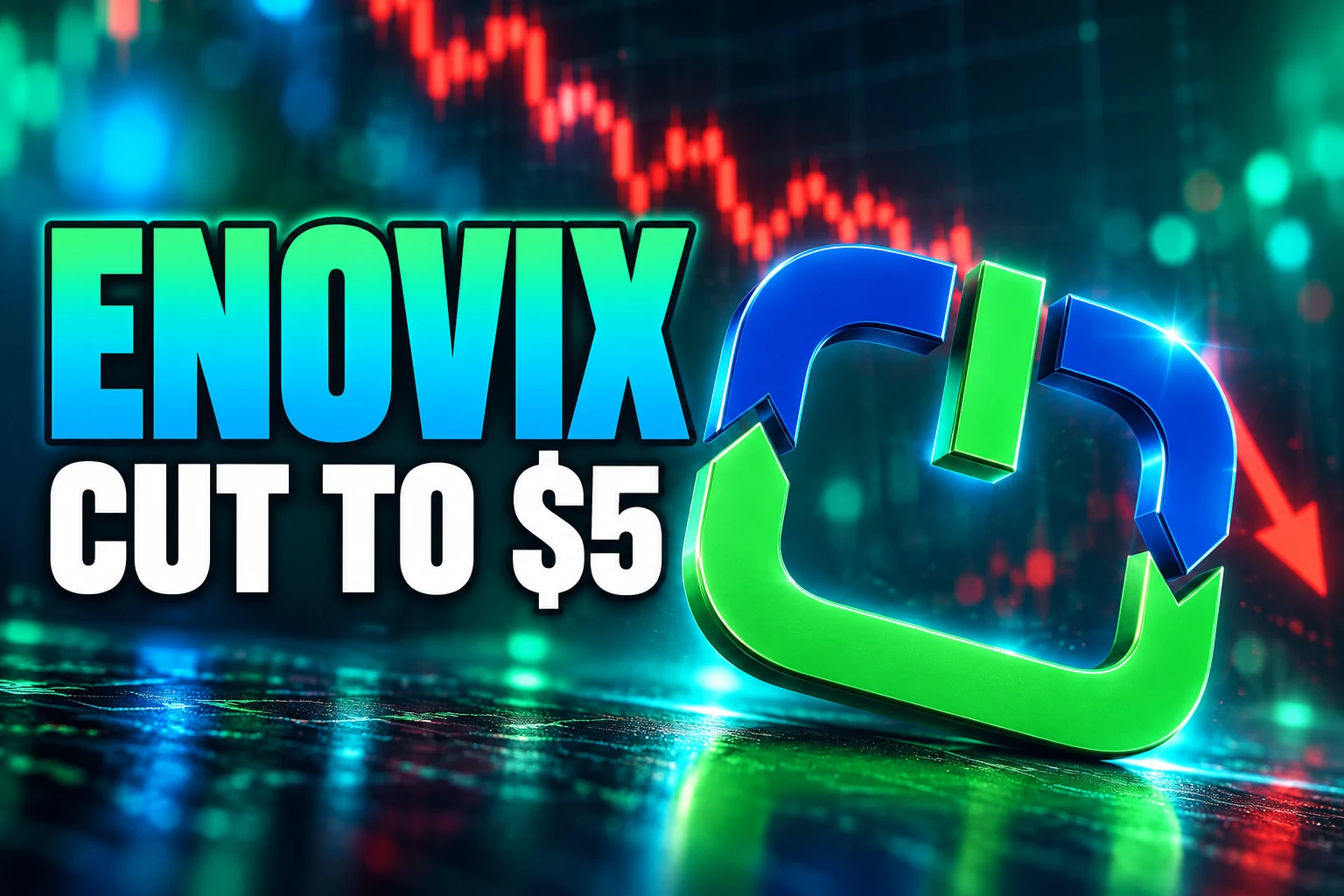
BofA’s $7 Enovix Target Collides With a 2027 Phone Delay
Honor passed Enovix’s 1,000-cycle test, but BofA cut its target to $5 after the CEO exit and phone revenue stays a 2027 event.

BofA Securities raised its Enovix price target to $7 from $6 on May 6, 2026, after Honor dropped a graphite-era battery test. The bank kept a Neutral rating. Enovix stock then traded at $6.29, with a market value of $1.34 billion.
The 8-K behind that $1 lift said Enovix and its lead smartphone customer had aligned on a silicon-specific qualification framework. Four months later the cells have cleared 1,000 slow cycles, the phones are still a 2027 product, the CEO who ran the Honor talks has left, and BofA’s number is $5. Shares last closed at $3.10 on September 11, 2026.
A $1 Raise for a Test Honor No Longer Required
Enovix Corporation filed the update on May 5, 2026, the day it also named Steve Bakos, a 35-year semiconductor sales veteran, as senior vice president of worldwide sales. The filing said the new framework better matches real-world use than legacy 0.7C testing, stretches the test calendar, and was producing results that were approaching the bar Honor had set for a 100% silicon-anode phone cell.
BofA read the filing as Honor agreeing to a requirement other than the 0.7C accelerated cycle-life test. The bank called that an incremental positive because Enovix would not have to cook a new chemical recipe just to survive a proxy test designed around graphite. Estimates stayed put. So did Neutral. When BofA first lifted its Enovix target to $7 on May 6, 2026, the stock changed hands at $6.29.
JPMorgan already sat Underweight, arguing Honor’s production ramp would be slower than earlier decks implied and that rival cell makers could close Enovix’s energy-density gap. That caution aged better than the $7 print.
THE BOFA TARGET PATH
| Date | BofA action | Target | ENVX price |
|---|---|---|---|
| May 6, 2026 | Raise, Neutral held | $7, from $6 | $6.29 |
| August 17, 2026 | Cut, Neutral held | $5, from $8 | $3.56 |
| September 11, 2026 | Last close (no new note) | $5 standing | $3.10 |
BofA later moved the same Neutral rating up to $8, then took it back through the May number after the CEO change. The September 11 close sits under every one of those targets. Market value that day was about $663.4 million, versus $1.34 billion on the May raise. The 52-week range runs from $3.06 to $14.21.
Graphite Rules Made Silicon Cells Fail on Purpose
Honor’s main durability ask has been 1,000 charge and discharge cycles at 0.2C. A 0.2C drain empties a cell in about five hours, which is how a phone is actually used. Running 1,000 of those cycles takes roughly a year, so brands compress the calendar with a faster 0.7C proxy. Enovix has said that proxy, built for graphite, punishes a 100% silicon anode.
Dr. Raj Talluri, then president and CEO, told analysts the 0.7C discharge “hurts the battery” and is “not really helping.” Phone use, he said, typically stays below 0.2C. Silicon swells as it takes on lithium. A fast drain that graphite can shrug off opens cracks and grows a thick surface film on a silicon anode. Enovix’s own lab work had the December 2025 cells on track to beat 1,000 cycles at 0.2C and short of Honor’s accelerated 0.7C mark.
HOW HONOR TESTS A PHONE BATTERY
- 0.2C cycle: About a five-hour drain, Honor’s 1,000-cycle bar, and the test Enovix said it could pass.
- 0.7C cycle: A faster proxy used to squeeze a year of wear into fewer weeks, and the gate Enovix was missing.
- Hybrid protocol: A mix of slow and fast cycles, written with Honor after the 0.7C gate came off, now the last lab item.
BofA’s May note assumed the 8-K meant Honor would accept something other than 0.7C as a must-have. The May 13 earnings call confirmed that reading. It also confirmed the trade: the replacement tests take longer to run. Talluri said 0.1C and 0.2C “take longer to run” than the old accelerated drain, “at least on the first launches.”
The May Call Moved Honor Phones Into 2027
On the May 13, 2026 call, Talluri said Honor had agreed to drop 0.7C as a “must do” and to treat a 0.2C-style test that started in the first quarter as the gating item. A second, unnamed smartphone OEM had also taken 0.7C off its hard list and was moving toward a similar framework. Talks with other large brands were open. “We recognize this qualification process has taken longer than we originally anticipated,” he said in the first-quarter release.
The commercial map shifted with the test. Enovix said it wanted a targeted system-level deployment with Honor in the second half of 2026, a limited “friends and family” field trial on a custom-sized cell for an existing phone, then a broader launch in 2027. Talluri told William Blair’s Mark Shooter the field units “will be small” and “the real volume will be in ’27.” Honor had already sent the form factor for that next-year SKU.
First-quarter revenue was $7.6 million, up 49% from a year earlier and above the high end of guidance, almost all of it from Korean military contractors rather than phones. Non-GAAP gross margin was 26.3%. Cash was about $582.7 million. The Korea pipeline sat above $130 million. Smart-eyewear production was just starting, with about 50,000 units planned for 2026. Fab 2 yields in most zones were near or above 90%; Zone 1 dicing, the bottleneck, was about 80%.
BofA had said it would listen for whether the new test changed fiscal 2026 and 2027 revenue. The call’s answer was implicit. Phone money in 2026, if it showed up at all, would be field-trial volume. The SKU that matters is 2027.
Honor Signed Off on 1,000 Cycles With One Test Left
The second-quarter release on August 12, 2026, is the first time Honor, still described as the lead smartphone customer, put its name on the slow-cycle result. The company said its lead customer confirmed more than 1,000 cycles under the 0.2C discharge test. Talluri called it “a defining smartphone qualification milestone.”
One lab item remains. Enovix is running a hybrid accelerated cycle-life test, written with Honor, that replaced the old 0.7C graphite proxy. The lead customer is trying more than one variant, including an enhanced cell design. The company said it expects to finish that work in the fourth quarter of 2026, with system-level field testing after that. The remaining 2026 test calendar still puts a commercial smartphone launch in 2027. Sample cells for the second OEM are due in the fourth quarter of 2026.
That is a slip from May. The first-quarter script put Honor field testing in the second half of 2026. By August, field testing sits behind a fourth-quarter lab finish. The 0.7C waiver did not shrink the calendar. It swapped a test Enovix was failing for tests that take longer, which is exactly what BofA flagged in May and what Talluri said on the call.
THE HONOR QUALIFICATION CLOCK
- Third quarter 2025: Formal Honor product qualification begins. Cycle life is the last major gate.
- January 2026: Honor starts customer-controlled testing on cells shipped in December 2025.
- May 5, 2026: Enovix files that Honor has aligned on a silicon-specific framework and dropped legacy 0.7C as the model.
- May 13, 2026: Talluri says the 0.2C work is more than halfway done and maps a small second-half field trial, with volume in 2027.
- August 12, 2026: Honor confirms more than 1,000 cycles at 0.2C. A hybrid accelerated test is still running, with a fourth-quarter finish and field testing after.
- 2027: Planned commercial smartphone launch on Honor’s next SKU.
T.J. Rodgers, who later became executive chairman, framed the 1,000-cycle result as a 14-year fight. Early etched-silicon anodes died in as few as 10 cycles. A later silicon-oxide generation reached 500. The current silicon-carbon particles, he said, are the first to hold 1,000. He also said no other maker of silicon-anode lithium-ion smartphone cells has put more than 32% silicon in the anode, against Enovix’s 100%.
Why Did BofA Then Cut Enovix to $5?
Talluri resigned as president, CEO, and director on August 13, 2026, one day after that quarter’s call, “to pursue another opportunity.” The board said the exit was not a fight over operations, policies, or practices. Kulicke & Soffa, the Singapore semiconductor-assembly firm, said the same week that he would join as president and CEO on September 1, 2026. Enovix recorded the August 13 resignation in the current report filed August 17.
On August 14 the board named Ryan Benton, CFO since April 2025, as interim CEO and moved Rodgers, chairman and largest shareholder, to executive chairman. Rodgers’s line, repeated on the August 17 webcast and in the August 18 note to shareholders on the transition, was that the strategy, the Honor calendar, the Malaysia and Korea operators, and third-quarter guidance were unchanged.
This is a CEO transition, not a strategy transition. Our Q3’26 guidance stands, our balance sheet shows $552 million in cash, and the teams executing customer programs are unchanged.
T.J. Rodgers, Executive Chairman, Enovix note to shareholders, August 18, 2026
BofA did not treat the bench as a free pass. On August 17 it cut the Enovix target to $5 from $8 and kept Neutral. The stock was then $3.56. The bank still listed the 1,000-cycle Honor result, then added Talluri’s exit as an overhang because he had been the person in the room with the Chinese phone brands. Positives (a large market, some revenue) were set against factory hurdles, long qualification, the CEO gap, and years of negative margins and cash flow. Third-quarter guidance stayed $9.0 million to $10.0 million of revenue.
Rodgers was blunter about the P&L than the rating language. He put the operating-loss rate at about $100 million a year and said it has to come down as the three end markets ramp. He also put “re-confirming our smartphone customer relationships in China following the CEO change” on his own to-do list. Samira Naraghi, the chief business officer who helped shape the Honor cell, remains in that seat. Talluri, the company said, would still help with customer introductions in China.
Eyewear Packs and Drone Orders Are the Revenue
None of the current sales are Honor phones. Second-quarter revenue was $9.0 million, up 21% from a year earlier and up from $7.6 million in the first quarter. First-half revenue was $16.6 million, up 32%. It was the fifth straight quarter of year-over-year growth and the seventh straight quarter of positive gross profit. GAAP gross margin fell to 14.4% and non-GAAP gross margin to 19.9% on mix. GAAP loss per share was $0.20; non-GAAP loss per share was $0.13. Cash, cash equivalents, and marketable securities, including restricted cash, were $552.1 million at quarter end.
Q2 2026 IN FOUR FIGURES
- Revenue: $9.0 million, at the high end of guidance, still a defense-and-industrial print.
- Cash: $552.1 million at July 5, 2026, down from about $582.7 million at the end of the first quarter.
- Eyewear: About 2,100 AI-1 packs shipped in the quarter; about 19,000 due in the third quarter against a 50,000-pack 2026 order.
- Korea pipeline: $183 million, up from $130 million at the end of the first quarter, with drone work above $100 million.
The eyewear line is the first 100% silicon-anode product in commercial production. Enovix completed UN 38.3, UL 2054, and KC 62133-2 safety work and says it will finish the 50,000-pack order in the fourth quarter. AI-2 engineering samples, pitched at about 20% more energy in the same volume, are with at least one tier-1 glasses customer. Those units matter for process proof. They do not replace a Honor flagship ramp.
The factory argument has moved from chemistry to dicing. Zone 1 yield, the cut that sets throughput on both phone and glasses lines, went from about 80% in the first quarter to about 84% in the second. Most other steps already sit at 95% or better. A hybrid laser-and-mechanical dicing setup is due around year end. Until that line actually runs faster, Honor can clear every lab test and still wait on cells. That is the complaint that keeps coming back around the stock: the anode can cycle, the Malaysia line has not yet shown it can print phone volumes.
Defense is the only place an Enovix-branded pack is showing up in public. After the quarter, the company started sampling the MX-1 drone cell and said it had passed UN 38.3. A U.S. pack assembler has since listed a 432-watt-hour UAV pack as powered by Enovix and aimed at NDAA rules. Honor phones are not on shelves. The Korea plant is adding capacity for mid-2027, when Enovix wants annual drone output near 1 million cells.
Price Targets Now Stretch From $5 to $25
The May $7 note sits in a split tape. Cantor Fitzgerald reiterated Overweight at $25 on August 13, 2026, the morning after the 1,000-cycle print. Canaccord Genuity is at $10. B. Riley is at $9. Craig-Hallum is at $7. TD Cowen is Hold at $5.50. BofA is Neutral at $5. William Blair cut Enovix from Outperform to Market Perform on August 17, the same week as the CEO news, and did not hang a number on the new rating. Across 12 analysts tracked with the September 11 close, the average target is $11.35, with a low of $5 and a high of $25.
That spread is the Honor story in dollar form. One camp is still underwriting a 2027 phone launch and a Korea drone book. The other is underwriting time, cash burn, a vacant CEO office, and a Malaysia process that has not yet run at phone scale. A 1,000-cycle pass is a real lab result. It is not a purchase order, and it is not 2026 phone revenue, which is what the May $7 raise was sold as a path toward.
WHAT STILL HAS TO HAPPEN
- The hybrid test: Finish Honor’s last accelerated cycle-life variants in the fourth quarter of 2026.
- Field trial: Put custom cells in existing Honor phones after that lab work, in small volume.
- The 2027 SKU: Build the next-phone form factor Honor already sent, then take a production order.
- The line: Get Zone 1 dicing off the ~84% yield step and onto the mechanical tools due around year end.
- The job: Name a permanent CEO while Benton runs both the finance office and the interim seat.
Honor’s 0.2C pass is in the bag. The hybrid test is still on the bench. Field phones are still a later step. BofA’s living number is $5, Neutral. Enovix last closed at $3.10 on September 11, 2026.
Disclaimer: This article is news reporting and analysis of Enovix Corporation, analyst price targets, and smartphone battery qualification, and it is for information only. It is not investment advice, a recommendation to buy or sell ENVX or any other security, or a forecast of Honor’s production plans. Readers should consult a licensed financial adviser or broker who can review their own holdings, time horizon, and risk before acting on any price, rating, or product timeline mentioned here. Figures, ratings, cash balances, test status, and leadership roles reflect the company filings, earnings materials, and market data cited in this piece as of the dates given and can change with the next test result, earnings print, or board announcement.

Instagram Plus Tests a Read-Only Mode That Cuts Stories

Altman Asks the Public to Accept Some AI Harm

Google Freezes OSS VRP Product Reports After AI Flood

AI Agents Make Payment Rails the Scarce Prize

Turkey’s Crypto Boom Now Runs Through Three Banks

Fable 5 Came Back Under a Commerce On-Off Switch

Google’s SpaceX GPU Lease Has a Sept. 30 Deadline

Plasma One’s XPL Locks Face a 1.81 Billion Cliff

DGO’s Rs 549 World Cup Pass Cost Fans Sleep and Data

Moonshot AI’s $30 Billion Ask Became a $35 Billion Close
-
 AI4 months ago
Fable 5 Came Back Under a Commerce On-Off Switch
-
 AI4 months ago
Google’s SpaceX GPU Lease Has a Sept. 30 Deadline
-
 CRYPTO4 months ago
Plasma One’s XPL Locks Face a 1.81 Billion Cliff
-
 APPS4 months ago
DGO’s Rs 549 World Cup Pass Cost Fans Sleep and Data
-
 AI4 months ago
Moonshot AI’s $30 Billion Ask Became a $35 Billion Close
-

 NEWS4 months ago
ColorOS 17 Device List Spans Oppo, OnePlus and Realme
-

 GAMING4 months ago
Xbox Cuts 3,200 Jobs After Five Years of Thin Returns
-
 GAMING4 months ago
The RTX 4050 Under Rs 70,000 Hides a Wattage Gap