
COMPUTERS
HPQ Shares Jump as AI PC Rally Hits a Memory Cost Test
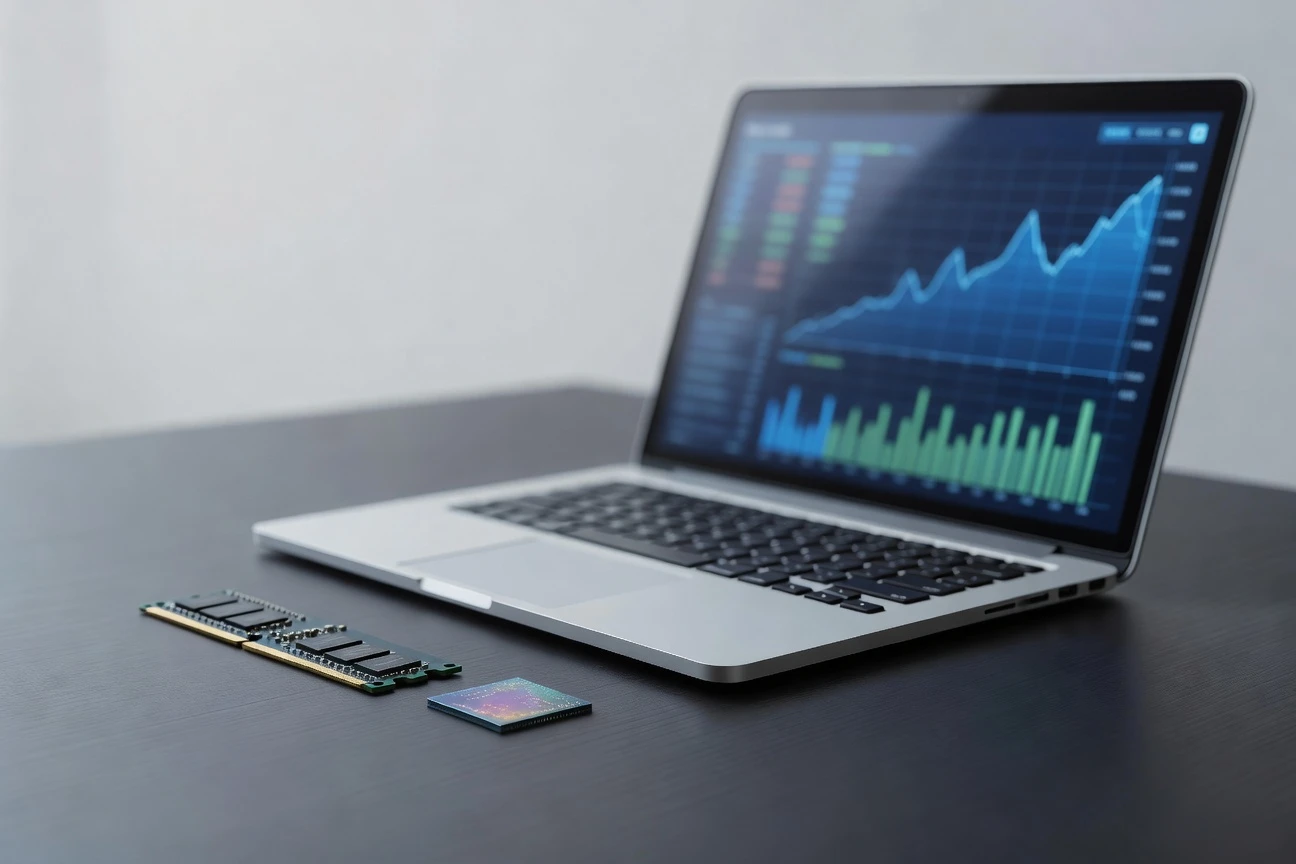
HPQ shares surged 15.3% on Friday, May 22, as investors rushed back into PC and printing company HP Inc. before the company’s scheduled May 27 earnings call, betting that demand for artificial intelligence personal computers (AI PCs, machines with on-device acceleration for AI tasks) and the Windows refresh can offset weak printing and higher memory costs.
The signal was loud because HP is usually priced like a mature cash-return hardware name. By the latest Friday quote, the stock was at $25.24 on 48.5 million shares traded, while rival computer maker Dell Technologies rose 16.8% in the same session. The read-through was simple enough: hardware stocks with an AI angle were getting a second look before HP’s numbers.
The Friday Move Was Rare for HPQ
HP has spent much of the past decade trading like a dividend and buyback story, not like a high-multiple AI proxy. That distinction matters. Traders were not reacting to a new company filing Friday afternoon; they were repricing the next report before management had answered the margin question.
The stock opened at $22.60, touched $25.55 intraday and last traded near $25.24. For a company whose daily moves are often modest, that range points to more than a routine bounce. It suggests investors were willing to pay in advance for evidence that the PC cycle has improved faster than feared.
- 15.3% one-day gain by the latest Friday quote.
- 48.5 million shares changed hands during the session.
- $25.55 marked the intraday high before the stock eased slightly.
AI PCs Gave Investors a Growth Hook
Segment math explains why the rally centered on computers. In HP’s fiscal first-quarter report, Personal Systems revenue was $10.3 billion, up 11% from a year earlier, while consumer personal-system revenue rose 16% and commercial revenue rose 9%. Printing, by contrast, fell 2% to $4.2 billion.
Personal Systems is carrying the stock because it gives investors a way to attach the company to two replacement cycles at once. One is the Windows fleet refresh in businesses. The other is a shift toward higher-spec laptops and desktops that can run some AI workloads locally instead of sending every request to the cloud.
Karen Parkhill, HP’s chief financial officer, gave traders a clean number for that story. On the latest reported quarter, she said AI-capable PCs were 35% of total shipments, up from 30% in the prior quarter and 25% the quarter before that. That progression turns AI from a product label into a mix shift investors can model.
The Windows side also has a calendar push. Microsoft, the Windows maker, says free software updates, technical assistance and security fixes ended after the Windows 10 support cutoff on Oct. 14, 2025. Corporate buyers can delay a refresh, but they cannot ignore an unsupported operating system forever.
The Cost Problem Travels With the Upgrade
The awkward part is that a richer computer can also be a more expensive computer to build. On the first-quarter call transcript, Parkhill said memory costs had increased roughly 100% sequentially. She also said memory and storage had moved from roughly 15% to 18% of the PC bill of materials in the prior quarter to roughly 35% for the year.
35% is the number that explains why Friday’s move should be treated as a test, not a victory lap. If dynamic random access memory (DRAM, the main memory chips inside PCs) and storage absorb a larger share of cost, the company must either raise prices, trim configurations, shift mix, or accept lower profit on the machines investors now want it to sell.
The table shows the split investors have to reconcile. The growth signals are visible, but the margin pressure is visible too, and both come from the same hardware upgrade cycle.
| Signal | Latest Company Data | Why It Matters After the Rally |
|---|---|---|
| PC demand | Personal Systems revenue rose 11% year over year | Gives the stock a growth story before earnings |
| AI mix | AI-capable PCs reached 35% of shipments | Moves the business toward premium hardware |
| Memory burden | Memory and storage were estimated near 35% of PC bill of materials | Puts pressure on Personal Systems margin |
| Printing revenue fell 2% while margin stayed at 18.3% | Keeps cash generation relevant, but cannot drive the rally alone |
Printing Still Buys HP Time
The old business did not cause Friday’s rally, but it still matters because it funds patience. Printing revenue was lower in the latest reported quarter, yet the segment’s operating margin of 18.3% was far above the 5.0% margin in Personal Systems. That gap is why a shrinking print line can remain important to a stock being repriced around newer PCs.
The same cash-return math showed up in the January quarter Form 10-Q. During the three months ended Jan. 31, the company returned $0.6 billion to shareholders through $0.3 billion of share repurchases and $0.3 billion of cash dividends. It also had about $8.1 billion remaining under its board-approved buyback authorization. That support has limits, though. If margins in the PC segment stay below target for longer than management expects, buybacks and dividends become a cushion while the market waits for the hardware mix to prove itself.
The Broader PC Cycle Is Pulling Demand Forward
Industry data backs part of the rally. Gartner’s first-quarter PC shipment data showed worldwide shipments of 62.8 million units, up 4% from a year earlier. The research firm also said growth had help from vendors and channel partners building inventory before expected memory cost increases.
That helps explain the strange setup. PC demand can look healthy at the same moment the forward market gets tougher, because distributors and buyers pull purchases into the first half before components become pricier. The sales then arrive early, and the second half has to clear a higher bar.
For HP, that timing matters because management has already said it expects the PC unit market to decline by double digits this calendar year as pricing actions weigh on demand. A rally built on shipped units has to survive the moment when higher device prices meet customers who can delay upgrades.
Windows refresh demand gives the cycle one stabilizer. The end of support pushed businesses to act, especially where fleets still had older machines. The same refresh also makes investors more willing to believe that new AI hardware can hold average prices above the plain replacement market.
May 27 Turns the Rally Into a Margin Exam
The next report has to do more than confirm that people are buying PCs. Investors need management to separate durable commercial refresh demand from purchases pulled forward by memory inflation. They also need a cleaner view of how much profit the company can protect while selling pricier machines.
- Earnings per share guidance needs to hold near the company’s prior adjusted earnings per share (EPS, profit per diluted share) outlook of $0.70 to $0.76 for the quarter.
- Personal Systems margin needs a credible bridge through memory costs, pricing, and mix.
- Print needs to keep funding capital returns without hiding demand weakness in hardware or supplies.
There is a cleaner upside case. Commercial buyers keep refreshing fleets, the AI mix rises, and price increases offset enough component inflation to let management sound less cautious about the back half. There is also a cleaner downside case: the first half borrowed too much demand from later quarters, and memory costs eat the premium that investors just paid for.
If the company shows AI PC growth with margin control, Friday’s move can look like the first repricing of a hardware cycle. If management has to lean on price hikes while warning about lower unit demand, the 15.3% jump starts to look like an earnings-week trade that arrived early.
Disclaimer: This article is for informational purposes only and discusses publicly traded securities. Equity prices can move sharply around earnings, component costs, and macro news. Consult a qualified financial adviser before making investment decisions. Figures are accurate as of publication.
COMPUTERS
Samsung Strike Ruling Shifts AI Chip Fight to Union Vote
The Samsung strike ruling changed the wage fight at Samsung Electronics from a shutdown threat into a controlled production dispute. A Suwon court required safety and product-protection work to continue at regular levels, and a last-minute wage accord on May 20 moved the fight to a union vote running May 22 to May 27.
For the AI supply chain, the important shift is from production outage to profit-sharing precedent. Samsung’s fabs may keep running this week, but the ballot will show whether workers in the most valuable part of the hardware stack can turn an AI memory boom into a standing claim on earnings.
The Court Order Cut Off the Production Threat
The May 18 order from Suwon District Court, a South Korean civil court, partially accepted Samsung’s request to limit unlawful industrial action by two unions, including the Samsung Group Supra-Enterprise Labor Union’s Samsung Electronics chapter. The key phrase was regular levels. In fab language, that meant the union could not treat weekend skeleton staffing as enough for a weekday strike if that staffing left safety or product-protection work below normal.
That matters because semiconductor plants are not offices with lights that can be switched off for 18 days. Wafers move through long process flows, chemicals and gases sit in controlled systems, and unfinished chips can lose value if protection work slips. The right to strike survived, but the work that could be withdrawn became narrower.
The law gave the court a practical hook. Korea’s Trade Union and Labor Relations Adjustment Act text requires work aimed at preventing equipment damage or raw-material and product deterioration to be conducted during industrial action, and it separately protects normal maintenance of workplace safety facilities. For a chip plant, that language is unusually powerful.
| Moment | What Changed | Why It Matters |
|---|---|---|
| May 18 court order | Safety and product-protection work had to stay at regular levels. | Samsung limited the risk of a sudden fab disruption. |
| May 20 tentative accord | The union put the strike on hold and sent the deal to a ballot. | Production risk shifted from factory floors to member approval. |
| May 22 to May 27 vote | Members decide whether the compromise ends the wage round. | The result sets the tone for chip-sector labor demands. |
A Wage Deal Put the Strike on Hold
By May 20, the dispute had moved from court papers to late-stage mediation. Choi Seung-ho, head of Samsung Electronics’ largest union, said the union would hold off on the planned 18-day strike and put a tentative agreement to members, according to the May 20 wage-deal report from the Associated Press. Members are due to vote from May 22 to May 27.
The union had said more than 46,000 members were willing to join the walkout. Management was also facing the awkward fact that its most important profit engine was being challenged by the people who run it. For workers, the deal offers a path to claim part of the AI recovery without absorbing fines or a separate court fight over staffing levels.
The choreography matters after Samsung’s first union strike in 2024, when organized labor showed it could pierce a company culture long known for weak union presence. This round was larger, more targeted and tied to the semiconductor unit rather than a symbolic one-day action. That gave the dispute more market weight and more political heat.
If members reject the deal, the union can revive industrial pressure, though the May 18 order would still shape how much pressure reaches production. If they approve it, the immediate strike risk fades, and the debate turns to the bonus formula.
AI Memory Profits Raised the Stakes
The bonus argument reached boiling point because Samsung’s recovery has been dramatic. In its official first-quarter earnings presentation, the company reported consolidated revenue of KRW 133.9 trillion and operating profit of KRW 57.2 trillion. Device Solutions (DS, Samsung’s semiconductor division) accounted for KRW 53.7 trillion of operating profit.
High-bandwidth memory (HBM, stacked memory used with AI accelerators) sits at the center of that surge. Samsung said memory sales surpassed its quarterly record and that high-value AI products helped drive results. The wage fight grew from a standard pay dispute into a fight over who shares in the AI cycle.
There is a second tension inside the numbers. Memory is throwing off most of the gains, while Samsung’s foundry business still has to prove it can turn advanced-node ambition into steadier earnings. A uniform bonus pool can look unfair to the high-profit team; a sharply divided one can split workers who need each other to keep the same fabs moving.
- KRW 57.2 trillion: Samsung’s total first-quarter operating profit.
- KRW 53.7 trillion: Operating profit from Device Solutions.
- 225%: Year-on-year sales growth in DS, according to Samsung’s segment table.
- KRW 11.3 trillion: Companywide research and development investment in the quarter.
The State Had Tools Beyond Mediation
South Korea’s labor system gives unions strike rights, but it also leaves the state with tools when a dispute threatens the national economy. The National Labor Relations Commission’s adjustment guide describes emergency adjustment as an exceptional step that can suspend action when public welfare or the economy is at risk.
The government avoided that hammer after the tentative deal. Still, the possibility changed the room. Kim Young-hoon, South Korea’s employment and labor minister, stepped into last-minute talks after earlier mediated talks failed, and the dispute landed in Suwon rather than on a picket line.
For Samsung, the legal shield was narrow because it covered safety, security and product protection, not the entire wage dispute. For the union, that narrowness matters too. A strike with normal staffing for protected functions can still embarrass management, slow routines and keep the bonus issue public.
That distinction is why the ruling helped management without solving management’s political problem. Courts can define illegal interference. They cannot write a bonus scheme that workers see as fair, especially when the company itself tells investors AI demand is driving record profits.
Korea’s Export Data Made the Dispute Larger
Samsung’s dispute triggered government attention because chips are now carrying Korean trade. The Ministry of Trade, Industry and Resources and the Ministry of Science and ICT (MSIT, South Korea’s digital policy ministry) said April information and communications technology exports reached $42.7 billion, up 125.9 percent from a year earlier.
Those information and communications technology (ICT, electronics and digital equipment trade category) exports accounted for 49.7 percent of Korea’s total exports in April, according to the same release. Semiconductor exports stayed above $30.0 billion for a second straight month, helped by memory contract prices and AI-server demand.
That is the reason a factory labor fight became a cabinet-level concern. A full outage could have affected HBM, dynamic random-access memory (DRAM, main memory used in servers and PCs), flash memory and solid-state drives (SSDs, storage drives using flash memory). Even a partial slowdown would have given customers another reason to worry about supply.
Customers have little patience for labor nuance when server buildouts are timed around accelerator deliveries. When memory supply tightens, buyers call other suppliers, prepay for inventory or delay system shipments long before Korean civil procedure finishes.
Rival SK hynix, a Korean memory chipmaker, matters in the background because its bonus practices became a benchmark in the dispute. If Samsung accepts a richer or more transparent incentive formula, the cost question spreads beyond one company and into the Korean memory duopoly.
The Vote Now Carries the Labor Precedent
The member ballot is the last hinge. A yes vote would spare Samsung an 18-day industrial action and give management time to sell the accord as a responsible compromise. A no vote would revive the strike threat under a court order that already defines protected work.
Union leaders also face a credibility test. They pushed the dispute to the edge of a national supply-chain alarm, then accepted a tentative deal before the first strike day. Members who wanted a direct share of record semiconductor profits will judge whether the accord does enough on incentives, transparency and future pay rounds.
Management’s calculation is just as awkward. The company protected production, but it has also taught engineers and fab workers that their labor has national bargaining value when AI demand is hot. That memory will matter the next time profits surge faster than pay formulas move.
If members approve the agreement, Samsung buys calm without ending the argument over AI profit sharing. If they reject it, the court order becomes the operating manual for a strike that no longer looks theoretical.
COMPUTERS
Samsung Strike Deal Leaves AI Memory Pay Fight Unsettled
The Samsung strike deal has converted an 18-day walkout threat into a ratification vote. The tentative wage agreement, reached after government-mediated talks on May 20, pauses a planned May 21 to June 7 strike by unionized workers at the world’s biggest memory-chip maker, with members scheduled to vote from May 22 to May 27, according to the tentative wage deal report from AP.
The pause matters because bonus design at the Korean chipmaker now sits inside a bigger question: how much of the artificial intelligence memory windfall should flow to engineers and fab staff before it reaches shareholders, customers and Seoul’s trade statistics?
A Deal at the Factory Gate
Choi Seung-ho, leader of the company’s largest labor union, used his public briefing to lower the temperature after months of pressure. The union represents more than 70,000 workers, AP reported, which made the threat bigger than a symbolic protest and closer to a national supply problem.
We would like to express our apologies to the people for causing concerns due to our internal conflicts.
Choi said that at a televised briefing on May 20, according to AP. Yeo Myounggoo, a senior company official, said management wanted the agreement to become a starting point for more stable relations, a careful phrase from a company that still needs rank-and-file approval.
The immediate win for management is procedural. The walkout did not start on the morning it was scheduled to begin, but the agreement is still tentative. The strike threat has moved from the factory gate to the ballot box.
| Pressure Point | Clock | Who Controls It | Practical Effect |
|---|---|---|---|
| Planned walkout | May 21 to June 7 | Union leadership and members | An 18-day stoppage threat over pay and bonuses |
| Tentative wage deal | Vote from May 22 to May 27 | Union members | A pause in labor action if the deal is approved |
| Emergency adjustment | State process after ministerial action | Employment and labor minister, then labor commission | A legal route for Seoul to suspend action and force formal mediation |
The Bonus Fight Followed a Record Chip Quarter
The wage dispute hardened after the company’s chip division printed numbers that changed the politics of pay. In the company’s official first-quarter results, consolidated revenue hit a quarterly record, and Device Solutions (DS, the chip division that includes memory, foundry and system logic) produced most of the profit.
- KRW 133.9 trillion: consolidated first-quarter revenue, roughly $89 billion using the Reuters exchange rate published on May 20.
- KRW 57.2 trillion: consolidated operating profit, also a quarterly record.
- KRW 53.7 trillion: operating profit at DS on KRW 81.7 trillion of segment revenue.
Those figures explain why a bonus formula became a control system. Artificial intelligence (AI, computing built around large models and specialized chips) has lifted demand for High Bandwidth Memory (HBM, stacked memory placed beside AI processors), and the employees closest to that profit pool want the payout rule to recognize it.
Management has the opposite problem. A formula that rises too directly with chip profit can become a long-term cost base during a boom. The deal appears to buy time, but it does not erase the basic tension between cyclical memory profits and permanent compensation rules.
Seoul’s Emergency Lever Changed the Bargaining Room
The government was in the room before the agreement was signed. That is the part customers and investors should not miss. A labor fight at a normal manufacturer stays between the company and the union. A labor fight at the country’s largest memory-chip producer quickly becomes industrial policy.
The National Labor Relations Commission (NLRC, South Korea’s labor-dispute agency) describes emergency adjustment as a rare process used when industrial action risks the national economy or daily life. The NLRC emergency adjustment guide says the employment and labor minister can decide to start the process after normal mediation fails, with the commission then moving quickly into mediation or compulsory arbitration.
That threat changed the bargaining room. A state-backed pause would have been politically costly for a government that wants to be seen as labor-friendly, but letting a strike hit a strategic chip producer carried its own cost. The tentative deal let Seoul avoid testing that tool, at least for now.
For the union, the signal was just as clear. The right to strike had legal force, yet the government was prepared to argue that national economic risk could outrank the timetable. That is a hard ceiling on labor leverage in a sector tied to exports, servers and AI capacity.
Memory Buyers Got a Short Reprieve
The supply concern was not theoretical. Korea’s Ministry of Trade, Industry and Resources said April information and communications technology exports reached $42.7 billion, up 125.9 percent from a year earlier. Information and communications technology (ICT, electronics and digital export goods) accounted for 49.7 percent of Korea’s total exports that month, and semiconductor exports stayed above $30 billion for a second straight month.
Memory fabs do not behave like phone assembly lines. Wafer starts, cleanroom staffing, tool maintenance and process checks have to be scheduled around continuous production. Even a partial disruption can leave buyers asking whether promised supply will arrive on time.
- AI server teams care about HBM slots because accelerator shipments depend on memory packages as much as on processors.
- PC and phone makers care about dynamic random access memory (DRAM, main memory used in servers, phones and PCs) because contract price moves flow into device bills of materials.
- Policy officials care because chip exports have become a shock absorber for the Korean economy.
The company’s wider hardware reach explains why this labor fight traveled outside memory. The same group appears across device supply chains, from Apple OLED panel supply from Samsung Display and LG to BOE talks for the Galaxy S27 base model. A chip strike starts in one division, but procurement teams read it across the full component map.
The AI Memory Race Made Labor a Supplier Risk
TrendForce, a Taiwan-based memory market researcher, has said HBM4 validation work at the three major suppliers is moving toward a multi-supplier setup for NVIDIA, with Samsung, SK hynix and Micron all in the frame. The reason is blunt: no single supplier can fully satisfy the needs of the next AI platform cycle.
That makes labor stability a supplier risk, not just a human-resources issue. A cloud buyer negotiating HBM allocation now has to ask whether a fab can hold yield, capacity and labor peace at the same time. The answer may affect who gets volume, not just who offers the best chip.
SK hynix and Micron do not need a prolonged strike to benefit from the question. They only need buyers to add a few more risk lines to procurement models. In a tight HBM market, confidence can matter almost as much as the next speed grade.
The tentative deal removes the immediate production scare, but it also advertises the new balance of power. Workers can see the AI profit pool. Customers can see the labor risk. The government can see both.
The Vote Leaves a Narrow Path
Members now decide whether the compromise is enough. That vote is the deal’s first operational test, because management can keep fabs running only if workers accept the settlement as more than a last-minute pressure release.
- Union members review the tentative wage agreement before balloting opens on May 22.
- Voting is scheduled to run through May 27, according to AP’s account of the union briefing.
- If members approve the deal, the immediate strike threat ends and both sides move into implementation.
- If members reject it, the walkout risk can return, with Seoul’s emergency adjustment power still hanging over the table.
For management, approval would protect a record chip quarter from becoming a production crisis. For workers, rejection would keep pressure alive but invite a stronger state response. For customers, the next signal is simple: whether the people building AI memory believe the AI bonus deal pays them enough.
If members approve the agreement, the chipmaker gets breathing room through the next earnings cycle. If they vote it down, the strike story returns with less patience from Seoul and more attention from every buyer waiting on HBM.
COMPUTERS
Arm Faces FTC Probe as Seoul and Brussels Pursue Same Case
The US Federal Trade Commission (FTC, the agency that polices anticompetitive behavior in American markets) has opened a formal antitrust probe into Arm Holdings over how the British chip-design firm licenses the architectures that sit inside almost every smartphone and a growing share of data center servers. The company confirmed earlier this year that it received a document-preservation request, and the investigation was first reported on May 15, sending Arm shares down as much as 8 percent intraday before the stock recovered to close near $208.
Cambridge, England has stopped being a pure blueprint shop. On March 24, Arm shipped a 136-core data center processor co-developed with Meta, the first production silicon in the firm’s 35-year history. That product, and the way it changes Arm’s relationship with the customers who pay its royalties, sits at the heart of three antitrust inquiries now running on three continents.
The FTC’s Question, in One Sentence
The Commission is asking whether Arm intends to refuse or degrade the central processing unit (CPU, the main calculation engine inside a chip) blueprints it licenses to Apple, NVIDIA, Qualcomm, MediaTek and roughly every other large fabless chip company, at the same moment Arm has begun selling its own competing silicon into the same accounts. The probe is at the information-gathering stage. Arm confirmed in a filing that it had been told to preserve documents and said it intends to cooperate.
Investors did not wait for the procedure to play out. ARM dropped to roughly $190 in extended trading on May 15 before institutional buyers stepped back in, leaving the close at $207.96, a slim daily loss against a stock that had nearly doubled this year and outpaced the Philadelphia Semiconductor Index. The pullback wiped close to $7 billion of paper value before most of it recovered, and the move underlined how much of the current valuation rides on regulators leaving the licensing model intact.
Three Continents, One Complaint
Look behind each of the three probes and you find the same plaintiff. Qualcomm filed parallel antitrust complaints with the FTC, the European Commission, and South Korea’s Korea Fair Trade Commission (KFTC, the country’s antitrust regulator) in March 2025, weeks after a Delaware jury sided with Qualcomm in a separate licensing fight.
| Regulator | Status (May 2026) | Trigger filing | Focus area |
|---|---|---|---|
| US Federal Trade Commission | Active probe, document-preservation order issued | Qualcomm complaint, March 2025 | Whether Arm degrades CPU licenses as it sells competing silicon |
| European Commission | Investigation opened | Qualcomm complaint, March 2025 | Abuse of dominance in CPU architectures across the bloc |
| South Korea KFTC | On-site inspection at Seoul office, November 2025 | Qualcomm complaint, March 2025 | Restrictions on Nuvia-derived licenses, market access |
A simultaneous filing across three jurisdictions is a chosen escalation. It forces parallel discovery, makes settlement harder to broker, and pushes the dispute from contract court into competition law, where injunctive remedies can include compulsory licensing. Each regulator picked up a different slice of the same question: Brussels on single-market access, Seoul on the contested Nuvia rights, Washington on the broader squeeze.
Why Cambridge Stopped Being Just a Licensor
For three and a half decades, Arm sold one product line: instruction-set architectures and CPU cores that other companies stitched into silicon and paid royalties on. Rene Haas, Arm’s chief executive officer, has been pushing the company up that value chain since the SoftBank-engineered initial public offering of September 2023.
The AGI CPU and the Meta Hand
The clearest break with the old model arrived in March of this year. Arm unveiled the AGI CPU, a 136-core processor built on TSMC’s 3-nanometer node and packed with Neoverse V3 cores running at up to 3.7 GHz boost across two dies, all within a 300-watt envelope. Meta is the lead customer and co-developer, with Santosh Janardhan, Meta’s head of infrastructure, publicly committing to a multi-generation roadmap.
Arm has also disclosed commercial commitments from Cerebras, Cloudflare, F5, OpenAI, Positron, Rebellions, SAP and SK Telecom. The chip is sold as finished silicon, not as a design file. That is the line the new business has crossed.
Compute Subsystems Double the Royalty
The shift began earlier with the Compute Subsystems product framing. CSS bundles CPU cores, memory controllers, and interconnect into a verified package rather than selling cores piecemeal. Arm’s own disclosures put CSS royalty rates at roughly double those of legacy core licenses.
By the November 2025 quarter, the company had signed 19 CSS licenses across 11 customers, with five designs already shipping inside products from NVIDIA, Google, and Microsoft.
From Cortex to C1
A naming change makes the strategy concrete. Arm is retiring the Cortex brand, in use since 2004, in favor of C1-Ultra, C1-Premium, C1-Pro and C1-Nano tiers. The new lineup comes pre-integrated for original equipment manufacturers. It also comes with the price tag of a finished platform rather than a piece of intellectual property, which is the lever regulators are watching most closely.
The Qualcomm Tripwire That Set Everything Off
The road to the Seoul raid runs through a Delaware courtroom. In December 2024, a jury found that Qualcomm did not breach Arm’s licensing agreement when it acquired the chip startup Nuvia for $1.4 billion and used its Oryon cores inside Snapdragon X laptop processors. A September 2025 post-trial ruling extinguished Arm’s last remaining claim.
After two years of litigation, Arm has lost. Every claim it asserted against Qualcomm and Nuvia has been rejected by the court.
That wording is from Qualcomm’s October 1, 2025 statement on the post-trial judgment. The phrasing matters: it converted what Arm framed as a contract dispute into the foundation for a multijurisdictional antitrust attack. Qualcomm’s regulatory complaints argue that Arm shifted from an open licensing model into a restrictive one, choosing which customers receive full access and which get a degraded tier as the licensor moves closer to selling rival products. Arm’s public position is that its terms are non-discriminatory and that finished silicon is additive to the licensing book, not exclusive of it.
What the Licensees Stand to Lose
If any of the three regulators finds Arm has been narrowing access, the immediate beneficiaries are the licensees that have been quietly stockpiling alternatives. Each carries a different exposure.
- Most insulated: Apple holds a perpetual architecture license dating to the 1990s. The probe still matters because Apple Silicon’s roadmap depends on Arm’s instruction-set extensions for matrix math, and the company has been hedging foundry exposure through a preliminary chip-manufacturing deal with Intel.
- The would-be acquirer: NVIDIA pays royalties on the Grace and Grace Blackwell server CPUs and tried to buy Arm outright for $40 billion in 2020 before regulators killed the deal. It now sits across the table from a licensor it once expected to own, while running its own $40 billion AI equity program in parallel.
- The plaintiff: Qualcomm has shifted Snapdragon X laptop chips onto Nuvia-derived Oryon cores. A favorable antitrust outcome would lock in that path and open compulsory-licensing remedies if any regulator wants them.
- Quiet hedger: MediaTek licenses Arm cores for smartphone platforms and has been evaluating RISC-V, the open instruction set, as an insurance line.
- Direct competitors now: Google, Microsoft, and Amazon all license Compute Subsystems and now face Arm’s own silicon bidding against them for Meta-style hyperscaler workloads.
The dependency runs deep. By Arm’s own count, the architectures power more than 50 percent of CPU compute shipped to hyperscalers in fiscal 2026. A regulator that finds the licensor abusing that base of power has substantial remedy options on the shelf.
The Royalty Engine Under the Probe
Arm’s fiscal year ended March 31, and the company reported record numbers on May 7. The shape of those numbers, disclosed in Arm’s fourth-quarter fiscal 2026 earnings release, explains why a probe focused on licensing behavior rattled investors so quickly.
- $4.92 billion in full-year revenue, the third straight year of growth above 20 percent since the 2023 listing.
- $2.61 billion in royalty revenue for the year, up 21 percent, with data center royalties more than doubling.
- $2 billion of AGI CPU customer demand booked across fiscal 2027 and 2028, per the AGI CPU launch disclosure, before the chip ships at volume.
The structure of those numbers tells the regulatory story. Royalty income, the older revenue line, grew slower than licensing. The licensing line is where CSS and the new pre-integrated platforms sit, and where price discipline can be exercised by tier. The new silicon business sits outside both lines: it is hardware revenue Arm did not collect before, sold into accounts that also pay fees on competing designs. That overlap is what the three regulators are now mapping.
If the FTC settles for a consent decree that constrains how Arm prices its Compute Subsystem tiers, Cambridge can absorb the friction and keep growing into the framework Haas has built. If any of the three authorities finds the new silicon business requires structural separation from the licensing book, the value-chain climb that took three years to engineer gets unwound on a regulator’s schedule.
-
CRYPTO3 weeks agoAndreessen Horowitz Bets $2.2B on Crypto’s Quiet Cycle
-
CRYPTO2 weeks agoCathie Wood Calls SpaceX IPO Demand ‘Voracious’ Ahead Of $1.75T Debut
-
NEWS2 weeks agoGhana CSA Plants Office In Ho As Volta Cybercrime Climbs
-
APPS3 weeks agoGoogle’s Buried Page Reveals 500 Niche Websites Still Making Cash
-
NEWS3 weeks agoHormuud Bets $19 Down Will Finally Pull Somalia Online
-
NEWS2 weeks agoApple Strikes Preliminary Deal For Intel To Make iPhone And Mac Chips
-
NEWS3 weeks agoMetalenz Polar ID Hides Face Unlock Under OLED Smartphone Screens
-
AI2 weeks agoGoogle AI Overviews Adds Subscribed Label, Reddit Quotes Inline





