
Connect with us

APPS

Google Wallet Turns Boarding Passes Into Airport Automation

Published

on

Google Wallet airport updates announced around Google I/O 2026 make the app a travel layer that can receive boarding passes from a saved loyalty card, surface linked items, and push the right ticket at the airport. Airlines still decide what appears, and Google says automatic delivery is best-effort.

Timing is the travel pitch. At a crowded gate, the best pass manager is the one that opens after your phone has already found the boarding pass, not the one that sends you back through email, an airline app, and a search box.

The Boarding Pass Moves Before You Search

The announcement landed during a developer session around Google I/O 2026, a conference dominated by Gemini and Android chatter. Wallet’s travel push was easy to miss. The session focused on a calmer airport path for people who already live on Android.

The feature set has three pieces: airline loyalty enrollment from a boarding pass, Auto Linked Passes that can place related passes into Wallet, and existing pass notifications that try to surface a saved item at the moment it matters. Put together, they move Wallet closer to an airport assistant than a digital drawer.

That was easy to lose in a week when Google’s AI work took the stage, including Oton Technology’s look at Gemini Omni Flash’s video editing push. Travel, though, is where a small Wallet change becomes visible in seconds.

We want to make travel feel less stressful and less disconnected and be with travelers throughout their journey.

Gokmen Goksel, Google Wallet tech lead, said that during the I/O developer session. The line is plain, but the product shift is sharper: the app is trying to handle the pass hunt before the passenger starts one.
Auto Linked Passes Change the Handoff

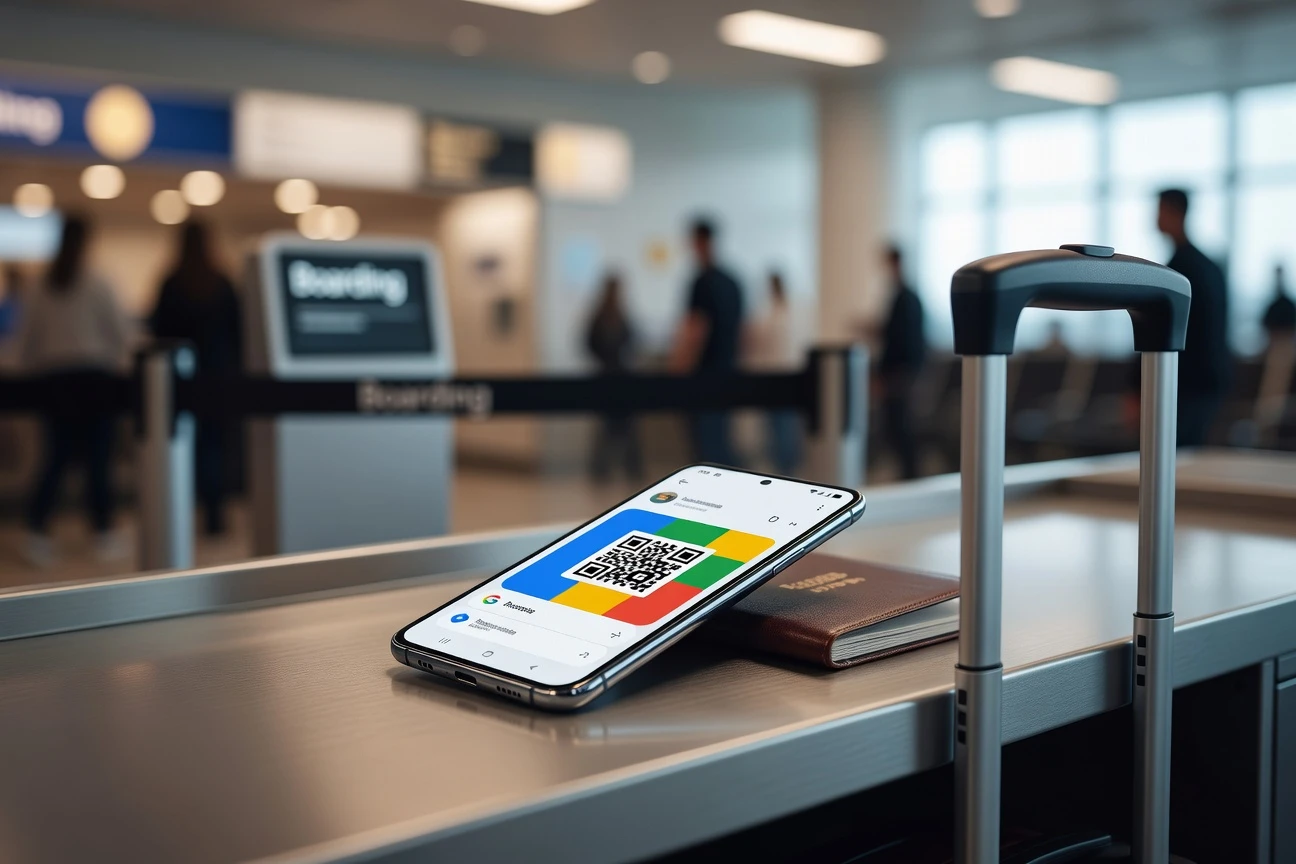
The core mechanic sits in Google’s Google Wallet Auto Linked Passes developer guide. An airline can link a boarding pass to a loyalty pass already saved in Wallet. After check-in through the web, an app, or an airport kiosk, the airline can use the loyalty account number to match the traveler and push the boarding pass into Wallet.

Google’s limits make the feature useful but not magic. The primary and linked pass need the same issuer ID, a primary pass can have up to 50 linked objects, and automatic pushing is best-effort, not guaranteed. If a boarding pass is mission-critical, Google’s own guidance tells issuers to use another channel too.

Wallet Path Trigger Best Use Main Limit
Manual Add to Google Wallet User taps the airline’s button Normal check-in from an app, email, or site Traveler has to find the button
Pixel Screenshot User captures a QR code or barcode Backup when the airline flow is clumsy Pixel 3 or newer flow, with fewer live updates
Auto Linked Passes Issuer links a pass to a saved loyalty card Repeat travelers and loyalty members Issuer support and best-effort delivery

Loyalty Cards Become Airport Keys

Google’s design choice is subtle. The frequent flyer card becomes the standing relationship, while the boarding pass becomes the temporary object that rides on top of it. That is why the developer guide recommends Sign Up or Sign In with Google and one-click enrollment for airline loyalty programs.

For airlines, that changes the moment of enrollment. A traveler staring at a boarding pass has a live reason to join a program, not an abstract promise of miles. For Google, the loyalty card becomes the anchor that lets Wallet recognize a traveler across future trips without asking the passenger to repeat the same add-to-wallet step.

Google’s Google Wallet linked passes support page draws the boundary. Users cannot link passes themselves today. The issuer does it. Related passes can include boarding passes, event tickets, loyalty cards, gift cards, offers, and other non-private passes, while payment cards, private IDs, health insurance cards, physical access passes, and digital car keys sit outside that linking model.

That boundary matters. The new travel flow depends on issuer plumbing, not user neatness. If your airline has not done the work, Wallet cannot organize the trip out of thin air.

The Setup Still Belongs to You

Travelers will have some control, but the most useful settings are easy to miss. Google says the Automatically add linked passes setting is on by default and can be turned off in Wallet settings. Nearby pass alerts add another layer: Google’s Google Wallet nearby notification developer guide says those alerts require notifications plus precise, always-on location access.

For airports, that can be helpful. A gate notification that jumps straight to the right pass beats digging through a list with one hand on a suitcase. The same guide says Google controls how close a user must be and how long they must stay in the area before a nearby notification appears, so this is not a setting that airlines can tune down to the inch.

  • Save your airline loyalty card in Wallet before check-in if your carrier supports it.
  • Open Wallet settings and check whether Automatically add linked passes is on.
  • Turn on pass notifications if you want boarding reminders and linked-pass alerts.
  • Grant location access only if airport or venue pass alerts are worth that trade for you.
  • Keep the airline app installed until after boarding because automatic delivery can fail.

The practical rule is simple: Wallet can be the faster lane, while the airline app remains your backup.

The Data Trade Sits in the Terminal

The convenience has a data side. Google’s Google Wallet passes data support page says Wallet activity is saved to the user’s Google Account, including items saved to Wallet and how they are used. It also says payment methods and digital receipts are managed separately, and private passes such as IDs and insurance cards follow different rules.

For travel, that distinction matters because a boarding pass carries time, route, airline, and identity signals. A linked-pass model can reduce taps at the gate, but it also makes the Google Account a stronger organizing point for trip objects. That is useful when the phone surfaces the pass. The same setup deserves review when you grant settings that run in the background.

Location-based alerts raise the bar further. If the airport prompt is worth it, enable it. If the trade feels too broad, standard Wallet storage still leaves you with a QR code or barcode you can open manually.

Airlines Decide How Useful This Gets

Airline support remains the bottleneck. Google can provide the pass format, the linking rule, the notification surface, and the settings switch. The boarding pass still starts with the carrier. That means the same Android phone can feel smart on one trip and oddly manual on the next.

There is also a platform race under the boarding pass. Apple’s Apple Wallet boarding pass support page says an iPhone boarding pass automatically appears on a paired Apple Watch, and eligible passes can share a Live Activity and flight status with another iPhone user. Google is answering with Android-native hooks around Wallet, pass linking, and airport timing.

The comparison stretches beyond Apple and Google. Airlines have long used apps to keep travelers close to seat upgrades, bag fees, lounge offers, and service alerts. A Wallet-centered trip flow gives users fewer reasons to open the airline app at the airport. That is convenient for passengers and a little uncomfortable for carriers that depend on app traffic.

Wallet Is Becoming Google’s Travel Surface

Wallet’s airport move matches a broader product direction: the phone should anticipate a stored credential when a place and time make the need obvious. Payment cards, loyalty IDs, receipts, passes, and tickets are different objects, but the strongest Wallet use cases all share the same question: can the phone put the right item in front of you at the moment of use?

That same pressure is showing up outside airports. Oton Technology recently examined AI shopping agents rebuilding the digital wallet, where the payment moment starts before the human reaches checkout. Boarding passes are a cleaner example because the user need is obvious. You have a flight. You need a scannable pass. You probably need it fast.

The travel update matters because a boarding pass is the rare digital item that becomes urgent at a known place and time. If Wallet can handle that well, the same pattern can extend to trains, stadiums, parking, hotel keys, and store offers. Those are exactly the kinds of objects that already sit near Wallet’s pass model.

If airlines adopt the new linking flow broadly, Google Wallet becomes the place Android travelers check because the pass is already there. If adoption stays patchy, the feature will feel like a pleasant surprise on some trips and a reminder to keep the carrier app close on others.

Frequently Asked Questions

How Do Google Wallet Airport Updates Work?

Google Wallet airport updates work when an airline or pass issuer creates Wallet passes and links them to a saved pass, usually a frequent flyer card; Wallet can then group or deliver the related boarding pass if the issuer supports the feature and the user’s settings allow it.

Do I Need an Airline App to Use Auto Linked Passes?

Sometimes, yes. Auto Linked Passes can send a boarding pass after check-in through the web, app, or kiosk, but Google’s developer guide calls delivery best-effort, so travelers should keep the airline app or confirmation email until the trip is over.

Can I Turn Off Automatically Added Linked Passes?

Yes. Google says Automatically add linked passes is turned on by default and can be disabled in Google Wallet settings under the account profile.

Will Google Wallet Work Without an Internet Connection at the Gate?

Yes, if the pass is already stored and the barcode is visible. Google’s Google Wallet flight ticket support guide says boarding passes added by screenshot are saved in the Wallet app and do not need an internet connection to be retrieved.

Does Google Wallet Support Apple Wallet PKPASS Files?

No. Google’s flight ticket help says Google Wallet does not support PKPASS files, so travelers should use an airline Add to Google Wallet button, a supported screenshot flow, or the airline app instead.

Logan Pierce is a writer and web publisher with over seven years of experience covering consumer technology. He has published work on independent tech blogs and freelance bylines covering Android devices, privacy focused software, and budget gadgets. Logan founded Oton Technology to publish clear, no nonsense tech news and reviews based on real hands on testing. He has personally tested and reviewed dozens of mid range and budget Android phones, written extensively about app privacy, and built and managed multiple WordPress publications over the past decade. Logan holds a bachelor's degree in English and studied digital marketing at a certificate level.

Continue Reading
Click to comment

Leave a Reply

Your email address will not be published. Required fields are marked *

APPS

YouTube Google TV Sidebar Puts Subscriptions First

Published

on

The YouTube Google TV sidebar update now showing for select users moves Subscriptions and Library directly below Search and Home, adds two channel shortcuts, and sends topic shortcuts such as News, Live, Podcasts, Music, Gaming and Sports lower down the rail. The limited rollout points to a server-side test rather than a normal app-store release.

The small menu change matters because YouTube is treating the TV remote like prime shelf space. A viewer who opens the app from a couch is less likely to type, browse deeply, or search with patience; the left rail decides whether that session begins with a known channel, a saved video, or whatever the home feed serves first.

The Sidebar Moves the Habit Loops Up

For regular viewers, the old problem was simple: the most personal parts of YouTube sat too low in the TV app’s left rail. YouTube’s official TV app guide describes the TV app as a place to sign in, view subscribed channels, search for content, and use a mobile device as a remote, and it treats Subscriptions and Library as core ways to find videos. The reported layout brings those two places closer to the first click, which means fewer remote presses before a viewer reaches followed channels or saved items.

Area Older TV Rail New Sidebar Seen by Some Users Viewer Effect
Top of rail Search, then Home Search, then Home No change to the main discovery entry point
Personal sections Subscriptions and Library below several content categories Subscriptions and Library grouped directly under Home Faster return to followed channels and saved items
Channel shortcuts No persistent channel tiles in the main rail Two direct channel shortcuts visible even when the rail is collapsed Recent or suggested channels can become one-click return paths
Topic shortcuts Music, Movies and TV, Podcasts and other tabs higher in the rail News, Live, Podcasts, Music, Gaming and Sports sit below the personal group, with variation by TV Categories stay present but lose the best shelf space
Settings Button at the bottom Button remains at the bottom The control area stays familiar

The update changes the default path from broad browsing to returning. That matters on a television, where the best interface is often the one that asks for the fewest button presses.

A Remote Control Changes the Math

On a phone, moving Library one row higher hardly registers. On a TV, a few clicks can be the difference between opening a saved video and giving up to the recommendation grid. The device in the hand is usually a remote with directional buttons, not a keyboard and cursor.

The remote also changes who wins a design debate. A feature buried five rows down may be found by power users, but a guest, child, or tired subscriber will choose from what appears first. That makes the left rail a product ranking as much as a menu.

The new group fits that constraint. Search and Home remain the fixed entry points, while Subscriptions and Library move into the first decision window. The user does not need to know any of Google’s product plan to feel the change; the path to a creator they already watch is shorter.

The Rollout Looks Like a Switch, Not a Store Update

The update has not landed evenly. Reports have placed it on Google TV and Samsung TV hardware, while other users with the same app family still see the older rail. That pattern usually means YouTube is testing an interface from its servers, not waiting for every device owner to install a new package.

  • Confirm the app is current, then stop there; a fresh version may still show the old rail.
  • Restart the TV or streaming box once, because cached TV apps can hold an old shell longer than mobile apps.
  • Check another profile in the same household, since account-level tests can land unevenly.
  • Use the feedback path inside the TV app if channel shortcuts feel wrong, because public help pages do not yet describe a disable switch.

That distinction matters for expectations. A normal update can bring fixes and code to a device, but a server flag can decide who sees a layout. Android TV and Google TV owners should still keep the app current, yet no viewer should expect a manual update button to force the new rail immediately.

The Numbers Behind the Living-Room Bet

There is a reason a sidebar test deserves attention. YouTube’s TV app has moved far beyond a side door for people who dislike casting from a phone, becoming a high-volume surface where entertainment, shopping and subscribed viewing can meet in the same session. That is the living-room bet behind a menu that looks modest at first glance.

TV Watch Time
YouTube’s big-screen design post said TV watch time had grown to more than 1 billion hours per day while the company was adding richer TV features.
Android TV Distribution
The Google Play listing for YouTube for Android TV showed more than 500 million downloads and an update date of May 19, 2026, as of publication.
Paid TV Intent
Neal Mohan, YouTube chief executive, said in the annual YouTube priorities note that YouTube TV would add more than 10 specialized plans spanning sports, entertainment and news. That is the paid live-TV service, but it shows the same push toward TV sessions with clearer intent.
Connected-TV Commerce
YouTube’s Brandcast update on connected-TV checkout said Buy with Google Pay would let viewers complete purchases directly on internet-connected televisions with just two clicks.

Those facts make the sidebar a small piece of a larger shift. The left rail is where YouTube can turn a passive TV session into a known-channel session, a saved-video session, or a shopping session without asking the viewer to type.

Google TV Is Pulling Shorts Toward the Home Page

The sidebar shift also arrives while Google TV is preparing to surface more YouTube before the app even opens. Google’s TV team said a Google TV short-video home-page plan will bring a row called Short videos for you to U.S. Google TV devices this summer, starting with YouTube Shorts.

That row changes the handoff. A viewer can be nudged toward vertical clips from the home screen, then land in the YouTube app where the left rail is better tuned for subscriptions, saved videos and known channels. The app and platform start to feel less separate.

The result is more YouTube before the app opens. For Google, that is tidy product logic. For viewers, it may feel like another layer of video in a place that already had plenty. The sidebar redesign can soften that by making the first in-app action more personal, but only if the shortcuts feel useful instead of noisy.

Creators Gain a Faster Path Back to Regular Viewers

The hidden beneficiary is the creator with a loyal TV audience. If the two channel shortcuts are based on recent viewing, a creator who earns a couch habit gets a small but valuable slot in the rail. If the shortcuts are algorithmic, the slot becomes a recommendation surface with very little room for explanation.

That advantage comes with a trade-off for viewers. Direct channel shortcuts take space from stable menu labels, and people who prize a clean rail may see the same feature as clutter, especially if the channels change without a setting to pin or hide them. The design will be judged by whether those shortcuts save time more often than they surprise people.

Viewer Control Remains the Test

The most important missing detail is viewer control. As of May 21, 2026, YouTube’s public Help Center pages did not describe a toggle to remove channel shortcuts, reorder the rail, or choose which categories appear. For a living-room app shared by a family, that matters more than it would on a personal phone.

Google already lets the TV app handle multiple accounts and kid profiles, and the same logic should apply to the rail. A parent may want Library and kid controls closer. A sports viewer may want Live higher. A music viewer may resent losing quick access to Music. One layout has to serve a room, not only an individual.

If the rollout widens without controls, the first complaint will be clutter. If it arrives with stable shortcuts, reliable profile behavior and a clear way to send feedback, the new rail will have done its basic job: make the couch session start faster.

Continue Reading

APPS

SoBanHang Funding Gives Hong Leong a Merchant Data Bet

Published

on

SoBanHang funding has reached at least US$3.8 million in a pre-Series A round anchored by Hong Leong Bank, but the sharper bet is on the daily sales record of Vietnam’s smallest merchants. Regulatory filings cited by DealStreetAsia put Hong Leong Bank’s check at US$2 million and OSK-SBI Venture Partners at US$1.5 million, with FEBE Ventures and Antler also participating.

For Finan, the Singapore-based parent of the Vietnamese sales management app, the money buys time to build Finan One. For banks, it buys a possible route from app usage to credit decisions in a market where many shopkeepers still sit outside formal lending.

The Round Bought More Than Runway

Finan said in its own pre-Series A announcement that the new capital will support Finan One, an artificial intelligence native system (AI-native, built around model-driven automation rather than added later) for small and micro businesses. The company also said the app now serves more than 800,000 business users and has processed more than US$5 billion in transaction value.

Those numbers explain why a bank-led round matters. A sales app can count orders, invoices, inventory and cash flow before a lender ever asks for documents. That is operating data, and in a thin-file merchant market it can be more useful than a glossy pitch deck.

  • US$3.8 million is the minimum size of the reported pre-Series A round, with fundraising said to be still open.
  • 800,000 business users is the scale Finan claims across its merchant base in Vietnam.
  • US$5 billion is the transaction value Finan says has moved through its systems.

The raise also follows a US$4 million seed round in 2021, which came across two tranches. That history matters because this is no longer a quarantine-era tool trying to help shops sell online. It is trying to become the business record that banks read first.

Why Hong Leong Wants the Cash Register

Hong Leong Bank’s interest did not start with the financing. In October, Hong Leong Bank’s partnership note with So Ban Hang described an all-in-one financial management solution with in-app account opening, automatic record keeping, tax-compliant quick response payments (QR, a scannable payment code) and e-invoice issuance.

That is a banking distribution play hidden inside merchant software. A corner shop owner may not open a separate business banking app every morning. But the same owner may open a sales app to check yesterday’s receipts, unpaid balances and stock. Put account opening or financing in that workflow and the bank meets the merchant at the point of need.

Hong Leong Bank Vietnam also framed the partnership around micro, small and medium sized enterprises (MSMEs, firms below large corporate scale). Its note cited Asia SME Monitor data saying MSMEs accounted for more than 97 percent of all enterprises and about 59 percent of total employment in Vietnam in 2022. The appeal is not one big borrower. It is thousands of small borrowers whose sales activity becomes more legible.

The Cap Table Shows Two Different Motives

The investor mix is small, but it is not random. Hong Leong brings a bank’s need for future customers. OSK-SBI brings a regional venture lens. FEBE Ventures and Antler bring earlier founder-stage familiarity with the company.

Backer Reported Check Role in the Round Strategic Read
Hong Leong Bank US$2 million Lead strategic investor Wants merchant banking reach through daily-use software
OSK-SBI Venture Partners US$1.5 million New venture investor Sees regional software and financial services upside
FEBE Ventures Not separately disclosed Existing backer Continues exposure to Vietnam’s small-business digitization
Antler Not separately disclosed Existing backer Maintains early-stage founder support into the next round

OSK-SBI’s timing is notable. In its second fund launch release, the Kuala Lumpur firm said its newer fund would invest across Southeast Asian technology companies from Series A to pre-IPO, including financial services and enterprise software. Finan sits close to both buckets.

Shinhan Store Shows the Bank App Endgame

The clearest preview is not the round itself. It is Shinhan Store, a separate app launched through Finan’s partnership with Shinhan Bank Vietnam. The official Shinhan Store launch release says the product lets merchants manage orders, track revenue, issue electronic invoices, monitor balances, open accounts and register for loans within one application.

That bundle changes the order of bank onboarding. Instead of asking a shopkeeper to become a bank customer first and a software user later, the model starts with sales management. Banking services arrive only after the app has earned a place in the store’s routine.

The credit angle is the important part. A lender that sees steady revenue, seasonal dips, unpaid invoices and inventory turnover has a better shot at building a credit file for a merchant with little collateral. That does not remove lending risk. It changes what the risk team can measure.

Vietnam’s Household Merchants Are the Prize

Finan’s pitch rests on a simple fact: Vietnam has a vast layer of family shops, market sellers, service stalls and online micro-merchants that are economically active but often poorly documented. Finan’s announcement described more than 5 million household businesses and small enterprises as the pool now moving toward digital tools because of e-invoicing, tax reporting, QR payments and digital banking.

Cash Records

Manual books are cheap until a lender asks for evidence. A notebook can tell the owner what came in yesterday, but it rarely gives a bank enough structured information to price credit. A mobile sales ledger turns that mess into dated, searchable records.

Tax Pressure

Compliance is another push. When electronic invoices and tighter reporting arrive, software stops being a nice upgrade and becomes a way to avoid penalties. The same transaction trail that supports tax reporting can support loan underwriting if permission and data controls are handled properly.

Loan Access

The International Finance Corporation, part of the World Bank Group, said in its digital finance inclusion agenda for Viet Nam that digital tools such as alternative data models and open banking can improve small-business financing. That is the lane Finan is trying to occupy, with the bank not at the edge of the product but built into the workflow.

Finan One Raises the Stakes

The next product promise is broader than sales management. Finan says Finan One will use existing transaction data to automate repeated tasks, forecast cash flow and help owners make faster operating decisions. That is ambitious for merchants who may still be moving from paper to mobile records.

There is also a payments layer. Finan’s announcement says the company has worked with Mastercard, and Mastercard’s own commercial virtual cards primer describes virtual cards as temporary card numbers linked to a funding account, often tied into accounting or expense systems. For a small business, that can mean cleaner spend controls and easier reconciliation if it is packaged simply enough.

The danger is product creep. A merchant app that begins with orders and invoices can become too heavy if it asks a shopkeeper to learn banking, tax, credit, cards, accounting and AI prompts at once. Finan’s target of one million enterprises will depend less on feature count than on whether the app still feels lighter than the paper book it replaced.

The Risk Sits in the Ledger

Embedded finance works only when the base record is trusted. If merchants enter partial sales, mix personal and business cash, or skip inventory updates, the data trail can flatter the business or punish it unfairly. Banks love structured data, but bad structured data travels faster than bad paper.

  • Merchant consent must be clear, especially when app activity informs credit offers.
  • Loan models need safeguards for seasonal businesses, family labor and cash-heavy sales.
  • Bank partners must avoid turning a useful app into a hard-sell lending channel.
  • Regional expansion will require local tax, payments and licensing work market by market.

That is why the round should be read as a bank experiment as much as a startup milestone. If Finan can keep merchants using the ledger and persuade lenders that the data is reliable, the new capital becomes a bridge from shop software to working-capital finance. If the ledger gets noisy, the whole promise stays stuck at bookkeeping.

Disclaimer: This article is for informational purposes only and does not provide investment, banking or credit advice. Private funding rounds and embedded finance products carry business, lending and regulatory risks. Consult a qualified professional before making financial decisions. Figures are accurate as of publication.

Continue Reading

APPS

India OTT Market’s 119M Payer Gap Pushes Ads First

Published

on

India OTT market growth has crossed the point where audience size alone answers the business question. Ormax Media’s public benchmark puts the country at 601.2 million over-the-top video (OTT, streaming delivered over internet apps rather than cable or satellite) viewers, while the Muvi projection now circulating through the industry uses a stricter 119 million active paying subscriber count. The gap is the story: hundreds of millions watch, but the billing relationship remains thin.

That does not make India a failed subscription market. It makes India a market where the winning model is likely to be hybrid, regional, ad-heavy, and sports-led. The platforms that build for ad pricing, not app installs, have the cleaner path.

The Paid Count Is Messier Than the Headline

The 119 million payer figure is useful because it captures the stricter boardroom problem: people who can be treated as active paid consumers. But it should not be confused with every paid subscription in circulation. IBEF’s summary of Ormax’s OTT audience study says active paid OTT subscriptions stood at 148.2 million, including telecom bundles and aggregator access, from a 15,600-person survey conducted in June and July 2025.

Those two numbers can both be directionally true. A household can hold more than one subscription. A bundled plan can count as a paid subscription without creating a full-price paying user. A family account can support several viewers while adding only one billing relationship.

  • 601.2 million OTT viewers were counted by Ormax for India.
  • 148.2 million active paid subscriptions were counted by Ormax, while Muvi’s stricter cited payer figure is 119 million.
  • 129.2 million connected TV viewers show the market moving beyond phones.
  • 500 million YouTube users were reachable in India through Google’s ad tools in late 2025.

The honest read is that **the paid count is not one number**. It is a stack of definitions. For streaming companies, that makes reported scale less useful than billing quality, churn, bundle exposure, and ad yield.

Free Viewers Are the Market, Not the Overflow

India’s free streaming audience is too large to treat as a conversion backlog. If the stricter 119 million payer count is used against 601.2 million viewers, about 482 million people sit outside direct payment. If Ormax’s 148.2 million subscription count is used instead, the unpaid or indirectly paid majority still dominates.

The free group is not one audience. It includes low-income households for whom even a modest monthly plan competes with mobile recharge, food, school costs, and transport. It also includes urban viewers who can pay but have been trained by YouTube, short video, and free sports windows to expect video at no direct cost.

  • Price-constrained viewers need free tiers, sachet pricing, or event passes before monthly plans make sense.
  • Habitual free viewers need exclusive content, fewer ads, better viewing quality, or social pressure to move.
  • Bundled viewers need to be measured separately because telecom access can hide weak direct willingness to pay.
  • Family-plan viewers raise engagement but blur the link between watch time and revenue per person.

This is why average revenue per user (ARPU, revenue divided by users over a period) can disappoint even when watch time rises. A platform can win attention and still lose pricing power.

Muvi’s South Asia OTT projection page says ad-supported, subscription, and free ad-supported streaming TV models are all part of the region’s growth from 2026 to 2030. That mix matters more than the headline user base.

YouTube Set the Reference Price at Zero

Every Indian streamer competes with YouTube before it competes with Netflix. DataReportal’s India digital report says Google advertising tools showed YouTube with 500 million users in India in late 2025. The same report puts India at 1.03 billion internet users and 70.0 percent online penetration at the end of that year.

That reach gives YouTube more than audience. It gives YouTube pricing memory. For more than a decade, many Indian viewers learned that professionally made video, creator content, music clips, education, sports commentary, and news snippets could be watched for free with ads. Paid OTT apps now have to argue against that habit.

Model What It Sells Best Fit In India Main Constraint
Ad-supported video on demand (AVOD) Free viewing funded by ads Mass reach, regional shows, catch-up TV Needs strong targeting and measurement
Subscription video on demand (SVOD) Monthly or annual access Premium drama, global originals, ad-light plans Churn after marquee releases
Transactional video on demand (TVOD) One event or title at a time Cricket matches, films, concerts Irregular revenue unless events repeat
Telecom bundle Access wrapped into a mobile or broadband plan Scale, low-friction sign-up, rural reach Weak direct pricing signal

The table shows the mistake in treating subscription as the final form of streaming. In India, subscription is one lane. Advertising, bundles, and event payments may carry more of the traffic.

Connected TV Raises the Value of Free

The phone made India’s streaming market large. Connected TV (CTV, internet video watched on a television screen) may make parts of it more valuable. Ormax’s connected TV data sheet says India had 129.2 million CTV viewers in 2025, up from 69.7 million in 2024. It also says 21 percent of India’s 601.2 million OTT audience used CTV to stream videos.

For advertisers, that shift matters. A television screen in a living room can carry a different ad price than a phone video watched on mute during a commute. But Ormax adds a sharper detail: 67 percent of India’s CTV audience did not have access to paid streaming content and used CTV devices only for free content.

That turns CTV into a test of strategy. Platforms can try to force upgrades from the sofa, or they can sell better ads against free viewing. The second path may be less glamorous, but it matches the user base more closely.

Reliance and Disney Bet on Scale Before Price

The biggest corporate move in Indian streaming points in the same direction. Reliance and Disney’s joint venture release valued their combined Indian media business at Rs 70,352 crore, about $8.5 billion, when the transaction became effective on November 14, 2024. The release said the venture brought together JioCinema and Hotstar on the digital side.

Reliance Industries Limited, India’s largest private sector company by revenue, invested Rs 11,500 crore of growth capital into the venture. The companies also said JioCinema and Hotstar had an aggregate subscription base of more than 50 million at closing, alongside more than 100 TV channels and a broad sports rights portfolio.

Our unmatched understanding of the Indian consumer will ensure unparalleled content choices at affordable prices for Indian viewers.

Mukesh D. Ambani, chairman and managing director of Reliance Industries Limited, said that in the transaction release. The phrase to notice is affordable prices. In a market where the free cohort is the majority, affordability is not a brand line. It is operating doctrine.

Scale also gives the combined platform a better shot at advertising budgets. It can sell cricket, Hindi entertainment, regional programming, and international shows across screens. That is the kind of bundle advertisers understand, even when viewers refuse to buy a standalone plan.

PwC’s India entertainment and media outlook shows why the definition fight matters. PwC put Indian OTT revenue at $2.3 billion in 2024 and projected $3.5 billion by 2029 at an 8.8 percent compound annual growth rate, while also forecasting AVOD revenue growth from $683 million to $960 million over that span. Different forecasts count different pools, but all point toward a slower, harder subscription climb than the user numbers suggest.

Cricket Is the Trial Payment Button

Sports sits apart from drama, comedy, and films because urgency changes payment behavior. A viewer can postpone a series. A live cricket match has to be watched now, preferably with friends, on the best screen in the house. That makes sports the cleanest bridge between free viewing and direct payment.

Pay-per-view and short-duration passes work because they ask for a smaller commitment than a recurring subscription. They also create payment muscle memory. Once a viewer has paid for one match, the barrier to paying for another event, tournament pack, or ad-light monthly tier falls.

For platforms, the path is narrower than it looks. Sports rights are expensive, ad loads can annoy paid users, and heavy discounting can train consumers to wait for bundles. But the direction is clear: the next phase of the India OTT market will reward companies that can turn one-off intent into repeat billing without killing the free audience that made the market so large.

If free viewers keep moving to connected TVs and sports keeps creating payment moments, India’s streaming winners will be the companies that stop treating free as failure and start pricing it with discipline.

Frequently Asked Questions

How many OTT users does India have?

India has about 601.2 million OTT viewers, according to Ormax Media’s 2025 audience study summarized by IBEF, which defines the audience as people who watched at least one online video in the past month.

How many OTT viewers in India pay for streaming?

The strict payer count cited in the Muvi-based market projection is 119 million, while Ormax’s public benchmark counts 148.2 million active paid OTT subscriptions, including telecom bundles and aggregator access.

Why is India’s OTT monetisation gap so large?

India’s OTT monetisation gap is large because free video habits, low monthly budgets, telecom bundles, shared accounts, and YouTube’s huge ad-funded reach all weaken the link between viewing and direct payment.

What does AVOD mean in streaming?

AVOD means ad-supported video on demand, a streaming model where viewers watch for free or at low cost while platforms earn money from advertising rather than only from subscriptions.

Why does connected TV matter for India’s OTT market?

Connected TV matters because living-room viewing can attract higher-value advertising, and Ormax says India already has 129.2 million CTV viewers, including many who watch only free streaming content.

Will subscriptions still grow in India?

Yes, subscriptions should still grow in India, especially around premium shows, sports, and bundles, but the larger market is likely to stay hybrid, with ads, telecom packages, and event payments doing much of the revenue work.

Continue Reading

Trending





