
AI
Visa and Mastercard Share IDs for AI Shopping Agents
Card networks are building a shared Know-Your-Agent check for AI shopping agents, because only 23% of U.S. consumers trust generative AI to pay.

Visa, Mastercard and Ant International began a shared Know-Your-Agent check on September 9 for AI shopping agents that spend other people’s money. The same day, Visa said only 23% of U.S. consumers trust generative AI to handle payment transactions, while 61% would trust Visa to handle those agent buys.
April’s Paymentology tracker, from PYMNTS Intelligence, had already put 48% of consumers at least somewhat interested in an agent for groceries or meal plans. Interest in help is not the same act as handing over a card.
Nearly Half Want an Agent for Groceries
The April 2026 Payments Innovation Tracker, a Paymentology collaboration, is the figure the industry still quotes. 48% would let an autonomous assistant manage subscriptions. 44% were at least somewhat interested in using the tech to buy gifts. Those are shopping tasks. They are not a vote to let software clear a charge.
Lily Varon, a principal analyst at Forrester, reported in June on an April survey of online adults in the United States, the United Kingdom and Canada. Three-quarters said they were uncomfortable allowing an AI agent to pay on its own, even if they could set spending limits and rules in advance. Many would let an agent recommend products or fill a cart. Comfort stopped, she wrote, at the payment.
INTEREST VERSUS TRUST IN AGENT PAY
| Survey | Fielded | Question | Share |
|---|---|---|---|
| Paymentology / PYMNTS Intelligence tracker | April 2026 | At least somewhat interested in an AI agent for groceries or meal planning | 48% |
| Paymentology / PYMNTS Intelligence tracker | April 2026 | Would let an assistant manage subscriptions | 48% |
| Paymentology / PYMNTS Intelligence tracker | April 2026 | Somewhat interested in using the tech to buy gifts | 44% |
| Forrester (US, UK, Canada) | April 2026 | Uncomfortable letting an agent complete a purchase and pay on its own, even with limits | Three-quarters |
| Visa Trust Index (2,065 U.S. consumers) | May 26-28, 2026 (released Sept. 9) | Trust generative AI to handle payment transactions | 23% |
| Visa Trust Index | May 26-28, 2026 | Would trust Visa to handle agentic transactions | 61% |
| Visa Trust Index | May 26-28, 2026 | Have used an AI assistant | 72% |
Visa’s own cut of the 61% is higher among younger and heavier AI users: 68% of people ages 18 to 34, and 71% of frequent AI users. Oliver Jenkyn, group president at Visa, said trust will be foundational to driving agentic commerce adoption, and that shoppers will look to payment brands as they deploy agents. The index is a sales argument as much as a poll. It is also a map of who wins if the bot is allowed to pay at all.
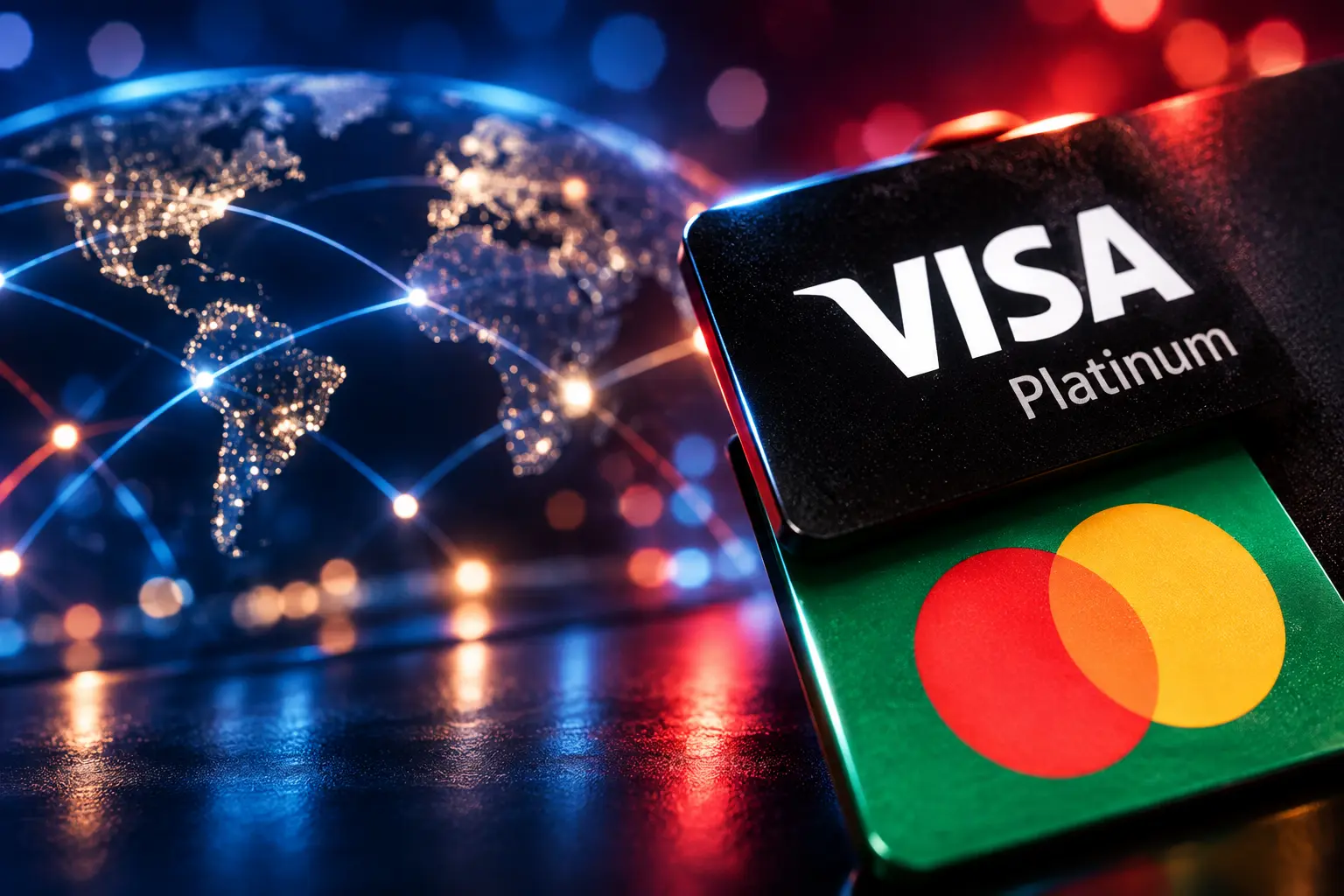
Visa, Mastercard and Ant Will Share Agent IDs
On September 9, Ant International, Mastercard and Visa said they had begun work on a Know-Your-Agent interoperability framework so card networks, wallets, agent platforms and marketplaces can onboard and identify agents under shared principles, while each network keeps its own approval and risk checks. The companies cited a McKinsey projection that AI agents could steer $3 trillion to $5 trillion of global consumer commerce by 2030.
Each already had a private passport. Visa has Trusted Agent Protocol. Mastercard has Verifiable Intent. Ant International has Agentic Mobile Protocol, which it has described as built for wallets, banking apps, super apps and wearables. A walled ID is worthless if the same agent cannot hop from a card rail to a wallet rail without a second inquest. Jiang-Ming Yang, Ant International’s chief innovation officer, put the practical pitch in one line: if an agent registers with Ant, it should not have to register again with Visa or Mastercard.
WHAT THE KYA PACT CENTERS ON
- Operator traceability: Each agent is linked to a validated operator, cardholder, or business so activity can be attributed.
- Shared certification: Each agent is assessed against security and behavioral requirements before it is treated as trusted.
- Continuous monitoring: Identity and transaction signals keep feeding a live judgment of whether the agent still deserves that trust.
The work is meant to run through BuildFin.ai, a platform convened by the Monetary Authority of Singapore, and to draw on Singapore’s Safeguards for Agentic Finance at Runtime project. Ant International said Alipay+ connects 150 million merchants to more than 50 wallets and banking apps, reaching 2 billion user accounts. That wallet base is why a card-only ID would leave a hole.
Interoperability across Know-Your-Agent frameworks is essential to making agentic commerce work at scale, giving merchants, platforms, wallets and issuers a consistent way to recognise trusted agents, verify that actions reflect the user’s intent, and preserve accountability across the transaction.
Pablo Fourez, Chief Digital Officer, Mastercard, in the September 9 announcement
Rubail Birwadker, Visa’s global head of growth products and strategic partnerships, said collaborations like this can create more consistency, better accountability and greater confidence as AI-driven transactions become more common. The three networks are not merging. They are agreeing that the scarce asset is a recognized agent identity, not another checkout button.
The Same June Day Produced Two Playbooks
June 10, 2026, already showed how that identity gets productized. Visa used its Payments Forum in San Francisco to bolt new tools onto Visa Intelligent Commerce, the platform it says gives agents the trust, controls and connectivity to discover, start and finish transactions. Mastercard, the same day, launched a sibling service for software that pays other software.
WHAT JUNE 10 PUT ON THE TABLE
| Move | Visa Intelligent Commerce | Mastercard Agent Pay for Machines |
|---|---|---|
| Who the buyer is | A verified agent acting for a cardholder, listed in an Agentic Directory of agents and merchants Visa has checked | A credentialed agent or machine, recognized with Verifiable Intent across ecosystems |
| Merchant tool | Agent Score, built with New Generation, grades whether a website can be navigated and completed by an agent | Permissioning rules and spending limits enforced in software, plus settlement across cards, accounts and stablecoins |
| AI-lab tie | A stated OpenAI partnership to put Visa credentials inside OpenAI agentic commerce | More than 30 first partners, including Adyen, Ant International, Checkout.com, Cloudflare, Coinbase and Stripe |
| Money behind the agent | Richer tokens that carry type, location and payer signals, plus a token assurance score; about $7 billion in annualized stablecoin settlement as of March 2026 | High-frequency, low-latency, low-value payments, some described as fractions of a cent, running in the background |
Jack Forestell, Visa’s chief product and strategy officer, said AI is transforming the front end of commerce and stablecoins are reshaping the back end, and that Visa’s job is to make both work securely at global scale. He also showed a command-line proof of concept so agents can pay for digital services in a terminal with tokenized Visa credentials. Visa said it has more than 160 stablecoin-linked card programs live or in development.
Mastercard’s consumer Agent Pay program dates to 2025. Agent Pay for Machines is the extra pipe: always-on, programmatic payments between systems, with credentialing, permissioning, transacting and guaranteed settlement. Jorn Lambert, Mastercard’s chief product officer, said those flows can run at very high volumes, very small values, very fast and at extremely low latency. In the company’s own example, a florist’s agent could buy a domain, hosting, images and checkout pages inside a budget, and a logistics agent could pay freight, a loading bay, cold-chain data and warehouse fees as a shipment moves.
That is a different business from a person tapping a phone at a grocery lock screen. Networks collect on volume. A chain of tiny machine payments is more swipes, not fewer. The grocery agent still needs a human who will let it loose.
The Checkout Spec Is Not the Payment Spec
Above the card rails sits a pile of commerce protocols that do not replace Know-Your-Agent, and do not agree with each other. OpenAI and Stripe maintain the Agentic Commerce Protocol, the open spec behind Instant Checkout in ChatGPT. Stripe issues a Shared Payment Token scoped to a merchant and a cart total so the agent never sees the raw card. Google and Shopify have pushed Universal Commerce Protocol for catalogs, carts and checkout on Google’s AI surfaces. Those specs tell an agent how to shop. They do not, on their own, tell a bank which bot is on the line.
On April 28, 2026, Google said it was donating the Agent Payments Protocol to the FIDO Alliance, the passkey group, and shipping AP2 v0.2 with “Human Not Present” payments. Those are charges an agent can fire from pre-authorized instructions, the kind of flow that buys a limited ticket the second it goes on sale. Mastercard’s Verifiable Intent, built with Google, went to FIDO in the same packet as a tamper-resistant log of what the user allowed. FIDO’s payments working group is chaired by members from Mastercard and Visa. The authorization evidence and the network ID are being standardized in one room, even as checkout specs keep multiplying in others.
Chat checkouts still need a last human yes. Meta’s Muse agent, rolled out to U.S. adults in September, can walk a checkout and then pay through Stripe’s Link after it shows the total for approval. Stripe’s own product lead, Jeff Weinstein, said the same Link agent wallet is the tech behind Muse, Instinct and Grok Bot, and that builders can add it in one shot.
To: weekend agent builders
Ready to add agentic payments to your application?
If yes, you can integrate Stripe’s @link agent wallet in one-shot. (It’s the same tech that powers Muse, Instinct, Grok Bot, and many more coming soon…)
And, it’s free.
— Jeff Weinstein (@jeff_weinstein) September 12, 2026
A token bound to a named agent is what turns that tap into something an issuer can underwrite. The network can see which agent paid, the merchant can see a listed participant, and the bank can match the charge to limits the cardholder set. If the cardholder later says they never approved it, there is a record that it was that agent, inside those rails. Without that record, the bot is just hostile traffic with a stolen-looking credential.
Issuers Already Sell Spend Limits and Tokens
Tim Joslyn, chief technology officer at Paymentology, has said the rails are not the hard part. In his telling, probably 99% of issuer processing systems in the world could process an agentic payment. The issue is whether the issuer recognized it as an agent payment and wrapped identity and trust around it. He has also said Alipay’s delegated AI purchasing had surpassed 100 million users, which is actual authority to spend, not a chatbot with a product carousel.
The April tracker already showed issuers shopping for the two features agents need. Nearly 46% said they picked their main issuer processor because it offered tokenization. Roughly 35% cited spend controls. Those are the switches that let a household agent reorder detergent under $40 and refuse a discretionary buy above a set line, or block a subscription that fails a rule. The payment credential becomes a policy file, not only a 16-digit number.
WHAT ISSUERS CAN ENFORCE TODAY
- Tokens, not PANs: Network tokens already hide the real card from the merchant; Visa is adding type, location, payer and an assurance signal so issuers can score an agent charge.
- Spend boxes: Amount caps, merchant locks, category blocks and time windows are ordinary issuer-processor tools, now aimed at software instead of a teenager’s first card.
- Stablecoin side door: Visa’s about $7 billion annualized on-chain settlement run rate as of March 2026, and Mastercard’s multi-rail AP4M design, give agents a second way to move value when a card fee or a cut-off time gets in the way.
- Human-not-present mandates: AP2’s signed instructions are the legal-looking wrapper issuers will want before they treat a no-phone-in-hand charge as authorized.
Processors that only authorize and clear, with no agent flag and no policy engine, still move the money. They do not own the interface between a person’s rules and a machine’s cart. That interface is where Visa, Mastercard and Ant just sat down together.
Who Pays When the Agent Buys the Wrong Thing?
Varon’s respondents kept asking who is held responsible if the AI’s actions go badly. They expected the answer engine, the AI platform, to own the mistake. They also wanted spending limits, a chance to approve purchases, a log of what the agent did and why, and someone who picks up the phone when it goes wrong. They did not believe, she wrote, that anyone in the stack would actually protect them.
Public network materials still do not spell out new dispute codes or a settled split of liability for agent-initiated buys. That gap is the open bill. A charge that looks like a card-on-file recurring debit is easy to route through today’s chargeback mill. A Human Not Present ticket grab that the cardholder later calls a hallucination is not.
WHAT WE KNOW
- The last yes: New shopping agents from large consumer platforms still present a total and wait for a person before Link or a card token fires.
- The blame instinct: Forrester’s shoppers assign the error to the AI company, not the retailer and not the issuer.
- The ID bet: Visa, Mastercard and Ant are building operator traceability so a later dispute can name the agent, the operator and the mandate.
WHAT IS UNCONFIRMED
- Network rules: No published agent-specific dispute code, reason code or chargeback timetable from the card brands.
- Who refunds first: Whether the AI platform, the merchant, the issuer or the network eats a bad autonomous buy is still a contract fight, not a standard.
- Human Not Present standing: Whether a pre-authorized AP2 mandate will be treated like a cardholder-present approval when the goods are wrong.
Until those items have numbers and rulebook pages, issuers will keep asking for an approve tap on anything that is not soap and batteries. That is not a product delay. It is the product.
The Approval Tap Is the New Checkout
Cart abandonment, conversion rate and the whole craft of squeezing a human through a shipping form lose their meaning if the cart is assembled by software. Merchants who still polish a human checkout page are optimizing a room the grocery agent may never enter. They keep the order only if they publish a machine-readable catalog, pass an Agent Score, sit in an Agentic Directory and accept a token that names the bot. The losers are the vendors who sold that old funnel, and the AI surfaces that wanted to be the wallet without becoming a regulated identity.
The winners are narrower than the $3 trillion to $5 trillion slide implies. Visa, Mastercard and Ant do not need shoppers to love ChatGPT with a card on file. They need shoppers to trust a payment brand enough to let a named, certified, monitored agent spend inside a box the issuer already knows how to build. 23% trust generative AI with the charge. 61% say they would trust Visa. That spread is the business.
June’s tools and September’s ID pact are how the networks plan to sit in that spread. The grocery agent can wait in the cart. The tap that releases it is still a person’s, and the passport it carries will be theirs.

Instagram Plus Tests a Read-Only Mode That Cuts Stories

Altman Asks the Public to Accept Some AI Harm

Google Freezes OSS VRP Product Reports After AI Flood

AI Agents Make Payment Rails the Scarce Prize

Turkey’s Crypto Boom Now Runs Through Three Banks

Fable 5 Came Back Under a Commerce On-Off Switch

Google’s SpaceX GPU Lease Has a Sept. 30 Deadline

Plasma One’s XPL Locks Face a 1.81 Billion Cliff

DGO’s Rs 549 World Cup Pass Cost Fans Sleep and Data

Moonshot AI’s $30 Billion Ask Became a $35 Billion Close
-
 AI4 months ago
Fable 5 Came Back Under a Commerce On-Off Switch
-
 AI5 months ago
Google’s SpaceX GPU Lease Has a Sept. 30 Deadline
-
 CRYPTO4 months ago
Plasma One’s XPL Locks Face a 1.81 Billion Cliff
-
 APPS5 months ago
DGO’s Rs 549 World Cup Pass Cost Fans Sleep and Data
-
 AI5 months ago
Moonshot AI’s $30 Billion Ask Became a $35 Billion Close
-

 NEWS5 months ago
ColorOS 17 Device List Spans Oppo, OnePlus and Realme
-

 GAMING4 months ago
The RTX 4050 Under Rs 70,000 Hides a Wattage Gap
-

 AI4 months ago
Boris Cherny’s Loops Still Demand a Higher Production Bar