
GADGETS
Android Hardware Week Shows the Niche Device Era Arriving

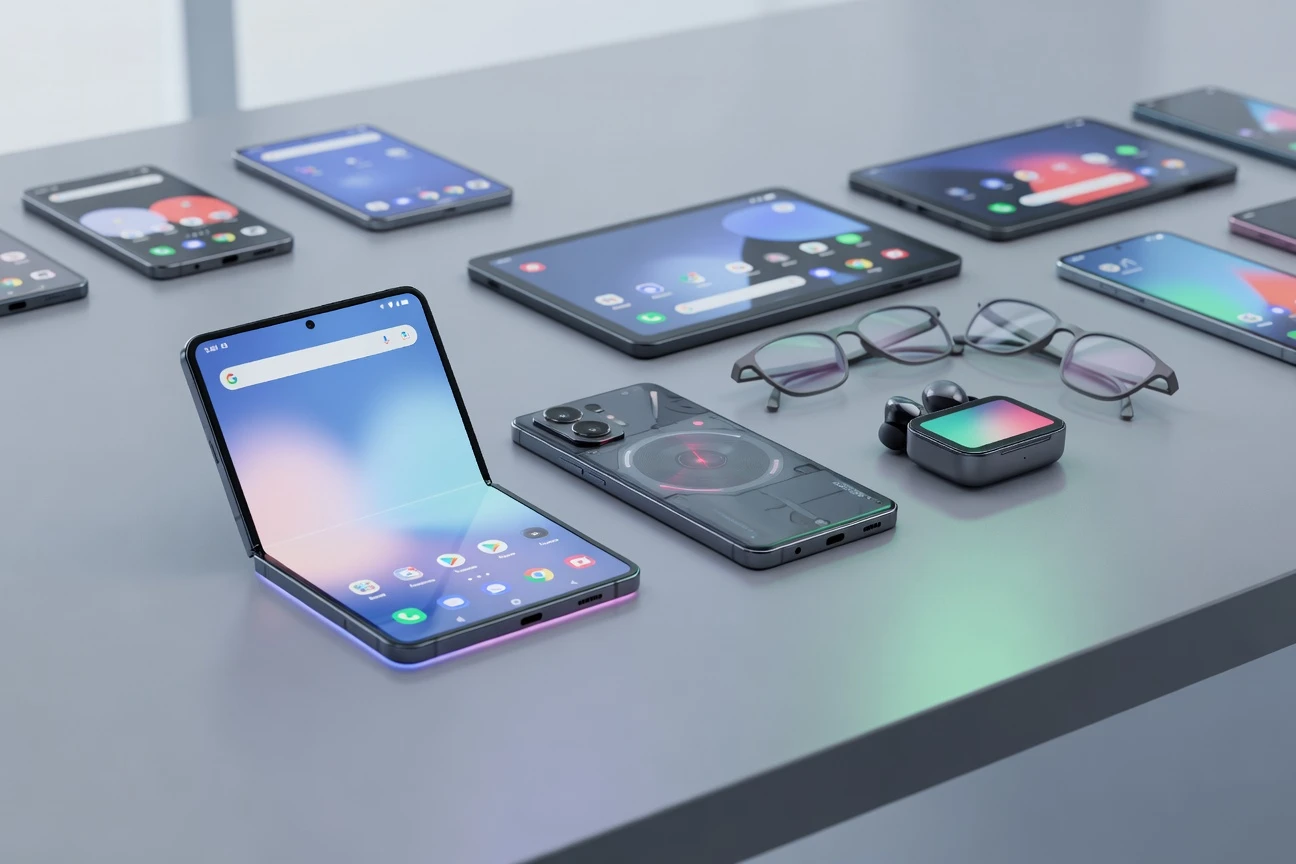
Android hardware week made the market’s split plain: Samsung kept privacy hardware on its slab flagship while Fold 8 reports point to restraint, Google and Samsung pushed Gemini into glasses, Anker put artificial intelligence (AI) in earbuds, REDMAGIC sold cooling as a feature, and Walmart held the budget tablet line at $97. For buyers, the signal is simple: the Android shelf is becoming a set of specialized tools for privacy, gaming, calls, health and cheap shared screens.
That makes this a mixed week. The wins are concrete, but the shelf gets messier when the strongest answer may be on your face, in your ear, on a family tablet or in a phone with a fan.
Android Hardware Split Into Specific Jobs
The connective tissue is hardware specialization. Samsung’s Galaxy S26 Ultra Privacy Display guide says the feature is integrated into the display hardware and changes how pixels send light, so the screen stays clear head-on while limiting side viewing. That is a narrow job, but it is a valuable one in trains, offices and airport lounges.
The same week brought devices that make narrower promises. The result is less tidy than the old flagship ladder, where every premium Android phone tried to win the same camera, chip and battery contest. Now privacy became a hardware lane, and so did voice calls, eyewear, fan cooling and cheap household screens.
| Lane | Device Or Move | Hardware Choice | Job It Claims |
|---|---|---|---|
| Privacy flagship | Galaxy S26 Ultra | Built-in privacy display layer | Hide sensitive screen content in public |
| AI eyewear | Samsung and Google Intelligent Eyewear | Gemini voice access in glasses | Handle navigation, messages and translation hands-free |
| AI audio | soundcore Liberty 5 Pro Max | Thus AI chip and 10-sensor call system | Clean up calls and capture meeting notes |
| Gaming phone | REDMAGIC 11S Pro | Snapdragon 8 Elite Gen 5 Leading Version with active cooling | Sustain game performance under heat |
| Budget tablet | Walmart onn tablets | Low-cost Android screens | Give families cheap shared devices |
Seen together, the week reads like a product map rather than a spec race. The phone remains central, but more tasks now have a better place to live.
Samsung’s Foldable Restraint Carries the Warning
The Fold 8 part of the week needs a caveat: Samsung has not announced the device, and current reports could change before launch. Still, the claim that the next book-style foldable may skip the privacy layer matters because it follows a pattern Samsung shoppers know well.
Foldables already carry more mechanical burden than slab phones. They need thin glass, hinge control, crease management, battery room and display durability in a body people still expect to pocket. Adding another screen layer is never free. If Samsung leaves the S26 Ultra’s privacy trick off a future foldable, the choice would say less about indifference to privacy and more about the physics of stacked compromises.
The leaked Galaxy Z Fold 8 Wide front design matters here because Samsung appears to be testing form as much as feature count. A wider foldable can make video, reading and typing feel less cramped, but it also changes weight balance and panel stress.
The same logic appeared in Oton Technology’s Galaxy Z Flip 8 and Flip 7 price comparison: once foldables mature, shoppers punish missing conveniences more than they reward another fast chip. That is the pressure Samsung is walking into.
AI Moved to Faces and Ears
Samsung and Google made the clearest confirmed AI move with the Intelligent Eyewear first look. The companies showed two premium styles created with Gentle Monster and Warby Parker, with first collections scheduled for this fall in select markets. The pitch is practical: ask Gemini for directions, summaries, calendar help, translation or a photo without pulling out a phone.
Intelligent eyewear represents a powerful step forward in our shared vision with Samsung to make AI more helpful and accessible in everyday life
Shahram Izadi, vice president and general manager of Android XR at Google, said that in Samsung’s May 19 press release. The line matters because it puts Google’s assistant work into a daily object instead of another phone app.
Anker’s contribution is smaller but more intimate. The soundcore Liberty 5 Pro Series page says the Liberty 5 Pro Max uses the Thus AI chip, 10 sensors and an AI note-taker in the case. It also claims 150 times the AI computing power for Environmental Noise Cancellation (ENC, call processing that cuts background noise) compared with its previous flagship earbuds.
The common bet is that AI moved closer to the senses. A phone sees only when it is raised; glasses can see what the wearer sees, and earbuds hear the call while the phone stays in a pocket.
Gaming Phones Turned Heat Into the Spec
REDMAGIC’s gaming pitch is blunt. The REDMAGIC 11S Pro launch page lists Qualcomm Snapdragon 8 Elite Gen 5 Leading Version, RedCore R4, Energy Cube 3.0, upgraded AquaCore liquid cooling, Liquid Metal 3.0, a larger vapor chamber and a 24,000 revolutions per minute (RPM, fan speed) turbo fan. It also lists a 7,500 milliamp-hour battery with 80W wired and wireless fast charging.
That is not a subtle phone. It is the Android gaming niche saying the quiet part out loud: peak silicon needs thermal hardware if the buyer wants long sessions, not just strong benchmark bursts. The rumored OnePlus Ace direction, with fan-cooled performance chatter still waiting on official confirmation, points at the same buyer psychology.
- heat is now a feature when a brand can show active cooling and sustained frame rates.
- Battery size has become part of gaming credibility because high refresh displays and flagship chips drain fast under load.
- Display speed needs game support, so a fast panel alone cannot promise a better match.
The loser in this lane is the do-it-all flagship. A thin glass sandwich with broad camera appeal can be the better daily phone, but it cannot easily look like the better gaming machine beside a device built around airflow.
Walmart Kept the Cheap Tablet Door Open
Walmart’s Android news sits at the other end of the shelf. On the company’s own onn Android tablet listings, new Core models appear at prices far below premium tablets: a 7-inch Core at $97, an 8-inch Core at $138 and an 11-inch Core at $167.
- $97 – Walmart’s listed price for the 7-inch onn Core Tablet.
- $138 – Walmart’s listed price for the 8-inch onn Core Tablet.
- $167 – Walmart’s listed price for the 11-inch onn Core Tablet.
The pitch is household utility: a kitchen recipe screen, a kid’s video device, a travel display, a smart-home controller or a couch browser that nobody worries about like an expensive iPad. Cheap Android tablets have always lived in that lane, but Walmart’s prices keep it alive in a week otherwise dominated by AI and premium components.
That matters for Android as a platform. Google and Samsung can push AI into eyewear, but the user base also grows through devices that cost less than a pair of high-end earbuds. Walmart’s onn line is not glamorous. It keeps Android present in the rooms where a flagship phone would be too personal, too fragile or too expensive to share.
The risk is support. Budget tablets age fast when updates slow or storage fills. A low price opens the door; software maintenance decides whether people come back for the next one.
Google Health Made the Widget Make Sense
A home-screen health widget has value only if the app behind it is becoming central. Google’s new Google Health app announcement says the Fitbit app is becoming Google Health, with an automatic rollout beginning May 19 and no separate app download needed for existing users.
The redesign gives Google four tabs: Today, Fitness, Sleep and Health. It also brings Google Health Coach, built with Gemini, into workout planning, sleep consistency and health summaries. That makes the widget in this week’s Android chatter more than a shortcut. It is a small front door into Google’s attempt to gather wearables, apps, medical records and coaching into one place.
Google also included the careful part. The company says Fitbit health and wellness data will not be used for Google Ads, and its footnotes say Google Health is not intended to diagnose, treat, cure, prevent or monitor disease. That language is not decoration. When AI moves into health, trust becomes as important as the interface.
The New Android Shelf Has Fewer Universal Answers
The buying question is becoming sharper. Someone who wants privacy on a train may look at Samsung’s slab flagship. Someone who wants phone-free prompts may wait for the eyewear launch. Someone who games hard may accept a fan. Someone who needs a family tablet may buy the cheapest onn model and ignore the rest of the week’s premium noise.
For Samsung, the risk is that foldable fans read restraint as stagnation. For Google and Samsung eyewear, the risk is comfort, battery life and data trust. For Anker, the challenge is proving that AI call processing and note-taking feel useful after the novelty fades. For Walmart, the test is whether cheap Android tablets age well enough to avoid becoming disposable screens.
If the fall eyewear launch arrives with normal-looking frames, useful battery life and careful data controls, Android gains a daily surface that does not need a hand. If it feels awkward or costly, this week still showed where the category is headed: sell the job first, then choose the shape.


South Korea Retail Investors Face Reckoning After KOSPI AI Rally Collapses

Surrey AI Maps Three Heart Attack Paths and Their Molecular Roots

Germany Locks Neutral Apple ATT Prompts Across Most of Europe

Apple’s 5% EU Fee Quietly Rewrites Alternative App Store Math

Apple’s EU Fee Truce Cuts Complexity but Leaves Rivals Fuming

Pixel 11 Pro Fold Trades Thinness for Durability and Seven-Year Stay

Mayo AI Flags HCM Obstruction From Everyday Ultrasound Videos

Indian Brands Quietly Scale Landmark Screens and Home Tech

Navin Vatsa Turns Grief Into a Lifetime of Quiet Seeing

Google Bets Pixel 11 Agentic AI Will Redefine Phones

Oracle Cuts 21,000 Jobs in a Year, Cites AI in 10-K Filing

Fable 5 and Mythos 5 Return as US Lifts Anthropic Export Controls

SpaceX’s Google Deal Turns a Rocket Company Into a Cloud Landlord

CD Projekt Red Co-CEO: Redemption Arc Isn’t Done, Witcher 4 in 2027

XPL Rallies 30% Ahead of Plasma One Card Tier Launch

Google Search Profiles Build a Follow Graph Inside Discover

DGO App Brings Rs 549 Mobile Pass for FIFA World Cup 2026 in Nepal

Moonshot AI Targets $30 Billion in China’s Fastest AI Funding Sprint

Oppo’s ColorOS 17 Eligibility List Leaves A-Series Buyers Behind

Microsoft Xbox Layoffs Start in July as Sharma Slams 3% Margin
-
 AI2 months ago
Oracle Cuts 21,000 Jobs in a Year, Cites AI in 10-K Filing
-
 AI2 months ago
Fable 5 and Mythos 5 Return as US Lifts Anthropic Export Controls
-
 AI3 months ago
SpaceX’s Google Deal Turns a Rocket Company Into a Cloud Landlord
-
 GAMING2 months ago
CD Projekt Red Co-CEO: Redemption Arc Isn’t Done, Witcher 4 in 2027
-
 CRYPTO3 months ago
XPL Rallies 30% Ahead of Plasma One Card Tier Launch
-
 NEWS3 months ago
Google Search Profiles Build a Follow Graph Inside Discover
-
 APPS3 months ago
DGO App Brings Rs 549 Mobile Pass for FIFA World Cup 2026 in Nepal
-
 AI3 months ago
Moonshot AI Targets $30 Billion in China’s Fastest AI Funding Sprint