
CRYPTO
SpaceX Pre-IPO Perp Traders Are Underwater While Exchanges Cash In
SpaceX shares have fallen to about $153 from a $225 peak, leaving crypto traders who paid a premium on pre-IPO perpetual futures underwater.

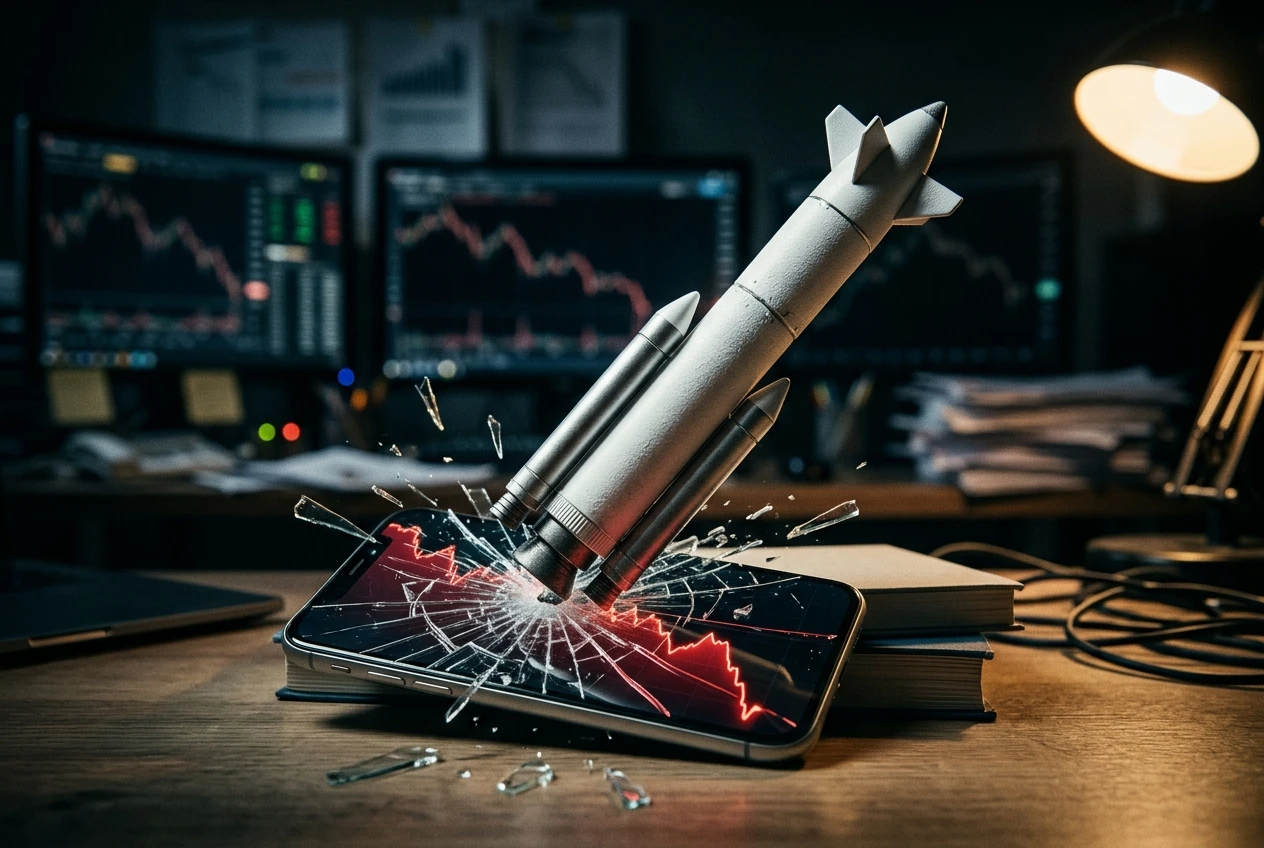
SpaceX shares have slid more than 30% from their June intraday peak of $225.64. They now trade around $153, above the fixed $135 IPO price but well below what many traders paid for exposure through pre-IPO perpetual futures before the rocket company ever reached Nasdaq.
Crypto exchanges built a multibillion-dollar market on that exposure weeks before a single share traded in public. Binance, Coinbase and Hyperliquid collected fees no matter which way the bet went. The traders who chased the richest premium in May and early June did not fare nearly as well.
Perps Priced the Pop Before Nasdaq Ever Opened
Pre-IPO perpetual futures, known in crypto slang as “perps,” create a synthetic, around-the-clock market for a private company’s expected valuation long before it lists. They carry no expiration date, and holders get no shares, no votes and no dividends, just a cash-settled bet on where the price is headed.
The mechanism had already proven itself once. When chipmaker Cerebras Systems went public, Hyperliquid’s pre-IPO perp had priced the stock within 1.3% of its opening trade, a credible dry run for the much bigger test to come.
SpaceX’s version of that market went live on Hyperliquid on May 18 under the ticker xyz:SPCX. It opened hot: prices clustered between $180 and $200, implying a valuation near $2.5 trillion against the $135 IPO reference. By June 8, the number had cooled into the $160 to $170 range as the actual listing approached.
Two days before the debut, the contract was pricing SpaceX around $162, about 20% above the fixed $135 offer price, down sharply from levels above $220 hit in the days right after its May launch.
“Perpetuals on Hyperliquid suggest there’s interest in the SpaceX IPO, but it’s far from euphoric,” said Eric Chen, cofounder and chief executive of the decentralized finance infrastructure firm Injective Labs. “These markets are dominated by very active, risk-tolerant traders, and they aren’t pricing in a massive premium versus other pre-IPO names.”
Binance and Hyperliquid Win No Matter Which Way SPCX Trades
Coinbase opened its own SpaceX pre-IPO perp on June 4, calling it the first entry in a planned pipeline covering artificial intelligence, energy and space.
“Access to high-conviction, non-correlated exposure has never been more valuable to traders,” said Liz Martin, Coinbase’s head of derivatives.
The timing was no accident. Bitcoin was sitting roughly 50% below its October 2025 peak near $126,000, dragged down by tighter Fed policy and ETF outflows, and had slid to about $61,340 the same week Coinbase launched its contract. A product line that did not depend on spot crypto prices gave the exchange somewhere else to earn fees.
Across eight exchanges, SpaceX pre-IPO perps logged about $3.2 billion in trading volume and $390 million in open interest between May 17 and June 10, according to data provider Talos. Binance alone said its contract saw $2.1 billion in volume in 18 days.
“This is obviously aimed at a crypto-native, crypto-friendly audience that are looking to obtain high-leverage bets on specific market movements,” said Philippe Noeltner, a lawyer at the firm A&O Shearman, who called the volumes “mind-boggling.”
Then SpaceX actually listed, and volume exploded. Binance processed more than $5.7 billion in trades on its contract on June 12 alone, the day of the debut, making it the exchange’s second most traded product behind Bitcoin. Binance said the pair went on to capture over 60% market share across CEX and DEX venues, with more than $9 billion in accumulated volume across the pre-IPO and post-listing phases.
Hyperliquid’s contract generated between $1.3 billion and $1.4 billion on listing day, its second busiest market that day behind Bitcoin. Within about a week it had grown into Hyperliquid’s single biggest market, accounting for roughly 30% of all trading volume on the exchange. MEXC, another venue chasing the trade, said its own contract accumulated $7.13 billion in volume within two weeks of listing, with open interest up more than 2,600% from launch.
| Exchange | Pre-IPO Highlight | Post-Listing Highlight |
|---|---|---|
| Binance | Only venue to successfully rebase its contract after SpaceX disclosed a higher share count | $190.59 million in open interest as of June 15, the most of any venue tracked |
| Hyperliquid | SPCX ran under the HIP-3 framework across two builders, Trade.xyz and Ventuals, each with different pricing rules | Stock-linked perps broadly logged $18.8 billion in volume on the exchange in the first half of June |
| MEXC | Launchpad subscriptions drew more than 74,000 participants, with one pool oversubscribed 30 times | Weekly active futures traders climbed as much as 806% after listing |
| Coinbase | Structured as USDC-settled contracts with no fixed expiry | Auto-converts into a standard SpaceX perp at IPO, no rollover required |
Traders Who Paid the Premium Are Underwater
The math is simple and unforgiving. Anyone who paid the $180 to $220 premium that prevailed through most of May and early June is now sitting on a loss, even though the stock still trades above its fixed $135 offering price.
Institutional investors with guaranteed IPO allocations had no reason to pay $180 on a crypto exchange for exposure to a $135 stock. The buyers were overwhelmingly retail, concentrated in regions where ordinary access to US IPOs barely exists.
This pre-IPO perpetual isn’t really anchored towards anything other than speculation. The pre-IPO thing is, alongside prediction markets, a good example of where the world is heading… it’s like the hyper-gambler-isation of everything.
Laurens Fraussen, an analyst at the crypto data firm Kaiko, said that as SpaceX’s IPO approached.
Some found out the hard way before the listing even happened. On May 28, a Ventuals-run contract on Hyperliquid crashed 45% in a matter of hours, sliding from a valuation-implied price near $2,200 to about $1,200 and liquidating more than $1.5 million in leveraged positions. Thin liquidity turned a modest wave of selling into forced liquidations.
Nobody outside the exchanges can say for certain who absorbed those losses. Coinbase and Binance have declined to disclose how many users traded the contracts, and Talos has said the data does not exist to work it out. “It’s also very difficult to know who’s active in these markets, whether it’s your retail trader punting £10 or a proprietary trading desk of a hedge fund taking a position,” Noeltner said. “It’s better not to assume that these are only retail traders.”
Tokenized SpaceX Shares Collapsed Where Perps Held
Perps were not the only crypto product chasing SpaceX. Several exchanges also tried to sell tokenized SpaceX shares, structured to mimic real ownership through a platform called xStocks. That version of the trade failed.
Binance, Bybit and Bitget Wallet all canceled planned distributions of tokenized SpaceX shares after xStocks could not secure enough underlying stock to meet customer demand, forcing the exchanges to refund users. Kraken, which had acquired xStocks, said it received only a partial allocation.
“It’s an unfortunate lesson learned for those who expected an allocation,” said Christopher Perkins, chief executive of 250 Digital Asset Management. “But, across crypto, pre-IPO perps once again demonstrated their utility as an important tool for early market access and price discovery.”
Adam McCarthy, head of research at the London-based crypto trading firm LO:TECH, was less impressed by the perps’ predictive power. “These pre-IPO perps do give an excellent real-time sentiment and 24/7 price discovery for names like SPCX, or Cerebras last month, but they’re not reliable predictors of listing prices or thereafter,” he said.
The split outcome made one thing clear: pricing a stock turned out to be far easier for crypto exchanges than actually delivering ownership of one.
Is SpaceX’s Trillion-Dollar Valuation Justified?
Wall Street is split. CFRA rates the stock a sell with a $115 target, implying nearly 29% downside from its first-day close. Morningstar puts fair value at $63, less than half the IPO price. NewStreet Research, more bullish, sees $165 and argues the payoff plays out over 20 to 25 years, not next quarter.
CFRA initiated coverage the day SpaceX listed, citing the company’s “extremely ambitious growth strategy, elevated valuation expectations, and significant capital intensity.”
- CFRA – sell rating, $115 price target, nearly 29% below the stock’s first-day close, citing an “extremely ambitious growth strategy” and heavy capital spending
- Morningstar’s Nicolas Owens – fair value estimate of $63 a share, less than half the fixed IPO price
- NewStreet Research’s James Ratzer – $165 price target, arguing the stock needs a 20 to 25 year horizon to justify today’s price
The average Wall Street target sits closer to $164 by one tally, roughly where NewStreet lands and far above Morningstar’s number.
Independent research firm futuresearch.ai puts the gap in starker terms. Its sum-of-the-parts model, adding up Starlink, xAI and Starship as if each were standalone, arrives at a fair value of about $1.25 trillion, which is roughly half the stock’s June market price. The same firm called SpaceX’s day-one close within a few dollars back in April, for what that track record is worth.
That June peak briefly did something rarer still. It pushed SpaceX’s market capitalization past Amazon and Microsoft, if only for a matter of days.
The underlying business gives both camps ammunition. Starlink generated $11.4 billion in 2025 revenue, up about 50% from the year before, and remains the profitable core funding SpaceX’s rocket and AI ambitions. The company as a whole still posted a GAAP net loss of nearly $5 billion for the year, and its AI division alone burned through $7.72 billion in the first quarter of 2026.
CME’s Duffy Calls Perps a ‘Disaster Waiting to Happen’
The CFTC approved the first US-regulated perpetual futures contracts, offered by Coinbase and Kalshi, on May 29. Wall Street’s incumbents did not take it well.
Terry Duffy, chief executive of CME Group, called the products “a disaster waiting to happen” days later. He warned that automatic liquidation systems and hidden funding rate costs could blindside retail traders who do not fully understand how the contracts work.
Shares of exchange operators felt it fast. Cboe Global Markets fell 9%, and CME Group and Intercontinental Exchange each dropped roughly 4% in the days after the approval, on fears the contracts would eventually spread from crypto into equities.
The World Federation of Exchanges, an industry body representing stock exchanges globally, told Reuters that buyers might assume they are getting the guardrails of a listed product without knowing how robust the pricing really is. “These are fundamental principles and we will work this issue into our dialogue with regulators,” a spokesperson said.
Better Markets, a Washington nonprofit that pushes for tighter financial oversight, went further, warning that perpetual futures carry more risk than the leveraged single-stock ETFs the SEC capped at 2x leverage four years ago. The group says the products offer leverage far beyond that 2x ceiling with none of the added disclosure it says retail traders need.
Even Coinbase’s own risk notice reads like a caution sign. The exchange warns of increased liquidation risk and lists several ways the product differs from an ordinary perpetual contract.
- Valuation-based pricing – before listing, the contract tracks a modeled private-market valuation instead of a transparent, exchange-quoted share price
- IPO conversion risk – the exact share count and offer price are only locked in when the final prospectus is filed, which can trigger sudden repricing
- Thin liquidity – fewer buyers and sellers than a listed stock, which can widen swings in both directions
- Elevated liquidation risk – leverage that cuts losses as fast as it can amplify gains
Regulators have not settled how to classify contracts like these, and CME has since taken the fight to court, suing the CFTC over the approval and citing competitive injury, according to one industry account.
OpenAI and Anthropic Are Next in Line
SpaceX was always meant to be the opening act. Coinbase has said OpenAI and Anthropic are next in its pre-IPO perp pipeline, alongside thematic index contracts like AI10 and Tech100 that already trade on its regulated futures exchange.
OpenAI is preparing to file confidentially for its own IPO, and Anthropic is weighing a public debut as soon as October. OpenAI last raised money at an $852 billion valuation, while Anthropic has gone from a $380 billion mark earlier this year to talks for a round above $900 billion. Worries about a delayed OpenAI listing have already dragged down AI-linked crypto tokens tied to that pipeline.
SpaceX, meanwhile, still has to clear its own calendar. Insiders can sell up to 20% of their stakes starting in late July, with further staggered releases through the fall. The big one lands December 8, when the 180-day lockup expires and the tradable float jumps roughly fourteenfold, from about 4% of shares to as much as 58%. Elon Musk’s own roughly 42% stake stays locked until June 2027.
Frequently Asked Questions
What happens to a SpaceX pre-IPO perp position once the stock lists?
The contract does not need to be closed or rolled over. Coinbase rebases open positions through a profit-and-loss neutral, stock-split-like adjustment that converts the valuation-based contract into a standard per-share SpaceX perpetual future once the final offer price and share count are disclosed, typically at the prospectus filing stage.
Can traders in the United States buy SpaceX pre-IPO perpetual futures?
No. Coinbase and Binance restrict the product to users outside the United States. American investors’ realistic options are buying SPCX directly through a normal brokerage now that it trades on Nasdaq, or using accredited-investor platforms like Forge Global or EquityZen to buy private shares before a listing.
How much leverage do SpaceX pre-IPO perps allow?
Coinbase caps leverage on its SpaceX contract at 5x, according to the Wall Street Journal, far below the up to 100-to-1 leverage available on some standard crypto perpetual contracts. Other exchanges set similar caps between 3x and 5x for pre-IPO products specifically.
How accurate was the pre-IPO perp price compared with SpaceX’s actual Nasdaq debut?
It tightened as the listing approached. Bid-ask spreads on Cerebras’ pre-IPO perp, an earlier test case, started near 50% at launch and narrowed to 0.26% the day before that company’s IPO, then to 0.07% once Nasdaq supplied a live reference price, a pattern SpaceX’s contract broadly followed.
Are pre-IPO perpetual futures regulated like ordinary stock trades?
Not in the same way. The contracts trade on offshore crypto venues without the disclosure rules that govern listed shares, and US regulators have not finished deciding how to classify them. The SEC and CFTC opened a joint public comment process in June to work out how swaps, security-based swaps and novel contracts like these should be defined.
Disclaimer: This article is for informational purposes only and does not constitute investment, financial or trading advice. Pre-IPO perpetual futures and other leveraged crypto derivatives carry a high risk of loss and are not available to US persons on most offshore platforms. Figures in this piece are accurate as of publication and may have changed. Consult a licensed financial professional before making investment decisions.


South Korea Retail Investors Face Reckoning After KOSPI AI Rally Collapses

Surrey AI Maps Three Heart Attack Paths and Their Molecular Roots

Germany Locks Neutral Apple ATT Prompts Across Most of Europe

Apple’s 5% EU Fee Quietly Rewrites Alternative App Store Math

Apple’s EU Fee Truce Cuts Complexity but Leaves Rivals Fuming

Pixel 11 Pro Fold Trades Thinness for Durability and Seven-Year Stay

Mayo AI Flags HCM Obstruction From Everyday Ultrasound Videos

Indian Brands Quietly Scale Landmark Screens and Home Tech

Navin Vatsa Turns Grief Into a Lifetime of Quiet Seeing

Google Bets Pixel 11 Agentic AI Will Redefine Phones

Oracle Cuts 21,000 Jobs in a Year, Cites AI in 10-K Filing

Fable 5 and Mythos 5 Return as US Lifts Anthropic Export Controls

SpaceX’s Google Deal Turns a Rocket Company Into a Cloud Landlord

CD Projekt Red Co-CEO: Redemption Arc Isn’t Done, Witcher 4 in 2027

XPL Rallies 30% Ahead of Plasma One Card Tier Launch

Google Search Profiles Build a Follow Graph Inside Discover

DGO App Brings Rs 549 Mobile Pass for FIFA World Cup 2026 in Nepal

Moonshot AI Targets $30 Billion in China’s Fastest AI Funding Sprint

Oppo’s ColorOS 17 Eligibility List Leaves A-Series Buyers Behind

Microsoft Xbox Layoffs Start in July as Sharma Slams 3% Margin
-
 AI2 months ago
Oracle Cuts 21,000 Jobs in a Year, Cites AI in 10-K Filing
-
 AI2 months ago
Fable 5 and Mythos 5 Return as US Lifts Anthropic Export Controls
-
 AI3 months ago
SpaceX’s Google Deal Turns a Rocket Company Into a Cloud Landlord
-
 GAMING2 months ago
CD Projekt Red Co-CEO: Redemption Arc Isn’t Done, Witcher 4 in 2027
-
 CRYPTO3 months ago
XPL Rallies 30% Ahead of Plasma One Card Tier Launch
-
 NEWS3 months ago
Google Search Profiles Build a Follow Graph Inside Discover
-
 APPS3 months ago
DGO App Brings Rs 549 Mobile Pass for FIFA World Cup 2026 in Nepal
-
 AI3 months ago
Moonshot AI Targets $30 Billion in China’s Fastest AI Funding Sprint