
GADGETS
Garmin Varia RTL515 in 2026: Still the Radar to Beat
Garmin’s Varia RTL515 launched in May 2020 and now sits below the Varia RearVue 820. Here’s what it still does, what shows its age, and what a July 2026 buyer pays.

The Garmin Varia RTL515 shipped to stores in mid-2020 and is, as of mid-2026, the discounted radar on Garmin’s cycling accessories page rather than a discontinued curiosity. Launched May 13, 2020, from Garmin International, a unit of Garmin Ltd. (NASDAQ: GRMN), the RTL515 paired a 140-meter rear radar to a 1-mile daylight-visible tail light and ran for up to 16 hours on a single day-flash charge. Six years later, Garmin has followed it with the Varia RearVue 820, leaving the RTL515 as the legacy option in many retailer listings. What the device promises, and where that promise is starting to fray in 2026, is the story of a still-useful product with one stubborn design choice that has aged badly and one ecosystem dependency that is easy to miss at the checkout counter.
What the Varia RTL515 Is, Six Years In
The Varia RTL515 is a rearview radar combined with a tail light for road and commuting cyclists. According to the official Varia RTL515 product page, the unit detects vehicles approaching from behind up to 153 yards (140 meters) and provides visual and audible alerts on a paired Edge cycling computer, compatible smartphone, select Garmin smartwatch, or Garmin’s optional radar display unit. The 140-meter figure is what Garmin prints on the spec sheet; real-world performance is shaped by terrain, which the next section walks through.
The unit pairs over ANT+ and Bluetooth Smart, mounts to most seatposts via Garmin’s quarter-turn system, and ships with rubber shims for round, D-shaped, and aero posts. Daylight visibility is listed at up to 1 mile (1.61 km), with output up to 65 lumens in day flash and 20 lumens in solid mode. Battery life runs up to 16 hours in day flash, up to 6 hours in solid mode, and up to 8 hours in peloton mode, the low-intensity flash designed to be tolerable to riders drafting in a group. A multi-tone audio alert and a vertical bar of colored dots on the paired display indicate passing vehicles, with green for clear, amber for a vehicle approaching, and red for a faster-closing threat.
Even with the February 2026 release of the Varia RearVue 820, Garmin’s 2020 release keeps showing up in retailer catalogs at $199.99 and as the smaller sibling of the newer flag-ship. DCRainmaker’s 2026 review of the 820 frames the older unit as “the existing $199…though really $149 most of the time.” Six years on, the RTL515’s feature set is still coherent; the question is which parts of it have aged past the rest of the cycling tech stack.
What 140 Meters of Detection Looks Like on Real Roads
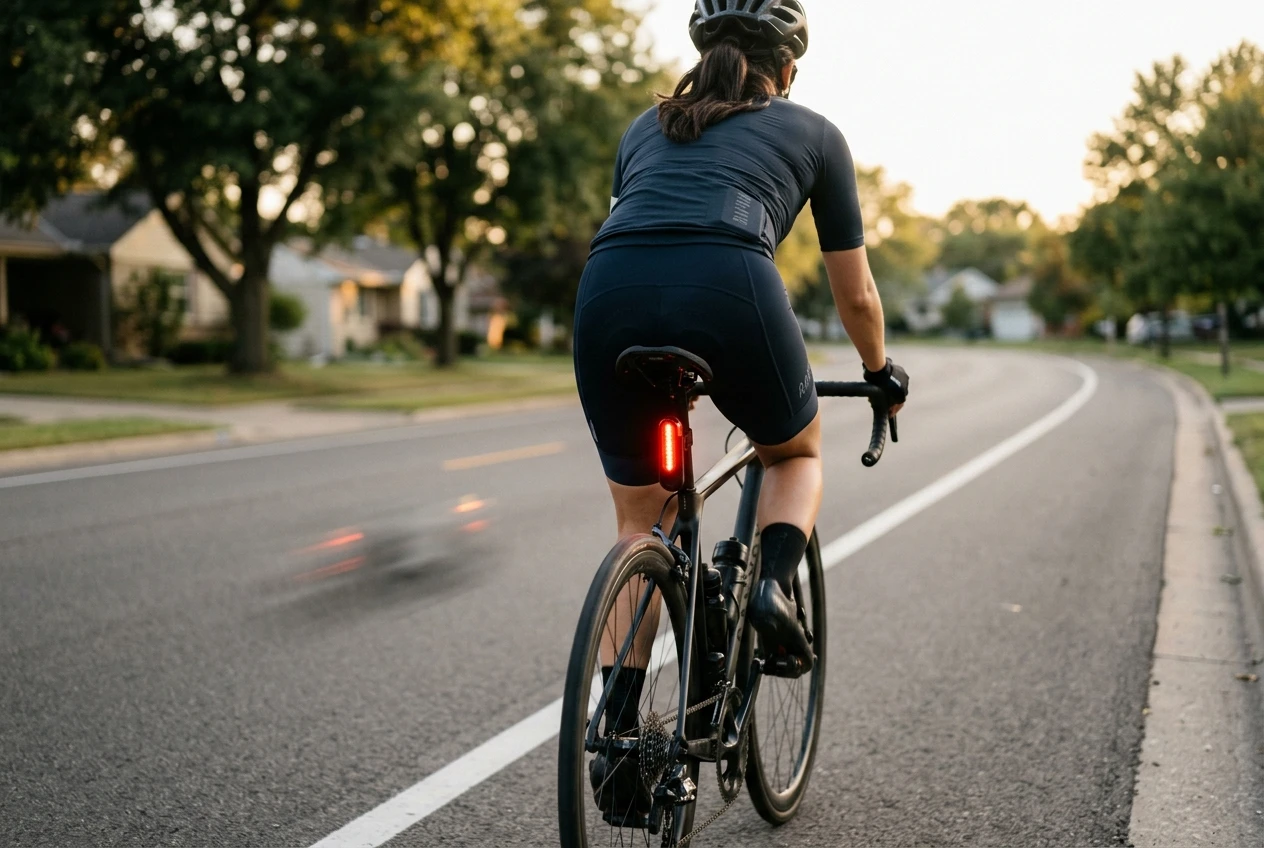
Garmin’s published detection range is 140 meters, or 153 yards, which holds up on open suburban roads and starts to compress in tighter terrain. In the in-depth hands-on review of the RTL515 from 2020, DCRainmaker tested the radar for a month of riding and found the 140-meter figure achievable on clear sight lines. Trees, walls, and sharp bends clipped usable range, sometimes cutting the alert off until the approaching object was already close enough to be heard unaided. The lesson was not that the radar over-promises; it was that its working envelope is the open road, not the urban canyon.
On a paired display, the radar shows a vertical strip of color along one edge of the screen. Each detected object appears as a dot that climbs toward a rider icon as it closes in. The display tints the strip amber for normal approach speeds and red for faster-closing threats. Multi-tone audio cues can be set to play escalating tones as a vehicle approaches; users who prefer a single tone can pick one in sensor settings. The audio profile is the same surface used by most bike computer brands via the open ANT+ radar standard.
What the radar picks up is anything that closes on the rider at a different speed: cars, trucks, mopeds, other bicycles, the occasional train. On the 515, that resolution is relative-velocity only; the newer 820 added vehicle-class and lane detection, which the 515 does not. For the most common case, a single car approaching at highway speed, the 515 still does the job Garmin built it for in 2020.
Our previous generation rearview radar with tail light quickly became a staple for cyclists around the world, providing peace of mind during any ride, day or night.
That line came from Dan Bartel, Garmin vice president of worldwide sales, on May 13, 2020, the day Garmin International announced the RTL515 alongside the smaller, light-free RVR315. The phrase “staple for cyclists around the world” was the framing Garmin chose at launch and the framing that still sells the RTL515 five years and one successor later.
The Micro-USB Problem No Review Bothered Naming Until 2026
When the RTL515 launched in May 2020, micro-USB charging was the rule, not the exception. By 2024, micro-USB was the holdout. By 2026, it is the rare device in a rider’s bag that still uses the older connector, which is the framing Velo’s February 2026 coverage of the Varia RearVue 820 launch opened with, calling the prior port “outdated” and noting that the move to USB-C alone would have made the older competitive. The RTL515 never got that port change, and the discrepancy between the bike computer on the bars (USB-C by 2026) and the radar on the seatpost (still micro-USB) is the gap most 2026 buyers will feel on a trip.
Garmin did not stand still on the rest of the cycling stack. Edge bike computers and Garmin’s smartwatch line moved through micro-USB to USB-C and onward to magnetic or solar charging on newer models. The RTL515 stayed at the original port while everything around it got modern, which leaves the radar as the cable a rider packs “just in case.”
That is an inconvenience, not a dealbreaker.
The unit charges from any standard USB power source, including a phone charger, a USB battery pack, or a car adapter. Any micro-USB cable on hand will refill the RTL515 overnight. The inconvenience is the extra cable in the bag and the inability to share one cable across a 2026 bike computer plus the rear light.
The minimum a 2026 buyer should know before adding an RTL515 to the kit: pack a micro-USB cable with intention, not by accident. The dependency does not break the device, but it is the one design choice that has visibly aged past the rest of Garmin’s cycling stack, which is the framing Velo used to introduce the 820.
- 153 yards of maximum rear detection range.
- 16 hours of battery in day flash mode.
- 6 hours of battery in solid mode.
- Up to 1 mile of daylight visibility.
- 65 lumens output in day flash.
Where the RTL515 Sits in Garmin’s 2026 Lineup
The RTL515 is still listed at the original $199.99 US MSRP in many bike-shop catalogs and is widely sold at discounts in the $149 neighborhood. Jenson USA, Bike Line, Proteus Bicycles, and Farina’s all carry the unit at $199.99 with periodic in-store promotion. DCRainmaker’s February 2026 review of the 820 called the RTL515 “the existing $199…though really $149 most of the time,” reflecting the typical street price in the months after the 820 shipped.
Above the RTL515 sits the new Varia RearVue 820, priced at $299.99 and shipping from February 6, 2026 per DCRainmaker’s hands-on. The 820 moves to USB-C charging, raises day flash battery life to 24 hours, stretches rear detection to 170 m, and adds same-speed vehicle tracking, vehicle-class detection (car, truck, bike), and customizable flash patterns via the Varia app. Garmin’s May 13, 2020 press release at Garmin’s May 13, 2020 launch announcement for the RTL515 set the original $199.99 US MSRP and the 16-hour / 6-hour battery figures that the 820 now improves on directly.
Below both sits the Varia RVR315, the radar-only sibling that has no tail light and was introduced at the same May 2020 press event. The three units now straddle Garmin’s cyclist radar line: the RVR315 for riders who want alerts without a light, the RTL515 for riders balancing price and feature, and the 820 for riders who want every improvement six years can buy. The choice between the two cycling-and-radar units turns on $100 of budget and a willingness to carry a micro-USB cable.
| Spec | Varia RTL515 | Varia RearVue 820 |
|---|---|---|
| Detection range | 140 m (153 yd) | 170 m |
| Day flash battery | up to 16 hours | up to 24 hours |
| Solid mode battery | up to 6 hours | up to 10 hours |
| Daylight visibility | up to 1 mile (1.61 km) | up to 1.24 miles (2 km) |
| Day flash output | 65 lumens | 100 lumens |
| Charging port | Micro-USB | USB-C |
| US launch price | $199.99 | $299.99 |
| Launch year | May 2020 | February 6, 2026 |
The Ecosystem Lock-In Hiding Behind a $199 Discount
The RTL515 on its own is a tail light that flashes red, and not much more. The radar piece is invisible until the unit is paired to a head device: an Edge cycling computer, a compatible Garmin smartwatch, the optional RDU display, or a phone running Garmin’s Varia app. Garmin’s UK May 13, 2020 press release explicitly lists each of those pairing options as the surface on which “visible and audible alerts” appear. The cheapest path to value from an RTL515 in 2026 is a phone running the free Varia app over Bluetooth, which is how a budget buyer can extract real value without buying an Edge head unit.
That’s the entry, and the move Garmin designed for back in 2020. The consequential piece is what happens next, which is the second-order cost the 2026 hands-on review of the Varia RearVue 820 flagged without saying it plainly: Garmin’s 2026 radar features, including multi-lane vehicle tracking and the new same-speed alerts, are surfacing on the newest Edge computers first. A 2026 buyer pairing the RTL515 to a phone is on the slow path to missing out, and on the fast path to the next purchase. The 2020 DCRainmaker review of the RTL515 noted that the unit broadcasts as both an ANT+ Radar sensor and an ANT+ Bicycle Light sensor, which is the architecture Garmin designed to keep that dependency in place: once a rider has one Garmin display in their cycling life, the next sensor is much easier to justify. A bike computer in the family tends to come with one already.
Frequently Asked Questions
Is the Garmin Varia RTL515 still worth buying in 2026?
Yes if the budget is the deciding constraint and the rider can accept a micro-USB cable in the bag. DCRainmaker’s February 2026 review framed the 515 as the device a buyer is “really $149 most of the time,” against the 820’s $299.99 launch price. For riders on a tighter budget who just need reliable rear detection, the 515 still does the job it was built for in 2020.
How far does the RTL515 radar actually detect vehicles?
Garmin’s spec lists detection up to 153 yards (140 meters), the same figure that appears on the official product page at garmin.com. DCRainmaker’s 2020 month-long test of the unit confirmed that figure on clear sight lines and noted that trees, walls, and sharp bends compress the working range.
Does the Varia RTL515 work without an Edge bike computer?
Yes. The RTL515 pairs over Bluetooth Smart with a phone running Garmin’s Varia app, over ANT+ with compatible Edge cycling computers, with select Garmin smartwatches, and with Garmin’s optional RDU display. The free Varia app on a phone gives the cheapest entry into the RTL515’s alerts.
How long does the RTL515 battery actually last?
Up to 16 hours in day flash mode, up to 8 hours in peloton mode, and up to 6 hours in solid or night-flash mode, per Garmin’s May 13, 2020 launch announcement. Real-world runtime depends on mode mix, with day flash delivering the longest of the four factory modes.
What is the difference between the RTL515 and the new Varia RearVue 820?
The 820 moves to USB-C charging, raises day flash battery life to 24 hours, stretches rear detection to 170 m, and adds same-speed vehicle tracking, customizable flash patterns, and vehicle-class detection. Garmin priced the 820 at $299.99 on February 6, 2026, which is $100 above the RTL515’s still-current $199.99 US MSRP.

Instagram Plus Tests a Read-Only Mode That Cuts Stories

Altman Asks the Public to Accept Some AI Harm

Google Freezes OSS VRP Product Reports After AI Flood

AI Agents Make Payment Rails the Scarce Prize

Turkey’s Crypto Boom Now Runs Through Three Banks

Fable 5 Came Back Under a Commerce On-Off Switch

Google’s SpaceX GPU Lease Has a Sept. 30 Deadline

Plasma One’s XPL Locks Face a 1.81 Billion Cliff

DGO’s Rs 549 World Cup Pass Cost Fans Sleep and Data

Moonshot AI’s $30 Billion Ask Became a $35 Billion Close
-
 AI4 months ago
Fable 5 Came Back Under a Commerce On-Off Switch
-
 AI5 months ago
Google’s SpaceX GPU Lease Has a Sept. 30 Deadline
-
 CRYPTO5 months ago
Plasma One’s XPL Locks Face a 1.81 Billion Cliff
-
 APPS5 months ago
DGO’s Rs 549 World Cup Pass Cost Fans Sleep and Data
-
 AI5 months ago
Moonshot AI’s $30 Billion Ask Became a $35 Billion Close
-
 NEWS5 months ago
ColorOS 17 Device List Spans Oppo, OnePlus and Realme
-

 GAMING4 months ago
The RTX 4050 Under Rs 70,000 Hides a Wattage Gap
-

 AI4 months ago
Boris Cherny’s Loops Still Demand a Higher Production Bar