
CRYPTO
XRP Tests $1 Support a Year After Ripple’s SEC Victory
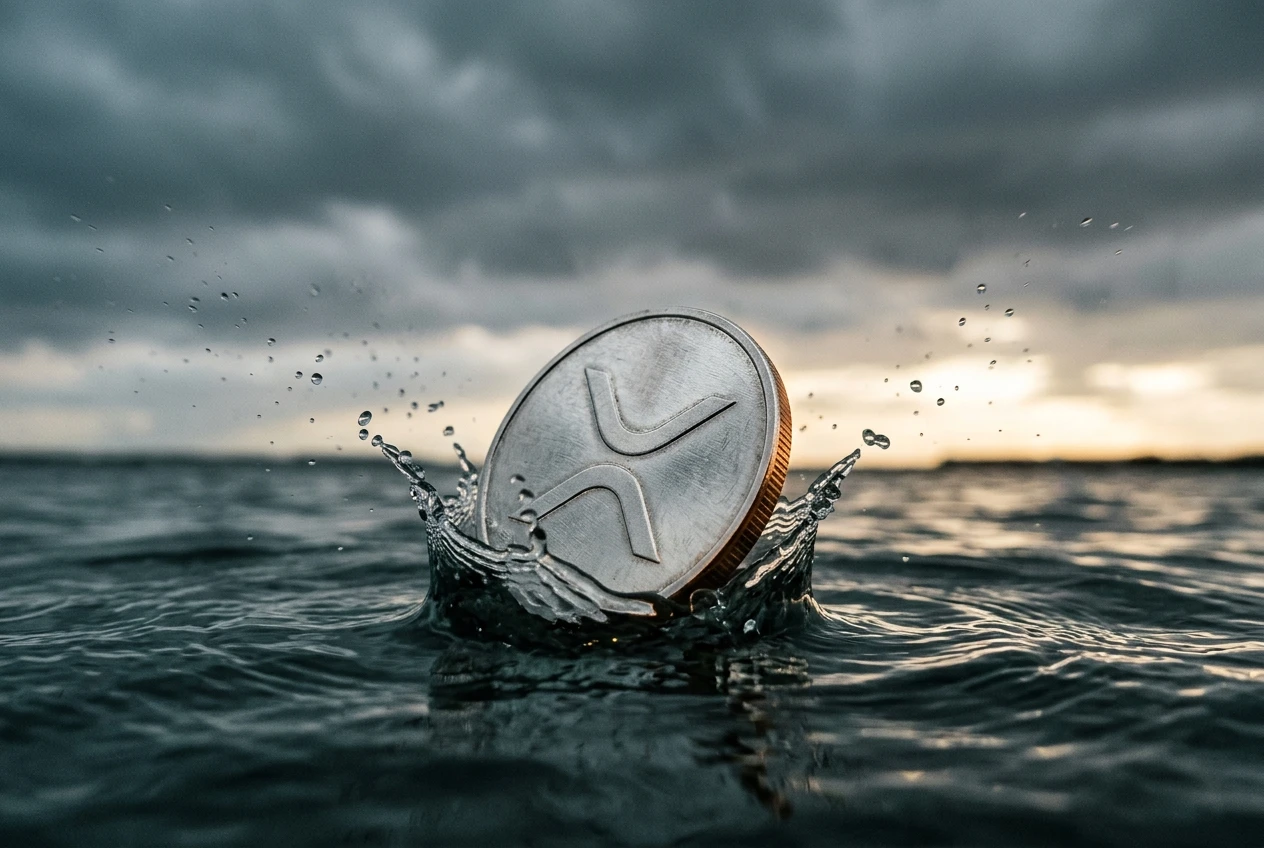
XRP is extending a fourth day of losses below $1.10, with ETF inflows drying up and Ripple’s SEC settlement no longer providing a floor for the price.

XRP fell for a fourth straight session on Tuesday, changing hands near $1.07 and sitting below every major moving average that traders track. It has not closed above $1.16 in a week.
The drop comes three years after a federal judge ruled XRP is not a security, and fourteen months after Ripple’s fight with the US Securities and Exchange Commission (SEC) formally ended. Days ago, Ripple chief executive Brad Garlinghouse revealed how close the company once came to dissolving itself rather than ever fighting that case in court.
Four Days Lower and Counting
XRP’s chart has a shape technical traders recognize. The token is trading inside a descending channel on the four-hour timeframe, where every bounce has failed before clearing the last one.
The Relative Strength Index (RSI), a momentum gauge that flags overbought or oversold conditions, sits near 39. That is below the neutral 50 mark, and it points to sellers still setting the pace.
XRP remains the sixth-largest cryptocurrency by market value, with a market capitalization near $66.6 billion. That is down from the levels it held a week earlier, when it traded above $1.16.
The token is also stuck below its 50-day, 100-day and 200-day exponential moving averages (EMAs), the trend lines traders watch most closely.
| Level | Price | Signal |
|---|---|---|
| 200-day EMA | $1.47 | Highest of the three moving averages overhead |
| 100-day EMA | $1.26 | Middle resistance level |
| 50-day EMA | $1.16 | Level bulls need to reclaim and hold |
| Immediate resistance | $1.12 | First test on any bounce attempt |
| Initial support | $1.04 | Floor buyers are defending now |
| Channel floor | $0.78 | Next stop if $1.04 gives way |
As long as XRP trades under those three moving averages, any rally looks like a bounce inside a downtrend. A close back above $1.16, and a hold there, would be the first sign that has changed.
Garlinghouse’s Confession from Kansas
Speaking at the University of Kansas School of Business in a KU Hustle podcast interview published July 8, Garlinghouse said he and Ripple co-founder Chris Larsen discussed dissolving the company entirely after the SEC sued in December 2020.
Facing a regulator he described as having near-limitless resources, the two considered distributing Ripple’s large XRP reserve to shareholders and walking away from the business altogether.
You guys think these are securities. Ripple doesn’t own it anymore. Ripple’s gone now.
That is how Garlinghouse described the pitch he imagined making to regulators, recalling the logic that made shutting down tempting in 2020.
David Schwartz, Ripple’s chief technology officer emeritus, said afterward on social media that the dissolution talk was a scenario the company weighed and rejected. It never came close to actually happening, he said.
Garlinghouse said the company chose to fight because closing would have cost hundreds of employees their jobs. “I’m glad in retrospect, but that was not obvious at the time,” he said.
Why Did Ripple Almost Shut Down?
Ripple weighed shutting down in 2020 because the SEC lawsuit threatened the company’s survival, and dissolving looked like the fastest way to end an uneven fight. Ripple fought instead, a decision that cost $150 million in legal fees, froze its US business for roughly five years, and only fully resolved in 2025.
The SEC’s December 2020 complaint accused Ripple of selling $1.3 billion of XRP as an unregistered security. Exchanges suspended or delisted the token within days, and its price crashed roughly 60% in a week.
Garlinghouse has said he met SEC officials four times between 2017 and 2019 to explain how Ripple used XRP, and that regulators never signaled the token could be treated as a security. The agency sued anyway, naming Garlinghouse and Larsen personally alongside the company.
- $150 million in legal fees Ripple spent fighting the case over four years
- $125 million civil penalty the company ultimately paid, far below the $2 billion the SEC originally sought
- 60% the approximate drop in XRP’s price during the week the lawsuit was filed
- Five years that Ripple’s US business stayed largely frozen while the case dragged on
US District Judge Analisa Torres delivered the turning point in July 2023, ruling that XRP sold on public exchanges was not a security, though certain institutional sales were treated differently. When the SEC and Ripple reached a settlement in May 2025, Commissioner Caroline Crenshaw publicly warned the deal would effectively vacate the court’s own decision, an unusual dissent from inside the regulator. Both sides dropped their remaining appeals anyway, and the Second Circuit formally closed the case on August 22, 2025.
ETF Demand Slows to a Trickle
Spot XRP exchange-traded funds (ETFs) recorded no inflow at all on Monday, following a modest $107,000 inflow the previous Friday. Cumulative net inflows since the funds launched in November 2025 have still climbed to roughly $1.48 billion.
That figure covers total contributions since launch. Combined assets under management across the XRP ETFs recently sat closer to $690 million, a smaller number that reflects how much XRP’s own price has fallen since much of that capital arrived.
The three largest funds, run by Bitwise, Canary and Franklin Templeton, hold roughly $245 million, $226 million and $168 million respectively. Individual investors have supplied most of that money, analysts tracking the flows say. Large institutional buyers have been harder to find.
Data tracked on SoSoValue’s dashboard show XRP funds stringing together cumulative net inflows near $1.49 billion during a multi-week streak of positive flows earlier this summer. That pace has since cooled to the single-day trickles and zero prints seen this week.
The Utility Debate Won’t Die
With the SEC fight resolved, XRP’s case for higher prices rests more than ever on whether banks and payment firms actually need the token. That question resurfaced hard last year and has not gone away.
Finance YouTuber Andrei Jikh, who has more than 2.5 million subscribers, pressed the point in a viral thread, asking why the XRP Ledger still was not carrying billions of dollars in daily onchain volume after 13 years. David Schwartz responded publicly and acknowledged the sluggish pace of onchain adoption, pointing to regulatory and compliance concerns that still limit how banks use the public ledger.
Schwartz argued XRP still works as a neutral bridge currency in a world with multiple competing stablecoins. Matt Hamilton, a former Ripple director, pushed back in the same thread, saying most of Ripple’s bank partnerships run through RippleNet, a separate off-chain network distinct from the public XRP Ledger.
- Onchain analyst Ali Martinez found XRP transactions above $1 million fell from about 70 in a week to just two in a single recent day.
- The CLARITY Act’s Senate floor vote, once expected this month, has no new date after clearing the Senate Banking Committee.
- Standard Chartered cut its long-term XRP price target from $8 to $2.80, citing slowing ETF demand.
- XRP’s Relative Strength Index remains stuck near 39, short of the 50 mark that would signal balanced buying and selling.
Ripple’s custody and payment infrastructure still supports more than $3.5 billion in tokenized real-world assets on the XRP Ledger. Roughly 30 of the banks moving onto SWIFT’s new retail payments framework already use Ripple’s On-Demand Liquidity rails. That utility has not been enough to move the price this week.
The Path Back to $1.16
A bounce first needs to clear $1.12, the nearest resistance on the four-hour chart. From there, the 50-day EMA at $1.16 is the level that matters most. A close above it, held for more than a day or two, would be the first technical sign the downtrend has turned, opening a path toward the 100-day EMA at $1.26.
The alternative is a break of the $1.04 support that has held so far. If that gives way, the lower boundary of the descending channel sits near $0.78.
Analyst targets for the rest of 2026 span a wide range, from Standard Chartered’s reduced $2.80 to as high as $6.53 among more bullish forecasters. One widely cited long-range model puts a 2030 target as high as $26.97. That spread mostly reflects how much still depends on the CLARITY Act reaching a Senate floor vote.
The bill’s supporters have not set a new date for that vote. Until they do, XRP is left trading on technicals alone.
Frequently Asked Questions
Is XRP Still Legally at Risk From the SEC?
No, the case itself closed on August 22, 2025, after both sides dropped their appeals. A permanent injunction barring direct institutional sales of unregistered XRP in the US remains in force, and the SEC’s original 2020 complaint named Garlinghouse and Larsen personally alongside the company itself. Lawyer John Deaton, who represented XRP holders during the case, said this year the SEC targeted Ripple’s executives individually to pressure a faster settlement.
Who Actually Owns Most of the XRP Supply?
Concentration is high. There are more than 220,000 XRP holders, but the top 10 wallets control over 70% of the circulating supply, and Binance alone custodies more than 30% of it on behalf of its users, according to exchange data.
What Price Levels Matter Most in the Short Term?
Pivot-based models point to a tighter band than the moving averages suggest. Support sits near $1.09, $1.07 and then $1.06; resistance clusters at $1.12, $1.13 and $1.14. A break of either band tends to move first, before the bigger EMA levels come into play.
What Is the CLARITY Act?
It is a Senate bill setting federal market-structure rules for digital assets, seen as XRP’s biggest remaining catalyst now that the SEC case is closed. It passed the Senate Banking Committee, but bettors on Polymarket now price its passage this year at just 43%, down from 74% a month earlier.
Did Big Institutions Abandon XRP?
Some did. Goldman Sachs fully exited a $153.8 million XRP ETF position during the first quarter, according to its 13F filing, and Bloomberg Intelligence estimates retail investors still account for roughly 84% of all cumulative XRP ETF flows. Institutional conviction has been thinner than the headline inflow totals suggest.
Disclaimer: This article is for informational purposes only and does not constitute financial or investment advice. Cryptocurrency prices, including XRP, are highly volatile, and the technical levels and forecasts discussed here can change quickly. Consult a licensed financial advisor before making investment decisions. Figures are accurate as of publication on July 14, 2026.


South Korea Retail Investors Face Reckoning After KOSPI AI Rally Collapses

Surrey AI Maps Three Heart Attack Paths and Their Molecular Roots

Germany Locks Neutral Apple ATT Prompts Across Most of Europe

Apple’s 5% EU Fee Quietly Rewrites Alternative App Store Math

Apple’s EU Fee Truce Cuts Complexity but Leaves Rivals Fuming

Pixel 11 Pro Fold Trades Thinness for Durability and Seven-Year Stay

Mayo AI Flags HCM Obstruction From Everyday Ultrasound Videos

Indian Brands Quietly Scale Landmark Screens and Home Tech

Navin Vatsa Turns Grief Into a Lifetime of Quiet Seeing

Google Bets Pixel 11 Agentic AI Will Redefine Phones

Oracle Cuts 21,000 Jobs in a Year, Cites AI in 10-K Filing

Fable 5 and Mythos 5 Return as US Lifts Anthropic Export Controls

SpaceX’s Google Deal Turns a Rocket Company Into a Cloud Landlord

CD Projekt Red Co-CEO: Redemption Arc Isn’t Done, Witcher 4 in 2027

XPL Rallies 30% Ahead of Plasma One Card Tier Launch

Google Search Profiles Build a Follow Graph Inside Discover

DGO App Brings Rs 549 Mobile Pass for FIFA World Cup 2026 in Nepal

Moonshot AI Targets $30 Billion in China’s Fastest AI Funding Sprint

Oppo’s ColorOS 17 Eligibility List Leaves A-Series Buyers Behind

Microsoft Xbox Layoffs Start in July as Sharma Slams 3% Margin
-
 AI2 months ago
Oracle Cuts 21,000 Jobs in a Year, Cites AI in 10-K Filing
-
 AI2 months ago
Fable 5 and Mythos 5 Return as US Lifts Anthropic Export Controls
-
 AI3 months ago
SpaceX’s Google Deal Turns a Rocket Company Into a Cloud Landlord
-
 GAMING2 months ago
CD Projekt Red Co-CEO: Redemption Arc Isn’t Done, Witcher 4 in 2027
-
 CRYPTO3 months ago
XPL Rallies 30% Ahead of Plasma One Card Tier Launch
-
 NEWS3 months ago
Google Search Profiles Build a Follow Graph Inside Discover
-
 APPS3 months ago
DGO App Brings Rs 549 Mobile Pass for FIFA World Cup 2026 in Nepal
-
 AI3 months ago
Moonshot AI Targets $30 Billion in China’s Fastest AI Funding Sprint