
NEWS
The One UI 9 Sketches Were Samsung’s Wide Fold Bet
One UI 9’s May front sketches of the Wide Fold were the Galaxy Z Fold8, the 4:3 volume Fold Samsung put ahead of Ultra.

One UI 9 hid front sketches of Samsung’s Wide Fold in May, and that phone shipped in July as the Galaxy Z Fold8. The short, wide inner screen in those drawings is now the 7.6-inch 4:3 panel on Samsung’s lightest Fold, on sale in the U.S. since August 7, 2026.
Those files were still moving around as rumor art when Samsung had already given the unadorned Fold8 name to the wide phone and parked the tall book under Ultra. The leak was the bet, printed in software a season early.
Front Sketches Hidden in One UI 9
The Cipher Project, a Telegram leak channel, posted the missing view on May 6, 2026: the Wide Fold from the front, folded and unfolded, in light and dark interface skins. Back-side assets had shown up in One UI 9 a day earlier, and they lined up with CAD drawings already in circulation. The new files were the first clean look at how short and wide the cover and inner panels would be.
February test builds of One UI 9 had already pointed at a landscape-style Fold, including firmware for SM-F971, the model family that later appeared on Samsung’s U.S. buy page as SM-F971U. The May drawings were not a designer’s mood board. They were tutorial and settings art for a device the software already knew how to draw.
FROM FIRMWARE FLAG TO STORE SHELF
- February 2026: One UI 9 test firmware for SM-F971 describes a landscape-style Fold.
- May 6, 2026: The Cipher Project posts front sketches in folded and unfolded states, light and dark.
- July 19, 2026: Ice Universe writes that Wide panel orders have passed both Ultra and Flip.
- July 22, 2026: Galaxy Unpacked in London shows the wide phone as Galaxy Z Fold8.
- August 7, 2026: U.S. retail availability begins, 16 days after the stage reveal.
The naming swap is the tell. Leak notes called the tall book Galaxy Z Fold 8 and the new shape Galaxy Z Fold 8 Wide. On stage, the wide one took the plain Fold8 badge and the tall one became the first Ultra in the Z Fold line.
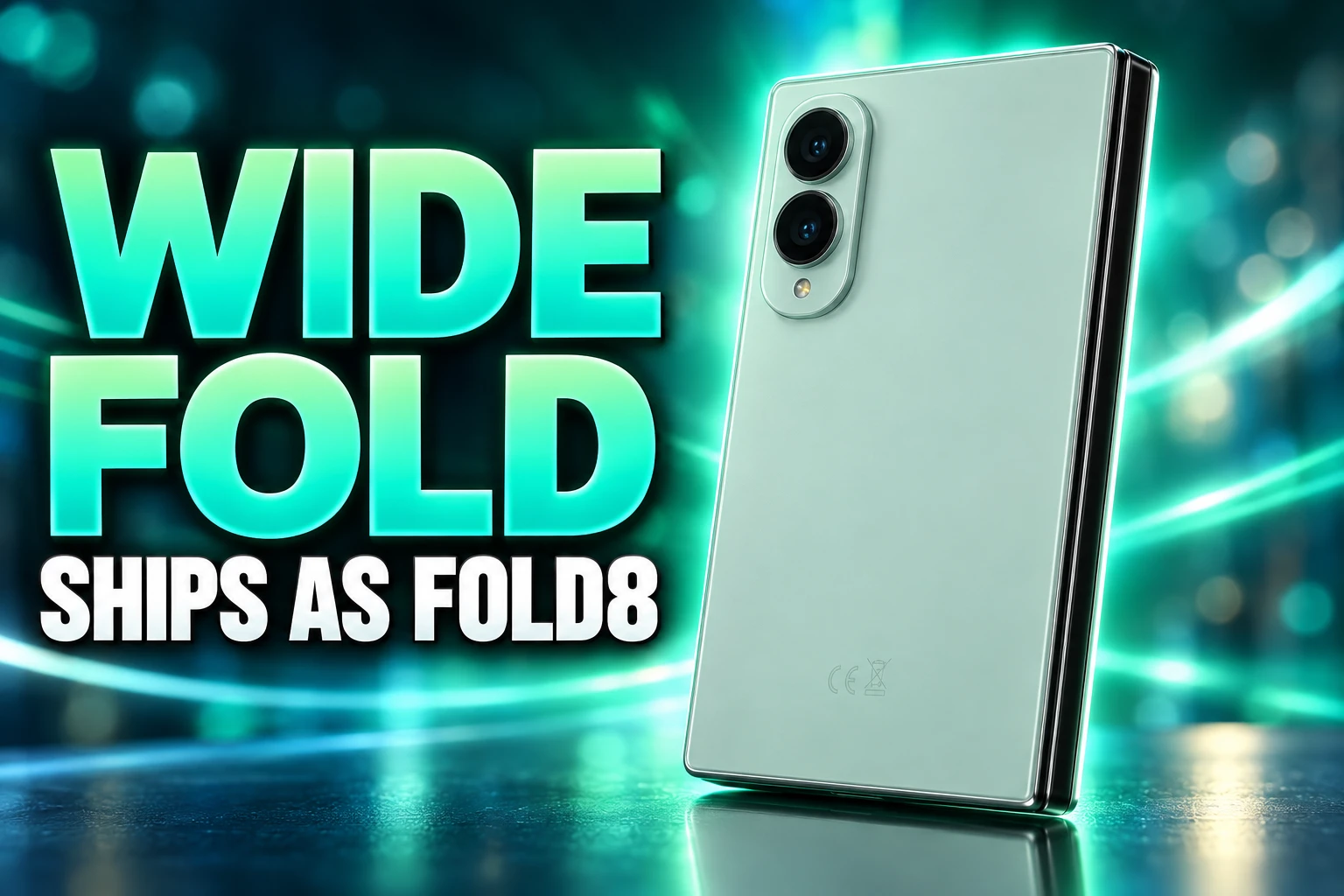
Samsung Built the Phone Around a Four-by-Three Panel
Samsung’s U.S. product page lists a 5.5-inch cover with a 10:16 shape and a 7.6-inch main screen at 4:3. Open it and the inner panel is closer to a small tablet page than to the near-square canvas every Galaxy Fold used since 2019. Turn it 90 degrees and Samsung calls that view 3:4, the orientation it wants for books and the web.
The company put that geometry at the center of the all-new form factor for Galaxy Z Fold8 when it opened Unpacked on July 22, 2026 at Old Billingsgate in London.
Unfolding the device expands the display to a 4:3 aspect ratio, ideal for watching movies or playing games. Rotating the device switches to a 3:4 aspect ratio that feels more natural for reading e-books or browsing the web.
Samsung Newsroom, Galaxy Unpacked July 2026 first look
The cover’s 10:16 ratio is the one you hold closed for messages and short video. Anti-reflection coating and a 3,000-nit peak sit on the inner panel. One UI 9, on Android 17, can run two-way and three-way split view on that 4:3 canvas, which is the software answer to the May hope that this shape would hold more than two apps at once.
How the Wide Fold Differs From Fold8 Ultra
The two Folds share a chip, Snapdragon 8 Elite Gen 5 for Galaxy, and the same One UI 9 launch software. They do not share a job. Fold8 is the short, wide media phone. Fold8 Ultra is the tall book with the bigger inner panel, the 200 MP main camera, and the 10 MP 3x telephoto the wide model never got.
Samsung’s own support sheet is the cleanest Fold8 and Fold8 Ultra spec split, and it matches what those May front files were already implying about size and cameras.
GALAXY Z FOLD8 VS FOLD8 ULTRA
| Spec | Galaxy Z Fold8 | Galaxy Z Fold8 Ultra |
|---|---|---|
| Inner display | 7.6 in, 4:3, 2448 x 1848 | 8.0 in, 2504 x 2256 |
| Cover display | 5.5 in, 10:16, 1972 x 1248 | 6.5 in, 2520 x 1080 |
| Unfolded (H x W x D) | 123.9 x 161.4 x 4.5 mm, 201 g | 143.2 x 158.4 x 4.1 mm, 215 g |
| Folded (H x W x D) | 123.9 x 81.9 x 9.7 mm | 72.8 x 158.4 x 8.9 mm |
| Rear cameras | 50 MP wide, 50 MP ultra wide | 200 MP wide, 50 MP ultra wide, 10 MP 3x |
| Battery (typical) | 4,800 mAh | 5,000 mAh |
Samsung calls Fold8 the lightest Galaxy Z Fold yet at 201 grams, 14 grams under the Ultra. The Ultra is thinner when open, 4.1 mm against 4.5 mm, and thinner when closed, 8.9 mm against 9.7 mm. U.S. launch pricing for Fold8 started at $1,899.99. Storage steps are 256 GB, 512 GB, and 1 TB, with 12 GB or 16 GB of RAM.
A Dual Camera Island, No Telephoto
The May sketches showed two rear lenses, not three, and retail hardware kept that cut. Samsung’s U.S. page sells dual 50 MP wide and ultra-wide cameras on Fold8, with 2x optical-quality zoom from the wide sensor and no dedicated telephoto. Cover and inner selfies are both 10 MP.
That is the camera set of a content phone, not the Ultra kit. Nightography and ProVisual Engine still run on the 50 MP pair, and Dual Recording can put cover and main cameras in a vertical split on either screen. My FanCam, the Galaxy AI trim tool, can recrop a wide clip around one person and spit out a 9:16 share version, which is a software patch for a panel that is still not a 16:9 television.
A 4,800 mAh battery is rated for up to 26 hours of video on the main screen in Samsung’s lab test, with 45W wired charging on a dual-path setup shared with the Ultra. Flex Titanium sits under the inner panel as the crease-control layer. None of that showed in the May line art, but none of it contradicts it either.
2.8 Million Panels Went to the Short Fold
Three days before Unpacked, Ice Universe, the supply-chain analyst, wrote that Samsung had already broken the early plan to build Wide and tall Fold volumes in a 1:1 split for the first three months.
Samsung is betting big on the golden 4:3 aspect ratio and reshaping its Galaxy Z series strategy: planned production of the Wide model has reached 2.8 million units, surpassing both the Ultra and the Flip.
Ice Universe, supply-chain analyst, on X
His note put about 2.8 million units for the Wide model against 2 million for the tall phone that would be renamed Ultra and 1.5 million for Galaxy Z Flip8. That is not a limited run. It is the main Fold build, assigned to the shape One UI 9 had already been drawing from the front.
Samsung sized that canvas for the same wide inner layout Apple was expected to bring later in 2026, then put the unadorned Fold8 name on it so the first device on that geometry would not look like a side SKU. The May leak made the hierarchy public before the invite went out.
Owners Get Thinner Bars, Not a Perfect Picture
Most movies and shows still arrive in 16:9 or wider, so 4:3 does not fill the inner panel edge to edge. It does cut the letterbox compared with the near-square books Samsung shipped through Galaxy Z Fold7. Horizontal video gets a larger picture. Rotate the open phone and vertical clips, web pages, and e-books use the 3:4 view without living in a skinny column.
WHAT THE 4:3 INNER SCREEN CHANGES
- Letterbox: 16:9 video still has bars, but they stay thinner than on a near-square Fold inner screen.
- Three columns: One UI 9’s three-way split can give each app a strip close to a normal phone’s width.
- Closed use: The 5.5-inch 10:16 cover is short enough for one-hand reach and wide enough for feeds that used to look cropped on older Fold covers.
The live complaint after launch is not that ratio. Inner-display corners on some Z Fold8 units still flex under finger pressure, a glue-and-support finish issue that the May sketches never showed and that a 4:3 panel does not cause. One UI 9’s extra tools, Now Nudge among them, also still look unfinished to some Ultra owners who wanted heavier blur and lock-screen options. The shape the firmware leaked is the part that landed as drawn.
Two Wide Follow-Ons Are Already With Suppliers
South Korean industry reporting in August said Samsung had opened two wide-foldable projects for the 2027 Z9 generation and had already briefed suppliers. One of those follow-ons is described as a still-wider inner panel aimed at video, which is an admission that 4:3 is a compromise, not a ceiling.
Fold8 colors are Lavender, Cream, and Graphite, with Pistachio as a Samsung.com exclusive. Pre-orders opened with Unpacked on July 22, 2026. U.S. units started reaching buyers on August 7. The phone that One UI 9 sketched from the front in May is no longer a rumor file. It is the Fold Samsung chose to build in volume, and the next wide boards are already in the chain.
Frequently Asked Questions
What Is the Galaxy Z Fold8 Model Number?
Retail units use the SM-F971 family. Samsung’s U.S. unlocked 256 GB listing is SKU SM-F971ULVAXAA, which matches the SM-F971 firmware that showed up in One UI 9 test builds in February 2026, months before Unpacked.
Does the Galaxy Z Fold8 Include S Pen Support?
No. Samsung’s Fold8 versus Fold8 Ultra comparison lists S Pen as unsupported on both phones, so the wide model did not trade the telephoto for a stylus, and the Ultra did not keep one either.
What Is the Fold8 Rated Battery Versus the 4,800 mAh Typical Figure?
Samsung quotes a typical 4,800 mAh pack and a rated capacity of 4,660 mAh under the IEC 61960 method. Fold8 Ultra is listed at a typical 5,000 mAh and a rated 4,854 mAh on the same scale.
What IP Rating Does the Galaxy Z Fold8 Use?
Both Fold8 and Fold8 Ultra are listed as IP48, which covers protection against solid objects larger than 1 mm and immersion up to 1.5 meters for 30 minutes, not a full dust-tight IP6x rating.
How Large Is the Cover Screen After the Rounded Corners?
Samsung measures the cover as 5.5 inches as a full rectangle and 5.4 inches once rounded corners are subtracted. The 7.6-inch inner panel is listed at 7.6 inches on both the full-rectangle and rounded-corner measures, with the camera hole still eating a bit of the view.

Instagram Plus Tests a Read-Only Mode That Cuts Stories

Altman Asks the Public to Accept Some AI Harm

Google Freezes OSS VRP Product Reports After AI Flood

AI Agents Make Payment Rails the Scarce Prize

Turkey’s Crypto Boom Now Runs Through Three Banks

Fable 5 Came Back Under a Commerce On-Off Switch

Google’s SpaceX GPU Lease Has a Sept. 30 Deadline

Plasma One’s XPL Locks Face a 1.81 Billion Cliff

DGO’s Rs 549 World Cup Pass Cost Fans Sleep and Data

Moonshot AI’s $30 Billion Ask Became a $35 Billion Close
-
 AI4 months ago
Fable 5 Came Back Under a Commerce On-Off Switch
-
 AI4 months ago
Google’s SpaceX GPU Lease Has a Sept. 30 Deadline
-
 CRYPTO4 months ago
Plasma One’s XPL Locks Face a 1.81 Billion Cliff
-
 APPS4 months ago
DGO’s Rs 549 World Cup Pass Cost Fans Sleep and Data
-
 AI4 months ago
Moonshot AI’s $30 Billion Ask Became a $35 Billion Close
-

 NEWS4 months ago
ColorOS 17 Device List Spans Oppo, OnePlus and Realme
-

 GAMING4 months ago
Xbox Cuts 3,200 Jobs After Five Years of Thin Returns
-
 GAMING4 months ago
The RTX 4050 Under Rs 70,000 Hides a Wattage Gap