
AI
Zhongji InnoLight’s $6.8 Billion IPO Funds AI Optics Lead Amid US Risk
Chinese optical leader Zhongji InnoLight raised $6.81 billion in Hong Kong’s biggest IPO since 2019.

Zhongji InnoLight raised HK$53.41 billion ($6.81 billion) in its Hong Kong listing, pricing 54.5 million H shares at HK$980 and becoming the city’s largest IPO since Alibaba’s 2019 secondary offering. Shares began trading July 30 and closed at HK$960, down 2 percent after dipping as low as HK$880, before recovering above the offer price in early August trading.
The Shenzhen-listed optical-transceiver maker is the world’s largest by revenue. The fresh capital arrives just as its US-heavy customer base and a new policy draft collide with the same AI data-centre boom that produced the numbers.
The Deal That Cleared Asia’s Second Spot
The final price sat below the HK$1,010 maximum. Net proceeds came in around HK$52.89 billion after fees. The Hong Kong public tranche drew 16.8 times coverage; the international book was 9.7 times covered. Cornerstone investors included Temasek Holdings, the Abu Dhabi Investment Authority, BlackRock, JPMorgan Asset Management, Alibaba Group and Tencent Holdings.
It ranked as Asia’s second-largest listing of 2026 behind CXMT’s $8.6 billion Shanghai IPO. Trading code 3308.HK joined the Hang Seng ecosystem with options and short-selling eligibility on day one.
- Offer size: 54.5 million H shares (plus 15 percent greenshoe option)
- Price: HK$980 final vs HK$1,010 max
- Gross raise: HK$53.41 billion ($6.81 billion)
- Debut close: HK$960 (-2.04 percent); Shenzhen A-shares fell 9.15 percent the same day
The gap between public and international coverage underscored stronger local retail demand than institutional appetite at the top of the range. Pricing below the maximum left room for the early August rebound once the broader AI-stock pullback eased.
The instant sell-off that hit the Hong Kong debut tracked a broader AI-stock pullback rather than company-specific news. By early August the H shares had climbed back through HK$1,100 on several sessions.
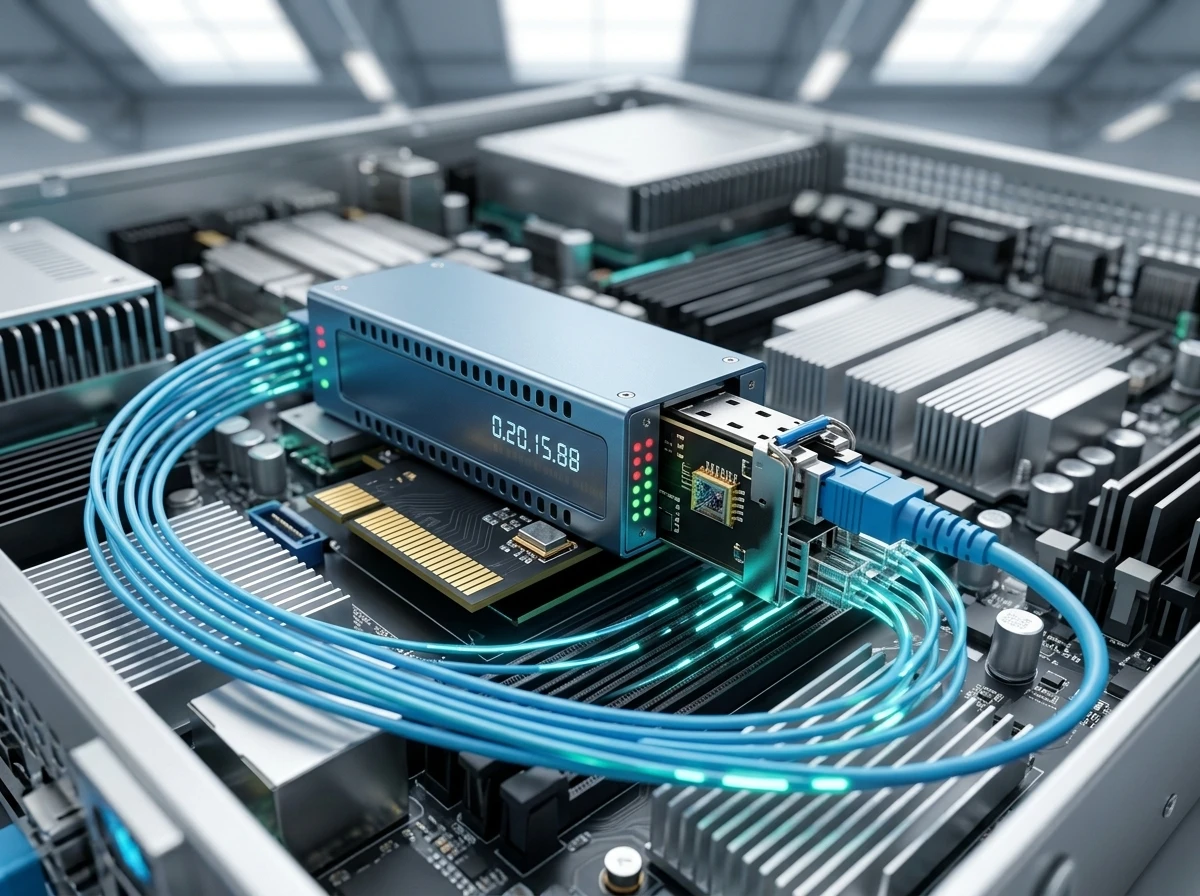
World’s Largest Optical Interconnect Supplier by Revenue
Zhongji InnoLight converts electrical signals into light and back again so that AI clusters can move data at the speeds modern GPUs demand. Its portfolio runs from 10G to 1.6T transceivers. According to China Insights Consultancy cited in the prospectus, the company held 21.2% of the overall optical interconnect solutions market in 2025 and 28.1 percent of the high-speed datacom segment.
It has ranked No. 1 globally in revenue among optical interconnect solution providers for five straight years since 2021. The firm was first to mass-ship the last three high-speed generations: 400G in 2018, 800G in 2020 and 1.6T in 2023, each roughly half a year ahead of the nearest peer. Silicon-photonics products made up about 70 percent of its high-speed revenue in the first quarter of 2026.
That half-year lead at each generation change compounded into the revenue ranking. Hyperscalers that qualified the company early for 400G and 800G had little reason to reopen the vendor list when 1.6T arrived on the same schedule.
First-quarter 2026 revenue nearly tripled to RMB 19.5 billion. Net profit roughly quadrupled to RMB 6.32 billion. More than 60 percent of that revenue came from the United States. Major customers include Nvidia and Alphabet along with other hyperscalers and AI compute providers. Five customers routinely account for more than 75 percent of sales.
Where the Cash Goes Next
Prospectus plans allocate the net proceeds across a five-year horizon:
| Use | Share | Approx. HK$ (at max price base) |
|---|---|---|
| Ongoing R&D of optical interconnect products | 35% | 19.08 billion |
| Global production capacity expansion | 30% | 16.35 billion |
| Strategic acquisitions and investments | 15% | 8.18 billion |
| Supply-chain resilience and commercialization | 10% | 5.45 billion |
| Working capital and general corporate | 10% | 5.45 billion |
The capacity tranche is expected to add roughly 50 million optical modules of annual output over three years. R&D priorities include lower-power 1.6T devices, preparation for 3.2T, and next-generation architectures such as LPO, NPO and CPO. Chairman and CEO Liu Sheng called the listing “a vital step toward the company’s future” at the July 30 ceremony and pledged continued delivery of industry-leading solutions to global customers.
R&D and capacity together absorb 65 percent of the raise. That split keeps product lead times short while the factories that fill those orders grow outside a single-jurisdiction footprint.
The Hong Kong listing is a vital step toward the company’s future. The company will continue to innovate and drive technological progress to deliver industry-leading optical interconnect solutions to global customers.
Liu Sheng made the remarks during the listing ceremony at the Hong Kong Stock Exchange.
US Demand Built the Numbers, Policy Now Tests Them
The same American hyperscale build-out that produced triple-digit growth also concentrates risk. The United States generated 61.7 percent of first-quarter revenue. In June 2026 the US Department of Defense added Zhongji InnoLight to its Entities Identified as Chinese Military Companies list under Section 1260H. The company stated the designation does not by itself restrict commercial business with US customers or trading in its securities.
What We Know
- DoD 1260H listing effective June 2026; procurement restrictions apply to US Defense Department contracts only.
- Company filings and statements assert no automatic bar on private US sales or capital-markets activity.
- US revenue share exceeded 60 percent in Q1 2026 and was the majority throughout the track-record period.
What’s Unconfirmed
- Scope and timing of any broader FCC or Commerce Department restrictions on Chinese optical-transceiver imports.
- Whether existing installed base or spare parts would be grandfathered under a new rule.
- Exact capacity and timeline for Western module makers to replace high-speed Chinese volume.
In early August reports circulated that the FCC was drafting a ban on new imports of Chinese optical transceivers, with Zhongji InnoLight and peer Eoptolink named as primary targets given their combined market weight. US pure-play names in lasers and modules rallied sharply on the headlines. Analysts noted that full Western substitution would take 12 to 24 months and that many Chinese modules already incorporate US DSPs and lasers, so a hard cut would hit multiple layers of the chain. Beijing’s earlier controls on indium phosphide further complicate any clean decoupling.
Customer concentration magnifies the policy question. When five buyers drive more than three-quarters of sales and one country supplies most of the revenue, any rule change lands on a narrow base rather than a diversified book.
AI Clusters Keep Raising the Bandwidth Bar
Global optical-interconnect demand is projected to climb from roughly $24.8 billion in 2025 to $111 billion by 2030, a 31.6 percent compound annual rate, according to CIC figures in the prospectus. Optical gear is expected to capture a rising share of total AI capital expenditure as clusters scale out and scale up. xPU shipments into AI systems are forecast to rise from about 14 million units in 2025 to 60 million in 2030.
That backdrop underpins China’s broader AI trade surge this year and explains why investors still cleared a multi-billion-dollar book even after a global AI-stock wobble. Zhongji’s own shipments illustrate the pace: 7.5 million units in 2023, 14.6 million in 2024, 21.1 million in 2025 and 9.0 million in the first quarter of 2026 alone.
- 2018: First commercial 400G transceiver launch
- 2020: First 800G mass shipment lead
- 2023: First 1.6T introduction and commercial ramp
- 2025-26: SiPh share reaches ~70 percent of high-speed revenue; capacity build accelerates with IPO proceeds
Crowd commentary on X after the debut focused less on the initial price dip and more on order visibility into 2027 and the still-unmet demand for 800G. Several voices treated the FCC draft as a negotiating signal ahead of high-level meetings rather than an imminent hard ban, while noting that any real restriction would lift near-term pricing power for US suppliers that currently lack the volume.
Shipment Volumes Map the Demand Curve
Unit growth supplies the clearest check on the revenue story. Annual shipments more than doubled from 2023 to 2025, and the first quarter of 2026 alone already approached half of the full-year 2023 total.
| Period | Modules shipped |
|---|---|
| 2023 full year | 7.5 million |
| 2024 full year | 14.6 million |
| 2025 full year | 21.1 million |
| Q1 2026 | 9.0 million |
The same cadence that put the company first to market on 400G, 800G and 1.6T now shows up in absolute volume. Each generation shift arrived roughly half a year ahead of peers; the shipment table shows that lead converted into scale rather than remaining a pure technology claim.
If Q1 run-rates hold, 2026 output will again outpace the prior year by a wide margin. That trajectory is what the capacity tranche of the IPO is meant to protect.
How Dual Listings Framed the Debut
The Hong Kong offer did not float in isolation. Shenzhen A-shares fell 9.15 percent on the same day the H shares closed down 2.04 percent after touching HK$880. Both markets priced the same AI-stock wobble, yet the depth of the moves differed.
- H-share debut close: HK$960, down 2.04 percent from HK$980 offer
- Intraday H-share low: HK$880
- Shenzhen A-share move same day: down 9.15 percent
- Early August H-share recovery: several sessions above HK$1,100
Cornerstone participation from Temasek Holdings, the Abu Dhabi Investment Authority, BlackRock, JPMorgan Asset Management, Alibaba Group and Tencent Holdings helped anchor the international book at 9.7 times coverage. The public tranche’s 16.8 times coverage pointed to heavier retail interest inside Hong Kong.
Day-one options and short-selling eligibility meant price discovery ran through the full toolkit from the open. The later climb back through the offer price suggested the initial discount was more macro than fundamental once the broader AI pullback cooled.
Capacity Cash Meets Policy Friction
The $6.8 billion gives Zhongji InnoLight the balance-sheet firepower to stay ahead on 1.6T and 3.2T while expanding factories outside pure China risk. It also arrives at the precise moment when the customer geography that produced the growth is under active political scrutiny. Western module makers need years, not months, to match the scale already in place. Chinese rare-earth and substrate leverage cuts both ways.
The 12-to-24-month substitution window cited by analysts is longer than a single product cycle at the current pace of 800G and 1.6T ramps. That mismatch is why installed-base qualification still favors the volume leader even while policy headlines move pure-play Western names.
For now the company remains the volume leader that hyperscalers already qualified and continue to buy. The listing converts that position into permanent capital. Whether the next twelve months are defined by capacity ramps or by import rules will decide how much of the AI optics upside stays with the firm that just raised the money to chase it.
Frequently Asked Questions
What products does Zhongji InnoLight make?
The core line is optical transceivers that convert electrical signals to light and back for fiber links inside data centers and AI clusters. Speeds range from 10G through 1.6T, with growing silicon-photonics content; the company also supplies related optical components and some automotive optoelectronics.
How large is Zhongji InnoLight’s market share?
China Insights Consultancy data in the 2026 prospectus put the company at 21.2 percent of the global optical-interconnect solutions market by revenue in 2025 and 28.1 percent of the high-speed datacom segment, making it the largest player for the fifth consecutive year.
How will the Hong Kong IPO proceeds be used?
Approximately 35 percent is earmarked for multi-year R&D on next-generation optical interconnects, 30 percent for expanding global manufacturing capacity by about 50 million modules per year, 15 percent for acquisitions, 10 percent for supply-chain and commercialization strength, and 10 percent for working capital.
Which customers drive most of Zhongji InnoLight’s sales?
Hyperscale cloud and AI compute providers, including Nvidia and Alphabet, account for the bulk of revenue. The top five customers regularly contribute more than 75 percent of total sales, and the United States alone generated 61.7 percent of first-quarter 2026 revenue.
Does the US DoD military-companies list block Zhongji InnoLight from selling to American firms?
The Section 1260H listing restricts US Defense Department procurement from the named entities but, according to the company’s own statements, does not by itself prohibit commercial sales to private US customers or trading of its shares. Broader import rules remain under discussion.


South Korea Retail Investors Face Reckoning After KOSPI AI Rally Collapses

Surrey AI Maps Three Heart Attack Paths and Their Molecular Roots

Germany Locks Neutral Apple ATT Prompts Across Most of Europe

Apple’s 5% EU Fee Quietly Rewrites Alternative App Store Math

Apple’s EU Fee Truce Cuts Complexity but Leaves Rivals Fuming

Pixel 11 Pro Fold Trades Thinness for Durability and Seven-Year Stay

Mayo AI Flags HCM Obstruction From Everyday Ultrasound Videos

Indian Brands Quietly Scale Landmark Screens and Home Tech

Navin Vatsa Turns Grief Into a Lifetime of Quiet Seeing

Google Bets Pixel 11 Agentic AI Will Redefine Phones

Oracle Cuts 21,000 Jobs in a Year, Cites AI in 10-K Filing

Fable 5 and Mythos 5 Return as US Lifts Anthropic Export Controls

SpaceX’s Google Deal Turns a Rocket Company Into a Cloud Landlord

CD Projekt Red Co-CEO: Redemption Arc Isn’t Done, Witcher 4 in 2027

XPL Rallies 30% Ahead of Plasma One Card Tier Launch

Google Search Profiles Build a Follow Graph Inside Discover

DGO App Brings Rs 549 Mobile Pass for FIFA World Cup 2026 in Nepal

Moonshot AI Targets $30 Billion in China’s Fastest AI Funding Sprint

Oppo’s ColorOS 17 Eligibility List Leaves A-Series Buyers Behind

Microsoft Xbox Layoffs Start in July as Sharma Slams 3% Margin
-
 AI2 months ago
Oracle Cuts 21,000 Jobs in a Year, Cites AI in 10-K Filing
-
 AI2 months ago
Fable 5 and Mythos 5 Return as US Lifts Anthropic Export Controls
-
 AI3 months ago
SpaceX’s Google Deal Turns a Rocket Company Into a Cloud Landlord
-
 GAMING2 months ago
CD Projekt Red Co-CEO: Redemption Arc Isn’t Done, Witcher 4 in 2027
-
 CRYPTO3 months ago
XPL Rallies 30% Ahead of Plasma One Card Tier Launch
-
 NEWS3 months ago
Google Search Profiles Build a Follow Graph Inside Discover
-
 APPS3 months ago
DGO App Brings Rs 549 Mobile Pass for FIFA World Cup 2026 in Nepal
-
 AI3 months ago
Moonshot AI Targets $30 Billion in China’s Fastest AI Funding Sprint