
AI
China’s AI Trade Surges to $723 Billion in First Half of 2026
China’s computing hardware trade hit $723 billion in H1 2026, up 56.6%, as robot exports and Hong Kong’s chip re-exports both set records.

China’s computing hardware trade hit 5.13 trillion yuan ($723 billion) in the first half of 2026, up 56.6% from a year earlier, as AI-powered robots shipped to more than 90 countries. Wang Jun, deputy head of China’s General Administration of Customs (GAC), delivered the numbers Tuesday at a State Council press briefing, part of a broader report showing the country’s total imports and exports reached a record 25.47 trillion yuan for the half, up 16.9%.
The same day, separate customs data showed June exports alone jumped 27% year-on-year, the fastest pace in four months and well past the 19% gain economists had forecast. The surge sits next to a domestic economy where car sales keep falling and a growing list of foreign tariff and export-control measures now takes direct aim at the robots and chips driving the boom.
Computing Hardware Trade Crosses $723 Billion
Smart products including AI glasses, translators and robotic exoskeletons are undergoing rapid upgrades, Wang said, with new devices arriving steadily. Exports of electronic components, computer parts and other computing-related products all posted double-digit growth in the first half, together contributing 6.9 percentage points to the country’s overall export growth, customs data showed.
Wang tied the surge to sustained worldwide appetite for computing infrastructure, data centers and end-user devices, the same buildout that is now driving up household electricity bills in markets far from China. A United Nations report separately found that global trade growth this year has concentrated largely in AI-related sectors, underscoring how tightly China’s export machine has hitched itself to the same demand curve.
“The strength in integrated circuits and technology exports is well expected, in line with the artificial intelligence investment boom,” said Xu Tianchen, senior economist at the Economist Intelligence Unit, describing the pattern earlier this year. Analysts told the GAC briefing the performance also reflects the resilience of Chinese manufacturing and its ability to match shifting global demand.
Robots Become China’s Newest Export Story
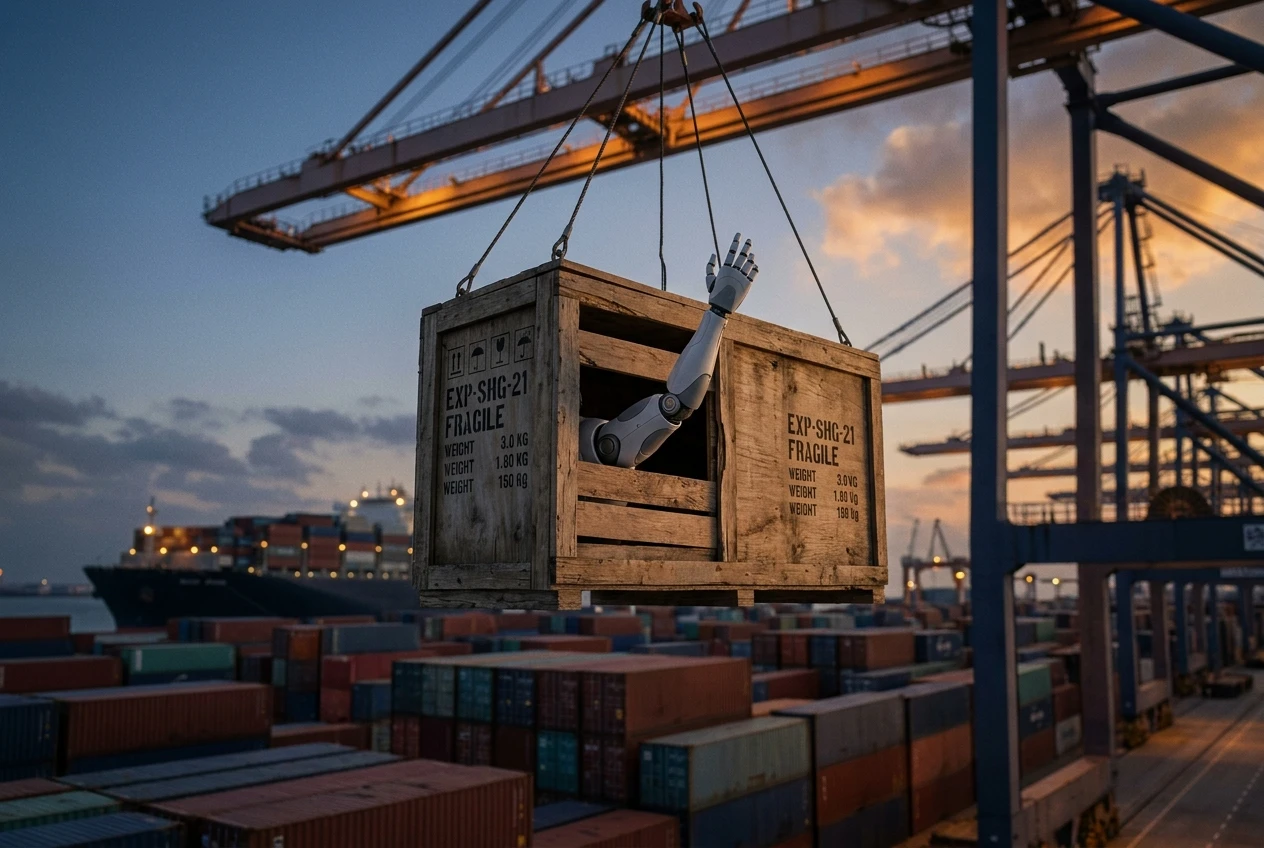
Exports of AI-powered intelligent bionic robots, humanoids, robot dogs and bionic fish and birds among them, surpassed 10,000 units in the first half, reaching more than 90 countries and regions. China’s industrial robots also kept climbing: the country became a net exporter of the category for the first time in 2025, after annual export volume surged 48.7% year-on-year in unit terms.
That momentum carried into 2026. Industrial robot exports reached 6.29 billion yuan in the first half, up 18.6%, reaching 141 countries and regions. Surgical robots, still a small category, grew far faster: exports hit 480 million yuan, up 3.3 times year-on-year, with markets expanding to 49 countries from 23 over the same period last year. Cleaning robots and intelligent bionic machines combined for 18.09 billion yuan in export value for the half.
| Robot Category | H1 2026 Figure | Year-on-Year Change | Global Reach |
|---|---|---|---|
| Industrial robots | 6.29 billion yuan | +18.6% | 141 countries and regions |
| Surgical robots | 480 million yuan | +3.3 times | 49 countries, up from 23 a year earlier |
| Cleaning and bionic robots (combined) | 18.09 billion yuan | Not separately disclosed | Millions of overseas households |
| AI-powered bionic robots (humanoids, robot dogs) | 10,000-plus units shipped | Not separately disclosed | 90-plus countries and regions |
China’s domestic robotics market is growing even faster than its exports. The market reached $14.2 billion in 2026, up 47% year-over-year, according to research firm SVRC, a base that gives Chinese manufacturers scale advantages before a single unit ships abroad.
Hong Kong’s Chip Back Door
None of this works without a steady flow of foreign-made chips, and increasingly those chips move through Hong Kong. Semiconductors re-exported from Hong Kong to the mainland reached $124 billion in the first five months of 2026, a record high, according to a Bloomberg analysis of Hong Kong government trade figures. Hong Kong Chief Executive John Lee has led delegations to the Middle East and Southeast Asia to diversify the city’s economic exposure as the arrangement draws more scrutiny.
Chips are high-value, lightweight, and time-sensitive.
Gary Ng, senior economist for Asia-Pacific at Natixis, said Hong Kong’s free port status and dense air cargo network make it an ideal staging ground for semiconductor trade, letting manufacturers ship frequently and store inventory flexibly while awaiting sale.
The same mainland tech wave is lifting Hong Kong’s finance side too. Mainland tech listings pushed Hong Kong to the world’s second-busiest IPO market in H1 2026, a parallel boom running alongside the chip re-export surge. Washington’s own export controls, tightened repeatedly since 2022, are aimed at slowing Beijing’s push for chip self-sufficiency, which is precisely why a free-trade conduit like Hong Kong has become so valuable to mainland buyers.
Why Is China Still Importing Record Volumes of Chips?
China imported a record $135 billion in semiconductors during the first quarter of 2026 alone, even as its own robot and computing-hardware exports set records, because domestic foundries still cannot fully replace foreign-made advanced chips that AI computing depends on. The gap explains why Hong Kong’s re-export channel matters so much and why chip imports and exports are climbing together rather than one replacing the other.
The record $135 billion in quarterly semiconductor imports highlights China’s continued reliance on foreign-made advanced chips even as its exports of finished hardware surge, the U.S.-China Economic and Security Review Commission noted. Nvidia’s own position captures the squeeze from the supply side: its share of China’s AI chip market has slid from more than 90% to roughly half, even as the company’s China chip sales evaporated on the way to a $5.1 trillion valuation built almost entirely on demand elsewhere.
Behind the Boom, Domestic Demand Is Sagging
China’s export machine is real, and it is masking a domestic slowdown that shows up everywhere except the customs data. Car sales confirm a split economy: exports of high-tech goods keep accelerating while household spending on big-ticket items keeps shrinking.
- 22% – year-on-year drop in China’s car sales in May 2026, the sixth straight month of double-digit declines, per Semafor’s review of the trade data.
- 15% – share of China’s total export value now coming from AI-related products, up from 9% just three years ago, according to Trivium China’s analysis.
- 12% – year-on-year decline in fixed asset investment through October 2025, a growth engine that has stalled even as exports climb.
- 20%-plus – year-on-year rise in gasoline and transport fuel costs, squeezing household budgets just as big-ticket consumer spending cools.
Capital-intensive export industries like chips and robotics employ relatively few workers and channel less revenue into household incomes than the labor-heavy sectors that once drove China’s growth. The trade-in subsidy program that propped up appliance and auto demand through 2024 and 2025 has run its course, leaving domestic consumption exposed just as exports hit records.
Washington and Brussels Build New Guardrails
China’s success at exporting robots and chips is now the reason foreign governments are moving to restrict them. The measures span both sides of the Atlantic and target the exact categories customs data shows growing fastest.
- November 2025 – Senators introduced the Humanoid ROBOT Act (S.3275), which would bar federal agencies from buying humanoid robots linked to foreign adversaries including China.
- March 2026 – A bipartisan Senate group introduced the American Security Robotics Act, targeting federal procurement of Chinese-made robotic systems.
- Ongoing – The Commerce Department’s Bureau of Industry and Security is running a Section 232 national security investigation into robotics and industrial machinery imports.
- 2026 – A European Parliament study flagged robotics among the sectors where Chinese capacity expansion could undermine European competitors.
The European Parliament study on industrial overcapacity points to a Chinese trade surplus that has doubled since 2015, alongside an EU trade deficit with China that has also doubled in value. The Section 232 investigation into robotics and industrial machinery could still result in tariffs, though the U.S. Chamber of Commerce has warned broad duties would raise costs for American manufacturers who depend on Chinese-made components just as much as Chinese exporters depend on American buyers.
The Second Half Puts the Trade-Off to the Test
Whether the export boom can keep outrunning the domestic slowdown becomes clearer as the second half unfolds. Trivium China’s analysts frame it as two true stories happening at once: an AI and clean-energy export machine humming at full speed, and a consumer economy running low on fuel.
“It’s a risky bet to assume the momentum will hold,” said Lynn Song, ING’s Greater China chief economist, pointing to the risk that a prolonged conflict in the Middle East could push energy prices high enough to tip economies toward stagflation.
China’s next showcase arrives fast. The 2026 World Artificial Intelligence Conference opens in Shanghai on July 17, just three days from now, with the same humanoid robots and export-ready hardware behind this year’s trade numbers again taking center stage.
Frequently Asked Questions
How much did China’s AI-related trade grow in the first half of 2026?
The current run marks 11 consecutive quarters of export growth for China, a streak customs officials attribute to manufacturers matching diverse global demand with precision rather than leaning on a single stimulus push. Analysts see the streak’s length as evidence of durability rather than a one-quarter spike tied to AI hardware alone.
Is China really a net exporter of industrial robots now?
Yes. China’s industrial robot exports first overtook imports in 2025, and the gap keeps widening. In April 2026 alone, the country exported 25,375 industrial robots, up 89.2% year-on-year, while importing 10,887 units, up 28.1%, according to customs figures cited by Chinese trade outlet Gasgoo.
What role does Hong Kong play in China’s chip trade?
Hong Kong has become the essential relay point for chips entering the mainland. Semiconductors re-exported through the city reached $124 billion in the first five months of 2026, about 52% of China’s total chip imports, up from roughly a third of that total a decade ago. AI-related electronics alone now make up 57% of Hong Kong’s own exports, versus 44% in 2024.
How have US tariffs already affected Chinese robot prices?
Tariffs have already reshaped price tags. The U.S. price of one popular Chinese-made humanoid robot, marketed as the G1, has nearly tripled from about $16,000 to roughly $40,000 because of import duties, according to industry tracking cited by the International Society of Automation. That kind of markup makes Chinese hardware less competitive in exactly the market Washington most wants to control.
What could slow China’s AI trade boom later this year?
Energy prices and sudden chip-access swings could both cut into the boom. ASML’s share of sales going to China fell from 36% in the fourth quarter of 2025 to just 19% in the first quarter of 2026 as controls tightened, a preview of how fast market access can vanish once restrictions bite. A prolonged Middle East conflict pushing energy costs higher is the other wildcard analysts are watching.


South Korea Retail Investors Face Reckoning After KOSPI AI Rally Collapses

Surrey AI Maps Three Heart Attack Paths and Their Molecular Roots

Germany Locks Neutral Apple ATT Prompts Across Most of Europe

Apple’s 5% EU Fee Quietly Rewrites Alternative App Store Math

Apple’s EU Fee Truce Cuts Complexity but Leaves Rivals Fuming

Pixel 11 Pro Fold Trades Thinness for Durability and Seven-Year Stay

Mayo AI Flags HCM Obstruction From Everyday Ultrasound Videos

Indian Brands Quietly Scale Landmark Screens and Home Tech

Navin Vatsa Turns Grief Into a Lifetime of Quiet Seeing

Google Bets Pixel 11 Agentic AI Will Redefine Phones

Oracle Cuts 21,000 Jobs in a Year, Cites AI in 10-K Filing

Fable 5 and Mythos 5 Return as US Lifts Anthropic Export Controls

SpaceX’s Google Deal Turns a Rocket Company Into a Cloud Landlord

CD Projekt Red Co-CEO: Redemption Arc Isn’t Done, Witcher 4 in 2027

XPL Rallies 30% Ahead of Plasma One Card Tier Launch

Google Search Profiles Build a Follow Graph Inside Discover

DGO App Brings Rs 549 Mobile Pass for FIFA World Cup 2026 in Nepal

Moonshot AI Targets $30 Billion in China’s Fastest AI Funding Sprint

Oppo’s ColorOS 17 Eligibility List Leaves A-Series Buyers Behind

Microsoft Xbox Layoffs Start in July as Sharma Slams 3% Margin
-
 AI2 months ago
Oracle Cuts 21,000 Jobs in a Year, Cites AI in 10-K Filing
-
 AI2 months ago
Fable 5 and Mythos 5 Return as US Lifts Anthropic Export Controls
-
 AI3 months ago
SpaceX’s Google Deal Turns a Rocket Company Into a Cloud Landlord
-
 GAMING2 months ago
CD Projekt Red Co-CEO: Redemption Arc Isn’t Done, Witcher 4 in 2027
-
 CRYPTO3 months ago
XPL Rallies 30% Ahead of Plasma One Card Tier Launch
-
 NEWS3 months ago
Google Search Profiles Build a Follow Graph Inside Discover
-
 APPS3 months ago
DGO App Brings Rs 549 Mobile Pass for FIFA World Cup 2026 in Nepal
-
 AI3 months ago
Moonshot AI Targets $30 Billion in China’s Fastest AI Funding Sprint