
NEWS
India’s EV Start-ups Are Now Selling Uptime, Not Vehicles
India’s EV start-ups chase software and fleet-intelligence revenue as hardware margins tighten. BikeWo targets 25-35 per cent from software in 3-5 years.

India’s electric-vehicle start-ups are no longer just selling vehicles. Founders across the mobility ecosystem told The Hindu Business Line in a July 6 report on the platform pivot that the buyer now wants a connected bundle: battery analytics, predictive maintenance, charging management, financing enablement, energy management. Hardware margins are shrinking under competition, localisation costs and pricing pressure, so the start-ups are repackaging themselves as software and data companies that happen to sell vehicles on the side.
BikeWo Green Tech has put a number on that shift, and three smaller rivals (LetzRyd, Folks Motor and Roadcast) describe the same move in similar terms. The company expects software, fleet management and energy services to contribute 25-35 per cent of revenues over the next three to five years, according to CEO-Designate Hiten Pal Saklani. The race for India’s EV market is moving to whoever runs the best operation around its vehicles. Operators who can sell software, charging, financing and uptime together are bidding for the part of the revenue mix that grows.
From Selling Vehicles to Selling Uptime
The industry framing inside the businessline report sets the tone for what is happening. Saklani told the paper that software revenue and recurring services now carry more long-term value than one-off hardware sales, and the rest of the read follows that logic. What fleets value is uptime, vehicles that run, batteries that last, charging that does not interrupt routes.
The four companies named in the report converge on the same point. Each is reinvesting in software layers it would once have outsourced or skipped: fleet management, battery analytics, charging optimisation, AI-powered route planning, video telematics. Sales no longer end at delivery; they continue as monthly subscriptions for the data and the uptime that follow. Commercial fleet operators are the buyers driving the change.
The bigger fleets in India now want operating control, not ownership of the asset alone; that is what turns a vehicle sale into a platform contract. Khurana at Folks Motor told The Hindu Business Line that buyers are asking for certainty rather than just vehicles, and a start-up that only sells a vehicle is now selling half a product by his read.
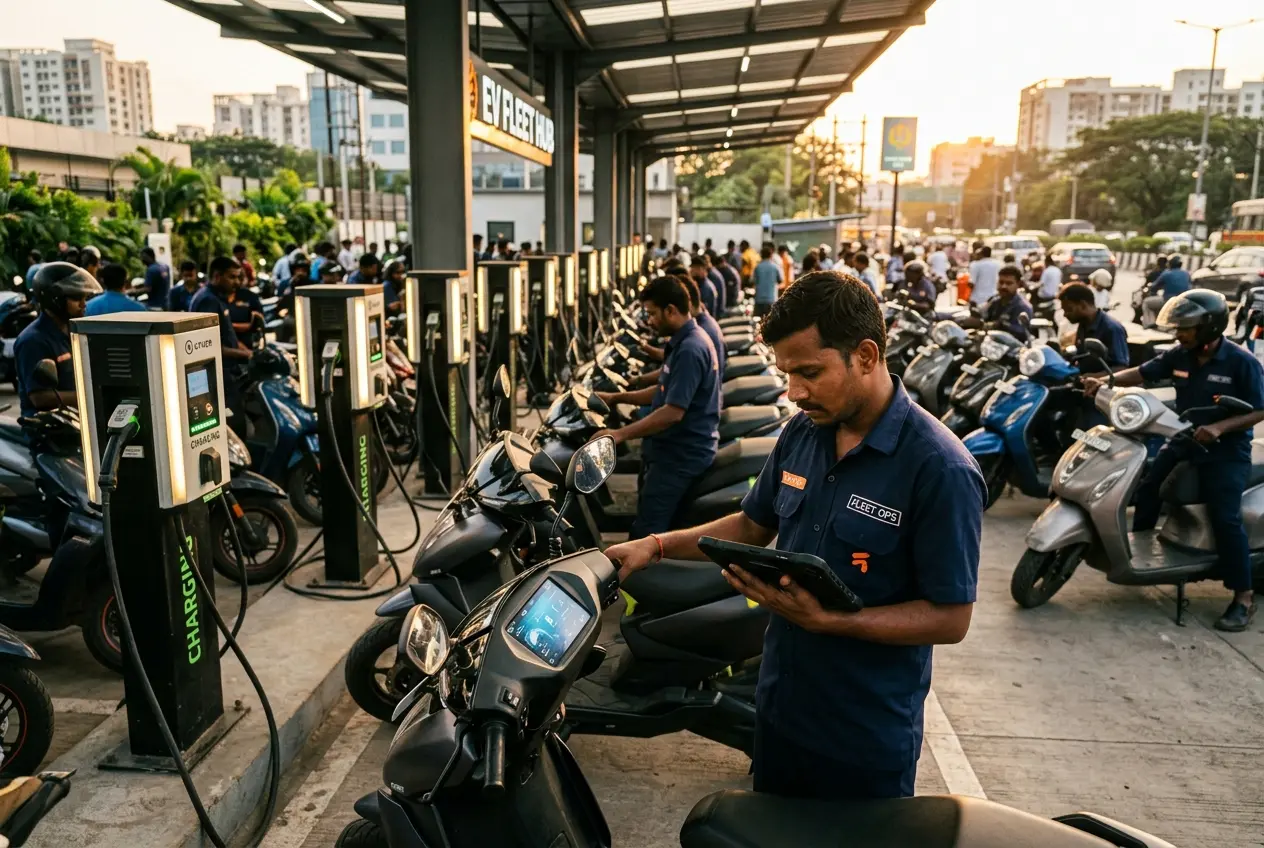
BikeWo’s Three-to-Five-Year Software Bet
BikeWo anchors the case in numbers. The Hyderabad-headquartered two-wheeler EV company has publicly told investors and operators that software and energy services will contribute 25-35 per cent of revenues within three to five years, with the rest still coming from vehicle sales. The push covers five named service lines: fleet management, predictive maintenance, battery health analytics, financing enablement and energy management.
The EV industry is rapidly shifting from a product-centric model to a platform-centric model. While vehicle sales remain important, we see significantly higher long-term value in recurring technology and service revenues through fleet management, predictive maintenance, battery health analytics, financing enablement and energy management.
Saklani’s title tells part of the story too. He is currently CEO-Designate at BikeWo, with a formal appointment tied to a separate deal: a memorandum of understanding for BikeWo to acquire a 51 per cent stake in PositiEV Mobility, a commercial EV distribution and leasing platform. The exchange filing, available as a press release disclosure on the PositiEV transaction, lists retail, leasing, financing, charging, battery swapping, fleet solutions and after-sales as the combined company’s targets. The acquisition closes the gap between the 25-35 per cent revenue goal and the corporate machinery needed to reach it.
The shape of the contract is changing with the stack. Where a commercial fleet deal once was a single delivery note, it is becoming a multi-year agreement with a software subscription, an energy supply clause, a financing line and a charging access pass. Saklani’s target is the math of how many such add-on lines a fleet operator will carry alongside the hardware, not a soft forecast. BikeWo’s bet is that the cumulative margin from those lines matches the gross profit from vehicle sales within three to five years. The acquisition of PositiEV is the corporate structure needed to make the bundle saleable in one contract.
The smaller operators in the businessline report are running the same arithmetic on a different scale. LetzRyd is selling the connected mobility layer for fleet customers, Folks Motor is bundling financing with the operating stack, and Roadcast, which builds the software other operators run, competes on a layer below the start-ups entirely. Each is now choosing between selling to other operators and selling to end fleets directly.
Why Hardware Margins Are Tightening
The pivot is happening because hardware no longer pays well enough to support the kind of R&D the start-ups want to add on top. The Hindu Business Line reports that vehicle manufacturers “grapple with shrinking hardware margins amid rising competition, localisation efforts and pricing pressure.” Tarun Jain, cofounder of LetzRyd, told the paper that “hardware margins have become more competitive,” pushing the company toward recurring software revenue. Three operators in the report say the same thing in different ways: the unit margin on a vehicle is thinner than the headline price suggests, and localisation is the main force driving the next round of unit economics lower.
Jain’s list of growth areas (fleet management, battery management, predictive maintenance, charging management and AI-powered mobility intelligence) reads less like a product roadmap, more like a software menu. Each item is a recurring service contract attached to a vehicle that any other maker could also have sold. The point that distinguishes one operator from another sits with the dashboard in LetzRyd’s framing, with what the operator sees on a tablet.
India’s EV policy has pushed for higher domestic content in motors, batteries and power electronics, which lowers unit cost over time but compresses what any single maker can charge per vehicle. With the cost curve falling for everyone, software and services are the only durable place to add margin. The number Saklani put forward (25-35 per cent of revenue from software, fleet and energy within three to five years) is the cleanest version of that arithmetic in public. Saklani suggested in the report that the same share will take longer to reach than the hardware-first start-ups expect.
What Fleet Buyers Now Ask For
The pressure is not only on the supply side. Buyers of commercial EV fleets have changed what they want, and that is what turns a software feature into a recurring contract. Khurana at Folks Motor laid out the new buying checklist in The Hindu Business Line without softening it: state of health, charging patterns, downtime risk, maintenance schedule and total cost of ownership, all in real time.
The buy-side demand list, in Khurana’s framing, lines up as follows. Operators want each item visible in the same dashboard:
- Battery health, with state of charge and degradation visible to the operator at any time
- Charging patterns that show where, when and how vehicles draw power
- Downtime risk profiles built from vehicle telemetry
- Maintenance schedules driven by use data
- Real-time total cost of ownership, including financing and energy costs
- Operational control over uptime, with software guaranteeing predictability
Khurana told the paper that “what they really value is uptime, predictability, financing support and operational control.” His company has answered the same way Saklani has, by combining fleet intelligence, battery analytics, charging infrastructure and financing into one operating stack. The bundling is not an upsell; it is what the tender requires when the procurement team asks for total cost of ownership in advance. Operators who cannot answer that brief in one contract are losing the bid before the price sheet opens.
The shift on the buy side is what makes the software line item recurring. A one-off battery telemetry subscription can be cancelled at the next budget review; a charging optimisation layer tied to the operator’s total cost of ownership report is harder to rip out. That is the pricing model the four operators in the businessline report are now building around.
When the Device Stops Being the Differentiator
Roadcast sits one layer further down the stack than the others; it is not a vehicle maker at all but the supplier of the software and telemetry other operators run on their fleets. Cofounder Rahul Mehra reframed the buyer’s request in the report, from “vehicle tracking” to “complete operational intelligence,” and the four operators in the businessline piece are all chasing the same shift:
- BikeWo’s stated service mix: fleet management, predictive maintenance, battery health analytics, financing enablement, energy management
- LetzRyd’s roadmap: fleet management, battery management, predictive maintenance, charging management, AI-powered mobility intelligence
- Roadcast’s offerings: AI-powered fleet management, predictive maintenance, video telematics, battery analytics, route optimisation
- Folks Motor’s bundling: fleet intelligence, battery analytics, charging infrastructure, financing as one operating ecosystem
Each operator is selling some version of the same five services, with different branding and different starting customers. The point that separates them now sits with whose dashboard the fleet manager keeps open at 7 a.m. when the first vehicle rolls out. Mehra’s line from The Hindu Business Line is the cleanest version of that idea: “Competitive advantage no longer comes from the device itself but from the intelligence built around it.” When the customer asks for total cost of ownership in advance, the software layer is what answers the brief.
What the New EV Stack Now Looks Like
The closing paragraph of the businessline report sketches where all four companies are heading. The next phase of India’s EV market, The Hindu Business Line reports industry executives as saying, “will be defined less by vehicle specifications and more by the software layer that improves fleet uptime, lowers operating costs and strengthens customer retention.” Buyers, suppliers and the start-ups themselves now agree on what a commercial EV product is: a vehicle and the operations that keep it working.
The implication for India’s EV market is structural. A start-up that only knows how to build and ship a vehicle is bidding for a shrinking slice of the value chain. The one that pairs hardware with software, energy, charging and financing under one contract is bidding for the recurring share that follows. BikeWo’s stated 25-35 per cent target, the PositiEV MoU and the buy-side checklist from Khurana all point in the same direction.
The race for India’s commercial EV market is now over which company can run the operation around its vehicles. Saklani’s platform-centric framing is no longer a slide in a pitch deck. It is the corporate form each of the four operators in the businessline report is now taking.


South Korea Retail Investors Face Reckoning After KOSPI AI Rally Collapses

Surrey AI Maps Three Heart Attack Paths and Their Molecular Roots

Germany Locks Neutral Apple ATT Prompts Across Most of Europe

Apple’s 5% EU Fee Quietly Rewrites Alternative App Store Math

Apple’s EU Fee Truce Cuts Complexity but Leaves Rivals Fuming

Pixel 11 Pro Fold Trades Thinness for Durability and Seven-Year Stay

Mayo AI Flags HCM Obstruction From Everyday Ultrasound Videos

Indian Brands Quietly Scale Landmark Screens and Home Tech

Navin Vatsa Turns Grief Into a Lifetime of Quiet Seeing

Google Bets Pixel 11 Agentic AI Will Redefine Phones

Oracle Cuts 21,000 Jobs in a Year, Cites AI in 10-K Filing

Fable 5 and Mythos 5 Return as US Lifts Anthropic Export Controls

SpaceX’s Google Deal Turns a Rocket Company Into a Cloud Landlord

CD Projekt Red Co-CEO: Redemption Arc Isn’t Done, Witcher 4 in 2027

XPL Rallies 30% Ahead of Plasma One Card Tier Launch

Google Search Profiles Build a Follow Graph Inside Discover

DGO App Brings Rs 549 Mobile Pass for FIFA World Cup 2026 in Nepal

Moonshot AI Targets $30 Billion in China’s Fastest AI Funding Sprint

Oppo’s ColorOS 17 Eligibility List Leaves A-Series Buyers Behind

Microsoft Xbox Layoffs Start in July as Sharma Slams 3% Margin
-
 AI2 months ago
Oracle Cuts 21,000 Jobs in a Year, Cites AI in 10-K Filing
-
 AI2 months ago
Fable 5 and Mythos 5 Return as US Lifts Anthropic Export Controls
-
 AI3 months ago
SpaceX’s Google Deal Turns a Rocket Company Into a Cloud Landlord
-
 GAMING2 months ago
CD Projekt Red Co-CEO: Redemption Arc Isn’t Done, Witcher 4 in 2027
-
 CRYPTO2 months ago
XPL Rallies 30% Ahead of Plasma One Card Tier Launch
-
 NEWS3 months ago
Google Search Profiles Build a Follow Graph Inside Discover
-
 APPS3 months ago
DGO App Brings Rs 549 Mobile Pass for FIFA World Cup 2026 in Nepal
-
 AI3 months ago
Moonshot AI Targets $30 Billion in China’s Fastest AI Funding Sprint