
COMPUTERS
IBM’s New Rack-Mount Mainframes Land as Data Center Space Hits a Wall
IBM launches rack-mount z17, LinuxONE Rockhopper 5, and LinuxONE 5 Express on August 12, 2026, with new Bob AI tools, as CBRE data center rents top $400/kW/month.

IBM on Tuesday rolled out the first rack-mount versions of its z17 mainframe and LinuxONE 5 line, alongside new agentic AI tools for mainframe developers, in a bid to fit big iron into data centers where floor tiles now rent for more than $400 per kilowatt per month. The new z17 single-frame, z17 rack-mount, LinuxONE Rockhopper 5, and LinuxONE 5 Express systems go on sale August 12, 2026, and represent the first time IBM is offering rack mount alongside single frame systems across its full Z and LinuxONE portfolio.
The shift is a direct reply to a constraint that has gone from nuisance to blocker. CBRE’s 2026 U.S. data center outlook finds that “vacancy remains at historic lows and pricing is at all-time highs,” with preleasing activity running in the mid-70% range against a historical norm of 40% to 50%, even after a 43% year-over-year expansion in primary-market inventory. The IBM press release cites the same CBRE figure: rental rates exceeding $400 per kW/month.
What IBM Is Putting on Sale
Four new hardware configurations land on August 12, 2026, and each is engineered to claw back floor space the old z17 multi-rack footprint could not. The new systems support up to 82 cores and 18 TB of memory across two processor drawers, a roughly 20% jump in core count and a 12% jump in memory capacity over the prior generation. Single-processor capacity on the IBM z17 ME2 delivers 10% greater throughput per core than the IBM z16 A02, with some variation by workload and configuration.
The four boxes differ in who they are for. The z17 single-frame is a fully packaged IBM rack with intelligent power distribution units, ready to deploy and now built with free space at the bottom for co-located Ethernet switches or storage. The z17 rack-mount lets customers drop IBM Z components into their own industry-standard rack alongside other equipment. LinuxONE Rockhopper 5, the scalable multi-drawer model for high-density Linux workloads, comes in both single-frame and rack-mount configurations with on-chip AI acceleration, confidential computing, and post-quantum cryptography. LinuxONE 5 Express, the smallest, is a compact 18U rack-mount entry point aimed at organizations consolidating a modest x86 estate or evaluating LinuxONE for the first time.
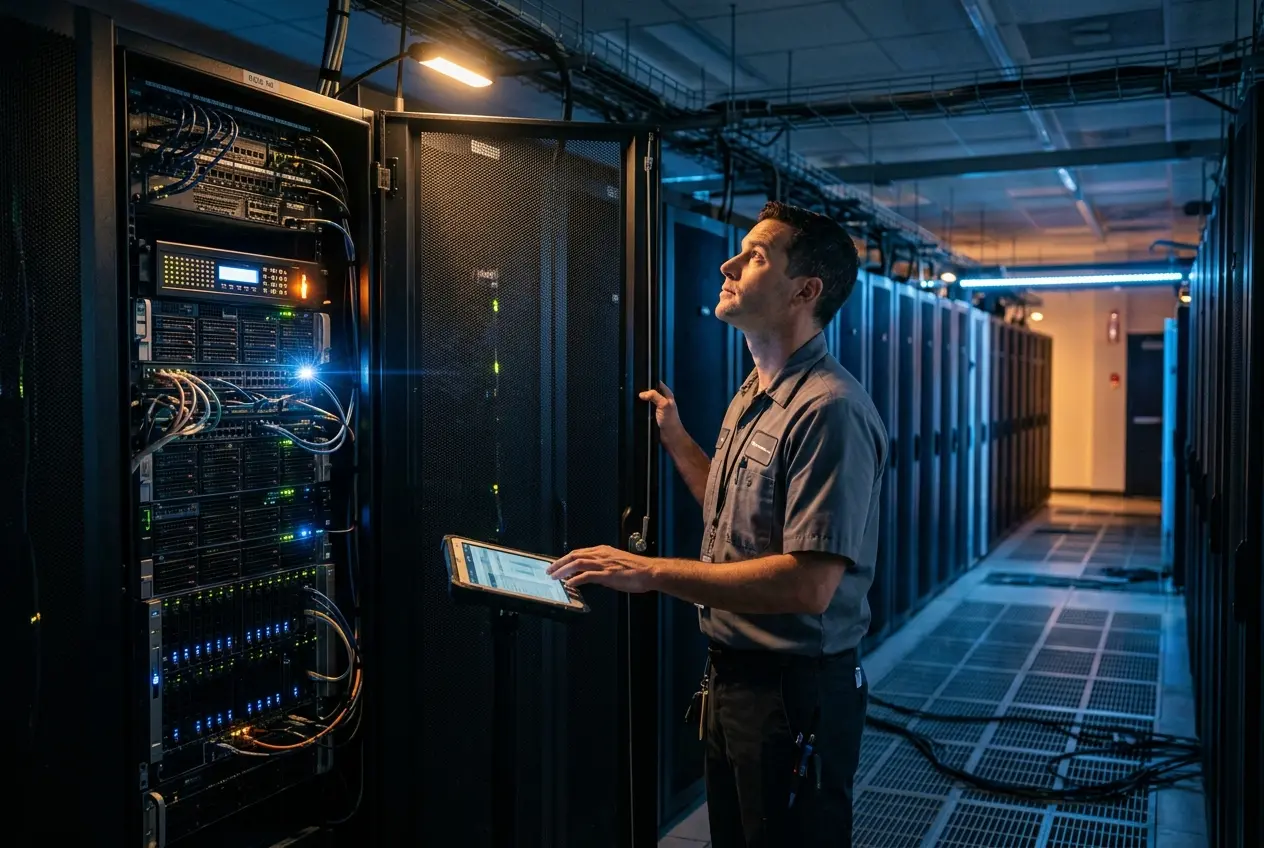
Why the Floor Tile Now Calls the Shots
IBM’s framing is unusually explicit about what is forcing the redesign. Tom McPherson, general manager of IBM Z and LinuxONE, said “the number of mission-critical workloads is rising at an incredible pace, forcing organizations to make tough decisions about performance, AI integration, and infrastructure footprint.” Tina Tarquinio, chief product officer for IBM Z and LinuxONE, called the moment “a new phase” in which enterprises must “support AI-driven growth while navigating resource constraints, evolving business requirements, and increasingly complex hybrid environments.”
The squeeze is not abstract. CBRE reports that the ability to secure 300-MW-plus deliveries in under 36 months now outweighs fiber redundancy as the top site-selection criterion, and that traditional 12-to-18-month timelines for sub-50-MW buildings no longer apply. AI occupiers are paying premiums for scale rather than the historical discounts on 10-MW-plus deployments. Steven Dickens, CEO and principal analyst at HyperFrame Research, told TechTarget the value of co-location is concrete: “If you can co-locate GPUs, memory, storage and other compute in the same rack and do that in one floor tile versus three floor tiles, that’s valuable. That’s real money.”
Density Up, Footprint Down
The new boxes pack more compute into less space than the prior generation, and IBM is leaning on that ratio to justify the redesign. The single-frame chassis now ships with intelligent power distribution units, SAN fiber connectivity, and room at the bottom of the frame for non-IBM equipment, a structural change that turns the mainframe from a sealed island into one rack in a row of racks. Each unit can hold up to 24 Spyre Accelerator cards, and IBM says a single z17 can deliver about 12.5 billion encrypted transactions per day for anti-money-laundering inference, with a separate IBM claim of more than 450 billion inferencing operations per day at a one-millisecond response time.
IBM is also preserving the resilience case that has long justified mainframes. Andrew Crimmin, principal product manager for IBM Z and an IBM master inventor, framed the downtime promise bluntly: “The common phrase ‘blink and you’ll miss it’ actually applies to how little downtime our systems have.” IBM is quoting 315 milliseconds of downtime a year, on par with the average human blink. For shops choosing between an x86 cluster that fills half a rack and a single-frame mainframe that occupies one floor tile, the per-square-foot reliability argument does most of the selling work.
Rick Schoonmaker, director of product management for IBM Z and LinuxONE, said IBM has seen a 65% reduction in total cost of ownership with certain customers migrating workloads from distributed systems to LinuxONE mainframes, a figure IBM used in the same briefing to argue that density and footprint, not raw sticker price, are where the real savings live.
AI Agents Move Onto the Mainframe
On the software side, IBM is extending Bob, the agentic AI development platform it introduced last year and built on VS Code, with two new premium packages aimed at mainframe work. The first, a Java modernization package, focuses on everyday application rewrites. The second, the Bob Premium Package for Z, integrates and enhances watsonx Code Assistant for Z, and is engineered for editing, linting, and debugging z/OS applications. IBM estimates the Z package can make complex engineering work 20% to 40% faster and cut the effort of building structured workflows by 50% to 80%.
Skyla Loomis, general manager for IBM Z Software, framed Bob as a way to put new developers in front of legacy code. “When a developer can step into a 30-plus-year-old insurance application and understand it with a single prompt, everything changes,” she wrote in an email interview. Marcel Mitran, IBM Fellow and CTO of IBM LinuxONE, said the same tooling thread runs into the LinuxONE 5 Express pitch: customers can deploy digital assets, AI-infused transaction processing, or confidential computing without “committing to the footprint of the larger model.” The combined pitch is that the same AI scaffolding now serves both the smallest rack-mount entry and the densest multi-drawer box.
Post-quantum cryptography is now standard on z17 and LinuxONE Rockhopper 5 systems, alongside confidential computing and enterprise-wide secrets management. A new IBM Crypto Discovery and Inventory capability gives security teams a consolidated view of cryptographic posture across the enterprise, intended to ease the migration to post-quantum standards.
Operations Tools for the Same Squeeze
IBM paired the hardware with two operations-side releases aimed at reducing the number of specialists a mainframe needs. IBM Infrastructure Management for Z and LinuxONE, generally available August 14, 2026, brings provisioning, configuration, and operations into a single interface that uses Terraform, the infrastructure-as-code tooling IBM acquired through its 2025 HashiCorp purchase, to orchestrate deployments. The product page frames the goal as “addressing the number of specialists required,” a pointed phrase given how thin mainframe talent has become.
IBM COBOL Elevate for z/OS arrives September 18, 2026, and is built to optimize performance and simplify modernization for the COBOL workloads that still anchor most large enterprises, with no rewrites and no specialized skills required. The two dates, August 14 for ops, September 18 for COBOL, are deliberate: IBM is shipping the hardware and the day-to-day tooling inside a month, and putting the deepest code-base work a few weeks later.
| Product | Availability | What it does |
|---|---|---|
| z17 single-frame and rack-mount | August 12, 2026 | Fits mainframe compute into standard racks and floor tiles |
| LinuxONE Rockhopper 5 single-frame and rack-mount | August 12, 2026 | High-density Linux workloads with on-chip AI and post-quantum security |
| LinuxONE 5 Express | August 12, 2026 | Compact 18U rack-mount entry for x86 consolidation or first-time LinuxONE buyers |
| IBM Infrastructure Management for Z and LinuxONE | August 14, 2026 | Unified provisioning and ops with Terraform-based automation |
| IBM Bob Premium Package for Z | With the hardware launch | Agentic AI coding and modernization for z/OS, Java |
| IBM COBOL Elevate for z/OS | September 18, 2026 | Optimization and modernization for existing COBOL workloads |
Who’s Already In
IBM released one customer endorsement with the announcement. Dr. Owain Kenway, head of research and development for platform technologies at University College London’s ARC, said the new LinuxONE 5 single-frame, rack-mount, and Express models “enable organizations like us to access advanced technologies at cost-effective prices, and help our academic teams deliver outstanding research.” The pitch to academia is the same as the pitch to commercial buyers: a smaller, cheaper mainframe that does not require a dedicated team to keep running.
Dickens, the HyperFrame analyst, pointed to an availability angle IBM did not lead with in its own briefing. Once orders go live in August, IBM has told customers it will deliver within a few days, a notable selling point in a market short on GPUs and memory. “Particularly for Linux workloads, people might make decisions purely just because of availability,” he said.
The Form Factor Is the Story
The agentic coding tools and post-quantum cryptography draw the headlines, but the deeper signal is the rack. For decades the mainframe has been the one system in the data center that does not share a row, that requires its own floor, its own power, and its own specialists. IBM is now selling the same Telum II silicon in boxes that drop into the same 19-inch racks as everything else, and is pricing and packaging them around the per-floor-tile economics that CBRE says now drive enterprise siting decisions. If the data center crunch keeps tightening, the rack-mount mainframe stops looking like a new SKU and starts looking like the new default.
Frequently Asked Questions
When do the new IBM z17 and LinuxONE 5 systems go on sale?
The z17 single-frame, z17 rack-mount, LinuxONE Rockhopper 5, and LinuxONE 5 Express all become generally available on August 12, 2026, with IBM Infrastructure Management for Z and LinuxONE following on August 14, 2026, and IBM COBOL Elevate for z/OS on September 18, 2026.
How does the rack-mount z17 differ from a standard mainframe?
The z17 rack-mount lets customers install IBM Z components directly into their own industry-standard rack alongside non-IBM equipment, rather than occupying a dedicated mainframe frame. The new single-frame z17 also ships with space at the bottom for co-located Ethernet switches or storage.
What is driving IBM to redesign mainframe hardware now?
IBM’s announcement cites rental rates exceeding $400 per kW/month and record-low vacancy from CBRE’s 2026 Global Data Center Trends report. CBRE’s separate U.S. outlook finds preleasing activity at 74% on average against a 40% to 50% historical norm, and the time to deliver a sub-50-MW building has stretched well past the old 12-to-18-month window.
What does IBM Bob add for mainframe developers?
Bob, an agentic AI coding platform built on VS Code, gets a Premium Package for Z that integrates watsonx Code Assistant for Z, plus a Java modernization package. IBM estimates the Z package makes complex engineering work 20% to 40% faster and reduces structured workflow effort by 50% to 80%.
What is LinuxONE 5 Express designed for?
LinuxONE 5 Express is a compact 18U rack-mount system aimed at organizations consolidating a modest x86 estate, evaluating LinuxONE for the first time, or deploying a specific workload such as digital assets, AI-infused transaction processing, or confidential computing without taking on the footprint of the larger Rockhopper 5 model.


South Korea Retail Investors Face Reckoning After KOSPI AI Rally Collapses

Surrey AI Maps Three Heart Attack Paths and Their Molecular Roots

Germany Locks Neutral Apple ATT Prompts Across Most of Europe

Apple’s 5% EU Fee Quietly Rewrites Alternative App Store Math

Apple’s EU Fee Truce Cuts Complexity but Leaves Rivals Fuming

Pixel 11 Pro Fold Trades Thinness for Durability and Seven-Year Stay

Mayo AI Flags HCM Obstruction From Everyday Ultrasound Videos

Indian Brands Quietly Scale Landmark Screens and Home Tech

Navin Vatsa Turns Grief Into a Lifetime of Quiet Seeing

Google Bets Pixel 11 Agentic AI Will Redefine Phones

Oracle Cuts 21,000 Jobs in a Year, Cites AI in 10-K Filing

Fable 5 and Mythos 5 Return as US Lifts Anthropic Export Controls

SpaceX’s Google Deal Turns a Rocket Company Into a Cloud Landlord

CD Projekt Red Co-CEO: Redemption Arc Isn’t Done, Witcher 4 in 2027

XPL Rallies 30% Ahead of Plasma One Card Tier Launch

Google Search Profiles Build a Follow Graph Inside Discover

DGO App Brings Rs 549 Mobile Pass for FIFA World Cup 2026 in Nepal

Moonshot AI Targets $30 Billion in China’s Fastest AI Funding Sprint

Oppo’s ColorOS 17 Eligibility List Leaves A-Series Buyers Behind

Microsoft Xbox Layoffs Start in July as Sharma Slams 3% Margin
-
 AI2 months ago
Oracle Cuts 21,000 Jobs in a Year, Cites AI in 10-K Filing
-
 AI2 months ago
Fable 5 and Mythos 5 Return as US Lifts Anthropic Export Controls
-
 AI2 months ago
SpaceX’s Google Deal Turns a Rocket Company Into a Cloud Landlord
-
 GAMING2 months ago
CD Projekt Red Co-CEO: Redemption Arc Isn’t Done, Witcher 4 in 2027
-
 CRYPTO2 months ago
XPL Rallies 30% Ahead of Plasma One Card Tier Launch
-
 NEWS3 months ago
Google Search Profiles Build a Follow Graph Inside Discover
-
 APPS2 months ago
DGO App Brings Rs 549 Mobile Pass for FIFA World Cup 2026 in Nepal
-
 AI2 months ago
Moonshot AI Targets $30 Billion in China’s Fastest AI Funding Sprint