
GADGETS
Google TV 300 Million Devices Tests Its Slower Growth
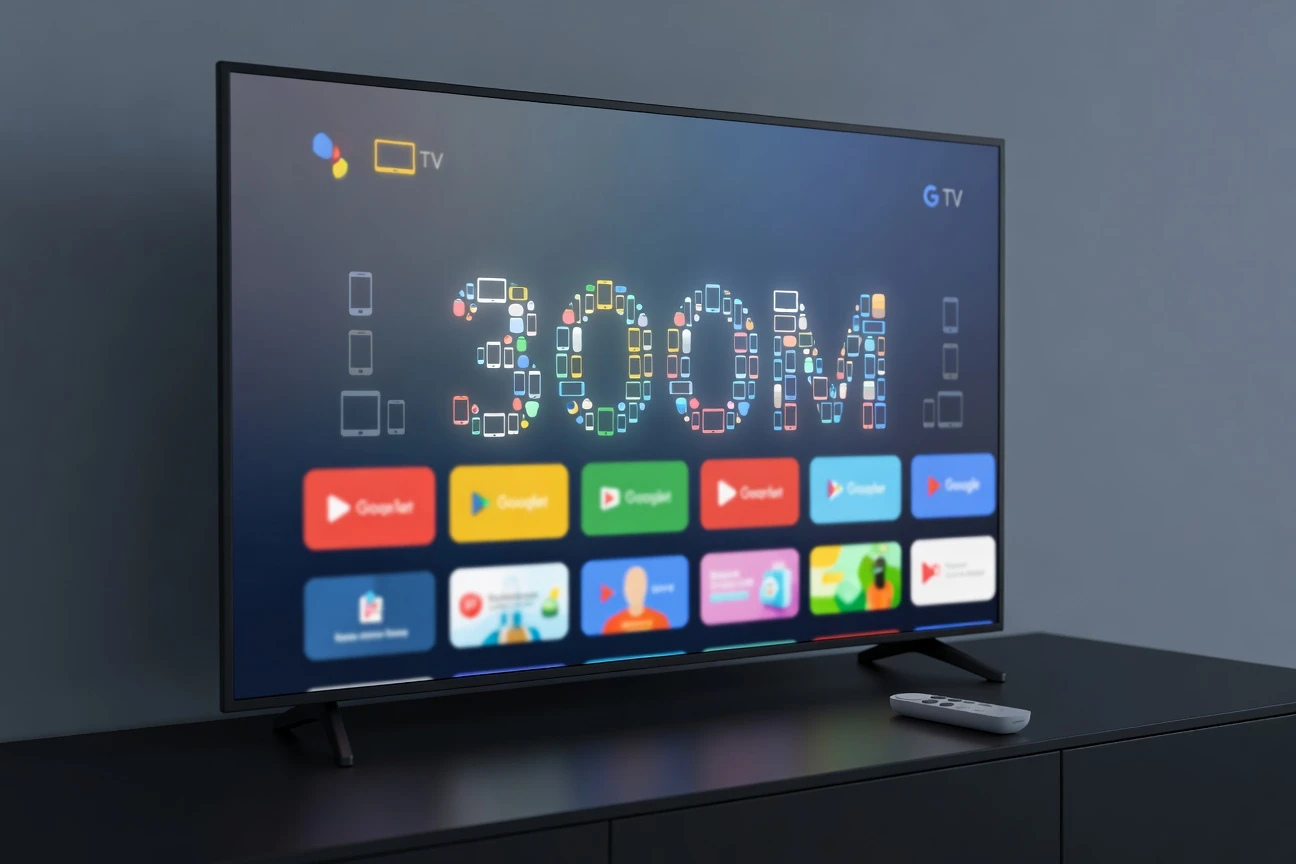
Google TV 300 million devices is the number Google, the search and Android company, wants developers to notice. The May 19 Android Developers update says Google TV and Android TV together now sit above that monthly active device tier worldwide, giving Google reach across smart TVs, streaming boxes, and app makers chasing the home screen.
The catch is pace and timing. Google reported 270 million devices on September 23, 2024, then used the same over 300 million phrasing in a September 22, 2025 Gemini rollout. At Google I/O, the number returned without a higher public tier, putting attention on discovery, ads, and app placement on the biggest screen at home.
A Milestone With Slower Math
The clean comparison starts with Google’s September 2024 Google TV update, which put the platform at 270 million monthly active Google TV and Android TV operating system (Android TV OS, the software base shared by Google TV and Android TV devices) units. The current public tier is only 30 million higher, and Google has not given a sharper figure.
A separate wrinkle matters. Google’s Gemini for TV rollout note already said the platform powered the 300M plus device tier in September 2025. That makes the I/O figure a restated scale marker rather than a fresh jump. The number remains large, but the cadence has cooled.
| Public Marker | Stated Scale | Signal for Google TV |
|---|---|---|
| September 2024 product update | 270M monthly active devices | The smart TV licensing wave was still running hot. |
| September 2025 Gemini rollout | 300M plus active devices | AI search became the next selling point. |
| May 2026 I/O developer update | Same public tier | Google put the scale in front of app developers, not a higher count. |
The route to scale came through licensing as much as hardware. TCL, the Chinese TV maker, and Hisense, the Chinese electronics company, helped put Google software into living rooms where buyers were choosing a television first and a platform second.
The Count Has Become a Surface-Area Number
Monthly active devices are not the same as people. One household can have a living-room TV, a bedroom TV, and a streaming puck all counted as separate active devices. That does not weaken Google’s number, but it changes what the number means.
For app developers, surface area is still valuable. A device can host a home row, a voice result, a free channel, a continue-watching card, and a search answer. Each placement can push a viewer toward one service and away from another before the viewer opens an app.
- 30 million disclosed net adds separate the late 2024 count and the current tier.
- Three home-screen surfaces now matter most: recommendations, voice answers, and channel rows.
- One household can own multiple active TV devices, so the count should not be read as people.
That is why the slower growth does not make the platform less important. It makes each screen more valuable. When hardware adoption cools, the money shifts to what Google can do with the screens it already has.
Gemini Moves the Fight to Discovery
Google’s answer to slower net adds is to make each screen do more. Gemini brings artificial intelligence (AI, software that turns prompts and context into responses) into TV discovery, letting viewers ask loose questions, get mixes of visuals, videos, and text, and continue the search with follow-up prompts while choosing what to watch.
The first rollout started on select TCL models, then expanded toward Google’s own streamer and more TV lines. That matters because search on a TV used to mean typing awkwardly into a box. A conversational answer can skip the app grid and move straight to a show, a clip, or a YouTube result.
- Streaming apps need cleaner metadata because prompts can surface a title before a viewer opens the app.
- YouTube gets another path into living-room answers when Gemini responds with supporting videos.
- Google Photos, Veo, and Nano Banana push the TV toward shared creation as well as playback.
That connects with the Google Gemini Omni Flash conversational video push, where Google is trying to make media creation feel less like editing software and more like a chat. On TV, the bet is similar: less menu diving, more intent.
North America Is the Weak Spot
The global count hides a regional problem. Omdia, the technology research firm, said in its North American TV operating system forecast that retailers are projected to control 47% of the region’s TV OS market by 2029, up from 27% in 2025. The same forecast said Google TV leads outside North America and China with 40% share, but faces gradual pressure from Vidaa, Titan, and TiVo.
That is the North American gatekeeper fight. Walmart, the US retailer, owns Vizio, the TV brand, and is building around CastOS. Amazon, the retail and cloud company, keeps pushing Fire TV. Google can be huge worldwide and still face a tougher path in the US living room.
Roku, the San Jose streaming platform company, makes the metric problem clear. Its first-quarter shareholder letter says more than 100 million Streaming Households worldwide use a device powered by the Roku TV operating system, and defines that as distinct accounts that streamed within the last 30 days.
That is a different metric from Google’s device count. It is also closer to how advertisers and subscription services think. A household can buy, churn, subscribe, and respond to ads. A device can only open the door.
Developers Get a New Remote Problem
The developer post gives app makers a practical clue beyond the headline count: remote input is changing. Pointer remotes bring motion-controlled input to the Google TV home page and content-heavy apps, which means old directional pad (D-pad, the up, down, left, right control on a remote) layouts need a rethink.
The idea sits near Google’s AI Pointer cursor move on smaller screens, though the TV version is about couch input rather than screen-reading assistance. The shared theme is clear enough: Google wants pointing and intent to replace slow, repeated taps.
- Add hover feedback so a viewer can see what the pointer is selecting from across the room.
- Make rows and grids respond to touchpad-style scrolling without losing focus state.
- Declare pointer support in Google Play, Google’s app marketplace, so compatible TV apps can be found and installed.
Google also wants video apps to move toward Engage SDK (software development kit, a package of tools that connects app content to Google TV recommendations). The older Watch Next API (application programming interface, a software bridge for continue-watching data) is due to lose support in the second half of 2027, which gives developers a calendar reason to pay attention now.
Advertising Turns Scale Into a Test
The business reason is advertising. The Google TV Network launch note from Google Ads, Google’s advertising business, said the network offered targeted in-stream inventory across more than 125 built-in channels. It also said Google TV and other retail Android TV OS devices had 20.1 million addressable monthly active devices in the US in 2023, with free-channel viewers averaging more than 75 minutes per day.
Those older ad figures predate the current scale marker, but they show why the device count matters. Google does not need every new viewer to buy a streamer. It needs more of the installed base to spend time in surfaces Google can measure, sell, and improve.
The same placement instinct shows up in the YouTube Google TV sidebar test, where Subscriptions and Library move higher in the rail. Small interface changes become valuable when they sit in front of hundreds of millions of devices.
If Google can make Gemini answers, Freeplay channels, and developer metadata raise viewing time per screen, the repeated scale number will look conservative. If the next public update still sits in the same tier, the living-room race will have moved from shipments to who owns the first click.
GADGETS
Chromecast Update Scare Exposes Google’s Support Gap
Chromecast security updates have not ended for most Google streaming devices, based on Google’s own support table checked on Saturday, May 23, 2026. The current list still marks Chromecast (2nd gen), Chromecast Audio, Chromecast Ultra, Chromecast (3rd gen), Chromecast with Google TV (4K), Chromecast with Google TV (HD), and Google TV Streamer (4K) as receiving critical security updates. The original 2013 Chromecast is the lone No.
That makes Friday’s scare useful, just not in the way early readers expected. Google’s older dongles remain covered on paper, yet the company has left owners to decode three support signals at once: a minimum-date table, a firmware page, and a hardware line that stopped production.
The Support Page Still Says Yes
The page that matters most is not a store listing or a forum thread. It is Google’s security update status table, the official list that pairs connected home devices with release dates, five-year minimum support dates, and a column for critical security updates.
- 5 years – Google’s minimum automatic critical security update pledge starts from the date a device first went on sale in the US Google Store.
- 1 unsupported Chromecast – The original model, released on July 31, 2013, is the only Chromecast row that currently shows
No. - Oct. 2025 – The firmware page lists that Android security patch level for both Chromecast with Google TV models.
There is a catch. Google’s public table does not show a change log for the status column, so a brief flip from Yes to No would leave no easy audit trail for normal users. The visible evidence right now points to a support-page scare rather than a mass end-of-life notice.
The Five-Year Column Changed the Read
The panic came from treating the five-year date as a hard cutoff. Google’s table labels that column as a release date plus five-year minimum, and the word minimum does a lot of work. A device can pass that date and still receive critical fixes if Google keeps it in the supported pool.
The minimum commitment gives Google room to keep shipping urgent fixes without promising full software support forever. That is why several older rows can sit years beyond their listed minimum dates and still show Yes in the support column.
| Device | Release Date | Five-Year Minimum Date | Current Critical Updates | Current Firmware or Build |
|---|---|---|---|---|
| Chromecast (2nd gen) | Sept. 30, 2015 | Sept. 30, 2020 | Yes | 1.56.467165 |
| Chromecast Audio | Sept. 29, 2015 | Sept. 29, 2020 | Yes | 1.56.467166 |
| Chromecast Ultra | Nov. 6, 2016 | Nov. 6, 2021 | Yes | 1.56.469779 |
| Chromecast (3rd gen) | Oct. 22, 2018 | Oct. 22, 2023 | Yes | 1.56.291998 |
| Chromecast with Google TV (4K) | Sept. 30, 2020 | Sept. 30, 2025 | Yes | UTTC.250917.004 |
| Chromecast (1st gen) | July 31, 2013 | July 31, 2018 | No | 1.36.159268 |
That comparison is the core of the false alarm. Five of the rows above have already crossed the listed five-year mark and still carry Google’s active critical-update status.
The Firmware Page Draws the Hardware Line
The second official signal is the Chromecast and Google TV Streamer firmware page, last updated on Nov. 24, 2025. It lists production firmware versions for older Cast devices, build numbers for Google TV devices, and release notes for the newest streaming box.
That firmware page is cleaner than the support table in one way: it gives the old devices a version number owners can compare against what appears in the Google Home app. The 2nd gen model, Audio, Ultra, and 3rd gen all sit on the 1.56 branch with bug-fix notes. The 4K and HD Google TV models share build UTTC.250917.004.
The original model gets different treatment. Google says support for the first-generation device has ended, and that it no longer receives software or security updates or technical support. That row matches the No status on the security table.
For everyone else, the firmware list matters because support status alone does not tell you whether your unit has actually taken the latest update. A device can be eligible and still lag if it has been unplugged, moved to a weak Wi-Fi spot, or left on a power strip that gets shut off every night.
Production End Made Every Support Signal Louder
Part of the confusion comes from Google’s own product shift. In its Chromecast history post, the company said the line had sold more than 100 million devices and would be available only while supplies lasted.
After 11 years and over 100 million devices sold, we’re ending production of Chromecast
Majd Bakar, VP of Engineering, Health & Home at Google, wrote that in the company’s Aug. 6, 2024 post. The same post said existing devices would keep getting software and security updates under the latest-device policy, which is why the current Yes rows carry weight.
The replacement is a more expensive living-room hub, not another tiny stick. Google’s Google TV Streamer launch post describes a 4K box with more storage, Matter support, a built-in Thread border router, and a redesigned voice remote. That move also puts more attention on the Google TV interface itself, including changes like the YouTube Google TV sidebar update now showing up for some users.
Owner Checklist for Older Google Streamers
For owners, the practical read is simple: do not replace a working device just because its five-year date passed. Do take the support page seriously if your exact model switches to No and stays there.
A few checks separate a normal old streamer from one that should leave your TV:
- Identify the exact model in the Google Home app before assuming a Reddit thread applies to your device.
- Compare the Cast firmware version or Google TV build number against Google’s official firmware page.
- For Google TV models, run System Update from the About menu after leaving the device powered on and connected.
- Retire the original 2013 model if apps stop seeing it, setup fails, or account behavior starts looking strange.
- Factory reset any streaming device before selling it, donating it, or handing it to someone outside your home.
The security point is narrower than the panic. A streamer without new critical fixes may still play video, but it becomes a weaker place to leave a signed-in Google account, streaming apps, and local-network access.
Google’s Support Gap Remains
Google’s broader Nest security commitments promise automatic critical security updates for at least five years and point users back to the published device list. The support gap is that the list itself gives no history, no timestamped row changes, and no explanation when a status changes.
The Android Open Source Project’s Chromecast Security Bulletin page adds another layer. It says Chromecast bulletins are published quarterly and that devices start receiving over the air (OTA, sent through the device’s own network connection) updates in the same month the bulletin is released. The newest Chromecast-specific entry shown there is December 2025, with security patch level 2025-12-01.
Those pages are useful for people who already know where to look. They are thin comfort for someone who sees a support row change, cannot find Google’s cached version of the old page, and has no official note explaining whether the change was intentional.
If Google leaves the table as it stands, Friday’s episode will fade as a bad screenshot day. If it silently flips older rows again, the next scare will be harder to wave away.
GADGETS
Android Hardware Week Shows the Niche Device Era Arriving
Android hardware week made the market’s split plain: Samsung kept privacy hardware on its slab flagship while Fold 8 reports point to restraint, Google and Samsung pushed Gemini into glasses, Anker put artificial intelligence (AI) in earbuds, REDMAGIC sold cooling as a feature, and Walmart held the budget tablet line at $97. For buyers, the signal is simple: the Android shelf is becoming a set of specialized tools for privacy, gaming, calls, health and cheap shared screens.
That makes this a mixed week. The wins are concrete, but the shelf gets messier when the strongest answer may be on your face, in your ear, on a family tablet or in a phone with a fan.
Android Hardware Split Into Specific Jobs
The connective tissue is hardware specialization. Samsung’s Galaxy S26 Ultra Privacy Display guide says the feature is integrated into the display hardware and changes how pixels send light, so the screen stays clear head-on while limiting side viewing. That is a narrow job, but it is a valuable one in trains, offices and airport lounges.
The same week brought devices that make narrower promises. The result is less tidy than the old flagship ladder, where every premium Android phone tried to win the same camera, chip and battery contest. Now privacy became a hardware lane, and so did voice calls, eyewear, fan cooling and cheap household screens.
| Lane | Device Or Move | Hardware Choice | Job It Claims |
|---|---|---|---|
| Privacy flagship | Galaxy S26 Ultra | Built-in privacy display layer | Hide sensitive screen content in public |
| AI eyewear | Samsung and Google Intelligent Eyewear | Gemini voice access in glasses | Handle navigation, messages and translation hands-free |
| AI audio | soundcore Liberty 5 Pro Max | Thus AI chip and 10-sensor call system | Clean up calls and capture meeting notes |
| Gaming phone | REDMAGIC 11S Pro | Snapdragon 8 Elite Gen 5 Leading Version with active cooling | Sustain game performance under heat |
| Budget tablet | Walmart onn tablets | Low-cost Android screens | Give families cheap shared devices |
Seen together, the week reads like a product map rather than a spec race. The phone remains central, but more tasks now have a better place to live.
Samsung’s Foldable Restraint Carries the Warning
The Fold 8 part of the week needs a caveat: Samsung has not announced the device, and current reports could change before launch. Still, the claim that the next book-style foldable may skip the privacy layer matters because it follows a pattern Samsung shoppers know well.
Foldables already carry more mechanical burden than slab phones. They need thin glass, hinge control, crease management, battery room and display durability in a body people still expect to pocket. Adding another screen layer is never free. If Samsung leaves the S26 Ultra’s privacy trick off a future foldable, the choice would say less about indifference to privacy and more about the physics of stacked compromises.
The leaked Galaxy Z Fold 8 Wide front design matters here because Samsung appears to be testing form as much as feature count. A wider foldable can make video, reading and typing feel less cramped, but it also changes weight balance and panel stress.
The same logic appeared in Oton Technology’s Galaxy Z Flip 8 and Flip 7 price comparison: once foldables mature, shoppers punish missing conveniences more than they reward another fast chip. That is the pressure Samsung is walking into.
AI Moved to Faces and Ears
Samsung and Google made the clearest confirmed AI move with the Intelligent Eyewear first look. The companies showed two premium styles created with Gentle Monster and Warby Parker, with first collections scheduled for this fall in select markets. The pitch is practical: ask Gemini for directions, summaries, calendar help, translation or a photo without pulling out a phone.
Intelligent eyewear represents a powerful step forward in our shared vision with Samsung to make AI more helpful and accessible in everyday life
Shahram Izadi, vice president and general manager of Android XR at Google, said that in Samsung’s May 19 press release. The line matters because it puts Google’s assistant work into a daily object instead of another phone app.
Anker’s contribution is smaller but more intimate. The soundcore Liberty 5 Pro Series page says the Liberty 5 Pro Max uses the Thus AI chip, 10 sensors and an AI note-taker in the case. It also claims 150 times the AI computing power for Environmental Noise Cancellation (ENC, call processing that cuts background noise) compared with its previous flagship earbuds.
The common bet is that AI moved closer to the senses. A phone sees only when it is raised; glasses can see what the wearer sees, and earbuds hear the call while the phone stays in a pocket.
Gaming Phones Turned Heat Into the Spec
REDMAGIC’s gaming pitch is blunt. The REDMAGIC 11S Pro launch page lists Qualcomm Snapdragon 8 Elite Gen 5 Leading Version, RedCore R4, Energy Cube 3.0, upgraded AquaCore liquid cooling, Liquid Metal 3.0, a larger vapor chamber and a 24,000 revolutions per minute (RPM, fan speed) turbo fan. It also lists a 7,500 milliamp-hour battery with 80W wired and wireless fast charging.
That is not a subtle phone. It is the Android gaming niche saying the quiet part out loud: peak silicon needs thermal hardware if the buyer wants long sessions, not just strong benchmark bursts. The rumored OnePlus Ace direction, with fan-cooled performance chatter still waiting on official confirmation, points at the same buyer psychology.
- heat is now a feature when a brand can show active cooling and sustained frame rates.
- Battery size has become part of gaming credibility because high refresh displays and flagship chips drain fast under load.
- Display speed needs game support, so a fast panel alone cannot promise a better match.
The loser in this lane is the do-it-all flagship. A thin glass sandwich with broad camera appeal can be the better daily phone, but it cannot easily look like the better gaming machine beside a device built around airflow.
Walmart Kept the Cheap Tablet Door Open
Walmart’s Android news sits at the other end of the shelf. On the company’s own onn Android tablet listings, new Core models appear at prices far below premium tablets: a 7-inch Core at $97, an 8-inch Core at $138 and an 11-inch Core at $167.
- $97 – Walmart’s listed price for the 7-inch onn Core Tablet.
- $138 – Walmart’s listed price for the 8-inch onn Core Tablet.
- $167 – Walmart’s listed price for the 11-inch onn Core Tablet.
The pitch is household utility: a kitchen recipe screen, a kid’s video device, a travel display, a smart-home controller or a couch browser that nobody worries about like an expensive iPad. Cheap Android tablets have always lived in that lane, but Walmart’s prices keep it alive in a week otherwise dominated by AI and premium components.
That matters for Android as a platform. Google and Samsung can push AI into eyewear, but the user base also grows through devices that cost less than a pair of high-end earbuds. Walmart’s onn line is not glamorous. It keeps Android present in the rooms where a flagship phone would be too personal, too fragile or too expensive to share.
The risk is support. Budget tablets age fast when updates slow or storage fills. A low price opens the door; software maintenance decides whether people come back for the next one.
Google Health Made the Widget Make Sense
A home-screen health widget has value only if the app behind it is becoming central. Google’s new Google Health app announcement says the Fitbit app is becoming Google Health, with an automatic rollout beginning May 19 and no separate app download needed for existing users.
The redesign gives Google four tabs: Today, Fitness, Sleep and Health. It also brings Google Health Coach, built with Gemini, into workout planning, sleep consistency and health summaries. That makes the widget in this week’s Android chatter more than a shortcut. It is a small front door into Google’s attempt to gather wearables, apps, medical records and coaching into one place.
Google also included the careful part. The company says Fitbit health and wellness data will not be used for Google Ads, and its footnotes say Google Health is not intended to diagnose, treat, cure, prevent or monitor disease. That language is not decoration. When AI moves into health, trust becomes as important as the interface.
The New Android Shelf Has Fewer Universal Answers
The buying question is becoming sharper. Someone who wants privacy on a train may look at Samsung’s slab flagship. Someone who wants phone-free prompts may wait for the eyewear launch. Someone who games hard may accept a fan. Someone who needs a family tablet may buy the cheapest onn model and ignore the rest of the week’s premium noise.
For Samsung, the risk is that foldable fans read restraint as stagnation. For Google and Samsung eyewear, the risk is comfort, battery life and data trust. For Anker, the challenge is proving that AI call processing and note-taking feel useful after the novelty fades. For Walmart, the test is whether cheap Android tablets age well enough to avoid becoming disposable screens.
If the fall eyewear launch arrives with normal-looking frames, useful battery life and careful data controls, Android gains a daily surface that does not need a hand. If it feels awkward or costly, this week still showed where the category is headed: sell the job first, then choose the shape.
GADGETS
Rocket Stove vs Clay Stove: India Test Exposes Smoke-Free Claims
Sellers of rocket stoves in India promise three things: smoke-free flames, soot-free pots, and firewood savings that make gas cylinders look expensive. A controlled kitchen test by Yusuf, host of the Engineering Facts YouTube channel, measured all three claims against a traditional clay wood stove (man aduppu) using an identical task: completely evaporating 2 liters of water to track time, firewood consumption, and combustion behavior. All three claims failed. The stove lit only after kerosene was poured in. The pot came off black. And both stoves burned through nearly identical amounts of wood.
The rocket stove under review came with a blower fan, a speed-control dial, and internal refractory insulation that made it several kilograms heavier than its size suggests. Its purchase price was ₹8,000, with ₹450 added for transport, for a landed cost of ₹8,450. The traditional clay stove used as the comparison cost ₹250.
The Insulated Chamber and What It Promises
The rocket stove design traces back to research developed at the Aprovecho Research Center in the United States during the early 1980s. The core principle is an L-shaped combustion chamber lined with refractory insulation that channels heat upward toward the pot in a concentrated column, rather than letting it disperse outward as in an open clay fire. Keeping chamber temperatures high promotes more complete combustion and, in controlled lab conditions, reduces smoke output by burning off wood gases before they can escape.
Blower-assisted models add an electric fan to push oxygen into the combustion zone, with a speed-control dial to adjust airflow intensity. Both the insulation mass and the powered fan explain why the stove weighs more than it looks: the internal structure is doing thermal work that an open clay stove leaves entirely to ambient air and gravity.
Sellers across product listings and promotional videos make three consistent claims for this category. First, that the stove burns without visible smoke during normal operation. Second, that heat concentrates so efficiently that pot bottoms stay clean. Third, that firewood consumption drops enough to offset both the purchase price premium and the per-kilogram cost of wood against gas alternatives.
Independent lab testing has found wide variation across models. India’s National Environmental Engineering Research Institute tested one category design and measured a thermal efficiency of 10.74% for cooking, a figure far below the 85-to-90 percent efficiency claims in some manufacturer specification materials reviewed by independent product assessors. That gap between marketed efficiency and measured output is the essential backdrop to any practical field test.
A Fire That Needed Kerosene to Start
Ignition was the first test, and the stove did not clear it without help. Working through approximately 5 kg of firewood across multiple failed attempts, Yusuf could not establish a stable fire. The wood was slightly damp, an unremarkable condition in any household kitchen but one that laboratory test protocols carefully exclude by specifying fully dried, small-diameter fuel sticks whose moisture content is precisely measured before each burn.
Kerosene was eventually poured in to get combustion started. A stove marketed as a cleaner and more modern alternative to open clay cooking requires users to keep a flammable accelerant on hand for ignition, which introduces both a safety variable and an additional input that the product’s promotional materials do not address.
Once the blower was running and the fire stable, the stove did burn intensely. Forced airflow created a concentrated, hot flame that transferred heat quickly to the pot. Completely evaporating 2 liters of water took approximately 20 minutes. The traditional clay stove needed about 90 minutes for the same task, a gap that is genuinely large and represents the rocket stove’s one defensible functional advantage in this test.
Smoke appeared throughout the burn from the fuel-feed side, not in trace amounts but visibly, particularly when fresh wood was added. The pot came off with a layer of soot on the bottom. Aprovecho’s published research on Indian rocket stove designs notes that natural-draft models without chimney systems were found not clean enough to meet health-protection emission thresholds, and the powered blower in this model did not overcome the fundamental problem that damp wood in an unvented kitchen space still produces particulates.
The clay stove also produced smoke and soot, as expected from any open wood fire. Neither stove delivered on the “smoke-free” or “soot-free” description that distinguishes the rocket stove in its marketing from the clay alternative it is supposed to replace.
Two Stoves, One Task, by the Numbers
Measured across the complete evaporation task with both stoves running under the same conditions, the results were as follows.
| Metric | Rocket Stove | Clay Stove (Man Aduppu) |
|---|---|---|
| Time to evaporate 2 liters of water | ~20 minutes | ~90 minutes |
| Firewood consumed | ~2.95 kg | ~2.8 kg |
| Firewood cost at ₹11 per kg | ~₹33 | ~₹33 |
| Visible smoke during burn | Yes | Yes |
| Soot on pot bottom | Yes | Yes |
| Electricity needed | Yes (~60W blower fan) | No |
| Purchase price | ₹8,450 (incl. transport) | ₹250 |
The firewood numbers are where the efficiency promise collapses most visibly. At roughly 2.95 kg for the rocket stove and 2.8 kg for the clay stove, the difference per task is about 150 grams, worth under ₹2 at prevailing rates. Peer-reviewed fuel consumption comparisons between stove types consistently show that field results vary substantially from manufacturer claims depending on wood moisture and cooking conditions. The test here, using slightly damp wood, produced near-parity on fuel use between a stove costing 33 times as much as the other.
Speed is where the results genuinely diverge. A 4.5-times faster task completion matters for any cook on a schedule, and it is the legitimate core of the rocket stove’s value case. That advantage deserved more prominence than the smoke-free and soot-free claims the category leads with.
- 20 min: time for the rocket stove to complete the evaporation task once burning at full heat
- 90 min: time needed in the clay stove for the same task
- ~150 g: the firewood edge the rocket stove showed per session, worth under ₹2 at market rates
- ₹8,200: the purchase premium over a clay stove that the near-identical per-session fuel savings cannot recover quickly
The Cost Breakdown That Changes the Math
The Purchase Price Gap
The rocket stove costs ₹8,000 before it reaches a kitchen, with ₹450 added for transport, landing at ₹8,450. That is a ₹8,200 gap over a traditional clay stove, and every rupee of it has to be recovered through operational savings before the premium product reaches financial break-even.
Firewood at ₹11 per kilogram makes the per-session cost nearly identical between the two stoves. Both consumed roughly ₹33 worth of wood to complete the evaporation task. Scale that to a full day of household cooking, morning chai, a pot of rice, lentils, and an evening meal, and the volumes rise considerably. But the percentage difference between 2.95 kg and 2.8 kg of consumption does not change with volume. The savings case rests entirely on whether efficiency widens with consistently dry wood, a condition the test did not demonstrate and that households in humid climates cannot always guarantee.
Running Costs in the Field
The blower fan draws approximately 60 watts during operation. At two hours of daily use, that comes to about 0.12 kilowatt-hours per day, or roughly 7.2 electricity units over 60 days. At average Indian domestic tariffs, the added power cost runs between ₹50 and ₹75 over two months, a minor figure that does not shift the analysis either way.
Gas is a different comparison. Yusuf’s review series includes a calculation putting the LPG (liquefied petroleum gas) cost for the same evaporation task at approximately ₹18. Firewood at ₹11 per kilogram, consuming roughly 3 kg per session in either wood-burning stove, comes to about ₹33. Under the test conditions, a gas burner was cheaper per cooking task than wood in either stove.
That comparison shifts when households have access to free, subsidized, or self-gathered wood, or when LPG supply tightens and cylinder prices move above current levels. For anyone purchasing firewood at open-market rates in an urban or peri-urban setting, the gas-versus-wood arithmetic is not the obvious win the rocket stove’s marketing implies.
The break-even timeline is long at the efficiency gap this test measured. With roughly ₹1 in firewood savings per session, recovering the ₹8,200 premium requires more than 8,000 cooking tasks. Even with a more optimistic ₹5 per-session advantage from sustained dry-wood operation, the break-even still sits beyond 1,600 sessions, over two years of twice-daily cooking at peak efficiency with no interruption.
Where the Rocket Stove Earns Its Keep
Speed is the one result from the test that was not close. Finishing the evaporation task in 20 minutes rather than 90 changes the shape of a working day, and for households that rely on wood fires for most of their cooking, the time savings carry genuine value that goes well beyond the per-session rupee calculation.
Commercial kitchens sit in a structurally different position than home users. A dhaba (roadside eatery) or catering operation running multiple service sittings needs large volumes of hot water, stock, and bulk cooking within a compressed window. Time savings that look modest at the household scale multiply across 10 to 20 liters per service batch, and throughput becomes the dominant metric rather than fuel cost per kilogram. Several conditions shift the cost-benefit calculation toward the rocket stove:
- Large-volume cooking where 10-plus liters need heating per service period
- Access to dry or free firewood, which closes the per-session cost gap and may widen the efficiency advantage
- Outdoor or well-ventilated commercial spaces where smoke from the fuel-feed side is a manageable rather than critical constraint
- Backup cooking capacity during LPG supply disruptions, where speed under uncertain fuel conditions carries operational value
- Settings where the purchase cost can be distributed across high daily throughput rather than occasional household tasks
The honest framing is that this is a speed-first wood-burning tool that works best with dry fuel, careful ignition management, and a cooking environment tolerant of some smoke output. Buyers choosing between the two stoves are making a bet on whether that speed advantage, and the operational discipline it demands, is worth 33 times the upfront clay-stove cost.
Put in a commercial kitchen running three service sittings a day, the ₹8,200 premium over a clay stove could plausibly be recovered within months through time savings alone. In a household kitchen used twice daily with seasonally damp wood, that recovery may never arrive.
Frequently Asked Questions
Is a Rocket Stove Smoke-Free?
No, not under typical real-world conditions. A blower-assisted rocket stove still produces visible smoke, particularly from the fuel-feed side when wood is added and when the wood is not fully dry. Laboratory tests using carefully controlled dry wood show meaningful emission reductions compared to open clay stoves, but “smoke-free” as an unqualified marketing claim does not hold up in a standard home kitchen where wood moisture is rarely controlled.
How Does Firewood Consumption Compare to a Clay Stove?
In the Engineering Facts comparison test, the rocket stove consumed approximately 2.95 kg of firewood and the clay stove consumed about 2.8 kg to complete the same evaporation task, a difference of roughly 150 grams per session. Under optimal conditions with fully dry, small-diameter wood, the gap may widen, but the test found both stoves performing nearly identically on fuel use.
Is a Rocket Stove Worth Buying for Home Cooking in India?
For most households, the test results suggest the premium is hard to justify. The stove’s purchase premium over a clay stove cannot be recovered quickly when per-session firewood consumption is nearly identical, ignition requires kerosene for damp wood, and LPG is cheaper per task at current market prices. The stove’s strongest advantage, speed, matters more in high-throughput commercial cooking than in typical daily household use.
Does a Rocket Stove Require Electricity?
Blower-assisted models, the dominant variety sold in the Indian market, use a small electric fan drawing approximately 60 watts, with a dial to adjust airflow speed. Basic passive rocket stove designs without a blower need no electricity, but powered models cannot operate during outages and add a small electricity cost to each session, estimated at roughly ₹50 to ₹75 over 60 days of two-hour daily use.
How Much Does a Rocket Stove Cost in India?
The model reviewed here cost ₹8,000 for the stove itself and ₹450 for transport. Other manufacturers offer models ranging from approximately ₹5,500 for basic designs to ₹27,000 for units with chimney pipe attachments suited to enclosed kitchens. A traditional clay stove (man aduppu) typically costs around ₹250.
Is Gas Cheaper Than Firewood for Boiling Water?
Under the conditions of this test, yes. Completing the evaporation task with LPG cost approximately ₹18, compared to roughly ₹33 worth of firewood in either wood-burning stove at ₹11 per kilogram. This comparison reverses when households have access to free or subsidized firewood, or when LPG prices rise significantly above the levels in this review.
-
CRYPTO3 weeks agoAndreessen Horowitz Bets $2.2B on Crypto’s Quiet Cycle
-
CRYPTO2 weeks agoCathie Wood Calls SpaceX IPO Demand ‘Voracious’ Ahead Of $1.75T Debut
-
NEWS2 weeks agoGhana CSA Plants Office In Ho As Volta Cybercrime Climbs
-
APPS3 weeks agoGoogle’s Buried Page Reveals 500 Niche Websites Still Making Cash
-
NEWS3 weeks agoHormuud Bets $19 Down Will Finally Pull Somalia Online
-
NEWS2 weeks agoApple Strikes Preliminary Deal For Intel To Make iPhone And Mac Chips
-
NEWS3 weeks agoMetalenz Polar ID Hides Face Unlock Under OLED Smartphone Screens
-
AI2 weeks agoGoogle AI Overviews Adds Subscribed Label, Reddit Quotes Inline





