NEWS
Samsung and LG Win iPhone 18 Pro LTPO+ Panels; BOE Sits Out
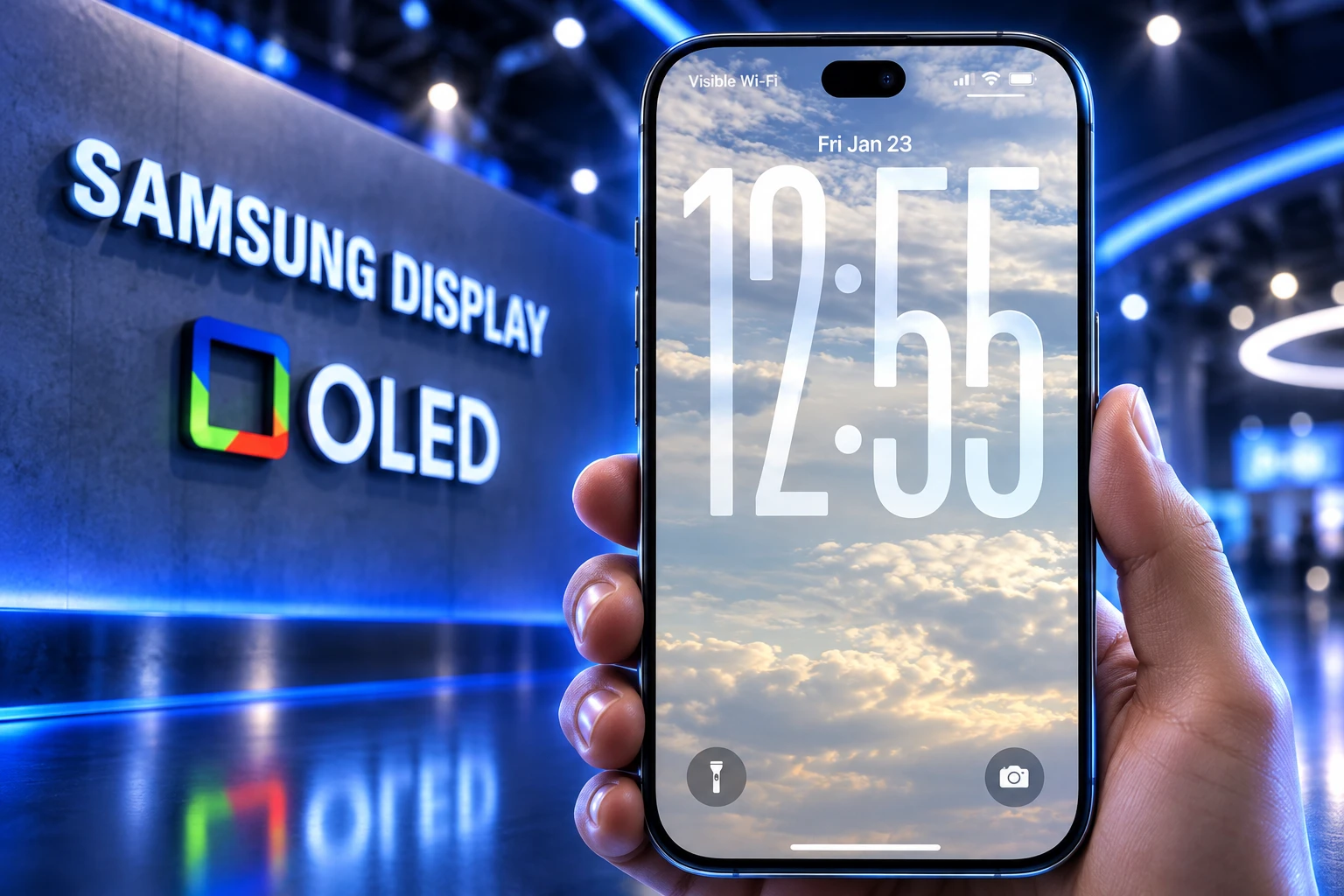
Samsung Display is on track to ship roughly 146 million OLED panels to Apple this year. LG Display has been cleared for more than 82 million. Both volumes lean on a new backplane technology that BOE, the Chinese supplier Cupertino spent four years grooming for the premium tier, could not yield in time.
The shift moves the iPhone 18 Pro display order back into a two-supplier Korean lock, with BOE relegated to legacy and entry-level iPhones. Korean publication The Elec, which broke the allocation in early May, says Apple plans to sign off on final LTPO+ (Low-Temperature Polycrystalline Oxide Plus, an oxide-extended OLED backplane) panel approvals this month ahead of a September unveil.
Samsung and LG Reclaim the Pro Panel Order
Only the Pro and Pro Max in the iPhone 18 family carry the new LTPO+ panel, the step beyond the LTPO screens Apple has shipped on Pro-series phones since the iPhone 13 Pro launch in September 2021. Samsung Display sourced the majority of Apple’s Pro panel volume in that period; BOE clawed in for the iPhone 17 Pro after passing certification late last year.
That window closed faster than the Chinese supplier expected.
Allocation as currently reported:
- Samsung Display: roughly 146 million OLED (Organic Light-Emitting Diode) panels across the iPhone 18 family, including the bulk of Pro and Pro Max units
- LG Display: more than 82 million units, including a meaningful share of the Pro and Pro Max
- BOE: approximately 35 million units, concentrated on iPhone 14, 15, 16e, 16, 17e, and 17, with the Pro 17 line alone accounting for about 8.2 million
Apple has scheduled its panel sign-offs for May, with mass-production ramps to follow in early summer for a September Pro launch. The cheaper iPhone 18 and iPhone 18e have been pushed to the spring of 2027, which means BOE’s premium shut-out also overlaps a quiet six-month stretch on the volume calendar; the budget models the Chinese supplier would have shipped at scale are not even in store yet.

How LTPO+ Rewires the OLED Backplane
LTPO+ is a backplane spec, not a panel surface. The visible glass and the OLED emission layer on top look the same. What changes is the layer of transistors underneath that decides which pixels light, how brightly, and when they update.
The shift has two ingredients in the transistor stack, both inherited from earlier OLED generations and then pushed further.
From LTPS to LTPO
LTPS (Low-Temperature Polycrystalline Silicon, the standard thin-film transistor layer behind AMOLED screens) is fast and drives current well, but it leaks power. A static screen on an LTPS panel still refreshes 60 to 120 times a second and burns battery for the privilege.
LTPO keeps LTPS for the high-speed current-driving transistors and swaps in IGZO (Indium Gallium Zinc Oxide, an oxide semiconductor) for the switching transistors. IGZO has near-zero off-state leakage, which is what lets the panel hold a frame at 1Hz without flicker or visible roll-off.
The Oxide Layer Goes Deeper
LTPO+ extends the oxide treatment further into the driving transistor itself. According to research from Seoul-based UBI Research, the upgrade enables finer control of how much current each subpixel receives, allowing the panel to optimise emission for the room and the content on screen.
The practical effect is more efficient pixel-level dimming and a wider variable refresh range, without the brownout artefacts current panels show in the 1Hz to 10Hz band.
The comparison stack:
| Backplane | Switching transistor | Driving transistor | Refresh range | Idle power |
|---|---|---|---|---|
| LTPS | LTPS | LTPS | 60 to 120Hz | Highest |
| LTPO | IGZO oxide | LTPS | 1 to 120Hz | Lower |
| LTPO+ | IGZO oxide | Extended oxide | 1 to 120Hz, finer steps | Lowest |
That technical shift is also what locked BOE out. Producing oxide transistors with the uniformity needed for primary current control is harder than producing them for switching alone, and defect rates climb with every additional oxide layer in the stack.
BOE’s Setback and the Hedge Apple Keeps
BOE certified for iPhone 17 Pro panels late last year after years of yield work, and the win was treated in Beijing as a milestone in China’s catch-up race against Samsung Display and LG Display.
The new spec reset that race. The Chinese maker’s pilot lines could produce the upgraded panels, but not at the yield and uniformity Apple’s quality team demanded for a Pro tier shipping tens of millions of units in a single quarter.
Still, Apple has not blacklisted the supplier.
BOE remains the primary OLED source for iPhone 14, iPhone 15, iPhone 16e, iPhone 16, iPhone 17e, and the standard iPhone 17. The company targets roughly 35 million Apple display shipments in 2026, with about 8.2 million of those tied to the iPhone 17 Pro line carrying over.
Apple’s purchasing pattern across two decades of iPhone production shows the company keeps a third supplier in the room even when it cannot fill the top tier. The presence of a viable alternative is what gives Cupertino price leverage against the dominant vendor; Korean panel pricing for Pro models has historically eased when BOE has been able to take incremental volume. The same hedging instinct shows up elsewhere in the supply bench, including Apple’s preliminary chip deal with Intel for iPhone and Mac silicon.
That backup role is what BOE will play through the iPhone 18 cycle. The cost advantage matters because the budget iPhone 18 and iPhone 18e, both pushed to spring 2027, will land into a price-sensitive band where Apple will lean on the Chinese supplier rather than the Koreans. The dynamic runs the other way too; Samsung’s own talks with BOE for the base Galaxy S27 display show even BOE’s South Korean rivals turn to the Chinese supplier when entry-level pricing matters.
Under-Display Face ID and a Shrinking Cutout
The reason the new backplane requirement was severe enough to drop BOE goes beyond power efficiency.
Reports from The Elec and ETNews indicate the iPhone 18 Pro panel specification includes a region of the backplane engineered to host an infrared sensor beneath the OLED layer. Apple needs the screen to pass enough infrared light through to the sensor for the dot-projector array Face ID uses, without compromising visible-light brightness or uniformity above it.
That hybrid region is what would reduce the size of the Dynamic Island cutout. Apple has carried a notch or pill on every iPhone since the iPhone X launched in 2017, so the iPhone 18 Pro would be the first to shrink the cutout substantially, with most Face ID components moving under the screen and only the front camera remaining in a smaller pinhole.
The under-display infrared work is a Samsung Display speciality deployed earlier on Galaxy Z Fold internal-camera modules, and Korean industry sources say the firm is the only LTPO+ partner already producing yield-passable infrared-window panels. LG Display is reportedly developing its own version of the technology but lags by roughly six months, which is why its share of the iPhone 18 Pro and Pro Max volume sits below Samsung’s even within the two-supplier Korean lock.
The Battery Question the Spec Sheet Will Not Answer
The selling point Apple typically attaches to a display upgrade is battery life, but the gain from a backplane transition is hard to isolate from everything else changing on the phone.
The numbers in play:
- About one hour: the video-runtime gain LTPO added to the iPhone 13 Pro over the iPhone 12 Pro, per Apple’s own spec sheet
- 2nm: the process node of the A20 Pro chip headed for the iPhone 18 Pro, the more obvious efficiency lever
- 1Hz to 120Hz: the variable-refresh range LTPO unlocked, retained in the new generation with finer steps
- ~228 million: the combined LTPO+ panel volume Samsung Display and LG Display are slated to produce this year
The display layer is rarely the headline efficiency story even when it changes substantially. Apple typically routes display-driver gains into a thinner phone rather than into a longer runtime number on the box, and the consensus design renders for the iPhone 18 Pro already show a thinner profile.
On-device AI workloads have been rising on every iPhone generation since the iPhone 16 introduced Apple Intelligence, and a more efficient backplane buys back some of the power those models consume. Neither analysts nor supply-chain reporters have yet given a verifiable percentage gain for the new panels alone.
A realistic forecast is one to two extra hours of advertised video playback over the iPhone 17 Pro Max’s current claim. Whether buyers feel that gain depends on how aggressively Apple’s AI features draw from the same battery pool.
September Hinges on May’s Panel Approvals
Apple is expected to sign off on Samsung Display’s and LG Display’s tooling this month, with mass production starting in early summer. The Pro and Pro Max would then move into final assembly through July and August before the fall reveal, slotted for the company’s usual September window.
What does not move in that window is the volume model. The standard iPhone 18 and iPhone 18e are now scheduled for spring 2027, the first time since the iPhone SE second generation in 2020 that Apple has decoupled its Pro and non-Pro launches by two quarters. The foldable iPhone is the wild card; reports place it alongside the iPhone 18 Pro in September, but supply-chain notes from earlier this month flag December as a fallback if Samsung’s foldable OLED ramp slips.
If the May approvals close cleanly, Apple ships a Pro line on the new backplane with a shrunken Dynamic Island, a 2nm chip, and a variable-aperture main camera. If the approvals slip into June, the Pro launch holds and the foldable absorbs the delay.
Apple’s panel approvals for the two Korean suppliers are due by the end of May at a combined volume of 228 million units. The September Pro launch falls or holds on that signoff.
CRYPTO
Iran’s Hormuz Safe Bitcoin Insurance Walks Into an OFAC Trap
Iran’s Ministry of Economic Affairs and Finance pushed a maritime insurance platform called Hormuz Safe into state media on Saturday, with premiums settled in bitcoin and a public revenue target above $10 billion. U.S. Energy Information Administration data on the world’s oil transit chokepoints show roughly a fifth of global petroleum consumption moves through the Strait of Hormuz, and the new platform proposes to let cargo owners buy coverage in bitcoin (BTC, the largest cryptocurrency by market capitalization), receive a digitally signed receipt, and transit the waterway.
The U.S. Treasury’s Office of Foreign Assets Control pre-empted the launch by two weeks. On May 1, 2026, OFAC told shippers that paying Iranian state actors for safe passage, in any currency including digital assets, is a sanctionable act.
What Hormuz Safe Claims and What Has Actually Shipped
The originating report came from Fars News Agency, an outlet affiliated with the Islamic Revolutionary Guard Corps. Fars News Agency published the originating report on May 16, 2026, citing a document obtained from the Ministry of Economy. The story was authored by Fatemeh Sadeghi and timestamped at 20:44 Tehran time.
Iranian state media framed the initiative as a sovereign instrument. “The Ministry of Economy is advancing a plan that would make the management of the Strait of Hormuz possible through insurance, a model that would be acceptable to other countries during peacetime while still allowing Iran to exercise control over the Strait,” the agency’s correspondent reported, citing a government document. A second line from the same document said Iran would achieve “informational dominance” and be able to distinguish between vessels from different countries.
The verified facts are narrower than the headline. The platform’s website is live but largely empty. OFAC has acknowledged Iranian threats to shipping and demands for toll payments through the strait, noting the demands may include fiat currency, digital assets, offsets, informal swaps, or in-kind payments such as nominally charitable donations to the Iranian Red Crescent Society, Bonyad Mostazafan, or Iranian embassy accounts. No independently audited revenue model, no list of underwriting partners, and no policy schedule has been published.
| Claim from Fars report | Verifiable status as of Monday |
|---|---|
| Platform settles policies in bitcoin and other digital assets | Stated on hormuzsafe.ir landing copy; no on-chain wallet disclosed |
| Revenue projection above $10 billion | No methodology, market share assumption, or premium schedule published |
| Covers inspection, detention, confiscation; excludes weapon-strike damage | Quoted from internal government document; no policy wording released |
| Backed by Iran’s Ministry of Economy | Sourced to one Fars News report citing one ministry document |
| Operationally live for cargo owners | Website shows a campaign page; no transaction flow tested publicly |

OFAC’s May 1 Alert Drew the Line Before Tehran Crossed It
The Treasury alert is the single most consequential document for any shipowner reading the Fars story. It was issued sixteen days before Hormuz Safe’s announcement, and it names the exact scenario the platform describes.
U.S. persons are also generally prohibited from engaging with Iranian digital asset exchanges, which are considered blocked Iranian financial institutions under U.S. sanctions.
That line, from the OFAC alert on Strait of Hormuz passage payments, closes the door on a U.S.-owned vessel paying a bitcoin premium to a state-backed Iranian platform. The alert goes further for non-U.S. shippers. Non-U.S. persons may face exposure to sanctions for transacting with the Iranian government and the IRGC, including secondary sanctions on participating foreign financial institutions.
Treasury also warned that vessels of all flags entering or leaving Iranian ports remain subject to U.S. Central Command’s naval enforcement, and that any OFAC license a shipper might hold does not supersede other federal agencies’ authorities. In short, the legal calculus for any commercial operator considering Hormuz Safe was already settled before the platform existed.
Bitcoin Is a Strange Choice for a Sanctions Workaround
The most counterintuitive element of the announcement is the choice of bitcoin as the settlement asset. State-sponsored sanctions evasion has gravitated toward stablecoins for years precisely because they hold dollar value, and even those have become harder to move undetected.
On April 24, Treasury added new cryptocurrency wallet addresses tied to the Central Bank of Iran to its Specially Designated Nationals list. The same enforcement window produced a striking number. Tether collaborated with U.S. law enforcement to freeze $344 million in USDT, and a U.S. official told CNN the seized funds were linked to Iran, citing transactions with Iranian exchanges and a series of intermediary addresses interacting with Central Bank of Iran-associated wallets.
Why Transparency Cuts Against the Stated Goal
A bitcoin transaction lives on a public ledger forever. The fact that payments would be denominated in cryptocurrency rather than fiat does not change the underlying sanctions implications, and unlike traditional payment rails, the blockchain’s inherent transparency makes it possible for regulators and compliance teams to trace the flow of funds in near real time. The choice of an open ledger as the rail for a covert payment is, on its face, self-defeating.
What hardens the irony is the visibility Iranian state-linked addresses already have. According to Chainalysis, the IRGC’s crypto footprint accounted for approximately 50% of Iran’s total crypto ecosystem in the fourth quarter of 2025 and has been documented across billions of dollars in transaction volume per OFAC designations, NBCTF seizure lists, and leaked Central Bank of Iran addresses. Any wallet Hormuz Safe publishes for premium collection enters that same surveillance perimeter the moment it receives its first transaction.
The Compliance Cost for Ports and Insurers
The downstream effect is the part shipowners actually care about. A vessel that paid a Hormuz Safe premium and later docks in Rotterdam, Singapore, or Houston risks having that on-chain payment surfaced by any compliance vendor with screening access. The certificate the platform issues, framed by Fars as a verifiable digital receipt, doubles as a record of the exact violation OFAC just warned against.
- Every premium settlement creates a permanent, attributable on-chain entry tied to a Treasury-flagged jurisdiction.
- Major stablecoin issuers have demonstrated they will freeze balances tied to Iranian wallets after Treasury designations.
- Port-state authorities in OECD jurisdictions can request the wallet history as evidence in a sanctions inquiry.
Who Could Pay Premiums Without Triggering Secondary Sanctions
The shrinking question is who Hormuz Safe is actually for. Western insurers, P&I clubs, and dollar-clearing banks are out by definition. That leaves a narrow set of operators already adapted to sanctions exposure.
Chinese refiners and the shadow-fleet tankers that move Iranian crude have been the operating customer base for years. China, India, Japan, and South Korea were the top destinations for crude oil moving through the Strait of Hormuz to Asia, accounting for 67% of all Hormuz crude oil and condensate flows in 2022 and the first half of 2023. Of those four, only the first two have a track record of accepting Iranian-linked cargoes after the U.S. snapped sanctions back into force.
The math on potential demand:
- 20.9 million barrels per day flowed through the strait in the first half of 2025, per EIA data.
- 5.5 million barrels per day of refined product moves through the same waterway daily.
- Roughly 40 vessels tied to Iran’s shadow fleet were named in Treasury actions around the April 24 designations.
- The International Energy Agency’s analysis of Strait of Hormuz energy security notes that almost 20% of global LNG trade also moves through the chokepoint.
Even within that pool of theoretical buyers, the platform faces a credibility test. Major questions remain over whether international shipping companies would recognize Iranian-issued maritime insurance, whether global insurers would accept the legal validity of such coverage, and whether ships using the system could face secondary U.S. sanctions, with no official response so far from the White House, the Pentagon, major Western maritime insurers, or Gulf governments.
From Strait Tolls to Insurance Wrapper
Hormuz Safe did not arrive cold. It is the latest iteration of a six-week-old pattern in which Iran has tried to monetize passage rather than block it. The reporting on bitcoin-denominated tolls predates the insurance announcement by weeks.
- Early April 2026: Reports of crypto-denominated and yuan-denominated payments for safe passage through Hormuz begin circulating.
- April 8, 2026: A Financial Times report quoted Hamid Hosseini, spokesperson for Iran’s Oil, Gas and Petrochemical Products Exporters’ Union, saying tankers would need to email Iranian authorities about their cargo and then be given a few seconds to pay in bitcoin to avoid being traced or confiscated due to sanctions.
- April 24, 2026: OFAC updates Central Bank of Iran designations with new crypto addresses; Tether freezes $344 million in USDT linked to the network.
- May 1, 2026: OFAC issues the formal alert on Strait of Hormuz passage payments, naming digital assets explicitly.
- May 16, 2026: Fars News publishes the Hormuz Safe document, repackaging the toll concept as insurance.
The repackaging matters legally and rhetorically. Shipping industry sources have described the platform as a formal mechanism for Iran to collect revenue from operators willing to move through waters under its control, while critics have called it a potential protection scheme, warning that vessels may effectively be pressured to pay Iran for safe passage through a waterway it helped destabilize. An insurance wrapper sounds more like commerce than coercion. The wrapper does not change what Treasury sees.
It also sits inside a broader pattern of Iranian pressure campaigns this spring, including a cyber operation that doxxed thousands of U.S. Marines stationed across the Persian Gulf. Tehran is testing leverage on multiple surfaces at once.
Inside hormuzsafe.ir as of Monday
The ground truth on the domain itself is the simplest part of the story. The platform’s website shows a “Coming Soon” or landing page as of the time of this report, and details are likely to evolve quickly given how recently the initiative was announced. Cybersecurity researchers have also flagged a parallel risk that has run alongside this entire toll story.
Scams have already moved into the gap. Cybersecurity professionals have noted that prior crypto scams have impersonated Iranian government authorities, ostensibly collecting “safe passage” fees from vessel operators, and while Hormuz Safe appears to be a distinct state-sanctioned initiative, crypto safe-passage scams have proliferated since the start of the war. A shipowner who Googles “hormuz safe passage bitcoin” today will surface both the official Iranian domain and a layer of impostor sites built to drain wallets without delivering anything.
For now the platform is a state-media announcement and a holding page. Whether it becomes an operational market, a useful piece of geopolitical signaling for Tehran, or a footnote depends on what hormuzsafe.ir actually publishes in the coming days. The website still reads Coming Soon; the sanctions exposure does not.
Disclaimer: This article is for informational purposes only and does not constitute legal, financial, or sanctions-compliance advice. Payments to Iranian state-linked platforms, including in cryptocurrency, may violate U.S. sanctions and expose operators to civil and criminal penalties. Shipowners, insurers, and cargo operators should consult qualified sanctions counsel before engaging with any service connected to the Strait of Hormuz. Figures and regulatory references are accurate as of publication on May 18, 2026.
COMPUTERS
Arm Faces FTC Probe as Seoul and Brussels Pursue Same Case
The US Federal Trade Commission (FTC, the agency that polices anticompetitive behavior in American markets) has opened a formal antitrust probe into Arm Holdings over how the British chip-design firm licenses the architectures that sit inside almost every smartphone and a growing share of data center servers. The company confirmed earlier this year that it received a document-preservation request, and the investigation was first reported on May 15, sending Arm shares down as much as 8 percent intraday before the stock recovered to close near $208.
Cambridge, England has stopped being a pure blueprint shop. On March 24, Arm shipped a 136-core data center processor co-developed with Meta, the first production silicon in the firm’s 35-year history. That product, and the way it changes Arm’s relationship with the customers who pay its royalties, sits at the heart of three antitrust inquiries now running on three continents.
The FTC’s Question, in One Sentence
The Commission is asking whether Arm intends to refuse or degrade the central processing unit (CPU, the main calculation engine inside a chip) blueprints it licenses to Apple, NVIDIA, Qualcomm, MediaTek and roughly every other large fabless chip company, at the same moment Arm has begun selling its own competing silicon into the same accounts. The probe is at the information-gathering stage. Arm confirmed in a filing that it had been told to preserve documents and said it intends to cooperate.
Investors did not wait for the procedure to play out. ARM dropped to roughly $190 in extended trading on May 15 before institutional buyers stepped back in, leaving the close at $207.96, a slim daily loss against a stock that had nearly doubled this year and outpaced the Philadelphia Semiconductor Index. The pullback wiped close to $7 billion of paper value before most of it recovered, and the move underlined how much of the current valuation rides on regulators leaving the licensing model intact.

Three Continents, One Complaint
Look behind each of the three probes and you find the same plaintiff. Qualcomm filed parallel antitrust complaints with the FTC, the European Commission, and South Korea’s Korea Fair Trade Commission (KFTC, the country’s antitrust regulator) in March 2025, weeks after a Delaware jury sided with Qualcomm in a separate licensing fight.
| Regulator | Status (May 2026) | Trigger filing | Focus area |
|---|---|---|---|
| US Federal Trade Commission | Active probe, document-preservation order issued | Qualcomm complaint, March 2025 | Whether Arm degrades CPU licenses as it sells competing silicon |
| European Commission | Investigation opened | Qualcomm complaint, March 2025 | Abuse of dominance in CPU architectures across the bloc |
| South Korea KFTC | On-site inspection at Seoul office, November 2025 | Qualcomm complaint, March 2025 | Restrictions on Nuvia-derived licenses, market access |
A simultaneous filing across three jurisdictions is a chosen escalation. It forces parallel discovery, makes settlement harder to broker, and pushes the dispute from contract court into competition law, where injunctive remedies can include compulsory licensing. Each regulator picked up a different slice of the same question: Brussels on single-market access, Seoul on the contested Nuvia rights, Washington on the broader squeeze.
Why Cambridge Stopped Being Just a Licensor
For three and a half decades, Arm sold one product line: instruction-set architectures and CPU cores that other companies stitched into silicon and paid royalties on. Rene Haas, Arm’s chief executive officer, has been pushing the company up that value chain since the SoftBank-engineered initial public offering of September 2023.
The AGI CPU and the Meta Hand
The clearest break with the old model arrived in March of this year. Arm unveiled the AGI CPU, a 136-core processor built on TSMC’s 3-nanometer node and packed with Neoverse V3 cores running at up to 3.7 GHz boost across two dies, all within a 300-watt envelope. Meta is the lead customer and co-developer, with Santosh Janardhan, Meta’s head of infrastructure, publicly committing to a multi-generation roadmap.
Arm has also disclosed commercial commitments from Cerebras, Cloudflare, F5, OpenAI, Positron, Rebellions, SAP and SK Telecom. The chip is sold as finished silicon, not as a design file. That is the line the new business has crossed.
Compute Subsystems Double the Royalty
The shift began earlier with the Compute Subsystems product framing. CSS bundles CPU cores, memory controllers, and interconnect into a verified package rather than selling cores piecemeal. Arm’s own disclosures put CSS royalty rates at roughly double those of legacy core licenses.
By the November 2025 quarter, the company had signed 19 CSS licenses across 11 customers, with five designs already shipping inside products from NVIDIA, Google, and Microsoft.
From Cortex to C1
A naming change makes the strategy concrete. Arm is retiring the Cortex brand, in use since 2004, in favor of C1-Ultra, C1-Premium, C1-Pro and C1-Nano tiers. The new lineup comes pre-integrated for original equipment manufacturers. It also comes with the price tag of a finished platform rather than a piece of intellectual property, which is the lever regulators are watching most closely.
The Qualcomm Tripwire That Set Everything Off
The road to the Seoul raid runs through a Delaware courtroom. In December 2024, a jury found that Qualcomm did not breach Arm’s licensing agreement when it acquired the chip startup Nuvia for $1.4 billion and used its Oryon cores inside Snapdragon X laptop processors. A September 2025 post-trial ruling extinguished Arm’s last remaining claim.
After two years of litigation, Arm has lost. Every claim it asserted against Qualcomm and Nuvia has been rejected by the court.
That wording is from Qualcomm’s October 1, 2025 statement on the post-trial judgment. The phrasing matters: it converted what Arm framed as a contract dispute into the foundation for a multijurisdictional antitrust attack. Qualcomm’s regulatory complaints argue that Arm shifted from an open licensing model into a restrictive one, choosing which customers receive full access and which get a degraded tier as the licensor moves closer to selling rival products. Arm’s public position is that its terms are non-discriminatory and that finished silicon is additive to the licensing book, not exclusive of it.
What the Licensees Stand to Lose
If any of the three regulators finds Arm has been narrowing access, the immediate beneficiaries are the licensees that have been quietly stockpiling alternatives. Each carries a different exposure.
- Most insulated: Apple holds a perpetual architecture license dating to the 1990s. The probe still matters because Apple Silicon’s roadmap depends on Arm’s instruction-set extensions for matrix math, and the company has been hedging foundry exposure through a preliminary chip-manufacturing deal with Intel.
- The would-be acquirer: NVIDIA pays royalties on the Grace and Grace Blackwell server CPUs and tried to buy Arm outright for $40 billion in 2020 before regulators killed the deal. It now sits across the table from a licensor it once expected to own, while running its own $40 billion AI equity program in parallel.
- The plaintiff: Qualcomm has shifted Snapdragon X laptop chips onto Nuvia-derived Oryon cores. A favorable antitrust outcome would lock in that path and open compulsory-licensing remedies if any regulator wants them.
- Quiet hedger: MediaTek licenses Arm cores for smartphone platforms and has been evaluating RISC-V, the open instruction set, as an insurance line.
- Direct competitors now: Google, Microsoft, and Amazon all license Compute Subsystems and now face Arm’s own silicon bidding against them for Meta-style hyperscaler workloads.
The dependency runs deep. By Arm’s own count, the architectures power more than 50 percent of CPU compute shipped to hyperscalers in fiscal 2026. A regulator that finds the licensor abusing that base of power has substantial remedy options on the shelf.
The Royalty Engine Under the Probe
Arm’s fiscal year ended March 31, and the company reported record numbers on May 7. The shape of those numbers, disclosed in Arm’s fourth-quarter fiscal 2026 earnings release, explains why a probe focused on licensing behavior rattled investors so quickly.
- $4.92 billion in full-year revenue, the third straight year of growth above 20 percent since the 2023 listing.
- $2.61 billion in royalty revenue for the year, up 21 percent, with data center royalties more than doubling.
- $2 billion of AGI CPU customer demand booked across fiscal 2027 and 2028, per the AGI CPU launch disclosure, before the chip ships at volume.
The structure of those numbers tells the regulatory story. Royalty income, the older revenue line, grew slower than licensing. The licensing line is where CSS and the new pre-integrated platforms sit, and where price discipline can be exercised by tier. The new silicon business sits outside both lines: it is hardware revenue Arm did not collect before, sold into accounts that also pay fees on competing designs. That overlap is what the three regulators are now mapping.
If the FTC settles for a consent decree that constrains how Arm prices its Compute Subsystem tiers, Cambridge can absorb the friction and keep growing into the framework Haas has built. If any of the three authorities finds the new silicon business requires structural separation from the licensing book, the value-chain climb that took three years to engineer gets unwound on a regulator’s schedule.
COMPUTERS
LILYGO Refreshes T-SIM Lineup With Lower-Power ESP32-S3 Boards
The most visible change in LILYGO’s T-SIM / T-A Standard Series isn’t a faster radio or a bigger flash chip. It’s the deep-sleep current, which the company says now sits between roughly 128 µA and 166 µA across several variants. Earlier boards in the same family pulled as much as 1.1 mA in the same state, an almost ten-fold gap that decides how many seasons a battery-powered remote sensor can live in the field before someone has to drive out and swap an 18650.
The refresh, first detailed by LinuxGizmos, lines up six ESP32-S3 cellular development boards under one pinout, one module choice, and one set of optional peripherals. Hobbyists, agritech prototypers, and small fleets running remote monitoring on Cat-M, NB-IoT, or LTE Cat-1 are the buyers; the boards now arrive with a Qwiic connector, optional camera headers, eSIM pads, and seamless USB-to-battery switching as defaults rather than as fork variants.
What Changed in the Standard Series Refresh
The lineup keeps its modem names. The T-SIM7000G-S3, T-SIM7080G-S3, T-SIM7670G-S3, and the T-A7670 family all carry their previous radio identities. What’s different is what sits around the modem.
Every Standard variant is now built on the ESP32-S3-WROOM-1 (N16R2) module, with 16 MB of flash and 2 MB of PSRAM. That replaces a mix of earlier ESP32-WROVER-B and ESP32-S3 N16R8 configurations used across older T-SIM revisions. The PSRAM figure is worth pausing on: it’s smaller than the 8 MB PSRAM the earlier S3 boards shipped with, a deliberate trade against the WROOM-1’s lower idle current and tighter PCB footprint. For Arduino-style sketches and AT-command modem control, 2 MB of PSRAM is comfortable. For heavier edge-AI inference with framebuffers and TensorFlow Lite Micro models, builders may need to think about what fits.
The Standard boards add Qwiic connectivity, GNSS routing to the SoC on variants that didn’t have it before, PPS (pulse per second, the one-edge-per-second timing pulse a GNSS receiver provides for clock discipline) support on selected models, eSIM solder pads, and pin compatibility across the family. A second USB Type-C port is now standard for modem firmware updates alongside the ESP programming port, which removes one of the more annoying parts of the older workflow.

The Modem Lineup at a Glance
The Standard Series collapses six product pages into one decision tree. The radio class drives the rest of the spec sheet.
| Board | Modem | Radio Class | Integrated GNSS | Target Use |
|---|---|---|---|---|
| T-SIM7000G-S3 | SIMCom SIM7000G | GSM / Cat-M / NB-IoT | Yes | Low-throughput sensors, legacy 2G fallback |
| T-SIM7080G-S3 | SIMCom SIM7080G | Cat-M / NB-IoT (no 2G) | Yes | Battery-first IoT, PSM-deep deployments |
| T-SIM7670G-S3 | SIMCom SIM7670G | LTE Cat-1 (FDD/TDD) | Yes | 4G data, video frames, MQTT-over-LTE |
| T-A7670E-S3 | SIMCom A7670E | LTE Cat-1, regional | Optional | Europe, MEA, South Korea, Thailand |
| T-A7670G-S3 | SIMCom A7670G | LTE Cat-1, global | Optional | Worldwide LTE deployments |
The two Cat-M / NB-IoT boards target the kind of project that needs a packet every few minutes, not a video stream. SIMCom’s own datasheet for the SIM7080G notes that the module supports Power Saving Mode and Extended Discontinuous Reception, two LTE features that let a device idle in a near-off state between scheduled wake-ups. The two LTE Cat-1 boards do the heavier lifting; the SIM7670G is the one builders pick when frames from a camera need to leave the field reliably.
Deep-Sleep Current Drops Nearly Ten-Fold
Average deep-sleep current is the number that decides whether a solar-charged remote sensor survives a cloudy week. The Standard Series moves it sharply.
The figures published in the comparison table:
- Approximately 128 µA on the lowest Standard variants, climbing to roughly 166 µA across the rest.
- Up to 1.1 mA reported for earlier T-SIM boards in the same deep-sleep state.
- That’s a reduction of roughly 8.6 times at the floor, large enough to swing the duty cycle math for a battery-powered node from days to weeks of standby on a single 18650 cell.
Two design choices drive the drop. The first is the move to the WROOM-1 (N16R2) module, which idles cleaner than the older WROVER-B and N16R8 parts the family used to ship. The second is the seamless power switching circuit, which removes a leakage path between USB and battery rails that some earlier T-SIM revisions carried. The catch sits in the PSRAM column: 2 MB is plenty for AT-command modem buffers, MQTT message queues, and a small image frame, but it isn’t generous if a builder wants to layer a real edge-AI vision pipeline on top.
Qwiic, Camera, and the Cellular-Camera BOM
The second-order story sits here. Building a remote camera node that uploads frames over LTE used to mean stitching three boards together: an ESP32-S3 dev board for the brains, a separate cellular modem with its own UART link and power management, and an OV-series camera carrier on yet another connector. The wiring was the project. The Standard Series turns that into one PCB.
Across the lineup, LILYGO now routes:
- An OV-series camera interface with GPIO mappings, allowing OV2640 or OV5640 modules to drop in directly for face detection, license-plate capture, or wildlife monitoring.
- A Qwiic connector (Sparkfun’s 4-pin I2C/UART standard, which lets sensors plug in without soldering) for downstream peripherals such as environmental sensors and OLED screens.
- An 18650 lithium-cell holder with USB-C and solar charging inputs, plus the new seamless power switching that hands off between sources without a brownout.
- A microSD slot for local frame buffering when the cellular link is offline, plus eSIM solder pads for fleet deployments that don’t want a physical SIM tray.
Before this refresh, a maker building a solar-powered remote camera-plus-cellular sensor would have priced two boards plus interconnect at around the cost of one mid-range smartphone. The Standard Series puts that bill of materials on a single PCB under one firmware image, which is the change that actually matters for small-fleet deployments. Whether the bet pays off depends on builders accepting the 2 MB PSRAM ceiling. For asset trackers, environmental loggers, and occasional-frame surveillance, the trade is straightforward.
Regional Bands and Modem Selection
The modem decision is regional first, application second. LILYGO splits the LTE Cat-1 family into two SKUs because the LTE band landscape doesn’t accept one global radio.
The A7670E variant is documented for Europe, the Middle East, Africa, South Korea, and Thailand. The A7670G is the global model, which is also the one most North American buyers pick when they want Cat-1 reach without committing to a region-specific board. The SIM7670G is the broadly compatible LTE Cat-1 option that ships with integrated GNSS routing to the ESP32-S3 in the Standard revision, a feature that the earlier non-Standard T-SIM7670G S3 did not include. LILYGO’s product page for the T-SIM7670G S3 spells out the difference between the two SKUs directly:
Feature T-SIM7670G S3 (H707) vs T-SIM7670G S3 Standard (H802): module changes from ESP32-S3-WROOM-1 (N16R8) to ESP32-S3-WROOM-1 (N16R2); QWIIC, seamless power switching, GNSS routing to SoC, GNSS PPS, eSIM pad, and camera interface all change from absent to present on the Standard SKU.
For builders deciding between Cat-M / NB-IoT and Cat-1, the trade is throughput against power. NB-IoT downlink on the SIM7080G tops out around 136 Kbps; Cat-1 on the SIM7670G clears single-digit megabits comfortably. A weather station does not need Cat-1. A field camera that uploads JPEG frames every fifteen minutes probably does.
Caveats Worth Knowing Before You Order
The refresh is genuinely useful, but the Standard Series carries a few rough edges worth flagging before a build order goes out.
- The PSRAM cut from 8 MB to 2 MB is real. Edge-AI vision projects that worked on the earlier S3 N16R8 boards may need to shrink their models or move framebuffers to PSRAM-light strategies.
- The Qwiic connector on some T-SIM boards has historically been wired as UART rather than I2C, a point earlier buyers flagged in product reviews. Builders should check the silkscreen and the per-board documentation in the LilyGo-Modem-Series GitHub repository before assuming an I2C-only sensor will work.
- LILYGO’s note that availability varies by modem selection is the practical headline. The A7670E ships into Europe-friendly stock channels; the A7670G global model is the safer pick for buyers outside listed regions.
- Cat-M and NB-IoT coverage is carrier-dependent. The SIM7080G supports the bands, but a builder in a market without commercial NB-IoT roaming will spend an evening on AT+CPSI debugging before the first packet leaves the bench.
Frequently Asked Questions
How Is the Standard Series Different From the Original T-SIM Boards?
The Standard Series replaces the older ESP32-S3-WROOM-1 (N16R8) and ESP32-WROVER-B modules with the WROOM-1 (N16R2), and it adds Qwiic, camera interfaces, seamless power switching, GNSS routing to the SoC, GNSS PPS, and eSIM pads as defaults across the lineup. Deep-sleep current also drops to roughly 128 to 166 µA on Standard variants, compared with up to 1.1 mA on earlier boards.
Which Standard Board Should I Pick for Battery-First Deployments?
The T-SIM7080G-S3 is the strongest pick when battery life matters more than throughput. Its SIM7080G modem supports Power Saving Mode and Extended Discontinuous Reception, two LTE features designed for low-data IoT nodes that wake briefly and sleep deeply.
Can I Use the Camera Interface for Edge-AI Vision?
Yes, the boards expose GPIO mappings for OV-series image sensors such as the OV2640 and OV5640. The constraint is the 2 MB PSRAM ceiling on the WROOM-1 (N16R2) module, which limits framebuffer size and the depth of TensorFlow Lite Micro models a builder can run alongside the cellular stack.
Which Modem Covers North America Best?
For LTE Cat-1, the A7670G global SKU is the broadly compatible choice for North American deployments. For Cat-M and NB-IoT, the SIM7080G covers most North American Cat-M bands, but carrier roaming for NB-IoT is still patchy outside specific commercial agreements.
Is There a Seamless Way to Switch Between USB and Battery Power?
Yes, the Standard Series introduces seamless power switching as a default circuit, which hands off between USB Type-C input and the 18650 cell without a brownout. Earlier T-SIM boards relied on the on/off switch being bypassed when external batteries were attached to the VBAT pin, which made unattended deployments fragile.
Where Can I Find Reference Code and Schematics?
LILYGO maintains the LilyGo-Modem-Series repository on GitHub with quick-start guides for the T-A7670X-S3-Standard, T-SIM7670G-S3-Standard, T-SIM7000G-S3-Standard, T-SIM7080G-S3-Standard, and T-SIM7600G-S3-Standard variants. The repo also documents the AT-command path through the modem and the TinyGSM fork required for A7670 and SIM767x parts.
The T-SIM / T-A Standard Series is listed on LILYGO’s website now, with availability varying by modem selection. The boards a remote-sensor builder reaches for this season are the same six names as before, on a refreshed PCB that finally treats Qwiic, camera, GNSS routing, and seamless power as table stakes rather than as upgrades.
-
CRYPTO2 weeks agoAndreessen Horowitz Bets $2.2B on Crypto’s Quiet Cycle
-
CRYPTO1 week agoCathie Wood Calls SpaceX IPO Demand ‘Voracious’ Ahead Of $1.75T Debut
-
NEWS2 weeks agoGhana CSA Plants Office In Ho As Volta Cybercrime Climbs
-
APPS2 weeks agoGoogle’s Buried Page Reveals 500 Niche Websites Still Making Cash
-
NEWS2 weeks agoHormuud Bets $19 Down Will Finally Pull Somalia Online
-
NEWS1 week agoApple Strikes Preliminary Deal For Intel To Make iPhone And Mac Chips
-
AI1 week agoGoogle AI Overviews Adds Subscribed Label, Reddit Quotes Inline
-
NEWS2 weeks agoMetalenz Polar ID Hides Face Unlock Under OLED Smartphone Screens