
COMPUTERS
Ferveret Fits Nuclear-Inspired Cooling Into a 4U Box
Ferveret’s 4U nuclear-inspired cooling skips facility water, a local veto that has already stalled more than $130 billion in U.S. data center projects.

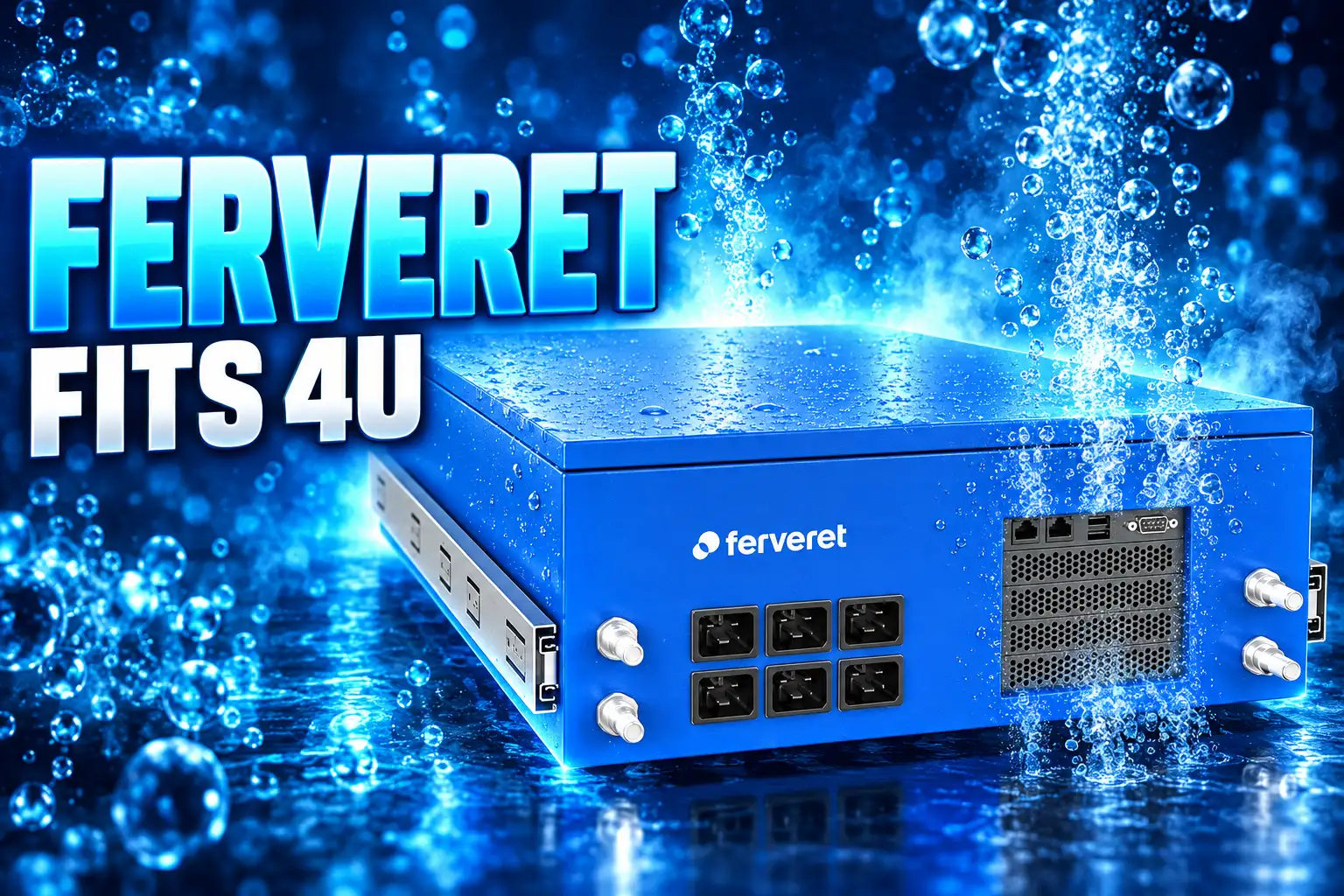
Ferveret now packs Adaptive Phase Cooling into a 4U cold box that slides into a standard rack and uses no facility water. CEO Reza Azizian said in early September that trials are running with Aramco, Switch, and the neocloud FarmGPU, and that ten of the boxes can sit in a 42U cabinet with a claimed 600 kW of cooling.
The Electric Power Research Institute projects data centers will take 9 percent to 17 percent of U.S. electricity by 2030, up from 4 to 5 percent now. About a third of that load already goes to cooling. The box is Ferveret’s answer to a second squeeze: towns that will not give new halls the water evaporative systems drink.
The 4U Box That Skips the Tank
Azizian, a former MIT nuclear engineering postdoc, founded the San Jose firm in 2021 with Matteo Bucci, MIT’s Esther and Harold E. Edgerton Associate Professor in Nuclear Science and Engineering. Azizian is CEO. Bucci is CTO and still on the MIT faculty. Y Combinator lists 16 people and a Summer 2021 batch. PitchBook records a $9.7 million seed dated June 4, 2025, with Aramco Ventures among the backers.
Most two-phase immersion still looks like a chest freezer. Operators dunk whole servers in a vat, then chase vapor, pressure, and fluid loss. Azizian said that form factor will not drop into a typical hall. Ferveret’s Lambert unit is a sealed 4U enclosure around one server, with a single inlet and outlet manifold, light enough that he says a rack can run half direct-to-chip and half Ferveret.
THE PATH FROM REACTOR LAB TO RACK
- 2013: Azizian, then an MIT postdoc, meets Bucci, then a research scientist, and they work on reactor heat transfer with MIT Energy Initiative funding.
- 2017: Azizian walks into his first data center, sees the fan wall, and later recalls thinking, “Holy crap, this is not how you cool facilities.”
- 2021: The pair starts Ferveret and joins Y Combinator’s Summer batch.
- June 4, 2025: PitchBook logs the $9.7 million seed, including Aramco Ventures.
- June 10, 2026: MIT News publishes the UCLA efficiency result and names CleanSpark, FuriosaAI, and Switch as test customers.
- September 3, 2026: Azizian describes the 4U Lambert box and names Aramco, Switch, and FarmGPU as current trials.
He also said the boxes skip the copper cold plates of direct-to-chip loops and hold much less fluid than a tank. Servers lift out for repair. With the glycol-based dielectric he described, they come out dry, so crews are not waiting a day for oil to drip off a board.
HOW THE FOUR COOLING PATHS COMPARE
| Approach | Where it lives | On-site water | What you trade |
|---|---|---|---|
| Air | CRAC units and a fan wall | Often evaporative | Azizian said air cooling can still take 40 percent of hall power |
| Direct-to-chip | Cold plates in a vertical rack | Facility loop and CDU | Fans still cool the rest of the server |
| Tank immersion | Large vats, often two-phase | Low or none at the chip | Rebuild the hall; manage vapor and pressure |
| Ferveret APC | 4U box, up to 10 in a 42U rack | None at the hall, company says | Still in pilots, not a production standard |
The rack math is the commercial pitch. Immersion has always had a heat-transfer case. It has not had a way into the cabinets already bolted to the floor.
Why Subcooled Boiling Fits in a Rack
Ferveret adapted a reactor regime called subcooled boiling, also described as subcooled nucleate boiling. The liquid has a low boiling point, which Azizian put between 45 and 50 degrees Celsius. Tiny bubbles form on the chip, detach, and collapse back into cooler bulk liquid before they can fill a vapor space. That rewetting cycle is the heat pump. Conventional two-phase immersion lets large bubbles rise into a plenum, which is why those systems need tanks and tight pressure control.
Liquid is a better heat transfer medium than air. That’s why when you stick your hand into room temperature water it still feels cold. When liquid is boiling, it becomes even better at removing heat because the phase change requires a lot of energy, which is the energy you remove from the chip.
Matteo Bucci, co-founder and CTO, MIT News
Azizian said a heat exchanger in the fluid holds a cool top layer so bubbles collapse in the bulk. Pressure does not stack the way it does when vapor leaves the liquid. Without that stack, the package can shrink to 4U. Y Combinator’s company page says the dielectric is not in any regulated PFAS class. Azizian separately said the loop can run on standard PG25, a glycol mix that is already common in cooling plants.
Heat still has to leave the building. In a subcooled box the energy rides in hot liquid that must be pumped to a dry cooler or other rejector, so facility flow still scales with watts. Two-phase tanks move much of that energy as vapor. The physics that lets Ferveret skip the tank does not skip the outdoor plant. It changes which plant you are allowed to build.
15 Percent More Teraflops Per Watt on H200s
A study with UCLA’s Samueli Computer Science Department found a 15 percent improvement in computational power efficiency against state-of-the-art liquid cooling. Azizian later said the same 15 percent was measured as teraflops per watt on Nvidia H200 GPUs versus direct-to-chip, with about 5 percent coming from a cooler chip and the rest from deleting the fan bank that direct-to-chip still needs for the rest of the server. That is the same result this site already covered as 15 percent more compute per watt in a UCLA test.
The company then stacks its power-control software, which reads temperature and pressure in each box and trims server power in real time. Combined, Ferveret says operators can pull 35 percent more tokens from the same power. That 35 percent is a company figure, not the UCLA head-to-head. Y Combinator lists a PUE of 1.03 versus the 1.2 industry standard, 45 C inlet water that is meant to kill chillers, and compatibility with Nvidia MGX and HGX. Ferveret is in Nvidia’s Inception program.
THE EFFICIENCY CLAIMS FERVERET IS SELLING
- UCLA / H200 result: 15 percent more teraflops per watt than direct-to-chip liquid cooling on Nvidia H200s.
- Fan share of that gain: Azizian said about 5 percent is cooler silicon; the rest is the fans that come out.
- Tokens with software: 35 percent more tokens from the same power, per Ferveret, once its control stack is included.
- Plant overhead: PUE 1.03 on the Y Combinator page, with 45 C inlets and no chiller in the design case.
Azizian has said the goal is to spend every watt on tokens. Bucci’s stack is the box, the rack, the distribution units, and the sensors. That is not a hyperscaler production contract.
Drought Counties Already Veto the Water
Lawrence Berkeley National Laboratory put U.S. data-center cooling at 17.4 billion gallons of direct water in 2023, plus 211 billion gallons used to make the electricity. Local fights ignore that split. They see a new campus asking a utility for cooling water in a dry basin. An analysis of 809 planned U.S. sites put 517 of them on land that had been in drought over the prior year.
The Information Technology and Innovation Foundation counted more than $130 billion in projects delayed or abandoned in the first quarter of 2026, more than the total for all of 2025. It also counted more than 200 state bills on data centers in 2025, more than 40 enacted, and bans or pauses under discussion in more than 20 states. After the Bureau of Reclamation required Arizona to cut 760,000 acre-feet under a two-year plan, Attorney General Kris Mayes called for a pause on new data-center construction, calling the sites power- and water-intensive.
THE WATER VETO ON NEW CAMPUSES
- Direct cooling water: 17.4 billion gallons in 2023, per Lawrence Berkeley National Laboratory.
- Power-plant water: 211 billion gallons tied to the same facilities’ electricity, more than ten times the direct figure.
- Drought map: 517 of 809 planned U.S. data centers sited on land that had been in drought.
- Permit freeze: More than $130 billion delayed or dropped in the first quarter of 2026, per ITIF.
Chips do not require municipal water. Operators use it because evaporative cooling is cheap. A sealed dielectric box is a way to take that cheap option off the application without waiting for a river allocation.
The Local Permit Is the Veto
Arizona has tightened groundwater certificates for hyperscale projects. Virginia has added no-net-increase water clauses. Google’s Lancaster, Ohio site won approval after a pledge to use non-potable or reclaimed supply. Microsoft’s Mount Pleasant campus in Wisconsin sat in a multi-year hold while regulators demanded aquifer studies. Those fights are about gallons a town can see, not about a coal plant two states away.
Bucci has made that geography the product story. “The sun shines in places where you don’t have much water, so the advantage of us being water-free is we allow you to build data centers where you have solar energy but nothing to cool the data center down,” he said, naming Africa, the Middle East, and parts of America.
Most AI Water Never Touches the Hall
A 2026 analysis by Xylem and Global Water Intelligence put direct data-center cooling at about 4 percent of the extra water AI will demand by 2050. Power generation took about 54 percent. Chip fabrication took about 42 percent. A water-free hall does not shrink a gas turbine’s cooling tower or a logic fab’s ultrapure loop. It can still change whether a county board votes yes. That is a smaller climate claim than the marketing line, and a larger permitting claim than the 15 percent lab result.
Aramco Backs the Desert Siting Bet
Aramco Ventures, the venture arm of Saudi Aramco, put money into the 2025 seed and, by early September, was on Azizian’s trial list. Switch, one of the largest U.S. operators, appears in both the June MIT News roster and the September list. FarmGPU is the new name. CleanSpark and FuriosaAI were named in June and were not in Azizian’s September trio. Ferveret has not published a customer-by-customer status board.
WHERE THE SEPTEMBER TRIALS SIT
- Aramco: Investor and, as of September 3, 2026, a named trial, which matches Bucci’s Middle East siting case.
- Switch: Large U.S. operator on both the June and September lists.
- FarmGPU: Neocloud named in September; no public production figures attached.
The company also said in June it was talking to hyperscalers and would name broader partnerships later in 2026. That announcement has not landed as a signed campus deal. The June post from the official account is still the public pitch: more tokens, zero water, modular boxes in existing racks.
What started as a friendship at @MIT has quickly become a mission: helping data centers generate more AI compute with less power and zero water consumption.
Today, Ferveret was featured in MIT News.
As AI infrastructure scales, cooling is no longer a supporting system. It's a…
— Ferveret (@ferveret) June 11, 2026
Azizian’s own line on reactors is the business model in one sentence. “Heat transfer determines how much energy you can extract from the reactor core, which translates directly to revenue.” Tokens are the same unit, counted at the meter instead of the turbine.
Direct-to-Chip Still Runs Most New Halls
Liquid cooling split years ago into cold plates and vats. Cold plates won the AI buildout because they fit the rack, spare operators a dunk tank, and ride the same Open Compute conversations that already govern server hardware. Samantha Yates, a principal engineer at Intel, has said large immersion deployments exist and that the Open Compute Project’s immersion group is moving fast, but that immersion has not had AI’s inflection the way direct-to-chip did.
The problem is that a lot of people have had a bad taste of immersion, especially two-phase, in the past, so getting past that initial barrier can be hard. But we’ve found that once we spend some time with customers, get our product in their hands, and run a pilot, they convert pretty fast.
Reza Azizian, CEO, on the September 3, 2026 product briefing
Austrian firm Diggers already sells a sealed direct-to-chip box, and Exoscale has run an 80 kW rack of that design in Vienna since 2023. Ferveret’s difference is boiling at the chip without a vapor plenum. That is a physics claim operators will test against leak, fluid makeup, and service time, not against a press photo of bubbles.
Azizian was blunt about incumbency. If direct-to-chip already delivers the performance a campus wants, he said, that campus will not move. He also said power is tight enough that many will have to look. Ferveret’s site puts a typical wait for large-campus power at three to seven years. Cooling that returns watts to the IT load is how a stalled interconnect still ships tokens.
Finish the Pilots or Lose the Window
The UCLA number is a completed test. The product is not. Azizian’s stated priority for the rest of 2026 is to finish the pilots on the floor, turn some into longer contracts, and close server-maker partnerships so the 4U box ships as a known SKU rather than a science project.
WHAT WE KNOW
- Hardware shape: A 4U sealed box, up to ten in a 42U rack, 600 kW of cooling claimed for that full stack.
- Measured gain: 15 percent teraflops per watt versus direct-to-chip on H200s, in work with UCLA Samueli.
- Capital: $9.7 million seed on June 4, 2025, Y Combinator alumni, Nvidia Inception.
WHAT IS UNCONFIRMED
- 35 percent tokens: Company figure that adds software and modeled plant savings; not a published production trace.
- June customers: CleanSpark and FuriosaAI were named in June and absent from the September trial list.
- Hyperscaler deals: Talks described, no named cloud campus on a multi-year cooling contract.
Azizian said data-center operators will do what they can to squeeze more work from the power they already have, and that Ferveret has shown it can move that number. The remaining proof is a signed hall, in a county that would not have given it water.

The Yemen Cell Kept Claude’s Flight Code After the Ban

Unofficial AI Pages Beat Marshall County’s Sheriff to Every Scare

The SEC Crypto Rule Leaves Exchanges Still Exposed

Brian Bengs Bets His Senate Race on an AI Stop

Agentic Workflows Turn Cheap Tokens Into Larger AI Bills

Fable 5 Came Back Under a Commerce On-Off Switch

Google’s SpaceX GPU Lease Has a Sept. 30 Deadline

Plasma One’s XPL Locks Face a 1.81 Billion Cliff

DGO’s Rs 549 World Cup Pass Cost Fans Sleep and Data

Moonshot AI’s $30 Billion Ask Became a $35 Billion Close
-
 AI3 months ago
Fable 5 Came Back Under a Commerce On-Off Switch
-
 AI4 months ago
Google’s SpaceX GPU Lease Has a Sept. 30 Deadline
-
 CRYPTO4 months ago
Plasma One’s XPL Locks Face a 1.81 Billion Cliff
-
 APPS4 months ago
DGO’s Rs 549 World Cup Pass Cost Fans Sleep and Data
-
 AI4 months ago
Moonshot AI’s $30 Billion Ask Became a $35 Billion Close
-

 NEWS4 months ago
ColorOS 17 Device List Spans Oppo, OnePlus and Realme
-

 GAMING4 months ago
Xbox Cuts 3,200 Jobs After Five Years of Thin Returns
-

 GAMING3 months ago
The RTX 4050 Under Rs 70,000 Hides a Wattage Gap