
AI
Canada’s Bill to Ban Under-16 Social Media and Regulate AI Chatbots
Canada’s Digital Safety Act would ban under-16s from social media, set new rules for AI chatbots, and create a Digital Safety Commission with fines of 3% of global revenue.

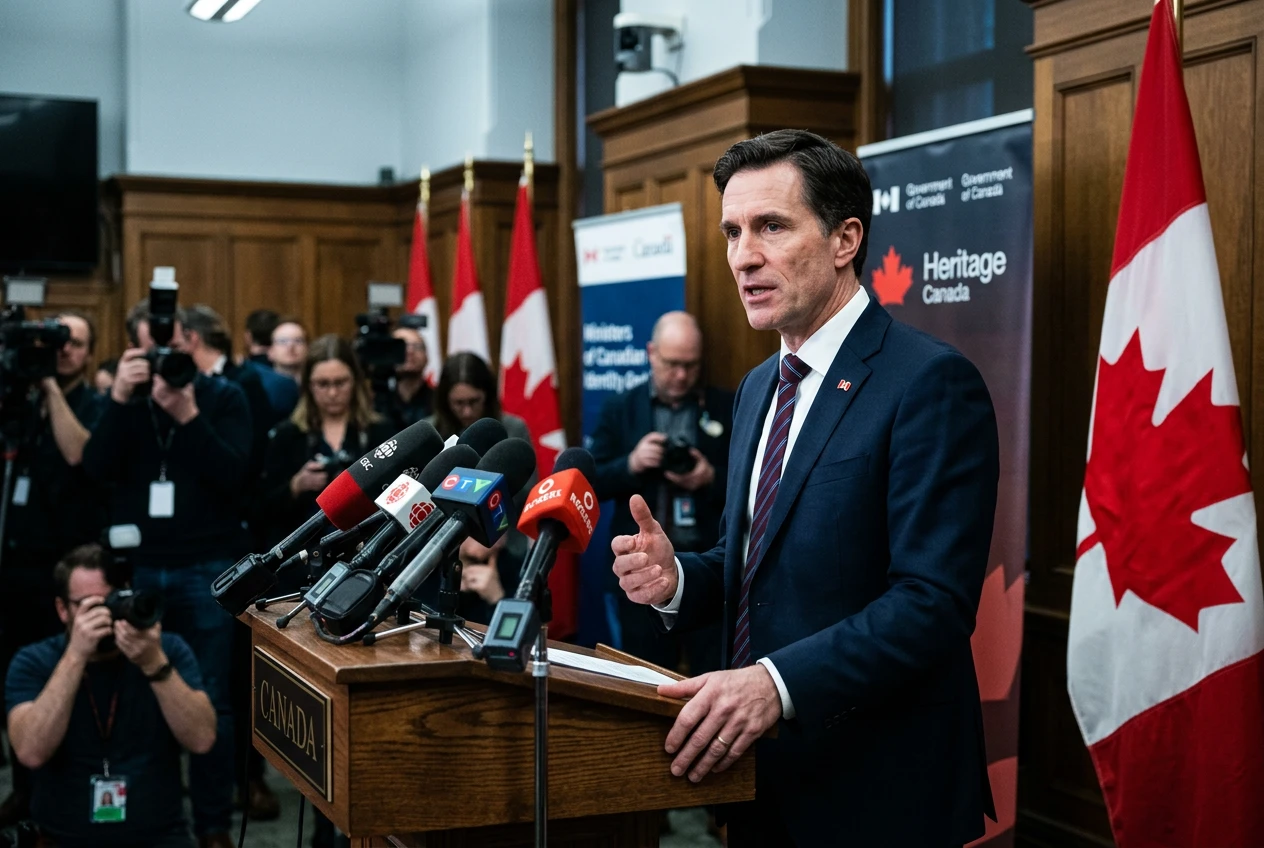
Canada’s Liberal government introduced a bill on Wednesday that would ban social media accounts for children under 16, with an exemption for platforms that can show they meet new safety standards. The bill, formally Bill C-34 and titled the Safe Social Media Act (also known as the Digital Safety Act), would also create a new Digital Safety Commission of Canada and impose the country’s first statutory duty of care on AI chatbots. Penalties for non-compliance reach 3% of global revenue or C$10 million (about $7.2 million), whichever is more.
What Bill C-34 Actually Does
Culture Minister Marc Miller tabled Bill C-34 in the House of Commons on June 10, two days after the government’s technical briefing signalled what was coming. Under the bill, regulated social media services would not be allowed to host accounts for users under 16, with a pathway back in for any platform that can demonstrate to the new regulator that it has put in place sufficient safeguards for children. Cabinet will issue a directive later naming which platforms the law actually applies to, a list expected to take six to eight months after royal assent to produce.
The bill extends well beyond social media. AI chatbot services would be subject to three statutory duties: a Duty to Protect Children, a Duty to Act Responsibly, and a Duty to Make Certain Content Inaccessible. Regulated services would be required to identify, mitigate, and address risks on their platforms, apply labels to synthetically generated content, and remove two specific categories of harmful content, child sexual victimization material and non-consensual intimate images, within 24 hours. The penalty tier is the same as the social media provision: 3% of global revenue or C$10 million, whichever is greater, with multiple penalties possible for repeated violations.
“Social media platforms and AI chatbots are designed to capture attention. They do not support healthy childhood development and have become a source of anxiety, isolation, depression and a range of other mental health challenges for many young Canadians,” Miller said in a statement. The full bill language, including definitions for chatbot services, social media services, and seven categories of harmful content, is laid out in the bill’s first reading text and full definitions. The same bill was reported the same day by the wire services, including the Reuters account that carries Miller’s statement, the platform reactions, and the global context in one place.
- Under-16 age threshold for the social media account restriction
- 3% of global revenue or C$10 million ($7.2 million) maximum penalty per violation
- 7 categories of harmful content defined in the bill, from child sexual victimization to violent extremism
- 18 months to stand up the Digital Safety Commission of Canada after royal assent
The AI Chatbot Rule and the Tumbler Ridge Backstory
The chatbot clause of Bill C-34 is the part of the bill that did not exist in the previous Canadian online-harms attempt. The legislative catalyst was a Feb. 10, 2026 mass shooting in Tumbler Ridge, B.C., in which an 18-year-old woman killed eight people, including six children at a local high school and two adults at her home, before dying of a self-inflicted gunshot wound. Investigators later found that the shooter had multi-day conversations with ChatGPT in the months before, describing scenarios involving gun violence, and that OpenAI had deactivated the underlying account in June 2025 for a violent-activities policy violation without alerting police.
CEO Sam Altman wrote a public letter of apology to the Tumbler Ridge community in the weeks after the attack, saying he was “deeply sorry that we did not alert law enforcement to the account that was banned in June.” On April 29, 2026, seven families of the deceased and the family of one survivor filed lawsuits against OpenAI and Altman in U.S. District Court for the Northern District of California, alleging negligence and that the company “made the conscious decision not to warn authorities.” The suits were filed on behalf of the five students and the teacher killed (Abel Mwansa, 12; Ezekiel Schofield, 13; Kylie Smith, 12; Zoey Benoit, 12; Ticaria Lampert, 12; and Shannda Aviugana-Durand, 39), the family of survivor Maya Gebala, 12, and others, with full details laid out in the seven families’ lawsuits against OpenAI in California. The Edmonds complaint alleges that OpenAI’s leadership overruled staff reviewers who recommended contacting Canadian law enforcement, citing a concern that the conversations did not meet the threshold of “credible and imminent” risk. The Canadian legal context also includes the earlier Canadian privacy ruling against OpenAI on its training data practices, which preceded the bill by a month.
The lawsuits seek damages and a court order requiring OpenAI to prevent users deactivated for discussing violence from creating new ChatGPT accounts, to notify law enforcement when its systems flag a real-world-harm risk, and to submit to independent monitoring. “The events in Tumbler Ridge are a tragedy,” an OpenAI spokesperson said in a statement. “We have a zero-tolerance policy for using our tools to assist in committing violence.” The spokesperson added that OpenAI has “already strengthened our safeguards, including improving how ChatGPT responds to signs of distress” and improving detection of repeat policy violators.
Bill C-34’s response to that gap is narrow but real. AI chatbot services are explicitly defined and regulated, and they are required to respond when a user “expresses ideas of suicide or self harm or an intention to commit an act that could cause death or serious bodily harm to an individual,” according to officials briefing reporters. The bill does not require chatbot companies to report those interactions to police, a limit Miller acknowledged. Asked whether the bill would have stopped the Tumbler Ridge attack, Miller said: “I’m not going to sit here and pretend today that there is one rapid solution that would have prevented” the shooting, “but I do think this law could have made a difference.” The bill’s first chatbot-service definition, covering systems that can simulate a sustained human-like relationship including therapeutic support, marks a first in Canadian law.
- June 2025 – OpenAI deactivates the future shooter’s ChatGPT account for a violent-activities violation, without contacting police.
- Feb. 10, 2026 – Eight people killed in the Tumbler Ridge, B.C. school and home attack.
- Feb. 23, 2026 – OpenAI publicly confirms it banned the account in June 2025 but did not alert authorities at the time.
- April 29, 2026 – Seven families of victims file lawsuits against OpenAI and Sam Altman in U.S. District Court for the Northern District of California.
- May 6, 2026 – Canadian privacy regulators rule OpenAI broke Canadian privacy law in training ChatGPT.
- June 10, 2026 – Bill C-34 tabled in the House of Commons, with an AI chatbot duty of care included for the first time in Canadian law.
How Canada’s Plan Differs From Australia’s
Australia became the first country in the world to enforce an under-16 social media ban when its law took effect Dec. 10, 2025. The Albanese government says 4.7 million underage accounts have been deactivated, removed, or restricted since then, a figure the communications minister, Anika Wells, has so far declined to back with supporting documents in Senate answers. Compliance data and academic research are pulling the other way, and the model is the one Ottawa is choosing not to copy. The lessons from Australia’s six-month under-16 ban in early 2026 are visible in the Canadian bill’s structure.
The Australian eSafety Commissioner’s first compliance report found that roughly 70% of children who had accounts before the ban retained access to at least one platform three months later, with no clear decline in cyberbullying or image-based abuse complaints from under-16 users. A May 2026 study of 1,027 Australian teens by Western Sydney University, Queensland University of Technology, and the University of Canberra found that two-thirds of under-16s had remained on social media since the ban took effect. A separate Western Sydney-led team surveyed 1,027 Australians aged 10 to 17 in February 2026 and found that, of the teenagers who had been blocked, roughly half said they were now seeing less news than before, with 47% reporting reduced access to world news and 45% to opportunities to share views, as detailed in the six-month Australia under-16 ban research findings. The eSafety Commissioner has opened five investigations into alleged non-compliance, including against Facebook, Instagram, Snapchat, and TikTok, and two High Court challenges to the Australian law are pending.
Brett Caraway, an associate professor of media economics at the University of Toronto whose work focuses on technology and privacy, framed the Canadian bill as a different animal. “Its aim is a redesign of the social media ecosystem to make it safer for children, whereas Australia’s law is about restricting access to the ecosystem,” he told Reuters. “The scope is also broader since the Canadian law would tackle AI as well.” The structural choice is visible in the bill’s exemption pathway, the chatbot clause, and the regulator’s product-level duties, none of which exist in the Australian law.
| Attribute | Australia | Canada (Bill C-34) |
|---|---|---|
| Took effect | Dec. 10, 2025 | Tabled June 10, 2026; not yet law |
| Approach | Flat ban on under-16 social media accounts | Under-16 ban with regulator-approved exemption pathway |
| AI chatbot rules | None | Statutory duty of care; respond to self-harm and violence signals |
| Penalty | Up to A$49.5m per breach | 3% of global revenue or C$10m, whichever is more |
| Regulator | eSafety Commissioner (existing) | New Digital Safety Commission of Canada |
| Early compliance signal | 4.7m accounts removed; 70% of pre-ban users still on at least one platform | Not yet in force |
Its aim is a redesign of the social media ecosystem to make it safer for children, whereas Australia’s law is about restricting access to the ecosystem. The scope is also broader since the Canadian law would tackle AI as well.
Brett Caraway, associate professor of media economics at the University of Toronto, drew the comparison in comments carried on the Reuters wire.
Meta, Google, and the Rest Weigh In
Big Tech’s response landed within hours of the bill’s tabling. Google, whose platforms include YouTube, said it was “committed to working with the federal government to establish higher safety standards for all platforms, so parents have the confidence and control to choose better, safer online experiences for their children.” Meta, the owner of Facebook and Instagram, called bans “counterproductive” but said it was “encouraged that the government appears to recognize that online services that provide teens with sufficient safeguards, like we’ve done with Teen Accounts and for teens’ conversations with AIs, provide real value to young people.”
Two of the most-targeted services were silent. Reuters, CTV, and CBC all requested comment from Snap Inc., which operates Snapchat, and from X, the Elon Musk-owned platform formerly known as Twitter. Neither responded. Snap and X were the names Miller specifically cited at the technical briefing as platforms likely to fall under the bill’s cabinet designation. The federal Conservative opposition has not yet taken a public position on Bill C-34.
- Google (owns YouTube): “committed to working with the federal government to establish higher safety standards for all platforms, so parents have the confidence and control to choose better, safer online experiences for their children.”
- Meta (owns Facebook, Instagram): Bans are “counterproductive, but we are encouraged that the government appears to recognize that online services that provide teens with sufficient safeguards, like we’ve done with Teen Accounts and for teens’ conversations with AIs, provide real value to young people.”
- Snap Inc. (Snapchat): No response to requests for comment.
- X (Elon Musk, formerly Twitter): No response to requests for comment.
The Digital Safety Commission and the Verification Question
The bill stands up a new Digital Safety Commission of Canada, an independent body whose members will be appointed by the federal cabinet. It will have the power to audit platforms, issue compliance orders, hear public complaints, and impose fines under the same tier that applies to the social media ban. Cabinet will issue a directive listing which platforms the law applies to, a designation expected to take six to eight months after royal assent, and the regulator itself could take 18 months to stand up, per officials at the technical briefing. Once the Commission is in place, the bill’s actual rules, including how age will be verified and what counts as a sufficient safeguard for an exemption, will be written by the Commission itself.
The bill does not prescribe a specific age-verification method. Miller told reporters there will “be a back and forth with platforms as to what protects people’s privacy and what is adequate and sufficient in the circumstances.” He acknowledged that some people wanted a flat, no-exemptions ban, saying “there is a part of my brain that agrees with it,” but argued that platforms and chatbots can be made “safe by design.”
University of Ottawa law professor Michael Geist argued in a FAQ on his own blog that any under-16 cutoff effectively becomes an age-verification mandate for the whole population, because identifying who falls below the line necessarily means identifying who sits above it. He cited the October 2025 Discord breach, in which about 70,000 users’ government IDs were leaked, as one example of the data risk, and noted that hundreds of scientists and technology experts have signed an open letter calling for a moratorium on mandatory age assurance. The bill’s text calls the kids’ ban a “temporary” measure, but Geist noted the regulator and the verification infrastructure built around it would not be temporary at all, a point he develops in Michael Geist’s FAQ on age verification and the kids’ ban.
A Global Wave Out of the G7
The bill lands in Ottawa the week before the G7 summit in Evian, France, where leaders are expected to issue statements on protecting children online. BBC reporting indicates the bill was specifically introduced ahead of the summit to give Canada a position to bring to the table, with leaders from the U.S., U.K., France, Germany, Italy, Japan, and the EU expected to discuss common approaches to online child safety.
A growing list of peer countries is moving in the same direction. France, Denmark, and Poland are considering tighter social media rules for minors. The United Kingdom closed a three-month public consultation on an under-16 ban in late May, with a response from Technology Secretary Peter Kyle expected before summer’s end. Greece in April announced its own under-15 social media ban, set to take effect in January 2027. The European Commission’s push for a pan-European age-verification framework, still in the proposal stage, would also fold Canada-adjacent platforms into the same compliance conversation.
Asia is moving in parallel. Malaysia’s under-16 social media ban took effect June 1, with platforms required to verify ages via MyKad or the national digital ID app, a regime similar in design to Malaysia’s under-16 ban with mandatory ID checks and a possible model for how a Canadian regulator would treat platform-side age assurance.
The global picture matters for Bill C-34’s design. Miller told BBC the legislation was a priority “because kids are dying,” a phrase that echoes the framing Carney’s Liberals have used to defend the bill’s scope. The bill’s reach, covering platforms with users in Canada regardless of where the company is headquartered, mirrors how the U.K. and Australia have framed their own regimes. The Carney government has not indicated it will copy the U.K. or Australia point-for-point, but the bill’s exemption pathway is closer to the U.K.’s “safety duties” model than to Australia’s flat access block.
- Australia – Under-16 ban in force since Dec. 10, 2025; 4.7m accounts removed; eSafety investigating Meta, Snap, TikTok, YouTube; A$49.5m per breach.
- United Kingdom – Consultation on an under-16 ban closed May 26, 2026; government response expected before summer’s end.
- France – Considering tighter rules; G7 host in June 2026.
- Greece – Under-15 ban announced April 2026, takes effect January 2027.
- Malaysia – Under-16 ban with mandatory MyKad or national digital ID checks in force since June 1, 2026.
A Year of Debate Before Any Ban
Bill C-34 was introduced in the House of Commons on June 10 with Prime Minister Mark Carney’s Liberal government holding a slim majority. The Liberals have promised some form of online-harms legislation for years; a previous attempt, Bill C-63, died on the order paper when Parliament was prorogued ahead of the 2025 election. CBC reported that C-63 was criticized for “overreach” on its Criminal Code provisions, and Miller said Wednesday those provisions were dropped from C-34. The Carney government also has the precedent of the Online News Act, which produced compliance frictions with global platforms, behind it.
Government officials told reporters the bill could take up to a year to pass both houses of Parliament, with the Digital Safety Commission taking another 18 months to stand up. The under-16 ban would take effect at royal assent, ahead of the regulator, meaning the restriction could be in force before any platform has had a chance to apply for an exemption. The G7 summit in France next week is the next pressure point on the government’s calendar.
Frequently Asked Questions
What does Bill C-34 actually ban?
The bill bans under-16s from holding accounts on regulated social media services in Canada. It does not ban AI chatbots for under-16s, but it does impose a new statutory duty of care on chatbot services, including a duty to respond when a user expresses ideas of suicide, self-harm, or an intention to commit a violent act. The bill’s text defines a chatbot service as a system that uses a natural language interface to provide adaptive, human-like responses and is capable of simulating a sustained human-like relationship, including one that may resemble therapeutic support.
When would the under-16 social media ban take effect?
At royal assent, not at regulator launch. The ban itself becomes enforceable as soon as the bill passes both houses of Parliament and receives royal assent, while the Digital Safety Commission of Canada is expected to take up to 18 months after that to stand up. The exemption mechanism may not be live when the ban first applies, a sequencing gap the government has not closed publicly.
What counts as social media under the bill?
Per the bill’s first reading text, a social media service is a website or application accessible in Canada whose primary purpose is to facilitate interprovincial or international online communication by enabling users to access and share content. Cabinet, not the bill, will issue the directive listing which platforms fall under the law, and the bill also covers user-uploaded livestreaming services and adult content services, including platforms such as OnlyFans and Pornhub in the latter category.
Can a platform get an exemption from the under-16 ban?
Yes. A regulated social media service can apply to the Digital Safety Commission for an exemption if it can demonstrate it has put in place sufficient safeguards for children. The Commission will set the standards; they are not yet written, and the bill does not specify what an acceptable safeguard would look like.
What does the bill require of AI chatbots?
Regulated chatbot services must respond when a user expresses ideas of suicide or self-harm, or an intention to commit an act that could cause death or serious bodily harm, with measures including crisis-intervention protocols. The bill does not require chatbot companies to report those interactions to police. Two of the seven categories of harmful content defined in the bill, content that sexually victimizes a child or revictimizes a survivor, and non-consensual intimate images, must be removed within 24 hours.


South Korea Retail Investors Face Reckoning After KOSPI AI Rally Collapses

Surrey AI Maps Three Heart Attack Paths and Their Molecular Roots

Germany Locks Neutral Apple ATT Prompts Across Most of Europe

Apple’s 5% EU Fee Quietly Rewrites Alternative App Store Math

Apple’s EU Fee Truce Cuts Complexity but Leaves Rivals Fuming

Pixel 11 Pro Fold Trades Thinness for Durability and Seven-Year Stay

Mayo AI Flags HCM Obstruction From Everyday Ultrasound Videos

Indian Brands Quietly Scale Landmark Screens and Home Tech

Navin Vatsa Turns Grief Into a Lifetime of Quiet Seeing

Google Bets Pixel 11 Agentic AI Will Redefine Phones

Oracle Cuts 21,000 Jobs in a Year, Cites AI in 10-K Filing

Fable 5 and Mythos 5 Return as US Lifts Anthropic Export Controls

SpaceX’s Google Deal Turns a Rocket Company Into a Cloud Landlord

CD Projekt Red Co-CEO: Redemption Arc Isn’t Done, Witcher 4 in 2027

XPL Rallies 30% Ahead of Plasma One Card Tier Launch

Google Search Profiles Build a Follow Graph Inside Discover

DGO App Brings Rs 549 Mobile Pass for FIFA World Cup 2026 in Nepal

Moonshot AI Targets $30 Billion in China’s Fastest AI Funding Sprint

Oppo’s ColorOS 17 Eligibility List Leaves A-Series Buyers Behind

Microsoft Xbox Layoffs Start in July as Sharma Slams 3% Margin
-
 AI2 months ago
Oracle Cuts 21,000 Jobs in a Year, Cites AI in 10-K Filing
-
 AI2 months ago
Fable 5 and Mythos 5 Return as US Lifts Anthropic Export Controls
-
 AI3 months ago
SpaceX’s Google Deal Turns a Rocket Company Into a Cloud Landlord
-
 GAMING2 months ago
CD Projekt Red Co-CEO: Redemption Arc Isn’t Done, Witcher 4 in 2027
-
 CRYPTO3 months ago
XPL Rallies 30% Ahead of Plasma One Card Tier Launch
-
 NEWS3 months ago
Google Search Profiles Build a Follow Graph Inside Discover
-
 APPS3 months ago
DGO App Brings Rs 549 Mobile Pass for FIFA World Cup 2026 in Nepal
-
 AI3 months ago
Moonshot AI Targets $30 Billion in China’s Fastest AI Funding Sprint