
COMPUTERS
Super Micro’s $7 Billion AI Raise Gets Its First Score
After Super Micro’s $7 billion raise, AI orders topped $60 billion, yet operating cash still ran $6.81 billion negative.

Super Micro Computer priced a $7 billion equity package in June and watched the stock drop 28% in a day. The San Jose server maker said it needed the cash to fund roughly $39 billion of orders for AI machines, a bet that existing holders would eat dilution so the company could buy parts.
By September 11 the shares closed at $40.10, within a dollar of the $40.64 print from June 9, on a larger share count. Fiscal 2027 sales are now guided as high as $72.0 billion. The demand side of the wager is running ahead of what the June tape priced. The cash side is not.
Super Micro Sold Stock to Cover a $39 Billion Book
On June 9 Super Micro said it would raise $7.0 billion through underwritten offerings and an at-the-market program, with J.P. Morgan, Goldman Sachs, and Citigroup as lead bookrunners. The money was meant to buy components for about $39 billion of advanced AI server orders from more than 20 customers, plus possible debt paydown, working capital, and capital spending. Those orders, the company warned in the same release, were not firm commitments and could be cancelled or delayed.
Two days later Super Micro priced common stock at $27.50 and sold 75,000,000 depositary shares at $50 each, each a 1/20th interest in new 7.0% Series A mandatory convertible preferred stock. The June 9 plan had listed a $2.0 billion ATM. At pricing the ATM was set at $1.25 billion, and the $7.0 billion headline included underwriters’ overallotment options.
THE JUNE EQUITY PACKAGE
| Piece | Priced size | What closed |
|---|---|---|
| Common stock | 45,454,545 shares at $27.50 | Gross $1.25 billion; net $1.22 billion on June 12 |
| Common overallotment | 6,818,181 extra shares | Exercised June 18; extra net $183.4 million |
| Depositary shares (SMCIP) | 75,000,000 at $50 | $3.75 billion face; $3.68 billion net if the option stayed unused |
| ATM program | Up to $1.25 billion of common | No sales as of June 30 |
The cash-flow statement for the year ended June 30 records $1.41 billion of net proceeds from common stock and $4.23 billion from the preferred, a preferred figure above the $3.68 billion quoted without the 11,250,000-share overallotment. Combined underwritten proceeds of about $5.64 billion are the cash Super Micro actually booked from the marketed deals, before any later ATM sales.
Shares Fell 28% After the Deal Was Announced
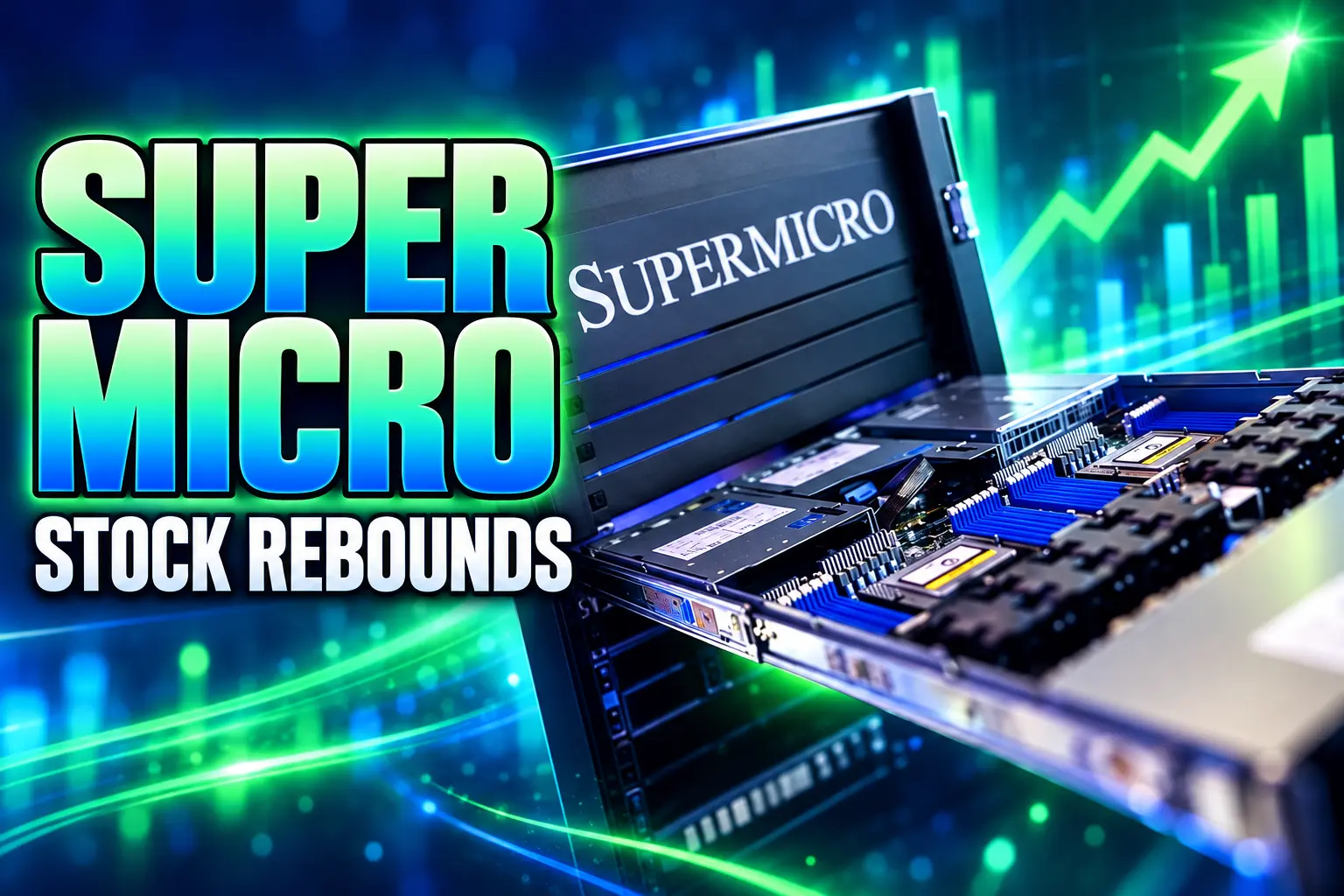
Holders did not wait for the 10-K. The stock dropped 28% to $29.27, the sharpest decline since March, after a 39% gain in 2026 through the June 9 close. Woo Jin Ho of Bloomberg Intelligence wrote that near-term earnings would be diluted, with the cut possibly exceeding 20% depending on final terms and ATM use, while the same capital could lift fiscal 2027 revenue above a $50 billion consensus.
Super Micro’s June equity offering was the bill for growth that had already outrun cash. Dell and Hewlett Packard Enterprise were taking AI server share in the same cycle, and Super Micro had just missed a quarter after customers were not ready for its kits. The $27.50 offer sat $13.14 below the June 9 close of $40.64.
THE DEAL CALENDAR
- June 9, 2026: Super Micro announces a $7.0 billion equity and equity-linked plan tied to about $39 billion of AI orders.
- June 10, 2026: Shares drop 28% to $29.27 in New York trading.
- June 11, 2026: Common prices at $27.50 and depositary shares at $50; the ATM is set at $1.25 billion.
- June 12, 2026: The common offering closes and Super Micro receives about $1.22 billion net.
- June 15, 2026: The depositary share offering closes.
- June 18, 2026: Underwriters take the common overallotment for another $183.4 million net.
- June 30, 2026: Fiscal 2026 ends with the ATM still unused.
From that $29.27 close the stock was at $40.10 on September 11, a 37% bounce that still leaves the June 9 holder with more shares outstanding. New common plus the June 18 overallotment added 52,272,726 shares. Shares outstanding rose from 601,418,482 on April 30 to 656,965,384 on July 31, a 9.24% increase that matches the offering plus ordinary equity awards, not a $1.25 billion ATM dump.
New Orders Then Jumped Past $60 Billion
The company put the new capital to work in the quarter that contained the raise. On August 11 it reported fiscal 2026 sales of $39.1 billion, up 78% from $22.0 billion a year earlier, and said it generated more than $60 billion of new orders in the fourth quarter alone, with record backlog heading into fiscal 2027.
Our Total AI/IT Solutions strategy continues to deliver strong results, we added several hundred enterprise and other customers in the past year, generated more than $60 billion in new orders, and booked record backlog entering fiscal 2027.
Charles Liang, Founder, President and CEO, Super Micro fourth-quarter release
Fourth-quarter sales were $11.1 billion, up 93% from $5.8 billion a year earlier and up from $10.2 billion in the third quarter. GAAP gross margin jumped to 17.5% from 9.9% in the prior quarter and 9.5% a year earlier, and net income was $1,178 million, or $1.62 a diluted share ($1.70 non-GAAP). Liang tied the margin lift to a richer enterprise mix and wider use of Data Center Building Block Solutions, the company’s rack-scale kit of compute, power, cooling, and networking.
FISCAL 2026 AT THE CLOSE
- Net sales: $39.1 billion, versus $22.0 billion in fiscal 2025.
- Net income: $2.23 billion, versus $1.05 billion a year earlier.
- Cash: $7.5 billion, against $8.7 billion of bank debt and convertible notes.
- New Q4 orders: more than $60 billion, with record backlog into fiscal 2027.
The $39 billion order figure Super Micro advertised in June was not the same object as fiscal 2026 revenue, and it was not a floor under the fourth-quarter intake. In one quarter the company booked new business equal to about 1.5 times a full year of sales. That is the demand proof the June raise asked holders to trust. Orders are still not cash, and the June disclosure already said they can slip.
Fiscal 2027 Guidance Now Runs as High as $72 Billion
Management set fiscal 2027 net sales at $65.0 billion to $72.0 billion. The $68.5 billion midpoint would be 75% above fiscal 2026. For the quarter ending September 30, 2026, Super Micro guided sales to $14.5 billion to $15.5 billion, with GAAP diluted earnings of $0.89 to $0.98 and non-GAAP earnings of $1.01 to $1.10, on fully diluted share counts of 745 million (GAAP) and 761 million (non-GAAP).
That first-quarter range sits well above the $11.1 billion fourth quarter. It also sits well above the $50 billion fiscal 2027 line Woo Jin Ho floated when the deal priced. The dilution math he flagged is visible in those share counts: 745 million GAAP diluted shares versus 656,965,384 shares outstanding on July 31. The extra paper is options, existing converts, and the new preferred under earnings-per-share rules.
Traders who still treat Super Micro as a swing rather than a hold are not arguing that AI racks are going unsold. The haircut is for execution, for legal residue, and for the next time the company has to sell stock. The order book stopped being the dispute in August. Conversion of that book into billed, paid racks is the dispute that remains, and the first test of that conversion is the quarter that ends September 30.
Why Super Micro Used $6.81 Billion of Operating Cash
Profit did not fund the build. Super Micro earned $2.23 billion in fiscal 2026 and still reported that operating activities used $6.81 billion, after providing $1.66 billion a year earlier. Financing inflows of $9.48 billion, including the June equity and more bank debt, filled the hole. Cash still rose to $7.5 billion from $5.2 billion because the company sold paper faster than operations consumed it.
The drain was inventory and invoices. Inventories ended at $12.9 billion, up from $4.7 billion. Accounts receivable rose to $6.1 billion from $2.2 billion. The 10-K says the swing came from more inventory purchases, more receivables, and higher operating spend. Fourth-quarter operations did turn, providing $747 million, with only $25 million of capital expenditures and investments in that quarter. The plant is not the sponge. The parts bins and customer invoices are.
THE WORKING-CAPITAL BILL
| Item | June 30, 2026 | June 30, 2025 |
|---|---|---|
| Cash and cash equivalents | $7.5 billion | $5.2 billion |
| Inventories | $12.9 billion | $4.7 billion |
| Accounts receivable | $6.1 billion | $2.2 billion |
| Operating cash flow | -$6.81 billion | +$1.66 billion |
That is why the June sale was not optional window dressing. A company that books $39.1 billion of sales and still burns $6.81 billion of operating cash cannot fill a $60 billion order wave from last year’s cash balance. The ATM remains a live tap. Sales under the $1.25 billion program were slated to start no earlier than the third calendar quarter of 2026, and the 10-K said none had occurred through June 30. The July 31 share count does not show a full ATM raise either. It can still arrive if receivables stay slow.
Preferred Holders Collect 7% Until June 2029
The common was the visible dilution. The preferred is the delayed kind, and it pays while it waits. Each depositary share is a slice of 7.0% Series A mandatory convertible preferred stock with a $1,000 liquidation preference per preferred share, listed as SMCIP. Unless converted earlier, the preferred automatically converts for settlement on or about June 1, 2029, into between 30.3040 and 36.3640 common shares per preferred share, which is 1.5152 to 1.8182 common shares per depositary share.
Those conversion rates imply a corridor of $27.50 to $33.00 on the common, the same $27.50 Super Micro just sold. If the stock stays above $33, preferred holders get the minimum share count. If it trades back toward the offer, they get more common. A 7.0% coupon on the $3.75 billion preferred face equals $262.5 million a year, payable in cash, common shares, or a mix, on March 1, June 1, September 1, and December 1 from September 1, 2026 through June 1, 2029. Common dividends and buybacks are restricted unless those preferred dividends are covered.
THE PREFERRED TERMS
- Coupon: 7.0% a year on the $1,000 liquidation preference, about $262.5 million annually on the $3.75 billion face.
- Conversion window: 1.5152 to 1.8182 common shares per depositary share, settling on or about June 1, 2029.
- Price corridor: $27.50 at the maximum conversion rate and $33.00 at the minimum.
- ATM overlay: up to $1.25 billion of extra common, unused as of June 30, sitting on top of that future conversion.
Add the 52,272,726 new common shares already out to a full preferred conversion on the 75,000,000 depositary shares, and the extra paper is 166 million to 189 million shares against the 601 million that were outstanding in April. That is the path to Ho’s “could exceed 20%” line, before the ATM. Fiscal 2027 guidance already bakes a 745 million GAAP diluted count into the earnings math. Holders who bought the June panic at $29.27 have a 37% price gain. Holders who sat through June 9 still have roughly the same share price and a smaller claim on the company.
The Board Closed Its Review of the Export Case
The other discount on the stock is older than the raise. On March 19, 2026, prosecutors unsealed an indictment against co-founder Yih-Shyan “Wally” Liaw, Taiwan sales manager Ruei-Tsang “Steven” Chang, and contractor Ting-Wei “Willy” Sun, alleging a scheme to divert about $2.5 billion of Nvidia-powered servers to China through a Southeast Asian pass-through. Super Micro was not named as a defendant. Liaw left the board. The company put Liaw and Chang on leave and cut ties with Sun, then launched an independent review led by Lead Independent Director Scott Angel and Audit Committee chair Tally Liu, with Munger, Tolles & Olson and AlixPartners.
On August 20 Super Micro said that review was finished. The team looked at the indicted customer transactions and at other buyers of restricted products.
The investigation team reviewed the customer transactions that were the subject of the federal indictment, as well as transactions with a selection of other customers who bought restricted products, and did not find any evidence that any current member of senior management had knowledge of the alleged diversion scheme or of any actual diversion of restricted products by the company.
Scott Angel, Lead Independent Director, Super Micro statement, August 20, 2026
The company also said it found no basis to treat prior financial statements as unreliable because of possible diversion, and that it had not directly sold export-controlled products to known restricted parties or locations. It did fire people in sales, technical support, and business development for policy and code-of-conduct failures, and the board adopted the advisers’ compliance recommendations in full. Federal investigations continue, and Super Micro said it is still cooperating. Shareholder suits filed after the indictment remain open. International sales were 29.1% of fiscal 2026 revenue, down from 40.6% in fiscal 2025, a mix shift that fits a company selling more inside the United States while a China-related case is in court.
The June raise asked holders to fund a build that the order book has since made larger, not smaller. Fiscal 2027 guidance of $65.0 billion to $72.0 billion is the demand half of that ask, written in Super Micro’s own numbers. The $6.81 billion operating cash use, the $12.9 billion inventory account, the 7.0% preferred coupon, and an unused $1.25 billion ATM are the other half. The first quarter that will show whether the new capital is turning into paid AI racks ends September 30, with sales guided at $14.5 billion to $15.5 billion.
Disclaimer: This article is news reporting and analysis of Super Micro Computer’s equity offerings, financial results, and related legal matters, and it is for information only. It is not investment advice, a recommendation to buy or sell SMCI or SMCIP, or a prediction of future prices, earnings, or court outcomes. Readers should consult a licensed financial adviser or securities attorney who can review their own holdings and risk limits before acting on any figure in this piece. Share prices, order figures, guidance, cash balances, and case status reflect company filings and market prints cited in the article, including results for the fiscal year ended June 30, 2026, and the September 11, 2026 close, and those items can change.

Instagram Plus Tests a Read-Only Mode That Cuts Stories

Altman Asks the Public to Accept Some AI Harm

Google Freezes OSS VRP Product Reports After AI Flood

AI Agents Make Payment Rails the Scarce Prize

Turkey’s Crypto Boom Now Runs Through Three Banks

Fable 5 Came Back Under a Commerce On-Off Switch

Google’s SpaceX GPU Lease Has a Sept. 30 Deadline

Plasma One’s XPL Locks Face a 1.81 Billion Cliff

DGO’s Rs 549 World Cup Pass Cost Fans Sleep and Data

Moonshot AI’s $30 Billion Ask Became a $35 Billion Close
-
 AI4 months ago
Fable 5 Came Back Under a Commerce On-Off Switch
-
 AI4 months ago
Google’s SpaceX GPU Lease Has a Sept. 30 Deadline
-
 CRYPTO4 months ago
Plasma One’s XPL Locks Face a 1.81 Billion Cliff
-
 APPS4 months ago
DGO’s Rs 549 World Cup Pass Cost Fans Sleep and Data
-
 AI4 months ago
Moonshot AI’s $30 Billion Ask Became a $35 Billion Close
-

 NEWS4 months ago
ColorOS 17 Device List Spans Oppo, OnePlus and Realme
-

 GAMING4 months ago
Xbox Cuts 3,200 Jobs After Five Years of Thin Returns
-

 GAMING4 months ago
The RTX 4050 Under Rs 70,000 Hides a Wattage Gap