
AI
Super Micro’s $39 Billion Orders Came With a $7 Billion Bill
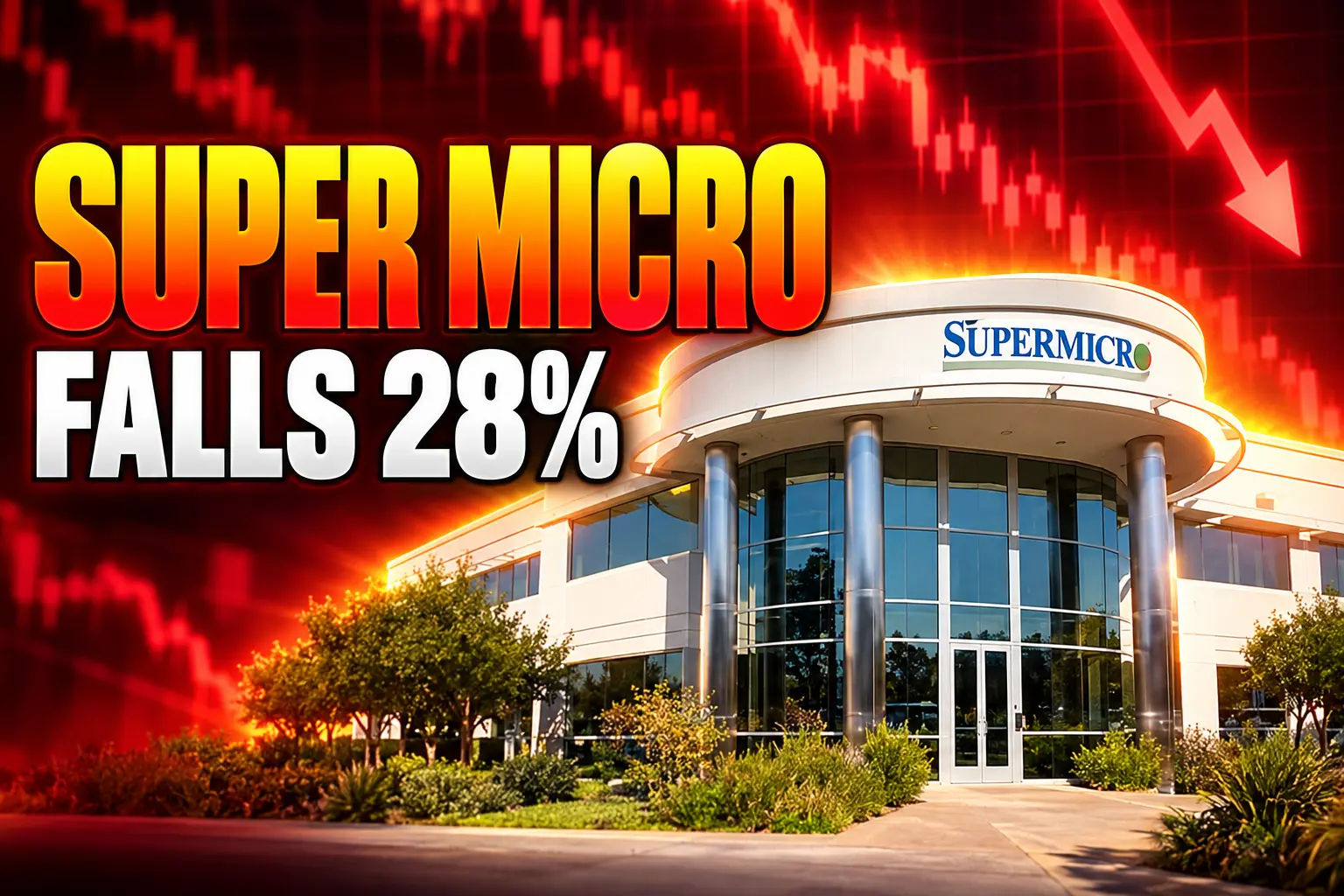
Super Micro’s $39 billion AI orders forced a $7.0 billion share sale, a 28% crash, and an S&P 500 slide back to early May.

Super Micro Computer fell 28% on June 10 after moving to raise $7.0 billion to fund about $39 billion of AI server orders. The S&P 500 dropped 1.6% to 7,266.99, its first back-to-back decline in three weeks, and sat back at early May levels.
Nvidia and Broadcom did the index damage by weight. A $75 billion SpaceX listing two days later, a hot inflation print, and oil at $93.10 did the rest. The order book that should have been the bull case was the bill.
Super Micro Sold Stock to Fill a $39 Billion Book
Super Micro, the San Jose server maker, said after the close on June 9 that it needed fresh equity to buy components for about $39 billion of advanced AI server orders received in recent weeks from more than 20 customers. On June 11 it priced 45,454,545 common shares at $27.50 and 75,000,000 depositary shares at $50, and it kept a $1.25 billion at-the-market program for later in the year. Counted with underwriter options, the company put the potential raise at $7.0 billion.
That is 18 cents of new paper for every dollar of quoted orders. The common sale was due to close on June 12 and the depositary sale on June 15. J.P. Morgan, Goldman Sachs, and Citigroup ran the books.
SUPER MICRO’S $7.0 BILLION PACKAGE
| Tranche | Gross size | Key terms |
|---|---|---|
| Common stock | $1.25 billion | 45,454,545 shares at $27.50 |
| Depositary shares | $3.75 billion | 75 million shares at $50 |
| At-the-market program | $1.25 billion | Common stock, not before fiscal Q3 2026 |
| Total potential | $7.0 billion | Includes 30-day underwriter options |
Net proceeds were about $1.22 billion on the common and about $3.68 billion on the depositary shares if the options stayed unexercised. The company said it would use the cash, plus the ATM, to buy parts for those AI servers, including its Data Center Building Block Solutions, with leftover funds available for debt, working capital, and capital spending.
Why the $7 Billion Package Hit Existing Holders
Companies raise the most money when the stock is high, and they dilute the people who already own it. Super Micro chose that window, then watched the stock fall 28% on June 10, through the $27.50 offer that would be set the next day. Shay Boloor, chief market strategist at Futurum Equities, put the session in one line: “$SMCI falls more than 25% after announcing a $7B stock offering.”
The louder problem was cash timing, not a missing customer. GPU servers have to be built before the invoice is paid, so a fat order book can drain cash even as sales rise. Holders who had bought the demand story woke up as the funding story. The raise read as Super Micro still paying for growth with new shares, and that reading, not a sudden hole in AI demand, is what knocked the name through the offer price.
HOW THE PREFERRED CONVERTS
- The coupon: Each depositary share is a 1/20th interest in a share of 7.00% Series A mandatory convertible preferred with a $1,000 liquidation preference.
- The conversion: Each preferred share converts into between 30.3040 and 36.3640 common shares around June 1, 2029, or 1.5152 to 1.8182 common shares per depositary share.
- The share load: The 3,750,000 preferred shares behind the 75 million depositary shares become 113,640,000 to 136,365,000 common shares if conversion runs to term.
- The cash cost: A 7.0% coupon on $3.75 billion is $262.5 million a year, payable in cash, stock, or both.
Underwriter options covered another 6,818,181 common shares and 11,250,000 depositary shares. The company asked Nasdaq to list the depositary shares as SMCIP. In the same release it warned that the $39 billion of orders do not constitute firm commitments and remain subject to cancellation, delays, and both sides meeting the contract terms.
Nvidia and Broadcom Dragged the Indexes Lower
Nvidia, then a nearly $4.9 trillion company on the back of the AI boom, fell 3.7% and was the heaviest weight on the S&P 500. Broadcom, the second-heaviest, fell 5.1%. Micron Technology swung from an early loss near 4% to a modest gain and closed down 4.7%, still up 212.5% for the year after a stretch that included a 7.7% drop the prior Thursday, a 13.3% plunge on Friday, and a 9.9% bounce on Monday.
Mark Haefele, chief investment officer at UBS Global Wealth Management, said tech was under pressure from higher rate expectations, which cut the present value of distant profits, and from anxiety over valuations and AI monetization. Positioning, he added, had become extended after a strong rally.
THE JUNE 10 CLOSE
- S&P 500: 7,266.99, down 119.66 points, or 1.6%.
- Dow Jones: 49,918.78, down 953.33 points, or 1.9%.
- Nasdaq composite: 25,169.50, down 509.32 points, or 2%.
- Super Micro: down 28% on the $7.0 billion plan.
Two days earlier in Seoul, Nvidia chief executive Jensen Huang had called the early June slide a chance to buy.
very happy because now you can buy at a discount
Jensen Huang, CEO of Nvidia, to reporters in Seoul, June 8, 2026
He was not pointing at that Wednesday’s low. Nvidia later traded down to an intraday low of $189.80 on June 29, almost 10% under its June 8 open, before the August earnings report reset the tape.
SpaceX Priced at $135 the Same Week
Some of the selling in AI names was cash leaving to make room for listings. SpaceX priced at $135 a share and raised $75 billion, then began trading on Nasdaq on June 12 under the ticker SPCX. Shares opened at $150 and closed at $160.95, up 19%, with a market value of $2.1 trillion against $1.77 trillion at the sale price.
Vanda Research, which tracks retail flows in single stocks and ETFs, said traders were on track for a third straight day of net selling across single names, something it had not seen since March 2020. The firm said retail accounts were rotating out of recent AI favorites ahead of SpaceX and other large offerings later in the year, including planned listings tied to Anthropic and OpenAI.
THE WEEK THE BID LEFT AI
- June 8, 2026: Huang, in Seoul, calls the tech slide a discount. Micron rallies 9.9%.
- June 9, 2026: Super Micro announces the $7.0 billion plan after the close. Chip names already weak into inflation data and the SpaceX calendar.
- June 10, 2026: Super Micro falls 28%. The S&P 500, Dow, and Nasdaq close at 7,266.99, 49,918.78, and 25,169.50. May CPI prints at 4.2%.
- June 11, 2026: Super Micro prices the common at $27.50 and the depositary shares at $50. SpaceX sets $135.
- June 12, 2026: The common offering is due to close. SpaceX opens at $150 and finishes at $160.95.
United Airlines fell 6.2% and Carnival fell 6.3% as crude rose. The oil move and the IPO calendar hit the same session as Super Micro’s sale, which is why a server-maker’s dilution printed as an index event.
May Inflation Hit 4.2% on Energy
The Bureau of Labor Statistics said the Consumer Price Index for All Urban Consumers rose 0.5% in May after 0.6% in April, and 4.2 percent over the 12 months ending May, up from 3.8% through April. That was the largest 12-month gain since April 2023. The energy index rose 3.9% in May and 23.5% over the year and accounted for over sixty percent of the monthly all-items increase. Gasoline rose 7.0% on the month and 40.5% on the year.
Core prices, all items less food and energy, rose 0.2% in May and 2.9% over 12 months. Shelter rose 0.3%. Food rose 0.2% on the month and 3.1% on the year. The unadjusted CPI-U stood at 335.123. Treasury yields barely moved because the print matched forecasts: the 10-year yield edged up to 4.54% from 4.53%, and the two-year yield held at 4.13%.
Traders had been building bets that the Federal Reserve would have to raise its main rate at least once in 2026, given inflation and a still-strong jobs market, and CME Group data showed Wednesday’s report did not shift those bets much. High yields hit the most expensive stocks first. Brent crude rose 1.8% to $93.10 after President Donald Trump said Iran would “pay the price” for stalled talks, with the Strait of Hormuz still effectively shut to tankers.
Seoul and Tokyo Sold Tech in Sympathy
Europe finished mixed after sharper losses in Asia. South Korea’s Kospi tumbled 4.5%, hurt by Samsung Electronics and SK Hynix. Tokyo’s Nikkei 225 sank 1.9% after Japan’s producer price index rose in May at the fastest pace in more than three years. SoftBank Group, with a heavy AI book, lost 8.3%.
The same trade that made Super Micro, Nvidia, and Broadcom the U.S. market’s engine had packed Asia’s chip and holding-company names. When U.S. AI stocks broke, those indexes had nowhere to hide, and a wholesale-price spike in Japan added a local reason to sell duration.
The Order Book Grew After the Dilution
The June 10 question was whether the break had cleared a crowded trade or started a longer downturn. Nvidia’s path from that week was slow, then sharp. After the June 29 low at $189.80, the stock’s largest move came when fiscal second-quarter results landed after the close on August 26: revenue of $96.2 billion, up 106%, data-center revenue of $89 billion, up 117%, and third-quarter guidance of $108 billion plus or minus 2%. Shares jumped 8.7% on August 27 and closed at $230.36 on Sept. 4. From the June 8 open to that Sept. 4 close, Nvidia gained about 9.6% against about 3.7% for the S&P 500.
Super Micro’s own scoreboard arrived on August 11. Fiscal 2026 sales were $39.1 billion, against $22 billion the year before. The company pointed to fiscal 2027 sales of $65.0 billion to $72.0 billion. Fourth-quarter sales were $11.1 billion, against $10.2 billion in the third quarter and $5.8 billion a year earlier, with gross margin of 17.5% against 9.9% and 9.5%, and net income of $1.18 billion against $483 million and $195 million. Full-year net income was $2.2 billion, against $1 billion.
Our Total AI/IT Solutions strategy continues to deliver strong results, we added several hundred enterprise and other customers in the past year, generated more than $60 billion in new orders, and booked record backlog entering fiscal 2027.
Charles Liang, Founder, President and CEO of Super Micro, August 11, 2026 earnings release
The $39 billion book that forced the June sale had not been a mirage. Super Micro closed at $27.22 on July 5, under the $27.50 offer, then at $40.10 on Sept. 11. Demand showed up. So did the cost of funding it. Super Micro closed at $40.10 on Sept. 11, above the $27.50 offer from the June sale.
Frequently Asked Questions
How Was Super Micro’s $7.0 Billion Raise Split on Paper?
The underwritten common sale was due to settle on June 12, 2026 and the depositary sale on June 15, 2026, with neither deal contingent on the other, and the $1.25 billion ATM was not expected to start until fiscal third quarter 2026. Net proceeds were about $1.22 billion on the common and about $3.68 billion on the depositary shares if underwriters left their 30-day options unexercised, against gross amounts of $1.25 billion and $3.75 billion.
What Else Did the May 2026 CPI Report Show?
Food rose 0.2% in May and 3.1% over 12 months, shelter rose 0.3% on the month, and the unadjusted CPI-U index level was 335.123. Motor vehicle insurance fell 1.7% in May, new vehicles fell 0.3%, and airline fares rose 2.7%, while energy still accounted for over sixty percent of the monthly all-items increase.
When Did SpaceX Shares Start Trading and at What Value?
SpaceX began trading on Nasdaq on June 12, 2026 under the ticker SPCX after pricing at $135 and raising $75 billion. The stock opened at $150, closed at $160.95, up 19%, and finished the session with a market value of $2.1 trillion against $1.77 trillion at the sale price.
What Are the Conversion Terms on Super Micro’s Preferred?
Dividends accrue at 7.0% and were scheduled quarterly on March 1, June 1, September 1, and December 1, starting September 1, 2026 and ending June 1, 2029, in cash, common stock, or both. Unless converted earlier, each preferred share turns into between 30.3040 and 36.3640 common shares after a 20-day averaging period into June 2029, and the company applied to list the depositary shares as SMCIP.
Were Super Micro’s $39 Billion of Orders Firm Commitments?
No. The June 11 pricing release said the about $39 billion of AI server orders do not constitute firm commitments and are all subject to cancellation, delays, and both parties meeting the applicable terms. That caveat sat in the same statement that tied the $7.0 billion package to buying components for those orders.
Disclaimer: This article is news reporting and analysis of market events, company filings, and public economic data, and it is for information only. It is not investment advice, a recommendation to buy or sell Super Micro Computer, Nvidia, Broadcom, Micron, SpaceX, or any other security, and it is not a forecast of future prices or Federal Reserve policy. Readers should consult a licensed financial adviser or broker who can review their own holdings, time horizon, and risk limits before making any trade. Figures, index closes, offering terms, and backlog comments reflect the cited company releases, SEC prospectus, Bureau of Labor Statistics print, and market data as published for the dates named, and those values can change with later filings, revisions, and trading sessions.

Instagram Plus Tests a Read-Only Mode That Cuts Stories

Altman Asks the Public to Accept Some AI Harm

Google Freezes OSS VRP Product Reports After AI Flood

AI Agents Make Payment Rails the Scarce Prize

Turkey’s Crypto Boom Now Runs Through Three Banks

Fable 5 Came Back Under a Commerce On-Off Switch

Google’s SpaceX GPU Lease Has a Sept. 30 Deadline

Plasma One’s XPL Locks Face a 1.81 Billion Cliff

DGO’s Rs 549 World Cup Pass Cost Fans Sleep and Data

Moonshot AI’s $30 Billion Ask Became a $35 Billion Close
-
 AI4 months ago
Fable 5 Came Back Under a Commerce On-Off Switch
-
 AI4 months ago
Google’s SpaceX GPU Lease Has a Sept. 30 Deadline
-
 CRYPTO4 months ago
Plasma One’s XPL Locks Face a 1.81 Billion Cliff
-
 APPS4 months ago
DGO’s Rs 549 World Cup Pass Cost Fans Sleep and Data
-
 AI4 months ago
Moonshot AI’s $30 Billion Ask Became a $35 Billion Close
-

 NEWS4 months ago
ColorOS 17 Device List Spans Oppo, OnePlus and Realme
-

 GAMING4 months ago
Xbox Cuts 3,200 Jobs After Five Years of Thin Returns
-
 GAMING4 months ago
The RTX 4050 Under Rs 70,000 Hides a Wattage Gap