
COMPUTERS
GIGABYTE Locks AI Motherboard Tuning to X3D Boards
GIGABYTE’s AI motherboard recap keeps X3D Turbo Mode 2.0 on exclusive boards, while testers find SMT cuts and title-by-title gains, not a 25% blanket lift.

GIGABYTE restated its AI motherboard stack on June 8, 2026, led by X3D Turbo Mode 2.0 and a dedicated onboard controller that only its X3D boards carry. The company still claims up to 25% more gaming performance and 14% more multitasking versus default settings.
Reviewer Areej Syed, testing a Ryzen 7 9800X3D, found a narrower picture: 10-12% in two of seven games, and little or no change in the other five. The second-order move is the SKU wall. The FPS trick is mostly SMT and CCD cuts that ASUS and MSI already ship as ordinary BIOS toggles.
GIGABYTE Recycled a CES Feature Onto B850
The June 8 note read like a fresh platform. The pieces inside it were already on the calendar. GIGABYTE first sold a simpler X3D Turbo Mode through AORUS AI SNATCH on November 27, 2024, with a claimed lift of up to 18% on Ryzen 9000 chips. The 2.0 pitch, with the onboard controller and the exclusive X3D board names, was in market by the time the X870E AORUS XTREME X3D AI TOP press note went out on November 7, 2025.
CES 2026 on January 6 put wood grain and reverse-connector stealth boards next to the same engine. A February 9 explainer then spelled out the hardware-software split. Three weeks after the June recap, GIGABYTE listed a B850 AORUS ELITE X3D so the exclusive mode could live below X870E.
THE X3D TURBO CALENDAR
- November 27, 2024: First-gen X3D Turbo Mode can be switched on through AORUS AI SNATCH, with a claimed lift of up to 18% on Ryzen 9000 processors.
- November 7, 2025: Flagship X870E AORUS XTREME X3D AI TOP press note cites 25% gaming and 14% multitasking over default settings, plus DDR5 at 9000+ MT/s and a 24+2+2 VRM using 110A SPS stages.
- January 6, 2026: CES 2026 adds the X870E AERO X3D WOOD board and PROJECT STEALTH X870 and B850 boards with a reverse-connector layout.
- February 9, 2026: GIGABYTE publishes the X3D Turbo Mode 2.0 explainer, including the dedicated onboard controller and three selectable modes.
- May 29, 2026: D5 Single Boost extends the D5 Bionic Corsa memory stack to one DIMM on Intel Z890 and B860 boards.
- June 8, 2026: The AI motherboard recap restates Turbo Mode 2.0, D5 Bionic Corsa, and HyperTune BIOS.
- June 29, 2026: GIGABYTE lists the B850 AORUS ELITE X3D, bringing the exclusive controller to B850.
- August 28, 2026: A full B850 Elite X3D review still finds Extreme Gaming parking cores and threads on a 9950X3D.
AORUS regional channels were still posting the B850 Elite X3D and the WOOD board in early September 2026, which is the tell. The June text was inventory and positioning, not a new silicon generation.
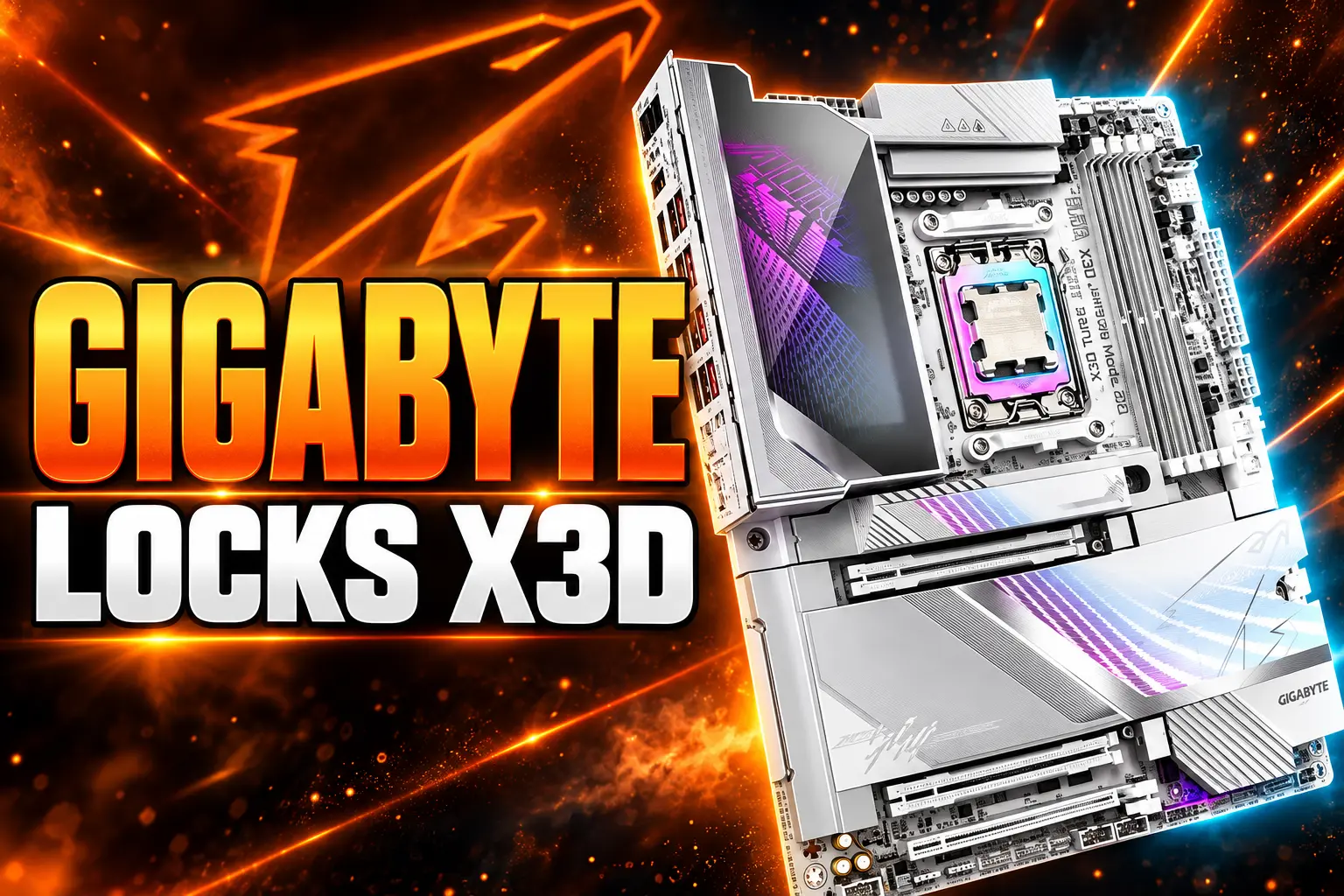
The Onboard Chip Stays Behind a SKU Wall
GIGABYTE describes X3D Turbo Mode 2.0 as a platform-level performance mode for X3D processors, not a classic clock chase. Ryzen X3D chips run extra 3D V-Cache, so voltage headroom is tight and old all-core overclocks fade fast. The company’s answer is a controller on the board that watches load without waiting on Windows, plus a Dynamic OC Engine trained on X3D datasets.
A dedicated controller on the motherboard continuously monitors platform conditions and workload behavior in real time. Because it operates independently from the operating system, it can react immediately, without waiting for software layers to catch up.
GIGABYTE, X3D Turbo Mode 2.0 explainer, February 9, 2026
That chip is the lock. Support is exclusive to GIGABYTE X3D-series motherboards, with day-0 backing for current AMD X3D parts. You cannot buy a plain X870E AORUS Elite and flash your way into 2.0. You buy the X3D SKU.
Syed’s May 6, 2026 notes put the X870E AORUS Elite X3D at $359 on Amazon and Newegg, about $100 over the non-X3D Elite. The two boards share VRM, M.2 layout, and I/O. The X3D version raises listed memory overclocking from 8200 MT/s to 9000 MT/s and adds the controller. The Elite X3D uses a 16+2+2 digital VRM. The XTREME X3D AI TOP steps up to 24+2+2.
On June 29, 2026, the same wall dropped onto B850. GIGABYTE’s listing for the B850 AORUS ELITE X3D shows a 16+2+2 VRM and 8+8 pin CPU power, against 14+2+2 and 8+4 pin on the B850 AORUS Elite WIFI7. It also lists four M.2 slots with two PCIe 5.0 M.2, 5GbE instead of 2.5GbE, four DIMMs, 256 GB, and DDR5 overclocking up to 8200 MT/s. BIOS F1 is dated May 14, 2026. BIOS F2a on June 10, 2026 brings AGESA 1.3.0.1b and EXPO Ultra Low Latency tweaks. The cheaper chipset still requires the X3D board name to get the controller.
What Extreme Gaming Mode Turns Off
X3D Turbo Mode 2.0 is a BIOS preset with three names, and Extreme Gaming is the one that changes the chip you thought you bought. Standard is everyday default behavior. Max Performance is the company’s mixed gaming and render profile. Extreme Gaming is the frame-rate profile, and on a Ryzen 9 9950X3D it disables SMT and the cache-less CCD, leaving an 8-core/8-thread part.
Product pages also brand the two hot profiles as Gamer Mode and Creator Mode. The Windows helper is On/Off X3D, which GIGABYTE’s AORUS channel shows as a tray toggle after a BIOS save. A late August review of the B850 AORUS Elite X3D described Max Performance as a brief boost-clock bump that then tracked default Cinebench and Blender scores once all cores were loaded.
THE THREE X3D TURBO MODE 2.0 PROFILES
| Mode | GIGABYTE’s stated job | What testers saw |
|---|---|---|
| Standard | Stable everyday default | Baseline clocks and full core count |
| Max Performance | Gaming plus multi-core work such as rendering | Short boost-clock headroom; Cinebench and Blender on a 9950X3D nearly match default once all threads load |
| Extreme Gaming | Average FPS and 1% lows in competitive titles | SMT off; on a 9950X3D the cache-less CCD is also off, so the chip runs 8-core/8-thread |
GIGABYTE’s own February 9 explainer says Max Performance delivers up to 13.76% more Cinebench multi-core score than a competitor’s default setup. That figure is a cross-board comparison, not a before-and-after on one machine, and it sits beside the older 25% gaming claim rather than replacing it. AORUS North America later posted a Max Performance result in Battlefield 6 of +11% at 254 average FPS, which is a long way under the blanket 25% line and in line with a one-click profile, not a new CPU.
Two Games Moved and Five Did Not
Syed ran Extreme Gaming and Max Performance on a Ryzen 7 9800X3D with an NZXT Kraken 420 Elite, a GeForce RTX 4090 Founders Edition, and 2×16 GB DDR5-6000 CL30. Stock boost sat at 5.25 GHz. With Turbo Mode 2.0 on, in-game clocks reached 5.5 GHz on a Vcore offset of +0.1-0.15 V, with no curve optimizer in the trace. Heavily threaded work cut that headroom back to just over 5 GHz.
SYED’S SEVEN-GAME PASS ON A 9800X3D
| Title | Change with X3D Turbo Mode 2.0 |
|---|---|
| Baldur’s Gate 3 | 12% faster |
| Oblivion Remastered | 10% faster |
| Arc Raiders | About 2% faster |
| Battlefield 6 | 1% faster |
| Crimson Desert | 1% faster |
| Cyberpunk 2077 | No gain |
| Kingdom Come 2 | No gain |
That is two titles in the 10-12% band and five that barely moved. Syed’s conclusion was blunt: a +0.15 to +0.2 V offset and a +300 frequency offset on any decent AM5 board can copy the same clocks, so the money is better spent on extra M.2 slots or I/O. GIGABYTE still prints 25% gaming gains on Ryzen X3D on the X870E AERO X3D WOOD page, with a footnote that results vary by game. The footnote is doing a lot of work.
Leave Extreme Gaming on a dual-CCD X3D chip and you have paid for 16 cores so a BIOS page can hide eight of them. Average FPS can tick up in older or lightly threaded games. Frame-time spread often gets worse, 1% lows drop in plenty of titles, and Blender-class jobs fall off a cliff. Prebuilt sellers still flip the switch because the menu says turbo or gaming, then ship a workstation that no longer has SMT.
ASUS and MSI Already Ship the Same Trick
The dedicated controller is GIGABYTE-only. The core-parking recipe is not. ASUS Turbo Game Mode and MSI X3D Gaming Mode also drop SMT, and on a 9950X3D they also park the frequency CCD. Enthusiasts who tune AM5 boards for a living treat all three names as the same profile and leave them off unless a specific title is proven to like an 8-core, 8-thread chip.
That is why the exclusive SKU matters more than the FPS chart. ASUS and MSI put the toggle on ordinary AM5 boards through a BIOS update. GIGABYTE put 2.0 behind an X3D product name, an extra controller, and a price delta of about $100 at the Elite level. The Dynamic OC Engine and the onboard chip can still do useful millisecond-scale power and thermal trims. They do not change the fact that Extreme Gaming’s big swing is a core-count cut you can type by hand.
First-gen X3D Turbo Mode, the November 2024 BIOS and AI SNATCH path, already talked about core distribution, bandwidth tuning, and power balancing. Version 2.0 adds the controller and the X3D-only board list. The marketing leap is “AI overclocking.” The practical leap is that GIGABYTE now has a reason to print X3D on a B850 Elite and charge for it.
One DIMM Reaches 8400 MT/s on Intel Boards
The other half of the June recap is D5 Bionic Corsa, GIGABYTE’s DDR5 kit that folds PCB layout, one-click software, and BIOS code into the same “AI” label. The AORUS write-up on the Z890 generation is the clearest description of the three layers, and it is older than the June note by a year and a half.
THE THREE LAYERS INSIDE D5 BIONIC CORSA
- AI PCB layout: Trace routing is simulated against the fiberglass weave, layer materials are chosen by model, and VIA geometry is tuned per job. GIGABYTE says that VIA work cuts signal reflection loss by up to 28%, and the boards use low-loss materials borrowed from server parts.
- One-click software: The AI SNATCH Engine and HyperTune BIOS train on thousands of memory tests. AORUS says a native 6400 MT/s CUDIMM kit can be snapped to 8933 MT/s in one pass, and the AORUS MASTER sample hit 9500+ MT/s with zero errors.
- HyperTune BIOS: AI proposes Memory Reference Code combinations for each board, then engineers lock the final set. That is firmware search, not a model running beside your game.
On May 29, 2026, the same stack gained D5 Single Boost, a BIOS profile that can take a single DDR5 module to 8400 MT/s if the stick uses Hynix M-Die. GIGABYTE claims a 10% gaming lift in frame rates and load times, and it says one tuned DIMM can rival a common dual-channel XMP kit. The feature is limited to Z890 and B860 boards. It does not land on the AM5 X3D boards the June recap is selling, and a single UDIMM still cannot match the bandwidth of two sticks on a full dual-channel bus.
That Intel-only, one-DIMM profile is the honest use of this tooling: DRAM has been expensive, builders are running one stick, and GIGABYTE would rather ship a BIOS recipe than lose the sale. It is also a reminder that “AI memory” here means a trained lookup plus a PCB that was simulated harder, not a coprocessor dreaming up timings in your game loop.
Wood Panels and Hidden Cables Close the Sale
CES 2026 did not hide the other half of the pitch. The X870E AERO X3D WOOD board adds wood-grain texture and leather pull tabs. PROJECT STEALTH X870 and B850 AORUS STEALTH boards flip the connectors to the rear for a cleaner windowed case. Flagship cooling claims on the XTREME X3D AI TOP are concrete: CPU Thermal Matrix cuts VRM and DDR temperatures by up to 8.5°C, DDR Wind Blade XTREME cuts module temperatures by up to 9°C, and M.2 Thermal Guard XTREME cuts SSD temperatures by up to 22°C.
Those numbers sell a board even if you never open On/Off X3D. So do 5GbE, Wi-Fi 7, four M.2 slots, and a 64 MB BIOS that reviewers flagged as ready for a later Zen generation on the B850 Elite X3D. The AI label is how GIGABYTE groups the exclusive controller, the memory recipes, and the X3D product names so a Ryzen 7 9800X3D buyer has a reason to stay inside one vendor’s stack.
On June 29, 2026, GIGABYTE listed the B850 AORUS ELITE X3D with that same exclusive controller. Regional AORUS posts in early September were still pitching that board, and the wood AERO, as the way to turn X3D Turbo Mode 2.0 on.

Instagram Plus Tests a Read-Only Mode That Cuts Stories

Altman Asks the Public to Accept Some AI Harm

Google Freezes OSS VRP Product Reports After AI Flood

AI Agents Make Payment Rails the Scarce Prize

Turkey’s Crypto Boom Now Runs Through Three Banks

Fable 5 Came Back Under a Commerce On-Off Switch

Google’s SpaceX GPU Lease Has a Sept. 30 Deadline

Plasma One’s XPL Locks Face a 1.81 Billion Cliff

DGO’s Rs 549 World Cup Pass Cost Fans Sleep and Data

Moonshot AI’s $30 Billion Ask Became a $35 Billion Close
-
 AI4 months ago
Fable 5 Came Back Under a Commerce On-Off Switch
-
 AI4 months ago
Google’s SpaceX GPU Lease Has a Sept. 30 Deadline
-
 CRYPTO4 months ago
Plasma One’s XPL Locks Face a 1.81 Billion Cliff
-
 APPS4 months ago
DGO’s Rs 549 World Cup Pass Cost Fans Sleep and Data
-
 AI4 months ago
Moonshot AI’s $30 Billion Ask Became a $35 Billion Close
-

 NEWS4 months ago
ColorOS 17 Device List Spans Oppo, OnePlus and Realme
-

 GAMING4 months ago
Xbox Cuts 3,200 Jobs After Five Years of Thin Returns
-

 GAMING4 months ago
The RTX 4050 Under Rs 70,000 Hides a Wattage Gap