
GAMING
Escape the Baby Alarm Finds a Publisher for Parent Players
Yotsuba Interactive signed Julie Normann Bjørnskov’s Escape the Baby Alarm, a maternity-leave puzzle whose Steam demo turns baby-monitor chaos into calm escape.

Yotsuba Interactive signed Escape the Baby Alarm on August 12, 2026, a parenthood puzzle whose demo is free on Steam. Julie Normann Bjørnskov built it in Aarhus, Denmark, after maternity leave filled her head with bedtimes and left no other idea standing.
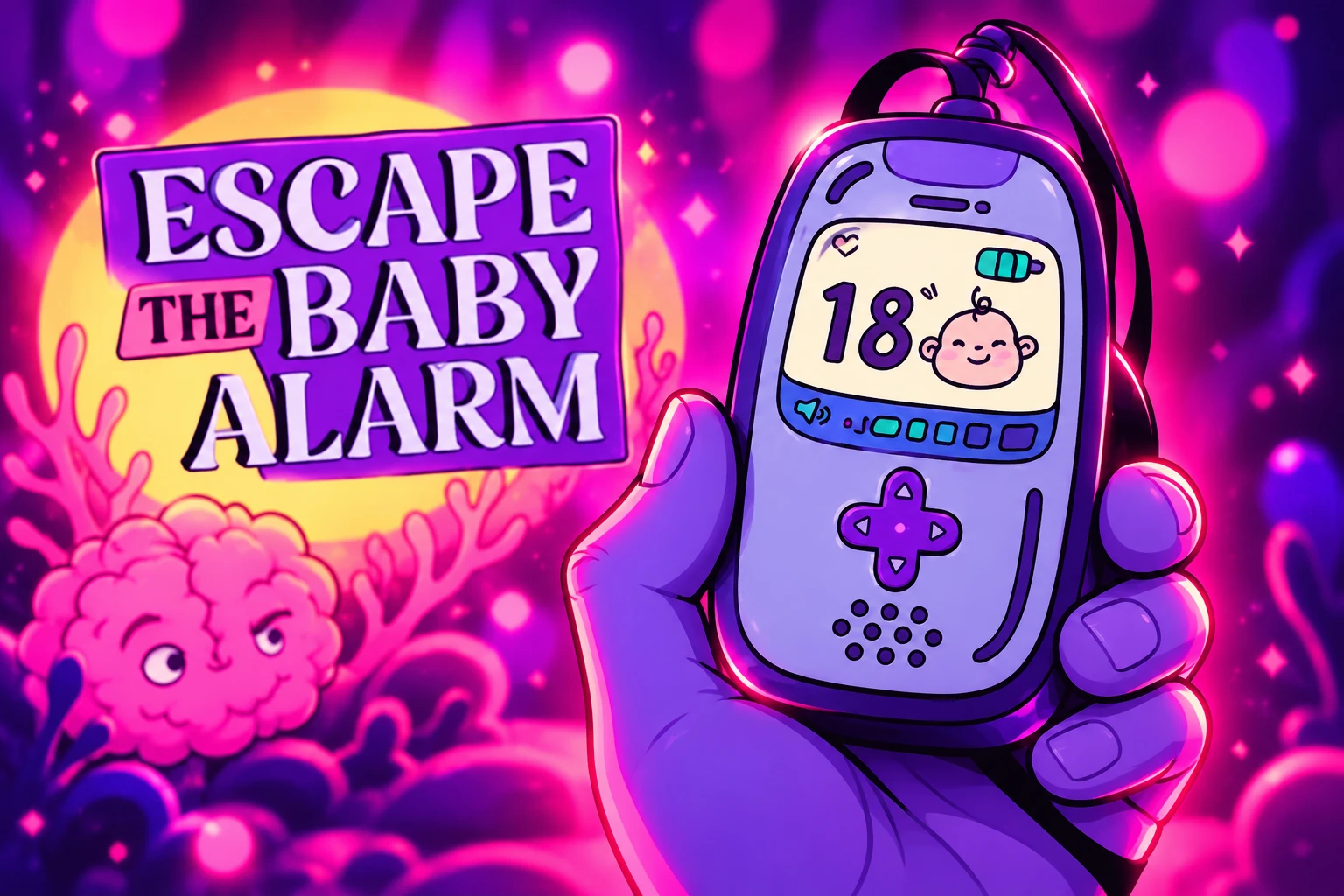
The game is a hand-drawn escape room set inside a baby monitor. Mashed peas, pacifiers, and sleepless nights are the locks. A tiny publisher that backs small personal games is now the one carrying it to a 2026 PC release, with a mobile version planned.
Shoes in the Fridge, Sunscreen on the Toothbrush
Store copy on Steam, written in Julie’s own voice, calls Escape the Baby Alarm a love letter to parenthood and a psychedelic puzzle adventure. The art is bright pop, chosen to mimic the dream state that comes with running on almost no sleep. Every scene is hand-drawn. The jokes are domestic and slightly wrong, which is the point.
Players hunt for shoes in the fridge, keep sunscreen off the toothbrush, and smash a box of chocolates “accidentally on purpose.” Rice sticks to socks. Snacks appear in every pocket. Advice arrives in a flood, each tip technically right and none of it quite usable. Some rooms ask you to sort that advice. Some rooms ask you to put it down and breathe.
PUZZLES DRAWN FROM THE HOUSE
- The fridge: Shoes turn up there, a real misplace turned into a lock you have to notice.
- The bathroom counter: Sunscreen and toothpaste share a surface, and the puzzle is not mixing them up.
- The chocolate box: Exhaustion-fuelled frustration becomes a smash you are allowed to mean.
- The advice pile: Contradictory tips, each one correct, none of them fitting together.
- The rice: Floors and socks stay dirty until you deal with the mess as a visual clue.
There are no timers, scores, or pressure. Julie has said that is deliberate, because the subject already brings up a lot and players should move at their own pace. Other games have treated early parenthood as frantic minigames or as a story about a mother and child in impossible architecture. This one treats the first year as a calm room you can leave when you are ready.
A June trailer walks through that range, from a wrecked morning to the fear that sits under it.
Maternity Leave Left No Room for Anything Else
Bjørnskov came back from leave full of feeling and short on sleep, with a wish to make something and a head that would only hold bedtimes, diapers, and the work of keeping small children well. She did not wait for a clearer idea. She used the one that would not leave.
I was so full of emotions after maternity leave. There was the lack of sleep, the chaos I found myself in, and a burning desire to be creative again and express myself. But the only things in my head were bedtimes, diaper changes, confusion, and doing everything I could to make sure my children were thriving. There wasn’t any space left… but maybe that wasn’t a problem. Maybe I could turn it into something rarely seen in video games: an honest game about being a parent, where I process everything my mind is already full of and turn it into a game. That’s what Escape the Baby Alarm is meant to be: a tribute to parents, and a celebration of the hard work that goes into raising a whole new generation of amazing little humans.
Julie Normann Bjørnskov, developer, June 2026 press release
That is her June statement on parenthood, issued when the expanded demo went up. She has a background in interactive design and works across illustration, animation, sound, music, graphic design, and games. Parenthood is the theme she keeps returning to, not a one-off joke about spit-up.
On Steam she describes an era of love and connection, plus “questionable hygiene standards” and the habit of functioning on 2% battery with a baby in one hand and cold coffee in the other. The line is funny until you have lived it. Then it is documentation.
The Am I a Good Mother Monster
At the centre of the story is a question new parents already know: am I doing this right? The plot moves through chaos and tenderness toward a confrontation with a creature Julie names the “Am I a Good Mother?” monster. Magical realism is the frame she has chosen. Sleeplessness blurs the house and the subconscious, so an escape room feels like a fair description of 3 a.m. rather than a genre stunt.
The Steam page says the game starts by asking how you become the person who can handle this. Somewhere between the puzzles and the panic, it wants you to land on a simpler line: you are enough, even if the baby monitor disagrees. That is a lot of feeling for a point-and-click about peas. It is also why the missing timer matters. A fail state that beeps at you would copy the hardware this game is trying to climb out of.
Parents are the hidden market here, and they are a bad fit for most Steam launches. Sessions break. Hands are full. The subject is either a punchline or it happens off-screen. Escape the Baby Alarm puts that audience in the room as both maker and player, then asks puzzle fans who have never changed a diaper to enjoy the same gags. Early replies to the demo treat it as a clever adventure first, which is how a game this personal still has a store page that is not only a support group.
What the Steam Demo Contains
The product is still listed as coming in 2026. Reviews have not opened because the full game is not out. You can download the expanded demo on Steam without waiting for a date. Yotsuba Interactive is the publisher of record. Price is not set.
STEAM PAGE AT A GLANCE
| Item | Detail |
|---|---|
| Platforms | PC on Steam; a mobile version is planned |
| Release | 2026, with the day and the price still unset |
| Players | 1 |
| Languages | 6, including English and Danish with full audio |
| Listed text languages | Japanese, Korean, and Simplified Chinese among them |
| Features | Single-player, Steam Achievements, Family Sharing |
| Pressure | No timers, scores, or clocks chasing you |
Steam lists six languages in total. English and Danish include full audio as well as interface and subtitles. Japanese, Korean, and Simplified Chinese are on the language table for interface and subtitles. The sixth language is not named in the public grid. Windows and macOS both appear, with a Mac floor of Apple M1 or Intel Core M and other specs still marked TBA. Steam Deck compatibility is unknown.
March Demo, June Fest, August Deal
The public life of the game is short and already has three beats. A first demo arrived in spring. An expanded build went up for Steam Next Fest in June. A publisher put its name on the page in August.
FROM FIRST DEMO TO A PUBLISHER
- March 24, 2026: A public demo and a short trailer go live on Steam, billed as a cozy escape-room take on the first year.
- June 10, 2026: The Steam page posts a demo update with new chapters and new puzzles, plus a longer trailer.
- June 15 to 22, 2026: Steam Next Fest runs, the window the expanded build was timed for.
- August 12, 2026: Yotsuba Interactive announces it will publish the game, with the demo still the thing you can play.
June Next Fest is over. The demo did not become a pile-on hit in the public feed; most of the clips still come from the publisher. That is a weak launch signal and a normal one for a small personal puzzle. The more useful fact is that the store page now has a publisher at all.
Before Steam, a Crank and a Yellow Screen
Bjørnskov started making games after maternity leave, first on Panic’s Playdate, the small yellow handheld with a crank. Her debut was staff-picked in the Playdate store and shown in Wholesome Direct. Escape the Arcade, made with her husband Anders, won Best Leap of Faith at the 2025 Danish Game Awards. She also shipped other crank-era puzzles with comic scenes, then moved into art and music on larger collaborations.
One of those is Wheelsprung, a physics platformer about a squirrel on a dirt bike. It landed in Playdate Season Two on June 5, 2025, with 34 levels. Nino van Hooff handled programming. Julie handled art and music and some level work. They talked through that split on a Playdate podcast episode on Wheelsprung. The through line is not parenthood yet. It is hand-drawn comedy and small hardware. Escape the Baby Alarm is the first time she puts the leave itself on a Steam page and asks a wider audience to sit in it.
In April she posted that she is a nostalgic person and that childhood objects went into the game as well as baby gear. The house in the puzzles is not only a war zone of rice. It is also a memory box. That mix is why the art can look warm while the monster in the middle is shame.
Yotsuba Interactive Takes the Parenthood Puzzle
Yotsuba Interactive announced the deal with a clip and a line about a new baby in town. On Steam the company describes itself as a publisher of games by small teams that reflect their lives, and lists itself as the publishing arm of Neon Noroshi. Its public feed calls the job finding small stories for players with big hearts. A maternity-leave escape room about brain fog is on-thesis for that roster in a way it would not be for a mid-size cozy mill.
Sound the alarm! There’s a new baby in town!👶🚨
We’re excited to announce that we will be publishing Escape The Baby Alarm by @juliebjornskov
🎨Surreal, light-hearted art
🧩Puzzle for the brain fog
💛The emotional journey of parenthoodPlay Demo NOW⬇️https://t.co/vGP4eFMnlM pic.twitter.com/4Y5WDte1DB
— Yotsuba Interactive (@YotsubaInt) August 12, 2026
The signing does not make parenthood a Steam genre. It does mean one micropublisher looked at a solo Danish maker, a free demo, and a subject most store tags still treat as a lifestyle filter, and said yes. Price, day, and mobile storefronts remain open. Until those land, the argument you can actually play is the demo: rice, advice, a monitor that will not shut up, and a puzzle that lets you put the whole pile down.
WHAT WE KNOW
- The demo: It is free on Steam and was expanded on June 10, 2026 with new chapters.
- The publisher: Yotsuba Interactive signed the game on August 12, 2026.
- The platforms: PC is the live target; a mobile version is planned.
- The rules: Single-player, no timers or scores, achievements and Family Sharing listed.
WHAT IS UNCONFIRMED
- The day: Steam only says 2026.
- The price: The August notice left it as TBC.
- Mobile stores: Phones are planned, with no shop named.
- Deck and specs: Steam Deck is unknown; most hardware lines are still TBA.
Parents remain the party with skin in the game, both as the people who will recognize the fridge and as the people who may only have ten interrupted minutes to play. The demo is built for that window. The full game still has to prove it can hold a Steam launch without a date or a price on the page.

Instagram Plus Tests a Read-Only Mode That Cuts Stories

Altman Asks the Public to Accept Some AI Harm

Google Freezes OSS VRP Product Reports After AI Flood

AI Agents Make Payment Rails the Scarce Prize

Turkey’s Crypto Boom Now Runs Through Three Banks

Fable 5 Came Back Under a Commerce On-Off Switch

Google’s SpaceX GPU Lease Has a Sept. 30 Deadline

Plasma One’s XPL Locks Face a 1.81 Billion Cliff

DGO’s Rs 549 World Cup Pass Cost Fans Sleep and Data

Moonshot AI’s $30 Billion Ask Became a $35 Billion Close
-
 AI4 months ago
Fable 5 Came Back Under a Commerce On-Off Switch
-
 AI5 months ago
Google’s SpaceX GPU Lease Has a Sept. 30 Deadline
-
 CRYPTO4 months ago
Plasma One’s XPL Locks Face a 1.81 Billion Cliff
-
 APPS4 months ago
DGO’s Rs 549 World Cup Pass Cost Fans Sleep and Data
-
 AI5 months ago
Moonshot AI’s $30 Billion Ask Became a $35 Billion Close
-

 NEWS5 months ago
ColorOS 17 Device List Spans Oppo, OnePlus and Realme
-

 GAMING4 months ago
The RTX 4050 Under Rs 70,000 Hides a Wattage Gap
-

 AI4 months ago
Boris Cherny’s Loops Still Demand a Higher Production Bar