
NEWS
Vietnam Facebook Farms Faked a Warriors Coach’s Wife’s Death
Vietnam-run Facebook farms used AI death notices about NZ athletes and their families to pull grief clicks onto ad-heavy pages.

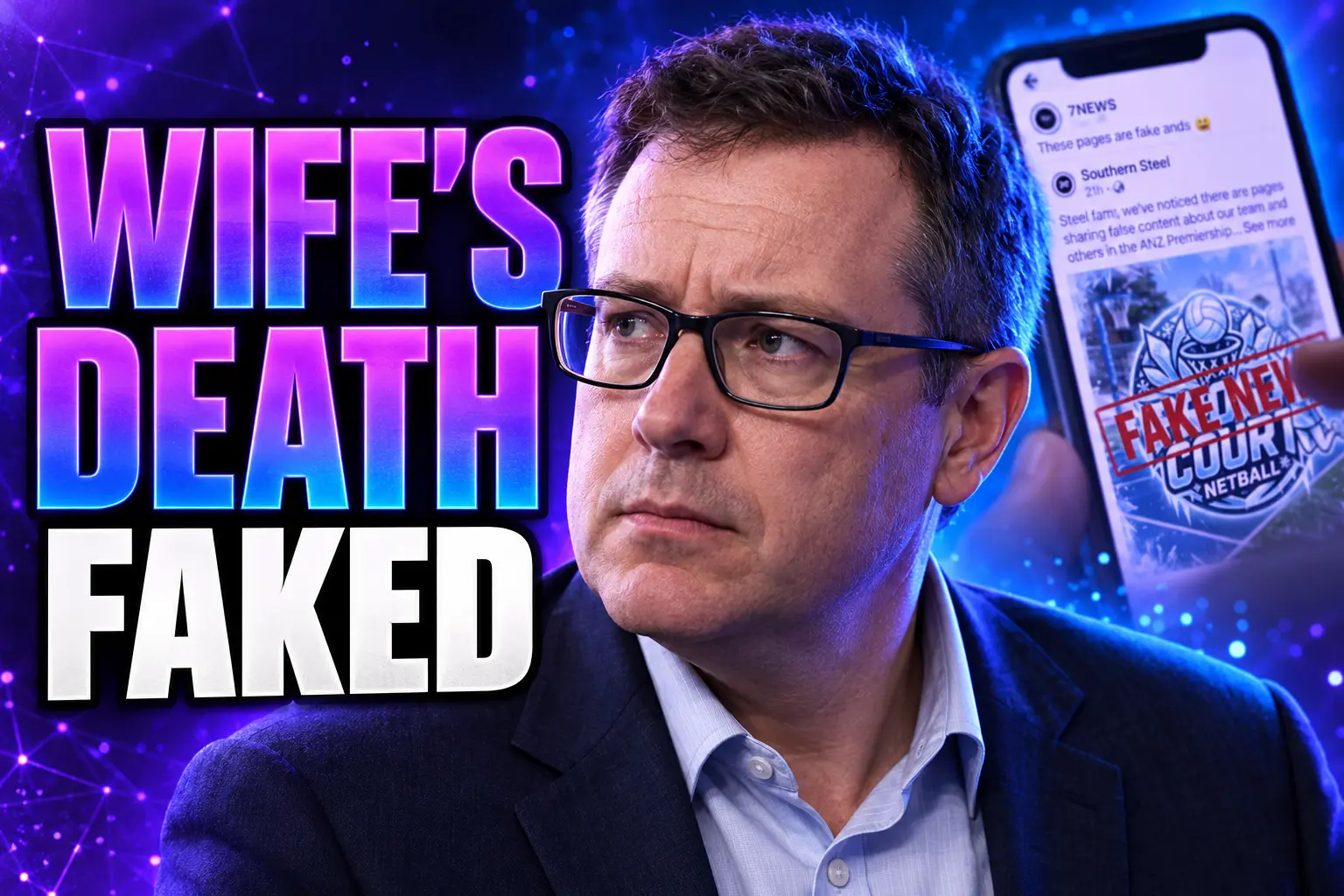
A Vietnam-run Facebook page posted an AI death notice for Emma Webster, wife of Warriors coach Andrew Webster. He is 44, and he is not on the apps. He heard the claim on June 10, 2026, from a reporter at the club’s weekly media conference.
The post used a real photo of the couple from the night he won the 2023 Dally M Coach of the Year. The text was written to look like a news obituary. Facebook’s own page label showed operators in Vietnam, and the same factory had already been hitting All Blacks, Crusaders and netball names with illness, sacking and death stories that were not true.
Vietnam-Run Pages Sold a Death That Never Happened
The line that reached the Warriors presser came off pages such as Warrior Spirit NZ and Rugged Titans NZ. It read: “The world of New Zealand rugby league is quietly mourning the passing of Emma Webster, the devoted wife of New Zealand Warriors head coach Andrew Webster.” Emma Webster is alive. The coach had to say so on camera because family and friends had already seen the post.
To hear you talk about my wife like that is not very nice. I’m not on social media, so I only hear about it from people like you today. At the same time, if you want to live in that world and be part of it, you’re going to get this. I’m sure somebody’s got enough technology to create something like that, they’ve got enough technology to get rid of it, so that stuff never happens.
Andrew Webster, New Zealand Warriors head coach, Warriors media conference
He said he would stay in his lane and make sure his family knew it was false. A May review of Warrior Spirit NZ found the page was run by users in Vietnam and posted through the day, with each item carrying a comment link to an off-site page packed with ads. That is not a bored fan with a grudge. It is a shop.
The Same Fake Obituary in Every Club Jersey
The Emma notice sat on a stack of near-identical fakes. Change the name, swap the jersey, keep the grief. Fact-checkers found a “Warriors staffer” shot at 35 while breaking up a bar fight; the same face appeared in other teams’ kits, and one version still showed the sparkle mark of Google’s Gemini assistant. A TIME magazine cover of Webster, and a hospital shot of him after “surgery,” both carried hidden Google AI marks. He does not appear on the 2026 list of influential people, and there was no surgery to recover from.
THE CLONED DEATH POSTS
| The claim | What checks showed | The giveaway |
|---|---|---|
| Emma Webster has died | She is alive; Webster answered at the June 10 presser | Fan-page “news” layout and AI text |
| Webster on a TIME 2026 cover | He is not on the magazine’s 2026 list | Hidden “Made with Google AI” mark |
| Webster recovering from surgery | No surgery on the record | Same hospital template used on other public figures |
| A 35-year-old Warriors staffer was shot | The club made no such announcement | Same face in other jerseys, Gemini sparkle left in frame |
| Chiefs player Jack Pugh has died | No such Super Rugby player exists | Photo of a US footballer of that name who died in April |
| Brad Weber has stage four cancer | The cancer claim is false | Posted with other All Blacks names in the same fake run |
Google DeepMind builds invisible watermarks in Google AI images so a search can show when a picture was made with its tools. The farms still ran the pictures, and people still left condolences. A fake childhood home for Roger Tuivasa-Sheck was a coastal mansion in Palm Beach, about 50 km north of Sydney, not a house in Auckland. A fake $500,000 donation in his name was tied to a child’s killing in Alice Springs that he had not spoken on.
Who Believes a Coach’s Wife Has Died?
Crusaders fullback Johnny McNicholl was not worried about teammates who live on their phones. He was worried about the people who do not.
Especially with my parents’ generation, they’re definitely believing some of those cruel statements about people getting cancer. I’ve seen one today that was Macca Springer terminated his contract for misbehaviour, which is obviously not true. He’s out here playing; he’s a good kid, having a laugh. They can be sometimes humorous, but then when you think about who’s gonna be reading them and believing them, it’s pretty sad, isn’t it.
Johnny McNicholl, Crusaders fullback
Avast’s 2026 Safe Tech Report found 66 percent of New Zealand adults believe they would recognise an AI fake. McNicholl’s point is that the posts are not aimed at those people. They are aimed at a parent who searches a player’s name and finds a cancer notice written like a news story.
FAMILY AND ILLNESS FAKES THE PAGES PUSHED
- Emma Webster: A death notice on Warriors fan pages, built on a real awards-night photo.
- Julian Savea’s wife: A false death post that drew more than 100 condolence comments, including “Condolences to Julian Savea and the family.”
- Brad Weber: A false stage four cancer claim, alongside posts that also used Will Jordan and David Havili.
- Dan Carter: A Red Knight Legacy post that said he was “fighting for his life” in hospital.
- A Crusaders staff member: A fake passing on the same Crusaders-styled page.
- Macca Springer: A fake sacking for misbehaviour while he was still in camp, having a laugh.
The Legend of Marty Banks, a known rugby fan page, put the next step in plain words: the farms had started inventing dead children, and New Zealanders were still treating the posts as real. Massey University marketing professor Bodo Lang said some operators want a huge following, and others only need a click that drops malware. “If 10,000 people do that, and it downloads something that then freezes the hard drive and extracts personal information, well, that’s the mission they accomplished for them,” he said.
After Super Rugby Takedowns, New Pages Keep Appearing
New Zealand Rugby said in June it was working through a process with Meta. Some union pages did come down. The Warriors-shaped ones that carried the Emma notice had been left up two weeks earlier, which is how a reporter could still put the death claim to Webster on June 10.
THE FACEBOOK FARM CALENDAR
- April 6, 2026: Red Knight Legacy is created under the name Linda Kilback, dressed as a Crusaders fan page.
- April 15, 2026: The page is renamed, nine days after it was set up.
- May 14, 2026: Warrior Spirit NZ is documented as Vietnam-run, posting all day, with ad links under fake Warriors stories.
- May 20, 2026: Red Knight Legacy, Storm Surge Squad and Waikato Rugby Force have tens of thousands of followers; a fake death of Julian Savea’s wife draws more than 100 comments.
- May 28, 2026: Those Super Rugby pages are removed; similar Warriors pages remain active.
- June 10, 2026: Webster is asked, on camera, about a post that says his wife has died.
- June 29, 2026: Dozens of supposed NRL and AFL fan pages, most run from Vietnam, are mapped across both codes, with other labels pointing to the Philippines, Bangladesh and Russia.
- August 2026: Iron Cavalry, labelled as run from Vietnam and Canada, is still posting fake All Blacks and Crusaders news, including a $6 million Ardie Savea deal the Crusaders said was false.
Lang called the takedowns a game of whack-a-mole: report a page, watch it come back somewhere else. Fifty-six days after Webster’s presser, the union side of the farm had a new name and a fake contract for the All Blacks captain. In early September, Webster again stayed off the apps and called the people who target his players online gutless, pointing back to the fake story about his wife.
Grief Comments Pay for the Next Fake
University of Queensland disinformation researcher Anne Kruger said the choice of sport is the point. Clubs already make grown adults cry on a normal Saturday, she said, so a death post is a reliable way to shove a reader toward an ad page. Fact-check editor Ben James said the people in Vietnam likely know very little about the players, and that a few years ago they could not have done this at all. AI now writes the local grief for them, at a volume no club comms desk can match.
The farm does not need every reader to be fooled. It needs a comment thread that looks like a wake. More than 100 people told Julian Savea they were sorry for a death that had not happened, and each reply taught Facebook to show the post again. Western Bulldogs, one of the few clubs to speak in public before the Webster presser, told fans to think twice before commenting, “as any engagement will make them more visible.”
That is why a shrug about gullible league fans misses the business. The pages mix real match photos with invented funerals so the first three posts look harmless. Then they ask for a click. Storm Surge Squad used a fake fire at the Hurricanes’ ground to push an off-site gallery. Red Knight Legacy pointed at a site that search results had already tied to scam warnings. The condolence is the bait. The ad page is the till.
The same network crossed the Tasman when it needed more inventory. After former Rabbitohs player Nathan Merritt told the public he had terminal cancer, a “family statement” appeared that said he was already dead. Club staff at Sydney’s Redfern All Blacks started getting calls. Melbourne Storm staff found and even shared posts that said Tui Kamikamica had died after a real hospital stay; he later spoke about his surgery and got a clearance to play. The product is the same whether the jersey is Warriors, Crusaders or Storm: a serious health scare, a family voice that was never given, and a comment box filling up with love.
What Facebook’s Own Transparency Label Already Shows
Meta does not need a detective novel to see who is running these pages. The company already prints a country on the Page. Warrior Spirit NZ came up as Vietnam. Iron Cavalry came up as Vietnam and Canada. Red Knight Legacy came up as a person named Linda Kilback. The label did not stop the Emma Webster post reaching a press conference, and it did not stop an All Blacks contract fake in August.
PAGES THE LABEL ALREADY TIED TO THIS RUN
- Warrior Spirit NZ: Vietnam-run Warriors fan skin; ad links under fake deaths, donations and magazine covers.
- Rugged Titans NZ: One of the pages that carried the Emma Webster death notice.
- Red Knight Legacy: Crusaders skin, created April 6 as Linda Kilback, renamed April 15; fake Carter hospital scare and a fake staff death.
- Storm Surge Squad: Hurricanes skin; fake stadium fire and an off-site click.
- Waikato Rugby Force: Chiefs-style page in the same Super Rugby cluster that later came down.
- Iron Cavalry: All Blacks and Crusaders fakes in August, including the $6 million Savea claim, run from Vietnam and Canada.
Meta’s public rules against inauthentic Pages and networks already ban assets used to deceive people about who is behind a page or where its audience came from. The company says it uses automated systems and manual review, and it has taken down clusters of fake sports pages when investigators put a pile of them on the table. The NZ rugby and league versions kept landing in parents’ feeds in the meantime. Tactix general manager Kate Agnew, speaking for a netball side that had to warn its own fans, rejected the idea that any publicity helps. “We are concerned that this is putting out a really negative environment and an unhealthy rhetoric that people are engaging with under false pretences,” she said.
New Zealand Law Already Treats Harmful Fakes as Harm
Webster’s ask was simple: if someone can build this, the platforms can take it down. Netsafe, which handles harmful digital communications, has been saying something dryer for months. There is no single “AI image” statute. Existing law still applies when the post is used to hurt someone. Netsafe’s chief online safety officer, Sean Lyons, has warned that fake tragedy pictures do not just mislead; they can add fear for people already in shock, and they can make real official information harder to trust.
The Harmful Digital Communications Act already covers AI fakes when a post causes, or is likely to cause, serious emotional distress, whether the picture is a camera shot or a generated one. The Classification Office is as blunt on the next question: AI-generated content can be illegal in New Zealand if it is treated as objectionable, and making, holding or sharing that kind of file is an offence. A death hoax about a coach’s wife will not always meet that bar. It can still be a harmful digital communication, and it can still be an inauthentic Page under Meta’s own rules.
WHAT WE KNOW
- Emma Webster: The death notice was false; she is alive, and her husband had to say so in public on June 10, 2026.
- The operators: Facebook’s transparency labels on the Warriors and All Blacks pages in this run pointed to Vietnam, and in one later case Canada as well.
- The method: AI text and Google-marked images, cloned across clubs, with ad links under the comments.
WHAT IS UNCONFIRMED
- Who gets paid: The people behind Linda Kilback, Warrior Spirit NZ and Iron Cavalry have not been named in public beyond those page labels.
- Which Warriors pages still sit live: Super Rugby clones were removed on May 28; later union fakes show the shop can reopen under a new title, but a live headcount for every Warriors skin is not on the record.
By August the farm had a fresh All Blacks page and a fake $6 million headline. The Crusaders had to say the stories were false. Webster still was not on Facebook. His family, and other families who do not treat every feed item as a draft, were.

Instagram Plus Tests a Read-Only Mode That Cuts Stories

Altman Asks the Public to Accept Some AI Harm

Google Freezes OSS VRP Product Reports After AI Flood

AI Agents Make Payment Rails the Scarce Prize

Turkey’s Crypto Boom Now Runs Through Three Banks

Fable 5 Came Back Under a Commerce On-Off Switch

Google’s SpaceX GPU Lease Has a Sept. 30 Deadline

Plasma One’s XPL Locks Face a 1.81 Billion Cliff

DGO’s Rs 549 World Cup Pass Cost Fans Sleep and Data

Moonshot AI’s $30 Billion Ask Became a $35 Billion Close
-
 AI3 months ago
Fable 5 Came Back Under a Commerce On-Off Switch
-
 AI4 months ago
Google’s SpaceX GPU Lease Has a Sept. 30 Deadline
-
 CRYPTO4 months ago
Plasma One’s XPL Locks Face a 1.81 Billion Cliff
-
 APPS4 months ago
DGO’s Rs 549 World Cup Pass Cost Fans Sleep and Data
-
 AI4 months ago
Moonshot AI’s $30 Billion Ask Became a $35 Billion Close
-

 NEWS4 months ago
ColorOS 17 Device List Spans Oppo, OnePlus and Realme
-

 GAMING4 months ago
Xbox Cuts 3,200 Jobs After Five Years of Thin Returns
-

 GAMING4 months ago
The RTX 4050 Under Rs 70,000 Hides a Wattage Gap