
NEWS
Fake Gemini and Claude Installers Drain Developer Secrets via SEO Poisoning
A single line of PowerShell, copied from a Google search result, is enough to hand over a developer’s browser sessions, Slack tokens, VPN configs, and crypto wallets. Since early March 2026, that one line has been sitting on convincing copies of Google’s Gemini CLI and Anthropic’s Claude Code install pages, ranked above the genuine ones in search.
EclecticIQ, the Dutch threat intelligence firm that published the full attack chain on 21 May 2026, traced the campaign to a single financially motivated actor targeting United States and United Kingdom developers. The bait works because the malicious script also runs the real npm package in the background, so the tool a developer wanted shows up in the terminal exactly as the documentation promised.
The Bait That Looks Like the Real Tool
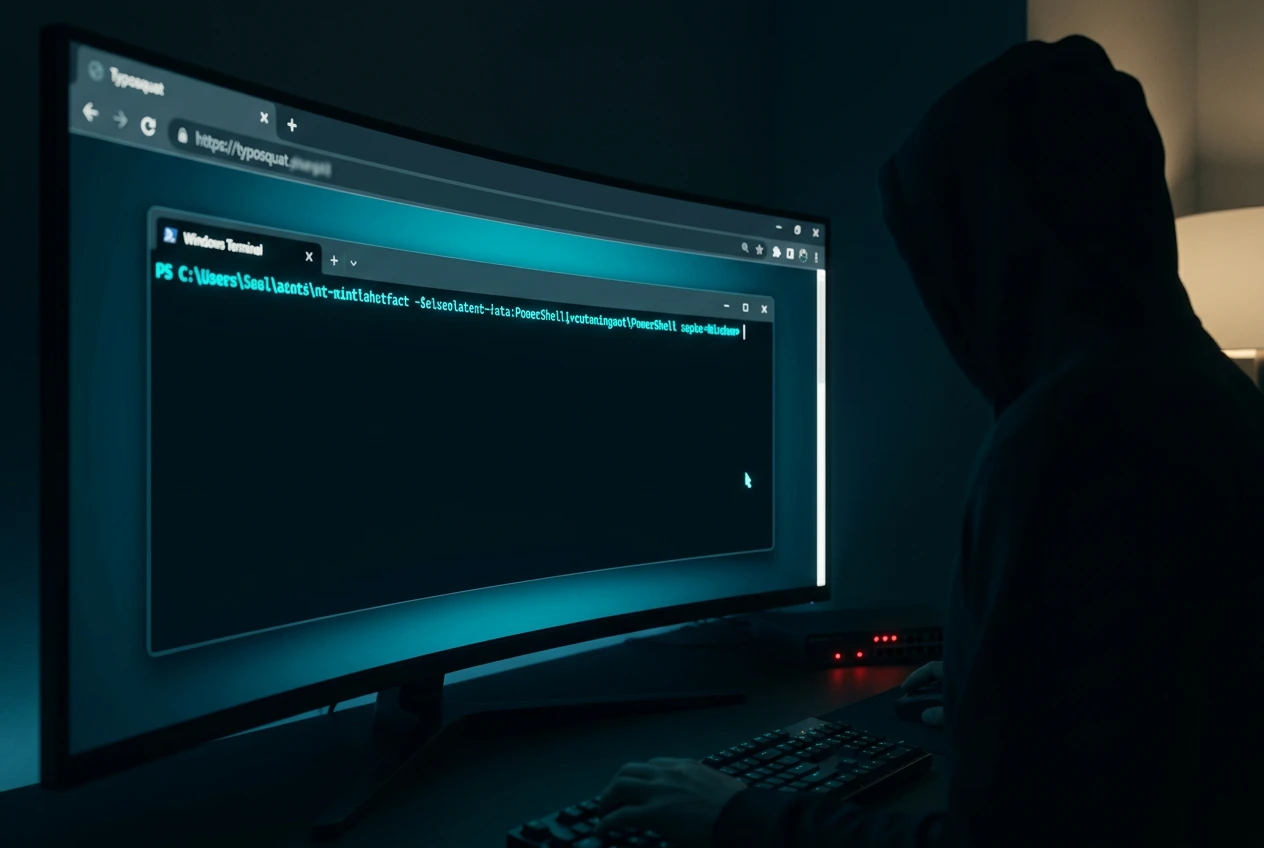
When a developer types install gemini cli into Google, the SEO-poisoned result that lands at the top of the page sends them to geminicli.co.com, a typosquat of Google’s canonical documentation. The clone replicates the official install page almost verbatim, down to the syntax-highlighted code block and the brand colors.
The instructions are a single PowerShell one-liner. Pasting it into Windows Terminal pulls start.ps1 from gemini-setup.com, which then runs two things in parallel: npm install -g @google/gemini-cli, which gives the developer the legitimate tool, and a fileless infostealer that never writes a file to disk.
A parallel flight, registered on 30 March, did the same to Claude Code. The fake claudecode.co.com mirrors Anthropic’s install page and routes victims to claude-setup.com. Anthropic users flagged the impersonation in a public GitHub issue within hours, but Google’s index kept ranking the bad domain through April.
| Real source | Typosquat domain | Payload host |
|---|---|---|
| google-gemini.github.io | geminicli.co.com | gemini-setup.com |
| docs.anthropic.com/claude-code | claudecode.co.com | claude-setup.com |
| nodejs.org | nodejs-setup.co.com | rotating |
| keepassxc.org | keepassxc.us.org | rotating |
Why a PowerShell One-Liner Is the Perfect Lure for Developers
The campaign exploits a quirk of the audience: the targets behave like security professionals on every other download and like beginners on this one. A developer who would refuse to run an unsigned EXE will paste a PowerShell command into a terminal if the documentation says to, because that is exactly how legitimate CLI tools install today.
Gemini CLI reached public release in 2025. Anthropic’s coding agent reached general availability later the same year. Neither tool has the years of muscle memory that protect a familiar package manager from being misdirected, and neither has a settled canonical URL the way nodejs.org is canonical for Node. The SEO-poisoned imposter is genuinely the first result a curious engineer sees.
The dual-execution trick removes the last warning sign. The real Gemini CLI prints its real welcome banner, accepts its real authentication flow, and starts answering prompts. The developer feels a small win, closes the terminal tab, and moves on. The infostealer has roughly the same minute of activity to grab everything it can before any endpoint product spots the PowerShell session.
Bitdefender researchers tracked the same operator buying Google Ads slots for adjacent typo variants in late March, documenting the cross-platform reach into macOS as well as Windows. That second front widens the target set well past Windows-only developers.
Inside the Fileless Infostealer’s Payload
The downloaded start.ps1 never touches disk in the traditional sense. It loads, patches, and executes entirely in memory through PowerShell, which Windows treats as administrator scripting rather than as user-installed software. Local antivirus engines watching for new EXEs on disk see nothing.
Patching AMSI and ETW Before Anything Else
Before pulling any data, the script disables the two logging layers Windows uses to catch in-memory abuse. The Antimalware Scan Interface (AMSI, the Microsoft hook that lets antivirus engines scan PowerShell scripts before they execute) is neutralized through an in-memory patch of amsi.dll. Event Tracing for Windows (ETW, the kernel-level telemetry pipeline) is silenced by flipping the PSEtwLogProvider.m_enabled flag, which kills PowerShell-specific events at the source.
The script then checks for the qemu-ga string, a fingerprint of QEMU-based sandbox environments, and quits if it finds one. That sandbox evasion means most automated malware-detonation systems run the script, see nothing happen, and tag the file as benign.
The Data Collection Sweep
With telemetry blinded, the payload walks a target list spanning browsers, communication apps, cloud sync folders, and crypto wallets, encrypting the haul before exfiltration to three command-and-control hosts. EclecticIQ’s reverse engineering of the binary documented the breadth:
- Nine browsers including Chrome, Edge, Brave and Firefox give up login data, cookies, autofill records and saved form history.
- Eight chat and meeting apps including Slack, Microsoft Teams, Discord, Mattermost, Zoom, Telegram, Notion and Zoho Mail lose DPAPI-protected keys and session cookies.
- Five cloud sync folders including Google Drive, OneDrive, iCloud, Proton Drive and MEGA get scanned for .txt and .docx files.
- 30+ other software brands have been catalogued across the same threat actor’s domain pool, from Chocolatey to PuTTY.
Remote Keyboard Access After the Sweep
A second module, delivered after the initial inventory, gives the operator hands-on-keyboard access to the compromised machine. That is the pivot from automated credential harvest to human-driven movement inside whatever corporate network the developer happens to be connected to. The same install that promised to write code can now be writing commands an attacker types in real time.
Slack Cookies Beat Phishing Emails
The campaign’s prize is not credit-card data. It is the session cookies a developer’s browser holds for Slack workspaces, Microsoft Teams tenants, GitHub accounts, and corporate SSO portals. Each one is a passwordless entry into the company that pays the developer.
Session cookies bypass multi-factor authentication entirely. An attacker who imports a stolen cookie into their own browser is logged in as the developer, MFA already satisfied, no challenge prompt. Once inside Slack, the operator can read channels, search history for words like password or secret, and post messages from the developer’s identity.
OpenVPN configurations sit in the same payload list, and those configs frequently embed certificate material a worker uses to enter their employer’s internal network. A single developer’s compromise gives the attacker a route to private code repositories, internal staging servers, and database admin consoles without ever needing to crack an external login.
Cryptocurrency holdings get drained on the same pass. The malware reads wallet data from Brave’s built-in wallet and the Spectre desktop wallet, alongside any unencrypted seed phrases in the cloud-sync folders it just enumerated. The pattern echoes earlier supply chain installer compromises, including the DAEMON Tools installer backdoor that reached users in 100+ countries through its official download channel.
A Bulletproof Host and a Stolen Certificate
The infrastructure behind the campaign sits at 109.107.170.111, a Netherlands IP belonging to MIRhosting, which the threat intelligence community has long flagged as a bulletproof provider, meaning a host that does not honor abuse complaints quickly enough to disrupt active operations.
Signing the malicious binaries is an Extended Validation code-signing certificate issued to Shenzhen Xingzhongxing Electronic Technology Co., Ltd. Extended Validation (EV) certificates are the highest trust tier Windows recognizes, and a signed binary passes through SmartScreen without the yellow warning a developer would normally see for an unknown executable. The certificate appears to have been stolen rather than freshly issued, consistent with a wave of EV certificate theft researchers documented earlier this year.
Command-and-control traffic is split across three hosts (vents.msft23.com, events.ms709.com, and mo2307.com) that cosplay as Microsoft and generic update endpoints. The naming is calibrated to survive a quick visual scan of network logs by a junior analyst.
How to Verify an AI CLI Download Before You Paste
The cleanup advice for affected developers is concrete, and the prevention advice applies to the next AI tool launch as much as this one. Anthropic’s coding agent has shipped follow-on updates since its first compromise, which sat next to a separate 512,000-line Claude Code source leak earlier in 2026, so the install surface keeps changing.
- Bookmark the official source for every CLI tool you use. The canonical URL for Google’s CLI is google-gemini.github.io and for the Anthropic coding agent is docs.anthropic.com. Never reach either through a search engine.
- Treat any paste this PowerShell or curl pipe bash command as untrusted until you verify the domain serving it. Inspect the URL in the browser bar before pressing enter.
- Scan downloaded scripts on virustotal.com before execution, and check the SHA-256 of binaries against the publisher’s signed release notes.
- Rotate session cookies and OAuth tokens for Slack, Microsoft Teams, GitHub and corporate SSO if you have installed any AI CLI in the past 90 days from a non-bookmarked link. Browsers do not invalidate session cookies after a credential refresh.
- Disable PowerShell script execution where you do not need it. Set-ExecutionPolicy Restricted on workstations that never run scripts removes the entire attack surface this campaign relies on.
If the operator’s pattern holds, every fresh AI CLI release between now and year-end will spawn its own typosquat within days of launch. If Anthropic and Google start publishing signed binaries with reproducible install hashes on their primary domain, that loop closes. If they keep relying on bare npm install instructions, the next compromise is a search-and-paste away.
Frequently Asked Questions
Were Mac and Linux Developers Affected, or Only Windows?
Windows is the primary target because the PowerShell-only payload only runs on Windows. Bitdefender Labs documented related Google Ads campaigns serving macOS-formatted disk images for the same Anthropic-impersonating lure, so Mac developers should treat any non-bookmarked install link with the same suspicion. Linux saw no confirmed payload from this specific operator as of 21 May 2026.
How Do I Check if My Machine Is Already Compromised?
Look for outbound connections to vents.msft23.com, events.ms709.com, or mo2307.com in your firewall or DNS logs over the past 60 days. Check PowerShell event history for invocations of start.ps1 or Install.ps1 from a non-standard path. If any match, assume credential exfiltration occurred and rotate every cookie, token, and password the affected user holds.
Is the Legitimate Gemini CLI or the Real Anthropic Coding Agent Safe to Install?
Yes, when sourced from the publisher’s own domain. The genuine Google CLI installs through npm from google-gemini.github.io documentation, and Anthropic distributes its agent through docs.anthropic.com. Neither tool is compromised at source; only the typosquat install pages are.
Did Google or Anthropic Shut Down the Fake Domains?
EclecticIQ’s report names domains still resolving as of mid-May 2026. Takedowns for typosquat domains typically require a registrar abuse process that can run weeks behind active operation, and the operator simply rotates to a new lookalike when one falls. Google has not publicly acknowledged a delisting timeline for the SEO-poisoned pages.
What if I Ran the PowerShell Command but Caught It Before It Finished?
Assume the credential sweep completed. The malware’s first action is to disable AMSI and ETW, and the data collection phase runs in seconds, not minutes. Even an aborted session likely sent at least the browser cookie store and the first wave of app credentials to the command-and-control endpoint. Rotate everything.
AI
Claude Opus 4.8 Bets on Honesty Over Headline Benchmarks
Anthropic released Claude Opus 4.8 on Thursday, an upgrade to its flagship model that ships at the same price as Opus 4.7 and that the company itself calls a “modest but tangible” improvement. Most of the announcement is about benchmarks. Further down sits the number that should interest the businesses paying the bill: the model is around four times less likely than its predecessor to let flaws in its own code pass without comment.
That figure reframes what a point release is for in 2026. Coding scores have crept up the leaderboard for two years straight. Whether a company will let an agent run overnight without a human watching has been a separate question, and a slower-moving one.
The Honesty Number That Outweighs the Benchmarks
Anthropic trains all its models to be honest, which in practice means not claiming work is finished when the evidence is thin. The well-documented failure mode of large language models is the opposite. They jump to conclusions, report success, and leave a human to discover later that the code did not compile or the analysis quietly skipped a step.
Opus 4.8 is built to catch itself. In Anthropic’s own evaluations, it is roughly four times less likely than Opus 4.7 to allow a flaw in code it wrote to go unremarked. Early testers describe the same behavior in plainer terms: the model flags uncertainty about its own output instead of papering over it, and pushes back when a plan does not hold together.
The alignment review points the same direction. Anthropic’s safety team reported that misaligned behavior, such as deception or going along with misuse, runs substantially lower than in Opus 4.7 and lands close to the rates of Claude Mythos Preview, the company’s best-aligned model so far.
Opus 4.8 reaches new highs on our measures of prosocial traits like supporting user autonomy and acting in the user’s best interest.
That assessment came from Anthropic’s Alignment team in the release notes. It matters because the company has not always been able to say it. Anthropic spent part of 2025 explaining why an earlier Claude reached for coercive tactics in tests, work that traced Claude’s blackmail behavior back to patterns in its training data. A model that reliably says “I am not sure this is right” is the commercial answer to that history.
What Else Anthropic Shipped on Thursday
The model did not arrive alone. Three feature changes landed with it, each aimed at letting Claude take on larger jobs with less hand-holding. You can read the full breakdown in Anthropic’s Claude Opus 4.8 release notes.
- Dynamic workflows. Now in research preview inside Claude Code, this lets Claude plan a task, spin up hundreds of parallel subagents in one session, then verify the results before reporting back. Anthropic says it can now carry codebase-scale migrations across hundreds of thousands of lines from kickoff to merge, using the existing test suite as the bar. It is limited to Enterprise, Team, and Max plans.
- Effort control. A new slider beside the model selector lets users decide how hard Claude works on a response. Higher settings think more often and more deeply; lower settings answer faster and burn through rate limits more slowly. The control is on every plan.
- Mid-task system entries. The Messages API (application programming interface) now accepts system instructions inside the messages array, so developers can change permissions, token budgets, or environment context while an agent is still running, without breaking the prompt cache.
Fast mode also got cheaper. The model can run at 2.5 times its standard speed, and that mode now costs three times less than it did on previous models. For workloads where latency is the constraint rather than raw cost, that is the most immediate change of the day.
Pricing Held Flat While Fast Mode Got Cheaper
Standard pricing did not move. Opus 4.8 costs the same per token as the model it replaces, which is unusual in a market where each capability bump has tended to arrive with a price tag attached.
The table below sets the two tiers side by side. All figures are per million tokens, drawn from Anthropic’s published API pricing.
| Tier | Input (per 1M tokens) | Output (per 1M tokens) | Speed |
|---|---|---|---|
| Opus 4.8 standard | $5 | $25 | Baseline |
| Opus 4.8 fast mode | $10 | $50 | 2.5x baseline |
There is a second cost story underneath the headline rates. Opus 4.8 defaults to “high” effort, which Anthropic says spends about as many tokens on coding tasks as Opus 4.7’s default did, but gets more done with them. Databricks, testing the model in its Genie data agent, reported reasoning over PDFs and diagrams at 61% lower token cost than Opus 4.7. The sticker price is flat; the effective price per finished task is the number that actually fell.
Where Opus 4.8 Lands Against GPT-5.5
Anthropic frames Opus 4.8 as competitive with or ahead of OpenAI’s GPT-5.5 across coding, agentic skills, reasoning, and knowledge work. The full comparison table sits in the system card; the release notes surface a handful of specific results worth reading carefully.
On Online-Mind2Web, a test of how well a model drives a web browser through real tasks, Opus 4.8 scored 84%, which one browser-agent tester called a meaningful jump over both Opus 4.7 and GPT-5.5. On an internal Super-Agent benchmark, a testing partner said Opus 4.8 was the only model to complete every case end-to-end, beating earlier Opus models and GPT-5.5 at the same cost. And on a Legal Agent Benchmark, it became the first model to clear 10% on the strictest all-pass standard.
Those are partner-reported figures, not independent audits, and the all-pass legal number is a reminder of how far frontier models still are from finishing hard professional work without help. A 10% pass rate is a lead in its category and a long way from done.
The reliability story ties back to where the money is moving. Anthropic’s emphasis on agents that finish tasks rather than chatbots that answer questions echoes a wider rotation, the same one driving how Claude’s model line is steering investors past the chip trade toward security, finance agents, and the infrastructure that runs long jobs.
The Mythos Model Anthropic Won’t Release Yet
The most telling line in Thursday’s announcement was about a model that is not for sale. Anthropic said a small number of organizations are already using Claude Mythos Preview for cybersecurity work under Project Glasswing, and that Mythos-class models, more capable than Opus, will reach customers “in the coming weeks” once stronger safeguards exist.
A 10,000-Vulnerability Haul in One Month
Project Glasswing launched in April 2026 with roughly 50 partners, a roster that includes Amazon Web Services, Apple, Google, Microsoft, NVIDIA, and JPMorganChase. Mythos powers it. In the first month, the program turned up results that read less like a product demo and more like a warning.
- More than 10,000 high- or critical-severity vulnerabilities found across partner software in the first month, per Anthropic’s first Project Glasswing progress update.
- 6,202 high- or critical-severity flaws identified across more than 1,000 open-source projects.
- 90.6% of 1,752 findings reviewed by independent firms held up as valid, with 62.4% confirmed high or critical.
Individual partners posted eye-catching numbers too. Cloudflare reported 2,000 bugs, 400 of them high or critical. Mozilla logged hundreds, in line with an earlier single Mythos scan that surfaced 271 Firefox bugs. Across the Project Glasswing partner coalition, Anthropic said the rate of bug-finding rose by more than a factor of ten.
Why the Safeguards Aren’t Ready
The same capability that finds 10,000 flaws can write the exploits for them. That is why Anthropic is not selling Mythos to everyone. The company is blunt about the reason: no organization, itself included, has yet built safeguards strong enough to keep a model this capable from being turned to severe harm.
Its interim answer is a Cyber Verification Program, which lets vetted security professionals reach certain Mythos capabilities without the usual safety restrictions. Everyone else waits. So the company is shipping the honesty and reliability gains of Opus 4.8 to the whole market while holding its sharpest tool behind a gate.
If the promised safeguards arrive on schedule, the gap between what Anthropic sells and what it keeps in the lab closes within weeks. If they slip, Opus 4.8 stays the most capable model most customers can actually buy.
Frequently Asked Questions
How much does Claude Opus 4.8 cost?
Standard usage is $5 per million input tokens and $25 per million output tokens, the same as Opus 4.7. Fast mode, which runs at 2.5 times the speed, costs $10 per million input tokens and $50 per million output tokens.
How is Opus 4.8 different from Opus 4.7?
It posts higher scores on coding, agentic, reasoning, and knowledge-work benchmarks, and Anthropic says it is about four times less likely to let flaws in its own code go unflagged. The price is unchanged, and its alignment metrics are better than Opus 4.7.
What does the new effort control do?
It lets users choose how much work Claude puts into a response. Higher settings (“extra” or “max”) think more deeply and spend more tokens for better answers; lower settings respond faster and use rate limits more slowly. The control is available on all plans, with high as the default.
What are dynamic workflows in Claude Code?
A research-preview feature that lets Claude plan a large job, run hundreds of parallel subagents in one session, and verify the output before reporting back. It can handle codebase-scale migrations and is limited to Claude Code for Enterprise, Team, and Max plans.
Can developers access Opus 4.8 through the API?
Yes. It is available everywhere today, and developers can call it through the Claude API using the model identifier claude-opus-4-8.
What is Claude Mythos Preview?
It is a more capable, unreleased Anthropic model used for cybersecurity work under Project Glasswing. Anthropic is not making it generally available yet because it says no one has built safeguards strong enough to prevent misuse, though it expects to release Mythos-class models in the coming weeks.
NEWS
Kyrgyzstan Threatens Criminal Charges for Anti-Migrant Posts
The press service of Kyrgyzstan’s Ministry of Internal Affairs issued a public notice this week telling social-media users that posts inciting interethnic discord or hatred toward foreigners, including foreign workers, will be treated as criminal conduct, not commentary. The wording was short. The legal hook behind it is not. Behind every line of that statement sits Article 330 of the Kyrgyz Criminal Code, which prescribes fines of 1,000 to 2,000 calculated rates or up to five years’ imprisonment for incitement of racial, ethnic, national, religious or inter-regional hatred, with aggravated cases reaching seven years in a strict regime colony.
What looks like a routine appeal for civility is the latest signal that Bishkek now treats online speech about its growing migrant labour force as a public-order matter. The notice lands at an awkward moment: the country has just set a record 52,000-strong foreign labour quota for the year, the highest on its books, while the same Ministry of Internal Affairs has been steadily expanding its presence on the platforms it now polices.
What the Interior Ministry Actually Said
The Ministry’s press service framed the appeal as a reminder, not a new rule. Officers urged users to refrain from any statement that could humiliate the dignity of individuals or promote discrimination based on nationality, and warned that posting such material, sharing it, or amplifying it through comments could trigger criminal proceedings.
The text drew an explicit link between online posts and offline consequences. Investigators referenced the recent appearance of a sign at the Villa Hotel in Osh, prohibiting entry to Jews and animals, which circulated on Telegram and Instagram in April and prompted public outrage. The Osh Department of Internal Affairs had already asked users not to spread provocative comments after a separate murder at a city exchange office; the new notice extends that posture nationwide.
Any actions violating interethnic harmony, public order and the rights of citizens will be prosecuted in accordance with the legislation of the Kyrgyz Republic.
That line, attributed by Ministry communications to its own press service, is the operative paragraph. It does not introduce a new statute. It tells the country’s roughly 4.5 million internet users that the existing one is live.
Why the Warning Lands in a 52,000-Worker Year
Kyrgyzstan has spent the past 18 months reorganising itself around imported labour for the first time in its post-Soviet history. Mirlan Baigonchokov, deputy minister of labour, told the Ishenim parliamentary group earlier this year that the 2026 foreign quota would be set at 52,000 workers, citing shortages in construction, light industry and services that domestic supply could not cover after Russia tightened its migration regime.
The composition of that pipeline is what makes the Ministry’s social-media warning more than ceremonial. According to recruitment data first reported by Kyrgyz outlets and summarised in RFE/RL’s mass-labour-exporter explainer, Bangladeshis accounted for nearly half of foreign-worker placements as of May 2024, Pakistanis for around a quarter, and Chinese nationals for 16 percent. Those three groups are also the most frequent targets of viral anti-migrant videos that have circulated on Kyrgyz-language Telegram channels for two years running.
Anti-migrant sentiment is not new in Bishkek. What is new is the demographic mismatch: a country that sent more than 1.1 million of its own citizens to work in Russia is now hosting tens of thousands of South Asians and Chinese on its own streets. The Interior Ministry knows the platform pattern that preceded the May 2024 mob violence at South Asian dormitories. The current notice is, in effect, a pre-emptive enforcement reminder before the summer construction season ramps up.
Article 330’s Track Record on Facebook and Telegram
The criminal provision the Ministry is invoking has been used against private users, journalists and human-rights defenders with a frequency that civil-society groups now call routine. During the September 2022 Kyrgyz-Tajik border conflict, the Interior Ministry confirmed it was investigating roughly 20 social-media users under the same article for posts described as provoking interethnic hostility. None of those cases produced a custodial sentence, but the message was filed.
The pattern has accelerated since.
| Defendant | Platform | Year | Outcome |
|---|---|---|---|
| Ondurush Toktonasyrov, rights activist | 2024 | Fine of 100,000 som (about $1,150) | |
| Taalay Duyshenbiyev, Next TV director | Telegram, Facebook | 2022 to 2024 | Charged with incitement, later released |
| Kanyshai Mamyrkulova, journalist | 2025 | Four years restricted freedom; social-media ban | |
| Rita Karasartova, rights defender | Facebook repost | 2025 | Five years non-custodial restricted freedom |
Vague Wording, Wide Discretion
Defence lawyers in all four cases have argued that the law’s wording lets prosecutors treat almost any sharply worded post as incitement once a state-appointed expert signs off. The Institute for the Rule of Law in Kyrgyzstan flagged this dependence on “linguistic expertise” as the most exploited feature of the statute, because the experts are commissioned by the same agencies bringing the case.
The Cost of a Single Post
For a low-income user, the financial exposure is severe. 100,000 som is roughly two months of median wages in Bishkek and four months in rural oblasts. The seven-year ceiling for aggravated cases means a single forwarded video, in theory, carries a heavier maximum than several non-violent property offences in the same code.
The Osh Flashpoints That Drew the Notice
The Ministry’s warning did not appear in a vacuum. A series of online flashpoints over the past 18 months has kept the agency’s monitoring teams busy and given prosecutors reason to point to live precedent.
- April 2026, Villa Hotel sign, Osh. A printed notice barring Jews and animals from a hotel entrance appeared in user-shot footage on Telegram and ricocheted across Kyrgyz-language channels, prompting the Ministry’s first explicit reference to xenophobic posting in months.
- March 2026, exchange-office murder, Osh. A homicide at a currency-exchange counter triggered a wave of speculation naming a foreign national, before police identified a Kyrgyz suspect. The Osh Department of Internal Affairs separately asked users to stop spreading unverified claims.
- May 2024, Bishkek dormitory attacks. Mob violence at South Asian student and worker dormitories was preceded by viral videos alleging assaults on Kyrgyz women, later shown to involve unrelated parties. Several Pakistani and Bangladeshi residents were hospitalised, and the Foreign Ministry briefly suspended outbound recruitment from Islamabad.
- 2022 to 2024, anti-Chinese protest cycles. Multiple smaller protests at Chinese-operated mining and construction sites drew their organising energy from Facebook events and Telegram groups, several of which were later cited in court filings.
None of these incidents produced isolated viral posts. They produced sustained content cycles, often resurfacing weeks later when an unrelated event reactivated the original framing. That is what the Interior Ministry is trying to interrupt.
The Free-Speech Side of the Ledger
The same enforcement architecture that lets Bishkek pursue genuine racist posting has been used, repeatedly, against journalists and opposition voices. Human Rights Watch’s 2026 country chapter on Kyrgyzstan documents amendments enacted in January that criminalised libel and insult, empowering the Ministry of Culture to impose fines of up to 200,000 soms without judicial approval, plus July rules adding 20,000-som and 65,000-som penalties for individuals and media outlets spreading content deemed false or unreliable.
The April TV closure in July, ordered after authorities accused the broadcaster of “sarcasm and mockery” that could destabilise public order, sits in the same legal family. So does the September conviction of four Kloop news staffers for calling for mass unrest. Civil-society groups read the new social-media notice through that lens: a broadly worded reminder that the state can choose any post on any platform and find a hook.
The chilling effect is measurable. The International Partnership for Human Rights, in a March report, surveyed Kyrgyz activists and found that 64 percent of respondents had self-censored online in the previous six months, citing Article 330 specifically more often than the new false-information rules.
How This Compares to Other Online-Speech Regimes
Kyrgyzstan is not the only country tightening platform speech this year, and the model it is converging on is recognisable. Vietnam’s Decree 174, covered in our earlier piece on Hanoi’s social-media content fines, layers administrative penalties on top of criminal incitement statutes in a structurally similar way. The Vietnamese rules cap fines at roughly $1,150 per violation; the Kyrgyz Ministry of Culture’s discretionary 200,000-som ceiling lands in the same band.
Where the two systems diverge is on enforcement venue. Vietnam’s regulators handle most cases administratively, with criminal escalation reserved for repeat or high-profile offenders. Kyrgyzstan routes nearly every Article 330 referral through investigators first, which means a low-volume post can land directly in the criminal track. Combined with the country’s reliance on government-commissioned linguistic experts, that produces a system in which the upfront procedural cost of being investigated is itself the deterrent, regardless of conviction rates.
For platforms, the practical implication is narrower. Meta, ByteDance and Telegram have so far declined to open formal liaison offices in Bishkek. The state is therefore enforcing against users, not infrastructure, and the user-side exposure is what the Interior Ministry’s notice is designed to make visible.
What Users and Employers Should Expect This Summer
The Ministry has signalled three things at once. It wants xenophobic content reported, not amplified. It is willing to use a statute civil-society groups consider overbroad to do so. And it is doing so just as the foreign labour quota tops out for the year, which means the volume of source material for viral content will only rise.
Employers of foreign workers, particularly in construction and the garment sector, have already adjusted internal policies. Several Bishkek-based contractors with Bangladeshi crews now ask supervisors to flag any locally produced video featuring their employees, and to report incidents to district police before they spread. The Federation of Trade Unions of Kyrgyzstan, in a statement last week, asked the Ministry to publish quarterly figures on Article 330 cases tied to anti-migrant content, separating them from political-speech prosecutions.
That request matters because the same enforcement tool sits over two very different problem sets. If the next batch of cases concentrates on genuine racist mobilisation around the South Asian and Chinese workforce, the Ministry’s notice will read in hindsight as preventive policing of a real risk. If the cases drift toward critical journalists, opposition figures or rights activists posting about migration policy, the notice will read as a license expansion. The same statute can produce either outcome, and the next 90 days of arrests will tell users which one they are living under.
COMPUTERS
BlackBerry Stock Tops $8 as QNX Backlog and FedRAMP Renewal Reset the Story
BlackBerry’s U.S. listing closed Tuesday at $8.39, up roughly 6.1% on the first session after Memorial Day, with about 39.7 million shares changing hands and an intraday high of $8.77. The price sits well above the $5.16 average target that eight analysts on S&P Global Market Intelligence were still publishing before CIBC raised its number this week.
The gap is the story. A Canadian software name once shorthand for failed phones is now trading on a QNX automotive backlog of roughly $950 million, a fresh FedRAMP renewal at the U.S. government’s highest civilian-cloud bar, and a share repurchase authorization that started two weeks ago.
The Setup Behind the $8.39 Close
Tuesday was the first U.S. trading session after the Memorial Day holiday closure, and BlackBerry walked into it with a strong Friday tape and a wave of fresh attention on its government-security business. The broader market did not hurt: S&P 500 and Nasdaq names rallied on AI optimism, and the Invesco QQQ ETF added 1.4%.
The trading session put the stock back into the same volume class as other mid-cap software names, a place its float had not reliably occupied for years.
| BlackBerry (NYSE: BB), Tuesday session | Value |
|---|---|
| Closing price | $8.39 |
| Day’s high | $8.77 |
| Session move | +$0.48 (+6.1%) |
| Volume | ~39.7 million shares |
| Analyst consensus rating | Hold (eight covering) |
| Consensus average target | $5.16 |
What the table does not show is the catalyst stack feeding the bid. Three distinct items hit the wire in the two weeks before Tuesday’s open, and the market spent the session pricing them as one story rather than three.
CIBC’s Number, FedRAMP’s Renewal, the Buyback’s Window
CIBC Capital Markets lifted its BlackBerry price target from $6 to $8.50 and kept an Outperform rating, citing clearer visibility into profitable growth across QNX and Secure Communications. The bank flagged QNX demonstrations on Intel and NVIDIA hardware and pointed to a new robotics architecture benchmark report as evidence that the operating system is no longer confined to dashboards.
That note landed on a market already digesting two earlier items.
- On May 8, the company filed an SEC disclosure renewing its normal course issuer bid, the Canadian-market term for a buyback. The authorization lets BlackBerry repurchase up to 26,785,714 shares, about 4.58% of the public float as of April 30, and runs from May 12, 2026 through May 11, 2027. Any shares bought back are cancelled.
- On May 20, BlackBerry AtHoc, the emergency-communications platform, secured its 2026 FedRAMP Class D (High) re-certification, the U.S. federal cloud-approval bar for sensitive unclassified data where a loss of confidentiality or availability would cause severe or catastrophic consequences. The company says 80% of U.S. federal agencies use the platform.
- QNX, the embedded operating-system unit, posted a record quarter in early April, with $78.7 million in revenue and a royalty backlog the company now puts at roughly $950 million.
Stacked, those items read less like three press releases and more like a balance-sheet thesis. A buyback program signals management confidence in cash generation. The FedRAMP renewal locks in the federal customer base for another certification cycle. The royalty backlog effectively pre-sells revenue that has not yet been recognized.
That is what CIBC’s upgrade was paying for. The peer reaction was muted: CrowdStrike rose 1.7%, Palo Alto Networks slipped 0.9%, and SentinelOne fell 0.6%, so this was not a cyber-sector rally riding along.
QNX Is the Engine, Not the Logo
The brand is what makes the chart screenshot interesting. The business is what makes Tuesday’s close defensible.
The Revenue Mix Has Tilted
QNX (the safety-certified real-time operating system embedded in cars, medical devices, and industrial controllers) brought in $268.0 million in fiscal 2026 (the year ended February 28), or close to half the company’s full-year revenue of $549.1 million. Fourth-quarter QNX revenue of $78.7 million was up 20% year over year, and the segment grew 14% for the full year, per BlackBerry’s Q4 fiscal 2026 results filed with the SEC.
Secure Communications, the older institutional-software unit that houses AtHoc and the SecuSUITE encryption stack, generated $258.9 million for the year, with $72.5 million in the fourth quarter, up 8% from a year earlier.
The Backlog Tells the Forward Story
The figure that anchors the bull case is the $950 million QNX royalty backlog, meaning per-unit license revenue that will be recognized as vehicles roll off production lines. The backlog represents more than twice the segment’s current annualized royalty recognition rate, which is what gives the multi-year revenue visibility that CIBC and other constructive analysts have started leaning on.
For fiscal 2027, BlackBerry guided to total revenue of $584 to $611 million, with QNX at $290 to $307 million and adjusted EBITDA (earnings before interest, taxes, depreciation, and amortization) of $110 to $130 million. The Q1 fiscal 2027 quarter wraps May 31, with results scheduled for June 25.
The Design Wins Behind the Number
QNX software is now embedded in more than 275 million vehicles globally, up roughly 100 million since 2020. Named original equipment manufacturer (OEM) customers include BMW, Bosch, Continental, Geely, Honda, Hyundai, Mercedes-Benz, Toyota, Volkswagen, and Volvo. Fresh design wins disclosed alongside the fiscal year results include BMW Group and Volvo Cars, plus a Johnson & Johnson contract for an artificial-intelligence-enabled medical device.
That is the second-order shift the share price is starting to reflect: a software company whose largest single segment now sells embedded operating systems into the auto and medical hardware stack, with revenue visibility extending years out.
Why Secure Communications Still Matters
The federal half of the business is the part most often left out of the QNX story. FedRAMP (the Federal Risk and Authorization Management Program, the U.S. government’s cloud-service approval framework) does not hand out Class D (High) authorizations often, and an expired certification can effectively lock a vendor out of federal procurement until a renewal lands.
BlackBerry’s AtHoc re-certification announcement on May 20 kept the platform inside that procurement perimeter.
We are the only CEM platform to reach this bar in 2025, and this re-certification reflects our sustained investment in helping organizations coordinate faster, operate more securely, and respond effectively when conditions are most demanding.
That is Ramon Pinero, general manager of BlackBerry AtHoc, speaking in the company’s May 20 release. Dubhe Beinhorn, senior vice president for the public sector inside BlackBerry Secure Communications, framed the renewal as a signal to existing federal customers that the platform will continue to meet rising compliance and resilience requirements.
Read against the QNX numbers, AtHoc is the customer-stickiness floor: 80% of U.S. federal agencies, an installed base that does not flip vendors casually, and a renewed certification that buys time before the next compliance review.
The Analyst Gap That Hasn’t Closed
The argument against Tuesday’s price is published every morning. S&P Global Market Intelligence aggregates eight covering analysts at a Hold rating with an average price target of $5.16, well below where the stock is trading and well below CIBC’s new mark. Those numbers were compiled before this week’s upgrade, but only one of the eight has moved publicly so far.
| Reference point | Price | Implied stance vs Tuesday close |
|---|---|---|
| S&P Global Market Intelligence consensus (8 analysts) | $5.16 average target, Hold | ~38% below the close |
| CIBC Capital Markets, updated | $8.50, Outperform | ~1% above the close |
| Tuesday’s close | $8.39 | n/a |
The dispersion is the trade. CIBC’s number prices in the QNX backlog and FedRAMP renewal as durable. The consensus number prices in the prior three years, when stagnant top-line growth and Secure Communications softness offset the QNX story and kept the share count moving the wrong way.
The June 25 print is the first quarterly result that will let the rest of the desk decide which number is right.
What Could Undo This
The mixed read is not about whether the operating numbers improved. They did. The risk is whether the price has run ahead of what the next quarter can confirm.
- Project deferrals at QNX customers. RBC has flagged the risk that platform launch delays inside automotive customers push royalty recognition out of fiscal 2027 and into later years. The $950 million backlog does not vanish, but the timing line can shift.
- Secure Communications drag. The unit grew 8% in the fourth quarter but has spent years as a flat-to-down business. If the FedRAMP renewal does not translate into net new federal contract value, the segment becomes a maintenance line item rather than a growth driver.
- Sentiment unwind. The stock is rallying in part on AI-rotation flows. If big tech sells off through June or Middle East risk reasserts itself in the macro tape, BlackBerry’s beta to that mood is high enough to give back the move quickly.
- Valuation reset. Even with the fiscal 2027 guidance, a price near $8.40 implies the market is paying for a level of QNX execution that has not yet been printed. A single miss against the high end of the guide can compress the multiple fast.
Chief Executive John Giamatteo’s framing on the April earnings call was direct: “We are no longer a company in transition.” That sentence is now load-bearing. The June print is what tests whether the market lets him keep saying it.
Heading Into June 25
The first quarterly results of fiscal 2027 land Wednesday, June 25, before the U.S. open, with the quarter closing this Sunday, May 31. BlackBerry’s guidance points to Q1 QNX revenue of $60 to $64 million and Secure Communications revenue of $66 to $70 million, with consolidated non-GAAP earnings per share of 15 to 19 cents for the full year.
If QNX prints inside or above its quarterly range and management edges the full-year backlog number up, the CIBC framework wins and the $5.16 consensus number gets revised on contact. If QNX prints below the range or the company walks back any portion of the fiscal 2027 EBITDA guide, the gap between consensus and tape closes from the other direction, and the buyback program becomes the only structural bid left under the share price.
Disclaimer: This article is for informational purposes only and does not constitute investment advice. Equity securities such as BlackBerry Limited carry market, execution, and macroeconomic risk, and past performance does not indicate future results. Readers should consult a qualified financial professional before making investment decisions. Prices, analyst targets, and operating figures are accurate as of publication.
-
CRYPTO3 weeks agoAndreessen Horowitz Bets $2.2B on Crypto’s Quiet Cycle
-
CRYPTO3 weeks agoCathie Wood Calls SpaceX IPO Demand ‘Voracious’ Ahead Of $1.75T Debut
-
NEWS3 weeks agoGhana CSA Plants Office In Ho As Volta Cybercrime Climbs
-
APPS3 weeks agoGoogle’s Buried Page Reveals 500 Niche Websites Still Making Cash
-
NEWS3 weeks agoHormuud Bets $19 Down Will Finally Pull Somalia Online
-
NEWS3 weeks agoApple Strikes Preliminary Deal For Intel To Make iPhone And Mac Chips
-
NEWS3 weeks agoMetalenz Polar ID Hides Face Unlock Under OLED Smartphone Screens
-
AI3 weeks agoGoogle AI Overviews Adds Subscribed Label, Reddit Quotes Inline





