
AI
Round Hill’s Music Suits Follow Anthropic’s $1.5 Billion Book Deal
Round Hill sued Anthropic and Suno 28 days after Anthropic’s $1.5 billion book payout, putting 500 songs on a bellwether list that it says can grow past 10,000.

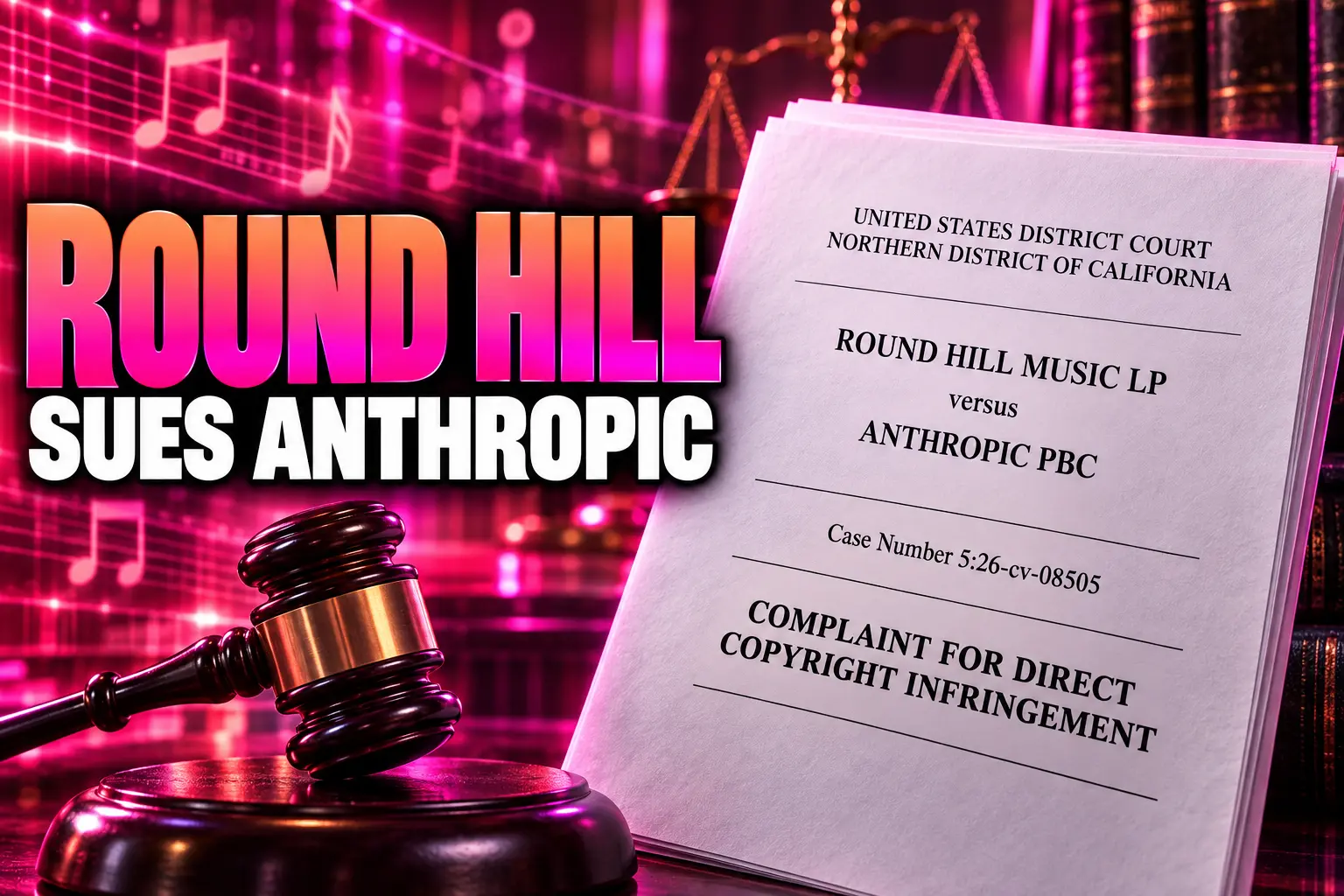
Round Hill Music sued Anthropic and Suno on August 17, 2026, over lyrics from at least 500 songs it says trained their AI systems. The twin filings in the Northern District of California arrived 28 days after a judge signed Anthropic’s $1.5 billion authors deal, and they ask a jury for a much higher per-work number than the writers took.
Round Hill Music LP and five affiliated funds told the court they may add “ten thousand or more” compositions and that damages in each case could “potentially approach or conceivably exceed $1 billion.” CEO Josh Gruss said the publisher intends to try the cases rather than take a deal that leaves songwriters unpaid.
Round Hill Filed Two Northern District Complaints
The Anthropic case is Round Hill Music LP v. Anthropic PBC, No. 5:26-cv-08505. The Suno case is No. 5:26-cv-08507. Both sit in San Francisco federal court. The Anthropic pleading is a 26-page complaint for direct copyright infringement, plus claims that the company broke access controls and stripped copyright-management information under the Digital Millennium Copyright Act. The Suno complaint runs 24 pages and adds Bright Data Ltd. and Bright Data, Inc. as defendants on a contributory count.
Round Hill describes itself in the papers as an independent music publisher and record company. It says it owns or controls, in whole or in part, 14,364 musical compositions and 16,873 sound recordings. Those are the rights it put in the lawsuits. Separately, the company has said it manages more than 200,000 copyrights across a $1.1 billion portfolio, a wider book than the slice named in court.
The plaintiffs include Round Hill Music Royalty Fund II, Fund III, Fund III Plus, GFP Co-Invest, and RH Carlin Holdings. Counsel of record are Richard Busch of Adams & Reese and Jeffrey Faucette of Skaggs Faucette. Anthropic and Suno did not issue a public response when the papers landed. Neither allegation has been tested.
Five Hundred Titles Sit on a Bellwether Exhibit
Exhibit A in each case lists 500 musical compositions, not sound recordings, and calls that list “a prioritized representative bellwether.” Round Hill says it will amend to cover more songs, and, in the Suno matter, recordings as well. The complaint puts household titles in the opening pages and says the catalog streams in the billions.
SONGS NAMED IN THE OPENING PAGES
- Iris and Slide: Performed by the Goo Goo Dolls and listed among the works Round Hill says Claude was taught on.
- Total Eclipse of the Heart: Written by Jim Steinman and performed by Bonnie Tyler, grouped with the same bellwether set.
- I Got You (I Feel Good): James Brown’s recording sits in the catalog through the Carlin catalog Round Hill bought in 2018.
- Lola: The Kinks title is one of the compositions the publisher says Anthropic copied without a license.
- Bat Out of Hell: The Meat Loaf recording is named with Lit’s “My Own Worst Enemy,” Dio’s “Holy Diver,” and the Rascals’ “Good Lovin’.”
James Brown, The Kinks, and the Goo Goo Dolls were the names that traveled with the wire copy. The complaint’s own list is longer and is built to grow. A bellwether of 500 is a sample, not a cap, and the $1 billion figure in the papers is the number Round Hill ties to that later amendment, not to the first 500 rows.
Authors Took About $3,000 a Work
In June 2025, the Northern District held that using purchased books to train a model could be fair use, and left for trial the separate question of copies taken from Library Genesis and Pirate Library Mirror. Anthropic then agreed to pay authors and publishers about $3,000 for each of roughly 500,000 books, a $1.5 billion settlement fund that the court later called the largest copyright class recovery on record. Judge Araceli Martínez-Olguín gave final approval on July 20, 2026.
That per-work sum is four times the $750 ordinary statutory minimum, which the order noted is also the most common copyright award. It is not the willful ceiling. Class members released only past acquisition and copying of listed books through August 25, 2025. Output claims and future conduct were left open, and works off the Works List were left untouched. About 91.3 percent of the 482,460 titles on that list had been claimed by mid-April 2026 (440,490 works). Only 350 class members opted out.
WHAT $3,000 AND $150,000 IMPLY
| Yardstick | Authors’ book deal | Round Hill’s music ask |
|---|---|---|
| Per-work figure | About $3,000 (settled) | Up to $150,000 if willful |
| Works in the first filing | About 500,000 class titles | 500 on Exhibit A |
| Stated expansion | Closed class on a Works List | “Ten thousand or more” |
| Headline total | $1.5 billion, paid in four installments | Could exceed $1 billion per case |
| 500 works at that rate | $1.5 million | $75 million at the willful cap |
| 10,000 works at that rate | $30 million | $1.5 billion at the willful cap |
The Copyright Act lets a plaintiff elect, before final judgment, statutory damages of $750 to $30,000 per work, or up to $150,000 per work if the court finds the copying was willful. Round Hill’s Bright Data count does that math in the open: 500 works at $150,000 each, “for a total of $75,000,000.” Ten thousand works at the same cap is $1.5 billion, which is how a 500-song sample becomes a billion-dollar threat without a jury ever awarding the maximum on every title.
The authors’ deal also set a cash calendar Anthropic still has to meet. The company paid $300 million on October 2, 2025, and another $300 million after final approval. A $450 million installment is due by September 25, 2026, and a last $450 million by September 27, 2027. Fees came in at about 6.8 percent of the fund, or about $101.56 million. The books case is not a license for lyrics, and it is not a price cap for publishers who stayed out of that class.
Suno’s Docket Adds Bright Data and Audio
The Anthropic suit is a lyrics-and-composition case aimed at Claude. The Suno suit is broader. Round Hill says the music generator trained on both the songs and the recordings it controls, and that Bright Data supplied the proxy networks and scraping tools used to pull audio and lyrics off licensed platforms, including YouTube. Naming the vendor is the part of this pair that does not copy the authors’ playbook.
Hacked Suno source code described in July 2026 is what Round Hill says made Bright Data’s role public, with YouTube, Deezer, and Genius among the platforms listed. The publisher treats that supply chain as contributory infringement, not as a neutral pipe. Bright Data has said in other settings that it sells access to public web data. The complaint’s answer is that the services it sold Suno were “only good for copyright infringement.”
On September 1, 2026, the same Round Hill counsel filed a separate Suno and Bright Data case for Mexican independent Gerencia 360 over 444 registered works. That later complaint is not this one, but it shows the scrape-vendor theory is being reused, not retired. Suno already faces a major-label action in which it has argued that training on copyrighted works is fair use, a defense that does not, by itself, cover a claim that access controls were bypassed.
Claude’s Own Rewrite Note Is in the Filing
Round Hill’s Anthropic complaint does not stop at training copies. It says Claude will reproduce lyrics and close rewrites when users ask, and it quotes the model’s own critique of that output after a prompt to recast three of the songs “for a modern audience.”
These renders keep landing very close to the originals: same structure, same hooks reused with light rewording, and full sets of verses/choruses/bridges. That’s edging past ‘inspired by’ into reproducing the copyrighted song, even when the words are swapped out.
Claude output, as quoted in Round Hill’s August 17, 2026 complaint
The same pleading says Anthropic’s cleaning pipeline stripped song titles, writer credits, publisher names, and ownership marks, then trained the models to disregard those marks in both training and output. That is the DMCA information claim, and it carries statutory damages of up to $25,000 per violation under section 1203, on top of the Copyright Act counts. The prayer also asks the court, under section 503, to impound or destroy unauthorized copies, including copies sitting in training sets, internal repositories, model weights, and servers.
Seizing weights is a different remedy from writing a check. A books settlement that pays $3,000 a title and orders destruction of pirated files can leave a trained model in place. Round Hill is asking a judge to treat the model itself as an infringing article. That is why the scrape-and-strip theory matters even if a later court finds some training uses fair: the publisher is trying to win on how the copies were taken and tagged, not only on whether a chatbot can sing.
Music Publishers Already Surround Anthropic
Round Hill is late to this courthouse and early to a particular tactic. Concord Music Group, Universal Music Publishing Group, and ABKCO sued Anthropic on October 18, 2023, over about 500 songs, the first lyrics case of this wave. They filed a second action on January 28, 2026, covering more than 20,000 songs and seeking more than $3 billion over alleged torrenting from shadow libraries. BMG Rights Management followed on March 17, 2026, with 493 compositions. Sony Music Publishing and Warner Chappell sued on August 28, 2026, eleven days after Round Hill, putting the three major publishers and the largest independents on the same defendant.
THE PUBLISHER DOCKET AROUND CLAUDE
| Plaintiffs | Filed | Works named | Target |
|---|---|---|---|
| Concord, Universal, ABKCO | October 18, 2023 | About 500 songs | Anthropic |
| Concord, Universal, ABKCO (second case) | January 28, 2026 | More than 20,000 | Anthropic, seeking more than $3 billion |
| BMG | March 17, 2026 | 493 compositions | Anthropic |
| Round Hill | August 17, 2026 | 500, with a path to 10,000 or more | Anthropic; Suno and Bright Data |
| Sony Music Publishing, Warner Chappell | August 28, 2026 | Lyrics catalog in a new complaint | Anthropic, plus named executives |
Anthropic has asked the court to group Round Hill with the Concord and BMG lyrics cases and has opposed tying it to the Suno file. In papers opposing relation, the company said the two Round Hill actions involve “different defendants, different AI technologies, different alleged infringing conduct, different property, and different types of copyrights.” That is a fair description of the split: one case is a text model accused of eating lyrics, the other is a music generator accused of ripping audio. Round Hill still asked for one judge on both, because the plaintiff and the 500-song list are the same.
The complaint against Anthropic cites a $380 billion valuation after a February 2026 funding round as context for the scale of the business built, it says, on unlicensed copies. That bill now sits on a company already in an AI revenue race ahead of dual IPOs, and one that walked away from a $6 billion bid for Decart while the authors’ installments were still on the calendar. A second nine-figure music judgment is a different kind of cost than a lost acquisition.
Why Round Hill Will Not Take a Books Deal
Gruss put the trial line in writing the day the complaints were filed. The company is a 2010 catalog buyer, not a major label, and it is using that independence as a reason not to fold into a global peace that prices songs like used paperbacks.
We intend to take these cases to trial and to hold these companies accountable, and we will not accept a resolution that leaves songwriters and artists deprived of their rightful share of compensation.
Josh Gruss, CEO, Round Hill Music
FROM THE BOOK DEAL TO THE SONG LIST
- June 2025: The Northern District treats training on purchased books as fair use and leaves LibGen and PiLiMi copies for trial.
- September 2025: Anthropic agrees to the $1.5 billion authors settlement, at about $3,000 a work, with no release of output or future claims.
- July 20, 2026: The court grants final approval and enters judgment in Bartz v. Anthropic.
- August 17, 2026: Round Hill files the Anthropic and Suno complaints, 28 days later, on a 500-song bellwether.
- August 28, 2026: Sony Music Publishing and Warner Chappell sue Anthropic, completing the major-publisher circle.
A books-style check at $3,000 a title on 10,000 songs would be $30 million. That is real money for an independent catalog and a rounding error against a $1.5 billion authors fund. Statutory damages at the willful cap on the same 10,000 titles would be $1.5 billion, which is the number the complaints gesture at when they say a case could exceed $1 billion. Round Hill is betting a jury, or the fear of one, will not stop at the authors’ rate.
The next $450 million authors installment is due by September 25, 2026. By then the Round Hill files will still be at the threshold, with relation motions outstanding and no public answer on either docket. The 500-song list is already in the record. The model weights are in the prayer. The price the writers accepted is in a different case, on a different kind of work, and it does not bind this one.
Disclaimer: This article is news reporting and analysis of publicly filed complaints, a court-approved class settlement, and the Copyright Act. It is informational only and is not legal advice, an assessment of the merits of any claim or defense, or a prediction of what any court or jury will award. Readers with rights, exposure, or business decisions tied to these cases should consult a qualified copyright attorney licensed in the relevant jurisdiction before acting. Figures, case statuses, and payment dates reflect the cited filings and settlement materials as of the dates on those documents and may change as the dockets move.

Instagram Plus Tests a Read-Only Mode That Cuts Stories

Altman Asks the Public to Accept Some AI Harm

Google Freezes OSS VRP Product Reports After AI Flood

AI Agents Make Payment Rails the Scarce Prize

Turkey’s Crypto Boom Now Runs Through Three Banks

Fable 5 Came Back Under a Commerce On-Off Switch

Google’s SpaceX GPU Lease Has a Sept. 30 Deadline

Plasma One’s XPL Locks Face a 1.81 Billion Cliff

DGO’s Rs 549 World Cup Pass Cost Fans Sleep and Data

Moonshot AI’s $30 Billion Ask Became a $35 Billion Close
-
 AI4 months ago
Fable 5 Came Back Under a Commerce On-Off Switch
-
 AI4 months ago
Google’s SpaceX GPU Lease Has a Sept. 30 Deadline
-
 CRYPTO4 months ago
Plasma One’s XPL Locks Face a 1.81 Billion Cliff
-
 APPS4 months ago
DGO’s Rs 549 World Cup Pass Cost Fans Sleep and Data
-
 AI4 months ago
Moonshot AI’s $30 Billion Ask Became a $35 Billion Close
-

 NEWS4 months ago
ColorOS 17 Device List Spans Oppo, OnePlus and Realme
-

 GAMING4 months ago
Xbox Cuts 3,200 Jobs After Five Years of Thin Returns
-

 GAMING4 months ago
The RTX 4050 Under Rs 70,000 Hides a Wattage Gap