
GAMING
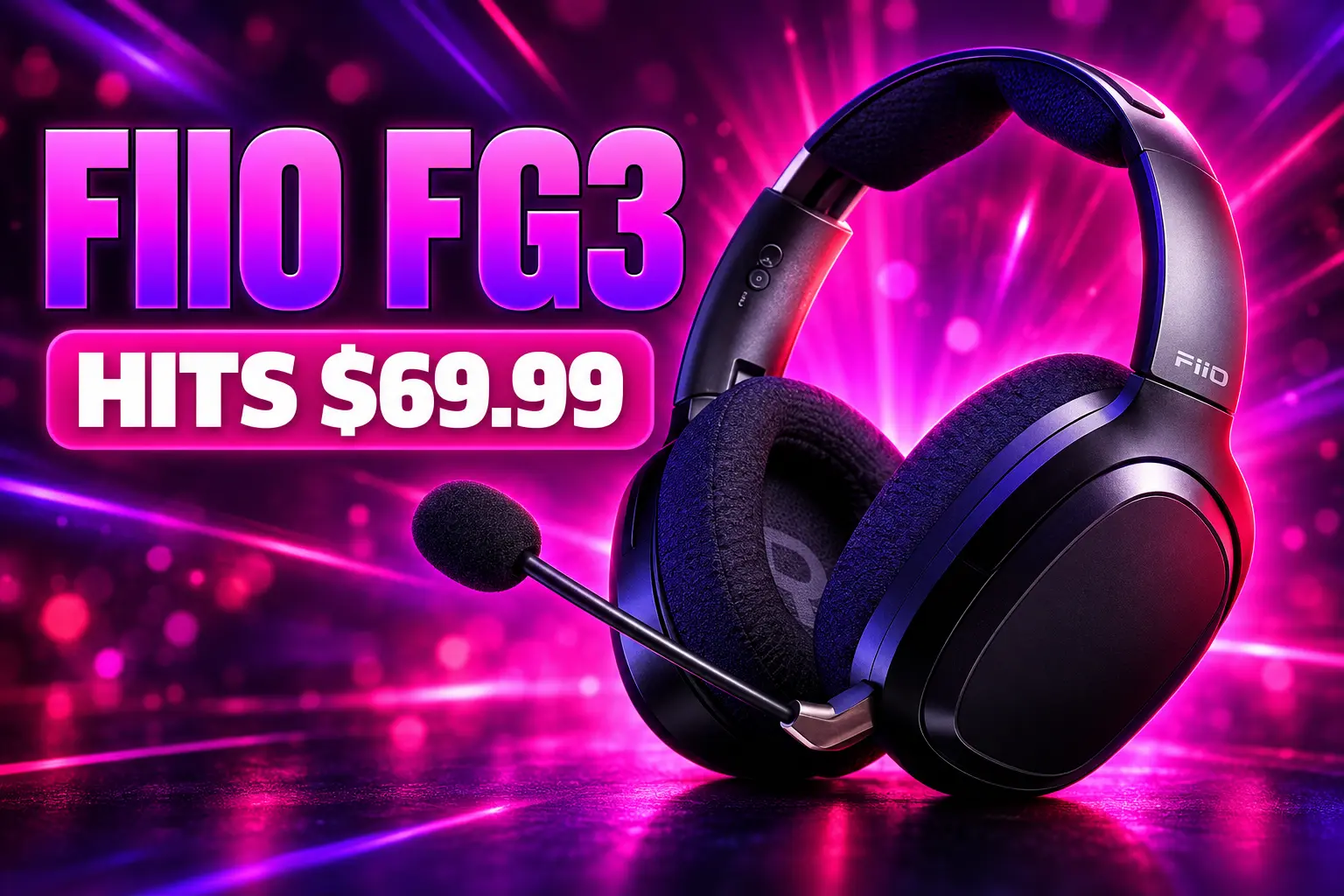
FiiO Parks Dual DACs in a $69.99 Gaming Headset
FiiO’s FG3 gaming headset stores dual DACs and a 10-band EQ on a USB dongle, so the $69.99 set works on consoles without an app.

FiiO’s FG3 gaming headset sells for $69.99 and stores its DAC, amp, and 10-band EQ in a USB-C brick. The cups are a 32-ohm headphone with a 50 mm + 16 mm coaxial pair. The brick is the part you move between a PC, a phone, and a docked Switch.
FiiO is a DAP and IEM company that put a boom mic on a dual-driver cup. The lasting move is that the sound processing lives in the cable, so a PlayStation or Xbox never has to run a FiiO app.
The USB Dongle That Holds the Sound
Out of the box the headset wears a short 0.7 m braided lead that ends in a 3.5 mm jack, the plug a Nintendo Switch still expects. Dig in the carton and you get a 1.5 m extension whose far end is a control module, plus a USB-C to USB-A adapter for older ports. Use both leads together and the USB path is 2.2 m.
That module is not a plastic volume widget. FiiO put two ES9068AS DAC chips in it, one for each channel, with a dual-core DSP and a headphone amp rated at 80 mW. Volume, mic mute, and a profile button sit on the brick, and an LED shows which curve is live. EQ you save from a browser is stored on the module, so a curve written on a Windows PC still loads when the same brick hits a PS5 USB port.
The analog jack and the USB brick are two different products that share one pair of cups. Seat the 3.5 mm tip in a controller and you have a passive 32-ohm headset with no DSP. Seat it in the module and you get decoding up to 192 kHz / 24-bit, hardware sidetone, and the profiles already sitting in flash.
THREE WAYS TO PLUG IT IN
- Short analog lead: The 0.7 m 3.5 mm cable on the cups feeds a Switch, a phone, or a controller with no USB processing.
- USB-C module: The 1.5 m brick adds the DACs, the 80 mW amp, mute, volume, and saved EQ.
- USB-A adapter: The included dongle turns that Type-C plug into a USB-A jack for older PCs and consoles.
FiiO’s own trailer is the usual headset montage, cups and cables, and it is still the cleanest look at the brick in motion.
Two Drivers Share One Point Source
FiiO did not drop two drivers in a cup and hope. The coaxial 50 mm dual-driver design puts a composite 50 mm unit on mids and lows and a titanium-plated 16 mm unit on the highs, with an electronic two-way crossover splitting the band. Sound is meant to leave as a single point source, which is the company’s pitch for keeping footsteps in place instead of smearing them across a wide, messy image.
At $69.99 that layout is the same budget dual-driver headset we already mapped on price alone. The extra claim is the cable: conversion, EQ memory, and the 80 mW amp sit outside the cups, which is how FiiO can keep the headband at 315 g with the mic attached.
FG3 HARDWARE ON PAPER
| Part | FiiO’s figure |
|---|---|
| Drivers | 50 mm composite + 16 mm titanium-plated, coaxial |
| DAC | Two ES9068AS chips, one per channel, in the USB module |
| Amp | Up to 80 mW in the cable |
| USB audio | Up to 192 kHz / 24-bit |
| Frequency range | 10 Hz to 40 kHz |
| Impedance | 32 ohm |
| Sensitivity | 100 dB/mW at 1 kHz |
| Weight | 315 g including the mic |
| Clamp | 3.8 N, plus or minus 0.3 N |
Most cheap gaming sets still use one full-range driver and then invent width in software. FiiO split the band in the cup and left the software for genre presets and a 10-band curve. The ES9068A 32-bit mobile DAC brief is the family those cable chips come from; it is the same class of converter FiiO has been dropping into pocket amps, not a gamer-RGB codec.
Browser EQ, Saved on the Cable
FiiO Control is a webpage. Plug the USB path into a computer, open the FiiO Control web platform, and write a 10-band curve. The curve is saved locally on the module. After that, the M button on the brick cycles profiles on an Xbox or a Switch that will never load a FiiO page.
If the host is offline, you cannot open the site, so you cannot edit. You can still jump among profiles already stored, which is the design in one line: no installer, no overlay, no account, and no live EQ on a locked-down cafe PC. FiiO lists FPS, ACT, MOBA, MUG, Cinema, and Music as named modes, and the LED on the brick changes with the one you pick.
Hardware sidetone is processed on the module rather than in a Windows path, and the web UI is where you set its level. The detachable ENC boom is the other half of that chain, with a mute button and a red indicator on the same brick. None of this needs a desktop service running in the tray.
Stock Music tuning can sound a little distant until you write your own curve, which is why the page exists. People who actually sit with the set keep coming back to that browser step, not to RGB, because the cups only show what the dongle is already doing.
Why FPS Mode Leaves Surround Off
FiiO’s own footnote is the tell. Virtual 7.1 is active only in Cinema and Action (ACT). FPS, MOBA, and MUG stay stereo on purpose, so a surround algorithm does not blur the positional cues those modes are built around. A typical gaming brand would stamp 7.1 on every preset and sell the badge. FiiO turned it off where footsteps pay the bills.
WHERE VIRTUAL 7.1 ACTUALLY RUNS
| Mode | Virtual 7.1 | What FiiO pointed it at |
|---|---|---|
| FPS | Off | Positional cues and voices |
| ACT | On | Action impact and immersion |
| MOBA | Off | Ability cues and comms |
| MUG | Off | Rhythm and bass |
| Cinema | On | A 360-degree mix |
| Music | Off | Playback |
That split is how a music company thinks about gaming, not how a peripheral house thinks about a feature list. Cinema and ACT are for seas, streets, and engines swirling around the head. FPS is for a footstep that needs to stay on the left, not in a processed halo. The dual-core DSP still runs either way; it just does not add the surround layer in the competitive presets.
UAC 1.0 and UAC 2.0 switching is how the same brick talks to Windows 7 through 11, phones, PS4, PS5, Xbox, and Switch without a driver install. The cups never change. The module negotiates the USB audio class, which is why a headset this cheap can move from a PC to a docked Switch 2 without a second SKU.
A Loose Clamp and a Long Cord
Spec sheets list clamping force at 3.8 N, plus or minus 0.3 N, and on some heads that reads as a light grip rather than a vise. The set is 315 g with the mic, the earpads are woven mesh over memory foam, and FiiO says those pads can be swapped when they wear. Comfort is not the problem. Stay-put is, if you lean over a desk and want more bite from the headband.
The 1.5 m USB run is long for a phone in a pocket while you walk a kitchen. That is a wired-headset problem as old as 3.5 mm, and wrapping the lead is the whole fix. The frame folds for a bag, which is the other half of FiiO’s cafe and dorm pitch: bring the same cups, keep the same EQ, skip the house headset.
Played loud, the 50 mm and 16 mm split keeps bass from sitting on the top, which is the practical point of the coaxial layout. Plenty of cheap sets gate output in the name of safety. This one will still get out of the way when a mix needs level, and that is also how you find the clamp and the cord, because you actually wear it around the room.
FiiO Built Dongles Long Before Headsets
Guangzhou FiiO Electronics Technology Co. was founded in April 2007. The first product shipped that August. For years the catalog was headphone amps, DAPs, USB DACs, and IEMs, which is why a gaming headset that looks like a USB dongle with cups attached is not a stretch for this factory. The FG3 is the first time the company has put that work under a boom mic and called it a gaming SKU.
The FG3 marks our first step into this new arena. A new journey begins here.
FiiO, FG3 product page
FiiO posted that the FG3 was officially available on July 3, 2026, with the same coaxial pair, ENC mic, and Control Web pitch it still uses.
FIIO FG3 Gaming Headset is Now Officially Available!🔥
👉Coaxial dual dynamic drivers: 50mm + 16mm dual-driver design paired with an electronic two-way crossover, delivering an expansive soundstage, rich details, precisely capturing subtle footsteps.
👉HiFi grade decoding:… https://t.co/NYPGuO5Ewe pic.twitter.com/C20FDeYgzX— FIIO (@FIIO_official) July 3, 2026
THE FG3’S FIRST MONTHS
- July 3, 2026: FiiO says the FG3 is officially available, black only, USB and 3.5 mm in the same carton.
- July 31, 2026: Japanese shops put the set on shelves after a late-July listing window.
- August 17, 2026: FiiO posts firmware V1.0.1, with the file and steps on its forum, the same path its DAPs use.
- September 9, 2026: India listings land at Rs 6,999, still the same dual-driver cups and USB brick.
A firmware drop on a forum thread is how a dongle company behaves, not how a RGB-headset house behaves. V1.0.1 does not change the coaxial pair. It changes the brick, which is where the product actually lives.
What You Give Up by Staying Wired
There is no Bluetooth, no 2.4 GHz radio, no battery claim, and no listening ANC. Edifier-class wireless sets at double the money still win if you want to leave a desk. The FG3’s bet is the opposite: a cable that does not drop, latency that is the length of the lead, and an EQ that does not vanish when you change PCs. FiiO even sells that as an internet-cafe feature, plug-and-play on a machine you do not own.
The mic is a detachable ENC boom, not a broadcast condenser, and sidetone is there so you can hear yourself without a software loop. Fold the frame, pocket the USB-A adapter, and the same 315 g set is the one you use for a podcast, a playlist, and a match, which is the only versatility test that matters at $69.99.
FiiO did not invent a cheaper SteelSeries. It parked two ES9068AS chips and a 10-band memory in a USB brick, hung a coaxial headphone on the other end, and let Cinema keep the surround while FPS stays stereo. The next file it ships will go to that brick, because that is the product, and the cups are how you wear it.

Instagram Plus Tests a Read-Only Mode That Cuts Stories

Altman Asks the Public to Accept Some AI Harm

Google Freezes OSS VRP Product Reports After AI Flood

AI Agents Make Payment Rails the Scarce Prize

Turkey’s Crypto Boom Now Runs Through Three Banks

Fable 5 Came Back Under a Commerce On-Off Switch

Google’s SpaceX GPU Lease Has a Sept. 30 Deadline

Plasma One’s XPL Locks Face a 1.81 Billion Cliff

DGO’s Rs 549 World Cup Pass Cost Fans Sleep and Data

Moonshot AI’s $30 Billion Ask Became a $35 Billion Close
-
 AI4 months ago
Fable 5 Came Back Under a Commerce On-Off Switch
-
 AI4 months ago
Google’s SpaceX GPU Lease Has a Sept. 30 Deadline
-
 CRYPTO4 months ago
Plasma One’s XPL Locks Face a 1.81 Billion Cliff
-
 APPS4 months ago
DGO’s Rs 549 World Cup Pass Cost Fans Sleep and Data
-
 AI4 months ago
Moonshot AI’s $30 Billion Ask Became a $35 Billion Close
-
 NEWS4 months ago
ColorOS 17 Device List Spans Oppo, OnePlus and Realme
-

 GAMING4 months ago
Xbox Cuts 3,200 Jobs After Five Years of Thin Returns
-

 GAMING4 months ago
The RTX 4050 Under Rs 70,000 Hides a Wattage Gap