
APPS
Apple Keeps App Tracking Transparency by Softening Its Prompt
Germany closed its Apple ATT case without a fine. The privacy prompt stays, minus the warning hand and the word tracking, for seven years of trustee oversight.

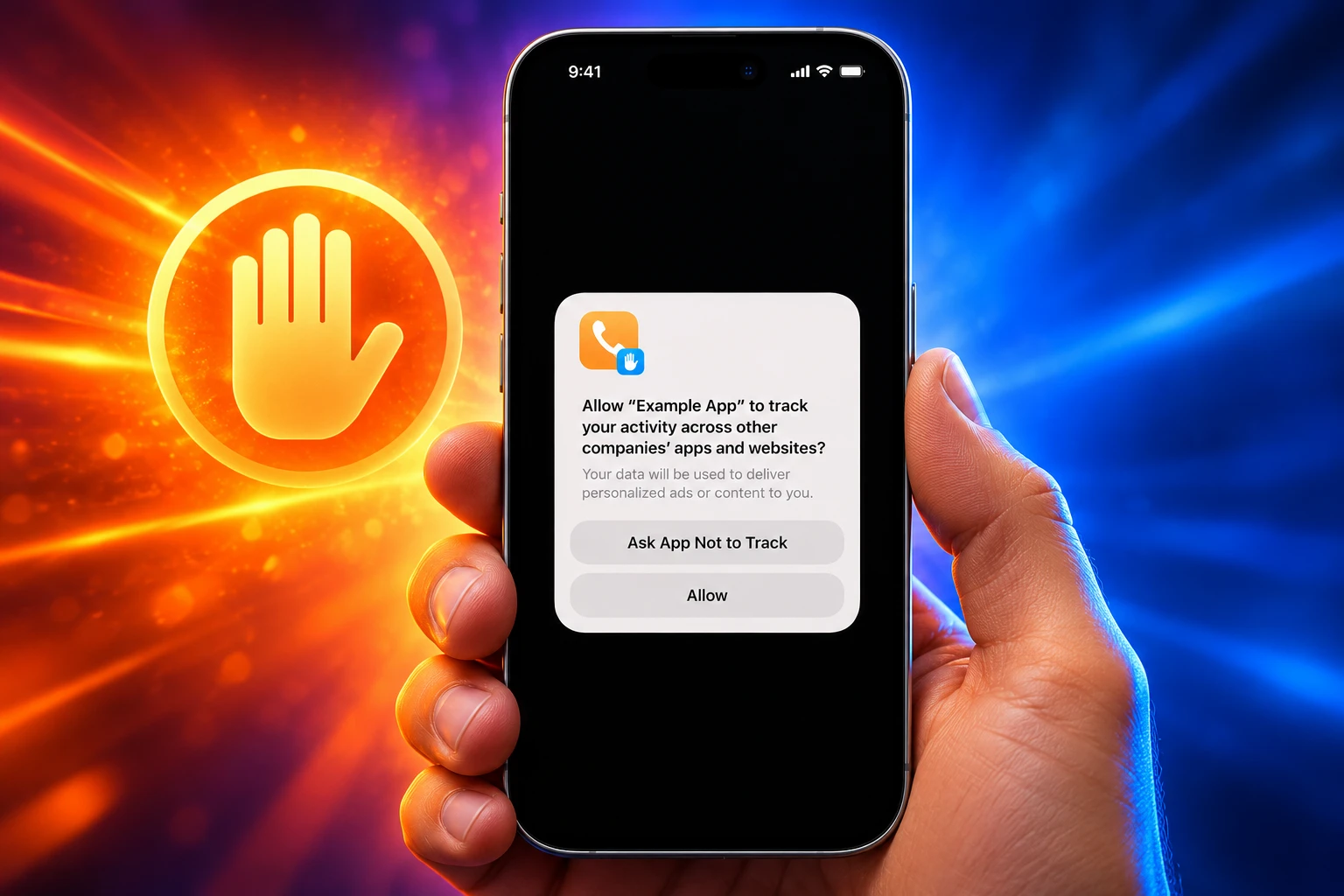
Apple will drop the warning-hand icon and the word tracking from its App Tracking Transparency prompt after Germany closed a four-year competition case without a fine. The framework stays on iPhone and iPad. The scare design does not.
The Bundeskartellamt declared Apple’s commitments legally binding on 17 August 2026, in case B7-54/25. Apple has four months from service of the 13 August decision to ship the new screens in iOS and iPadOS, then live with a trustee for seven years from the day they go live.
What Changes in the ATT Prompt
The Bundeskartellamt’s objection was the design of the choice, not the existence of a choice. Its preliminary view was that the third-party ATT prompt steered people toward refusal, while Apple’s own Personalized Ads prompt steered them toward yes. The warning hand, the word tracking, the short space for an explanation, and the order of the buttons all counted as that steering.
Apple still says the current sheet is clear and effective. It agreed to change the text and formatting anyway, and it described a set of interface moves that match what the authority wanted taken out.
THE NEW ATT SHEET
- Warning hand: The raised-palm symbol on the third-party prompt comes off.
- The word tracking: It leaves both the ATT prompt and Apple’s Personalized Ads prompt.
- The buttons: Allow and Ask App Not to Track become Allow and Reject.
- The graphic: The colour at the top of the sheet shifts from orange to blue, and the prompt becomes a full page.
- The copy: Publishers get more room, plus bold, italics and lists, to say why personalized ads fund the app.
- The double ask: Developers can combine Apple’s prompt with a data-protection consent request instead of stacking two.
- A second chance: An app may show the ATT prompt again one year after the user first answered, yes or no.
- Apple’s own sheet: The Personalized Ads prompt gets wording tweaks so the two asks sit closer together.
Before the screens go live, Apple will run technical tests with app publishers, which the authority calls Beta Seed Testing. The ATTF itself remains in force. No infringement was found and no penalty was attached to the German file.
German Privacy Offices Never Required This Extra Ask
The competition office spent the case talking to Germany’s data-protection authorities, the Federal Commissioner for Data Protection and Freedom of Information and the Bavarian State Office for Data Protection Supervision. Those offices view the ATTF positively as a privacy-policy matter and point to weak GDPR compliance by some publishers. They also told the file that Apple’s extra prompt is not required under data protection law.
That split is the whole German outcome. Privacy officials did not ask for a softer sheet. The cartel office did, because it treats a gatekeeper’s extra rule as a competition problem when the rule is harsher on rivals than on Apple.
It is expressly not our aim to help achieve the highest possible levels of consent to personalised advertising. We want to ensure that users can make a free and informed decision. Users who do not wish to allow their data to be used for personalised advertising must be able to make an equally free and informed decision as users who intend to consent to such data use.
Andreas Mundt, President of the Bundeskartellamt, 17 August 2026 press statement
Mundt also said Apple may give users more protection than the legal minimum. Additional rules inside iOS still may not treat Apple’s own offerings better than a competitor’s. Apple rejects that reading. It offered the commitments without accepting the preliminary legal view, and the proceeding ended there.
“While we believe the current ATT prompt provides a clear, easy-to-understand and effective way to keep users in control of their data,” Apple said, an opinion it says German data-protection authorities share, “we have agreed to make changes to the text and formatting of the prompt at the FCO’s request.” It added that the commitments “ensure we can continue to provide this important privacy tool in Europe and keep users, not ad tech companies and data brokers, in control of their data.”
The Dual Role Inside iOS Advertising
ATT arrived in April 2021 with iOS 14.5, iPadOS 14.5 and tvOS 14.5. From 26 April 2021, a third-party app that wants to track a person across other companies’ apps and sites, or to read the Identifier for Advertisers, has to obtain permission through the AppTrackingTransparency framework. If the user refuses, the IDFA comes back as a string of zeros.
Apple does not put its own ads through that sheet. It says it does not use personal data collected from apps to target ads or to measure campaigns the way third parties use the IDFA, so its own apps never trigger ATT. It uses data from its own apps, Apple ID and devices, and it asks through the Personalized Ads prompt instead. The cartel office said that difference, plus a second GDPR banner that Apple does not show for its own ads, went beyond what different data uses could justify.
Money sits under the design fight. Many apps are free and live on ads. Personalized ads pay more than broad ones. Apple often takes a cut of paid downloads and subscriptions and generally takes no cut of a publisher’s ad sales, so a prompt that kills tracking can push a developer toward products Apple taxes. In the designation file that sits behind this case, up to 60% of app publishers’ revenue on Apple devices was found to run through Apple’s distribution infrastructure.
Apple was designated in April 2023 as a company of paramount significance for competition across markets under Section 19a of the German Competition Act. The Federal Court of Justice confirmed that finding in March 2025. The ATT proceeding ran on that statute and on Article 102 of the Treaty on the Functioning of the European Union, the abuse-of-dominance rule. German publisher and advertising associations that complained in 2021, including ZAW, called the August outcome the first binding Section 19a measure against Apple, and said the commitments still fall short of the competition finding they wanted.
France and Italy Fined Apple; Germany Took Commitments
Germany chose a redesign and a monitor. Two other national files chose money. The Bundeskartellamt kept a running dialogue with those authorities and with the European Commission inside the European Competition Network, and it said the German solution may yet shape ATT in other member states.
THREE ATT OUTCOMES IN EUROPE
| Country | Date | Outcome | Penalty |
|---|---|---|---|
| France | 31 March 2025 | ATT itself not banned; the way it was built was held abusive | €150 million |
| Italy | 22 December 2025 | Dominant-position finding; Apple told to stop the conduct | €98.6 million |
| Germany | 13 August 2026 | Binding commitments; no infringement finding | None |
France’s authority held that ATT’s aim was not the problem and that the stacked pop-ups and the uneven rules were. Italy’s authority said the double consent was extremely burdensome, that smaller developers felt it first, and that Apple’s own advertising had room to grow while rivals lost tracking. Apple is appealing both penalties. Poland and Romania still have live files.
THE ATT FILE FROM 2021 TO 2026
- April 2021: ATT ships with iOS 14.5 and starts asking for extra consent before IDFA access.
- June 2022: The Bundeskartellamt opens its proceeding against Apple.
- April 2023: Apple is designated under Section 19a GWB.
- 13 February 2025: The authority sends its preliminary legal assessment.
- March 2025: The Federal Court of Justice confirms the Section 19a designation.
- 31 March 2025: France fines Apple €150 million over ATT.
- 2 December 2025: Germany puts Apple’s draft commitments into a market test.
- 22 December 2025: Italy fines Apple €98.6 million.
- 13 August 2026: Germany issues the commitment decision in case B7-54/25.
- 3 September 2026: A UK developer class files for £2 billion in London.
The legal commitments bind users who have an App Store billing address and a device located in Germany. The authority said that bargain may influence how ATT looks elsewhere in the EU. Apple has said the prompt changes will run in almost all European Union countries, without publishing a country list.
Publishers Get Room to Argue for Personalized Ads
The other half of the German deal is space. Third-party apps had a short, Apple-written purpose line. Publishers and newsrooms will now get more room to tell a user that personalized ads pay for the product, and they can format that pitch. They also get defined ways to join the ATT ask with a Consent Management Platform request, the GDPR sheet that already looks like a cookie banner on the web.
That is the piece advertisers wanted. Meta and other ad-funded apps have argued since 2021 that they need a clean yes if targeted campaigns are going to beat untargeted ones. The cartel office is not promising them a higher yes rate. Mundt said the opposite. Removing a warning hand and the word tracking still changes the emotional temperature of the first screen a user sees.
The likely effect is a gentler ask, not an automatic reversal of every old no. People who already tapped Ask App Not to Track will not be swept back into tracking when the new sheet appears. Fresh installs, reinstalls and the new one-year re-prompt are where the copy change can move numbers. The United States prompt is outside the German order, so the large share of global iPhone ad inventory that sits there is untouched by this file.
A £2 Billion London Claim Follows the German File
Three weeks after the Bonn announcement, ATT Collective Action Limited filed a £2 billion collective action in London at the Competition Appeal Tribunal. The proposed class is UK app developers who sold ads inside third-party iOS apps or spent money to acquire users for those apps. It is an opt-out case, so eligible firms are in unless they step out. The tribunal has not yet said whether the claim can proceed.
The vehicle’s director is Ann Pope, who was the CMA’s Senior Director for Antitrust from 2014 to 2024. Hausfeld is the solicitor. The claim tracks the German theory: third parties had to obtain data-protection consent and then pass Apple’s predefined prompt, while Apple used its own, lighter Personalized Ads sheet. The UK Department for Science, Innovation and Technology has found that 70% of app developers in Britain employ fewer than 10 staff, most often two.
Privacy is an important protection for consumers, but it should be applied fairly and in a way that ensures businesses of all sizes can compete on a level playing field. It cannot become a reason for digital platforms to play by one set of rules while forcing app developers to play by another.
Ann Pope, director, ATT Collective Action Limited, 3 September 2026
Apple’s reply to that claim is that ATT exists so people can decide whether apps track them across other companies’ apps and websites, and that the company is bound by the exact same requirements as all developers. That is the same line it has used since 2021. Germany’s file is the first time a competition authority has locked Apple into a rewritten prompt rather than a bill.
A Trustee Will Watch the New Prompt for Seven Years
An independent monitoring trustee will watch the commitments for seven years from implementation, report to the Bundeskartellamt, and mediate when a publisher says Apple has broken the deal. If mediation fails, the trustee takes the fight back to the authority. The office’s own enforcement powers stay in place. Publishers can go to the trustee directly.
Mobile analyst Eric Seufert wrote that the new copy and the right to bundle other consent requests with ATT will nudge opt-in rates upward by a non-trivial amount in Europe, that he does not expect the same rewrite in the United States, and that the larger effect is a limit on how far Apple can push platform-wide extra rules. Old refusals stay refused unless a user is asked again.
The privacy feature Apple threatened might have to leave Europe is still there. The hand that told people to stop, and the word that named what they were stopping, will not be.

Instagram Plus Tests a Read-Only Mode That Cuts Stories

Altman Asks the Public to Accept Some AI Harm

Google Freezes OSS VRP Product Reports After AI Flood

AI Agents Make Payment Rails the Scarce Prize

Turkey’s Crypto Boom Now Runs Through Three Banks

Fable 5 Came Back Under a Commerce On-Off Switch

Google’s SpaceX GPU Lease Has a Sept. 30 Deadline

Plasma One’s XPL Locks Face a 1.81 Billion Cliff

DGO’s Rs 549 World Cup Pass Cost Fans Sleep and Data

Moonshot AI’s $30 Billion Ask Became a $35 Billion Close
-
 AI4 months ago
Fable 5 Came Back Under a Commerce On-Off Switch
-
 AI5 months ago
Google’s SpaceX GPU Lease Has a Sept. 30 Deadline
-
 CRYPTO4 months ago
Plasma One’s XPL Locks Face a 1.81 Billion Cliff
-
 APPS4 months ago
DGO’s Rs 549 World Cup Pass Cost Fans Sleep and Data
-
 AI5 months ago
Moonshot AI’s $30 Billion Ask Became a $35 Billion Close
-

 NEWS5 months ago
ColorOS 17 Device List Spans Oppo, OnePlus and Realme
-

 GAMING4 months ago
Xbox Cuts 3,200 Jobs After Five Years of Thin Returns
-

 GAMING4 months ago
The RTX 4050 Under Rs 70,000 Hides a Wattage Gap