
NEWS
Lava Virat V1 5G Fills a Shelf That Emptied
Lava’s Virat V1 5G sells Android 16 and a 6,000mAh cell at Rs 12,999 because memory costs gutted India’s budget 5G shelf, not because the hardware is generous.

Lava’s Virat V1 5G sells for Rs 12,999 with Android 16, a 6,000mAh cell, and a 10W charger that needs more than three hours for a full fill. It is a 5G phone for a bracket other brands have largely left, after memory costs gutted India’s sub-Rs 15,000 shelf in 2026.
Noida-based Lava announced the set on 24 July 2026 and opened Flipkart and lavamobiles.com sales on 31 July at Rs 11,999 for one day. The 4GB plus 64GB phone then sat at Rs 12,999, about $135 at the mid-market rate on launch day. That price is the pitch. The hardware is what a hollow aisle will still support.
Memory Prices Emptied the Sub-Rs 15,000 Shelf
Counterpoint Research’s Monthly India Smartphone Tracker put Q2 2026 (April to June) shipments down 10 percent year-on-year, the steepest June-quarter drop in six years. Senior analyst Prachir Singh tied that slide to round after round of list-price increases, about 15 percent on average by the end of the quarter, as DRAM and NAND costs jumped.
Phones under Rs 15,000 took the hit. Singh recorded mass-market shipments falling 45 percent year-on-year, and said many brands widened 4G line-ups to keep a cheap ticket on the shelf until 5G parts calmed down. Memory’s share of the bill of materials in that band moved from below 20 percent to over 45 percent. Some models more than doubled their launch price.
COUNTERPOINT’S Q2 2026 TALLY
- India shipments: Down 10 percent year-on-year in April to June 2026.
- Under Rs 15,000: Down 45 percent year-on-year, the weakest band in the tracker.
- Memory costs: Nearly 4 times the September 2025 level, with 5 times flagged as a near-term risk.
- Full-year call: A 13 percent shipment decline for 2026, per research director Tarun Pathak.
Pathak’s note is the frame for every Rs 12,999 5G that still uses 4GB of LPDDR4X. DRAM and NAND prices still climbing through the September 2026 window keep that pressure on, because AI data-centre demand is still taking wafers that used to feed handsets.
Smartphone memory prices have increased nearly 4x since September 2025 and are expected to rise further, potentially reaching 5x in the coming months. As a result, we expect the market to decline by 13% YoY for the full year.
Tarun Pathak, Research Director, Counterpoint Research
MediaTek still held 49 percent of India’s chipset shipments in the quarter. Financing covered more than half of mainline sales. The Virat V1 5G is not swimming against that tide. It is the handset you can still print when 4GB and 64GB eat the budget.
What You Get for Rs 12,999
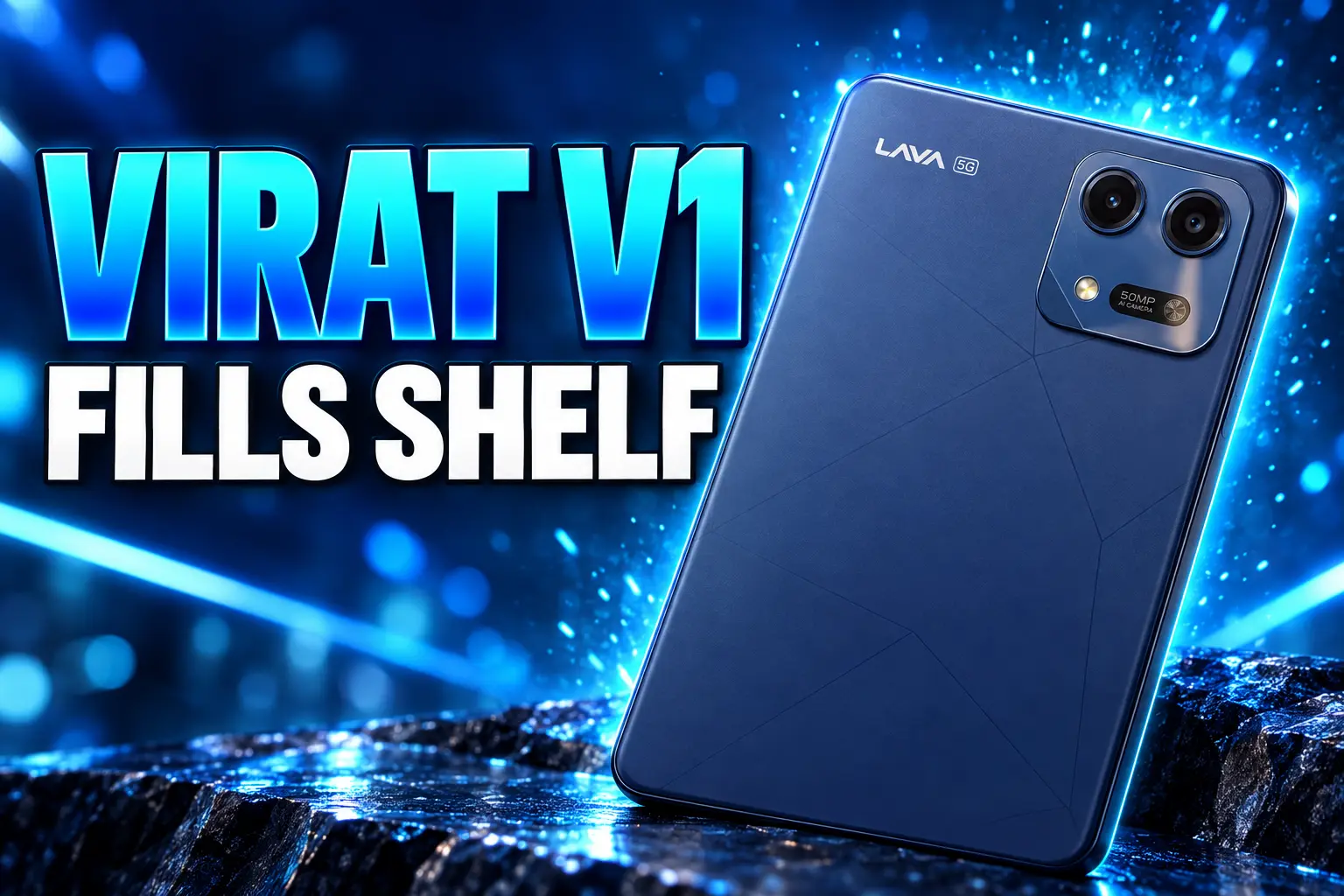
The Virat V1 5G is 165.85 x 76.8 x 8.75 mm and 210 g, in Arya Blue or Sonar Gold, with IP64 splash and dust protection and a side fingerprint reader. The back is plastic with a quadrilateral pattern around a square camera island, a layout Lava already used on the Shark 2 5G. Buttons sit where a thumb expects them. The waterdrop notch looks old. The plastics do not feel as cheap as the bill of materials.
The screen is a 6.75-inch IPS LCD at 720 x 1600 (HD+), 120Hz, about 260 ppi. Whites run a little yellow. Light colours are less accurate than on dearer panels, and small type is soft at the edges. Video still works. Hands-on testers sat through long sessions of Netflix, Jio Hotstar, and YouTube without the panel being the break point.
On 3 September 2026 Lava added a 128GB option at Rs 14,499. Physical RAM stayed at 4GB. The extra NAND does not fix the memory squeeze that defined the original SKU.
We’re upgrading Virat V1 5G. More Storage. More to look forward to.
Now with 128GB Storage at ₹14,499.
To buy now, visit https://t.co/Yq1QSpWf4z#Flipkart #LavaMobiles #ProudlyIndian #Shaqhataolavauthao pic.twitter.com/MP7cNF3QsA
— Lava Mobiles (@LavaMobile) September 3, 2026
THE RS 12,999 NEIGHBOURHOOD
| Phone | Price | Chip | RAM | Battery | Charge |
|---|---|---|---|---|---|
| Lava Virat V1 5G | Rs 12,999 | Unisoc T8200 | 4GB | 6,000mAh | 10W |
| Moto G37 Power | Rs 14,999 | Dimensity 6400 | 4GB | 7,000mAh | 30W |
| OnePlus N6x | Rs 19,999 | Dimensity 6360 Apex | 4GB | 7,000mAh | 15W |
Lava also sells the Bold N2 5G in this band with the same Unisoc T8200, 4GB, and 6,000mAh recipe. The Vivo T5e sits a little higher and uses a weaker Unisoc T7225 with a 5,500mAh cell. If the brief is “any 5G under Rs 15,000,” the Virat V1 5G is still on the short list. If the brief is “spend Rs 2,000 more,” the Moto G37 Power changes the battery and the plug.
A 6,000mAh Cell That Takes All Afternoon
The cell is the number Lava prints largest, and the 10W brick is the number it prints smallest. Hands-on use got through a workday with about 45 minutes of YouTube, five to six hours of YouTube Music, a few calls, and 20 to 25 stills. That is one day, not two. PCMark’s battery run lasted 13 hours 10 minutes, low for 6,000mAh, while standby drain was modest.
Other budget Indian phones are already pushing past this cell. Listings for 7,200mAh cells now showing up in the same neighbourhood make Lava’s 6,000mAh pack look ordinary, and the 10W cap makes it feel older still.
THE 10W CHARGE TEST
- Lava’s claim: The product page’s 185-minute 0 to 100 percent claim is 3 hours 5 minutes with the in-box 10W adapter.
- 30 minutes: Hands-on charging from empty reached 17 percent.
- 60 minutes: The same test sat at about 33 percent.
- Full fill: More than 3 hours 25 minutes to 100 percent in that hands-on run.
Lava rates YouTube playback at 810 minutes and talk time at 47 hours. The pack can last. It cannot recover in a lunch break. The phone warms a little on the cable and under load, not enough to throttle in those tests, which is small comfort when the wall wart is the bottleneck.
Four Gigabytes Meets Android 16
The Unisoc T8200 is a 6nm octa-core with two Cortex-A76 cores at 2.3GHz, six Cortex-A55 cores at 2.1GHz, and a Mali-G57 MC2 GPU. Lava pairs it with 4GB of LPDDR4X and a 4GB virtual-RAM toggle, plus 64GB of UFS 2.2. Casual use is fine. Multitasking is not.
The tell is YouTube. Hands-on testers saw the phone hitch on the site more than once, and a shift into a pop-up window took a full 10 seconds. That stall is the 4GB ceiling meeting a 120Hz panel and a full Android 16 build, not a mystery thermal event.
Synthetic scores from the same hands-on set put AnTuTu at 514,507, Geekbench 6 at 694 single-core and 1,719 multi-core, and PCMark Work 3.0 at 11,462. The Moto G37 Power in that table scored 491,727 on AnTuTu and 1,385 on 3DMark Wild Life against the Virat’s 1,109, so the Unisoc wins some CPU runs and loses the GPU ones. Arcade titles such as Temple Run 2, Angry Birds, and Subway Surfers ran with stray frame drops. Battlegrounds Mobile India is a poor fit.
Clean Software With a Few Leftovers
Lava still sells clean Android on thin hardware as the reason to pick a homegrown 5G over an ad-heavy import. The Virat V1 5G ships Android 16, not the Go cut used on the 4G Virat V1. Spec sheets promise one major upgrade (Android 17) and two years of security patches. App drawers and settings stay snappy if you are not juggling windows.
The “zero bloatware” line is softer in practice. Hands-on units carried Adobe Scan, Tile Explorer, and Phone Clone, all removable. Quick settings and the Settings app now look closer to ColorOS than to Pixel Android. Circle to Search was missing on current firmware, even with Gemini available through the Google app.
WHAT ARRIVES IN THE BOX SOFTWARE
- The pitch: Full Android 16 with no ad overlay and no third-party store besides Play.
- The extras: Adobe Scan, Tile Explorer, and Phone Clone, which you can uninstall.
- The support window: One OS upgrade and two years of security updates on the spec sheet.
That is still a quieter setup than many sub-Rs 15,000 skins. It is not the untouched Android 16 build the launch copy implied, and the 4GB of RAM is what you feel before you ever notice a leftover icon.
Lava Already Sold a Faster Chip for Less
The irony is in Lava’s own catalogue. The company’s shop still lists a Dimensity 6400 Storm Lite 5G at Rs 8,499, with a 50MP Sony IMX752 camera, a 5,000mAh cell, 15W charging, Android 15, and IP64. That phone launched in June 2025 and shows as sold out. It is the 5G Lava could print before memory ate the bill of materials.
So the Virat V1 5G is not Lava’s first cheap 5G with a competent chip. It is the cheap 5G Lava can still build in 2026, which is why the T8200, 4GB, and 10W brick share a Rs 12,999 tag. Spend Rs 2,000 more and the Moto G37 Power brings a 7,000mAh cell and 30W. Spend Rs 7,000 more and the OnePlus N6x brings a 7,000mAh cell and OxygenOS 16, still on HD+ and still on 4GB in the base SKU.
Homegrown names have died in this aisle before. Micromax, Karbonn, Spice, and iBall all had a moment and then did not. Lava is still here, still making phones in India, and still putting a 3.5mm jack on a 5G slab. Survival is not the same as a spec win.
The Virat Curve Lands on 21 September
Lava is already moving the Virat name up. Launch listings circulating in mid-September put a Virat Curve on Flipkart for 21 September 2026, with a curved AMOLED panel and a MediaTek chip above the T8200. Treat those board specs as unconfirmed. The date is the tell: six weeks after the V1 5G went on sale, the series is being asked to look like a mid-range phone.
THE VIRAT V1 5G CALENDAR
- 24 July 2026: Lava announces the Virat V1 5G and the 4G Virat V1 with Flipkart.
- 31 July 2026: Sales open at 12pm IST at Rs 11,999, then the 4GB plus 64GB SKU holds at Rs 12,999.
- 3 September 2026: Lava adds 128GB storage at Rs 14,499, still with 4GB of RAM.
- 21 September 2026: Virat Curve launch listings land on Flipkart.
The V1 5G remains the 5G Lava will sell you for Rs 12,999 if you need a new phone before that Curve date and will not cross Rs 15,000. You get Android 16, IP64, a headphone jack, and a 6,000mAh cell that charges at 10W. You also get 4GB of RAM and a Unisoc that can take 10 seconds to park YouTube in a pop-up. That is the product the empty shelf will still hold.
Frequently Asked Questions
How Does the 4G Lava Virat V1 Differ From the 5G Model?
The 4G Virat V1 uses a Unisoc SC9863A, a 90Hz 6.75-inch HD+ panel, a 5,000mAh cell, and Android 15 Go rather than full Android 16. After the Rs 8,999 launch-day tag it is Rs 9,999, in Nilgiri Blue and Himalayan Silver, and it is 8.5 mm thick against the 5G model’s 8.75 mm.
Does the Virat V1 5G Ship With a Charger and a Headphone Jack?
Yes. Lava puts a 10W adapter and a USB-C cable in the box, and the phone keeps a 3.5mm headphone jack plus FM radio. Spec sheets also list an infrared port, face unlock in 0.67 seconds, and a side fingerprint unlock in 0.33 seconds.
What Warranty and Doorstep Service Does Lava Include?
The handset carries a 1-year warranty and accessories a 6-month warranty. Lava’s Free Service@Home programme covers doorstep support across India for Virat buyers, which is the after-sales pitch that sits beside the Flipkart exclusive listing.
What Storage Hardware Does the Rs 12,999 SKU Use?
The base phone uses 64GB of UFS 2.2 with a dedicated microSD slot rated to 1TB, plus a 4GB virtual-RAM toggle on top of 4GB of LPDDR4X. The later Rs 14,499 SKU doubles onboard storage to 128GB and does not add physical RAM.

Instagram Plus Tests a Read-Only Mode That Cuts Stories

Altman Asks the Public to Accept Some AI Harm

Google Freezes OSS VRP Product Reports After AI Flood

AI Agents Make Payment Rails the Scarce Prize

Turkey’s Crypto Boom Now Runs Through Three Banks

Fable 5 Came Back Under a Commerce On-Off Switch

Google’s SpaceX GPU Lease Has a Sept. 30 Deadline

Plasma One’s XPL Locks Face a 1.81 Billion Cliff

DGO’s Rs 549 World Cup Pass Cost Fans Sleep and Data

Moonshot AI’s $30 Billion Ask Became a $35 Billion Close
-
 AI4 months ago
Fable 5 Came Back Under a Commerce On-Off Switch
-
 AI4 months ago
Google’s SpaceX GPU Lease Has a Sept. 30 Deadline
-
 CRYPTO4 months ago
Plasma One’s XPL Locks Face a 1.81 Billion Cliff
-
 APPS4 months ago
DGO’s Rs 549 World Cup Pass Cost Fans Sleep and Data
-
 AI4 months ago
Moonshot AI’s $30 Billion Ask Became a $35 Billion Close
-

 NEWS4 months ago
ColorOS 17 Device List Spans Oppo, OnePlus and Realme
-

 GAMING4 months ago
Xbox Cuts 3,200 Jobs After Five Years of Thin Returns
-

 GAMING4 months ago
The RTX 4050 Under Rs 70,000 Hides a Wattage Gap