
GAMING
Payop Bets Cosplay Village Can Open Game Checkouts
Payop sponsored Gamescom’s Cosplay Village after a Fedoriv rebrand, betting player culture can win studio checkout from larger payment rivals.

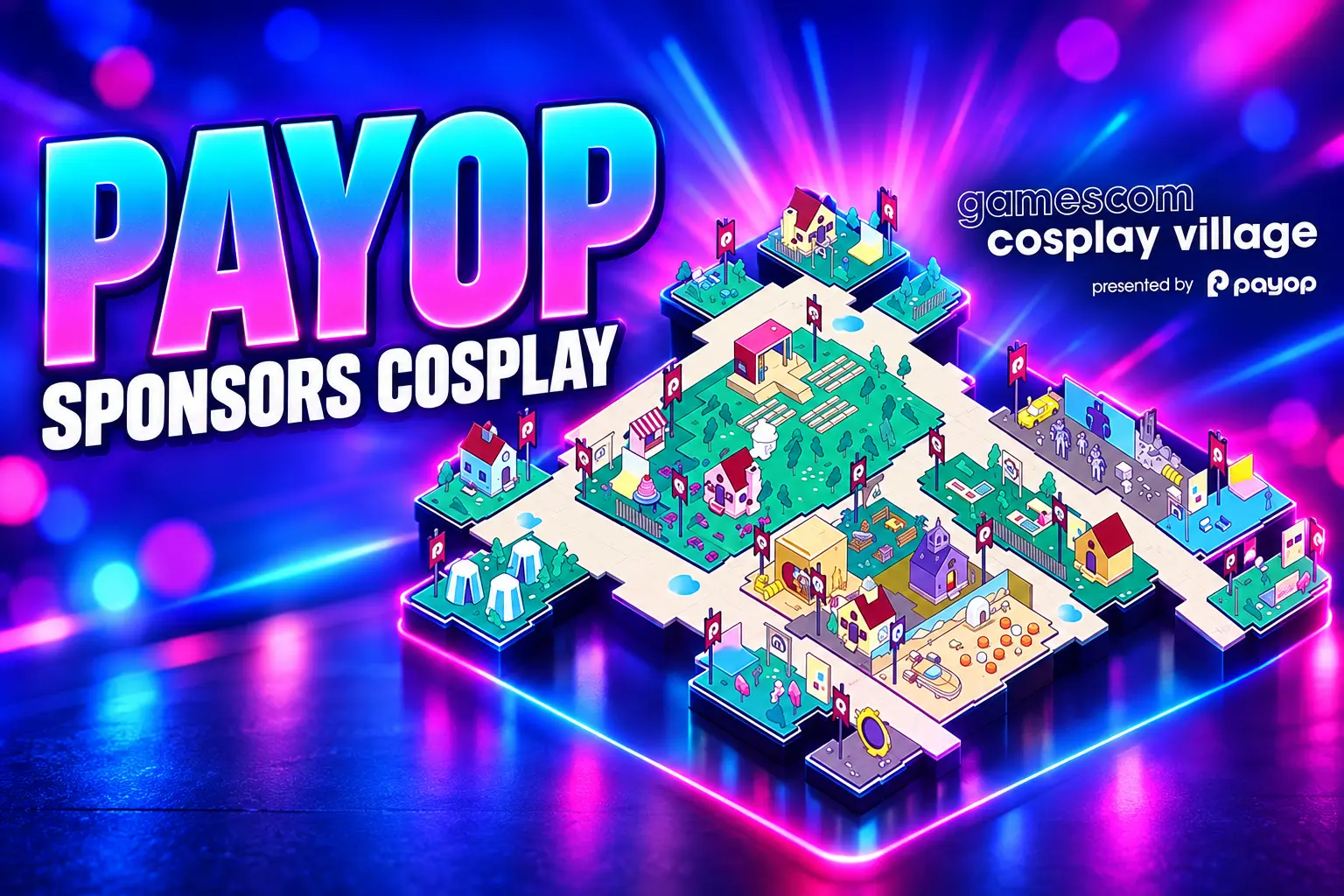
Payop spent Gamescom 2026 as official sponsor of Cosplay Village, a fan hall, while larger processors fought over local payment rails. The five-day Cologne show ran August 26 to 30. The costume floor in Hall 5.1 carried the payments firm’s name for four of those days.
The wager was cultural on purpose. Payop is trying to look like it belongs next to players, then sell studios a checkout that uses the wallets those players already have.
Hall 5.1 Carried Payop’s Name for Four Days
Organizers still title the Cosplay Village presented by Payop on the official program page. The downstairs hall held a cosplay stage, workshops, photobooths, artist tables, and group stands. Merchandise sat above it in Hall 5.2. The big contest left the village on Saturday, August 29, at 5:00 PM, when 30 finalists went to the event arena in Hall 1 under a separate presenter, Essence.
Gamescom drew 368,000 visitors from 131 countries, with international attendance up 6%. Trade badges topped 36,000, about half of them from abroad. A record 1,743 companies from 66 countries filled about 233,000 square metres that sold out for the first time, and 72% of exhibitors came from outside Germany. Digital content around the show passed 624 million views by Saturday evening. Forty-eight pavilions represented 41 countries.
THE COLOGNE CALENDAR
- July 22, 2026: Payop’s own account posts that it is official Cosplay Village sponsor.
- July 28, 2026: The company unveils a new brand built with Fedoriv and ties it to the hall.
- August 11, 2026: A Vancouver-dated release invites studios to meet the team in Cologne.
- August 17, 2026: Xsolla adds 15+ local payment methods ahead of the same show.
- August 26, 2026: Gamescom opens. Cosplay Village runs four public days in Hall 5.1.
- August 29, 2026: The Cosplay Contest final runs in Hall 1, presented by Essence.
- August 30, 2026: The halls close. Payop has not named a new publisher client from the week.
The official post is the one asset the company put on the record before the doors opened.
Gaming is all about fast, seamless experiences, and payments should never interrupt the moment. That’s why Payop is super excited to be the official sponsor of the @gamescom Cosplay Village this year 🎮 #paymentsolutions #payop #gamescom #gamescom2026 #gamescomgermany pic.twitter.com/vru8Ou7L8n
— Payop (@payopcom) July 22, 2026
Business halls 2 to 4 stayed a trade-badge zone. Payop’s public play was the costume floor, where consumers actually walk. That is a different door from a publisher pitch table, and it is the door they bought.
500 Methods Versus a 1,000-Method Incumbent
Payop tells merchants it can reach players in more than 170 countries with 500+ payment methods and 100+ currencies. Its about page adds 1 billion transactions and 10,000 websites. Those are real figures, and they still sit under the lists the incumbents print.
Xsolla’s Pay Station advertises 1,000 localized payment methods, 130+ currencies, and 200+ geographies, and the company says it is trusted by more than 70% of the top 100 highest-grossing games. Nine days before Cologne it added 15+ local methods, including Mandiri in Indonesia, ShopeePay in the Philippines, LINE Pay in Taiwan, Octopus in Hong Kong, 7-Eleven konbini payments in Japan, Wero in Germany and Belgium, and Aeropay pay-by-bank in the United States.
Stripe’s gaming page lists Take-Two, Ubisoft, Unity, NVIDIA, Scopely, Zynga, and Voodoo, and it offers 125 local payment methods. Stripe says it processed $1.9T in a year, holds 99.999% historical uptime, and lifts acceptance 3.8% with Authorization Boost. That is the stack a mid-size studio already knows.
WHO SHOWED UP WITH WHAT
| Firm | Methods claimed | Coverage claimed | Gamescom 2026 move |
|---|---|---|---|
| Payop | 500+ | More than 170 countries, 100+ currencies | Official Cosplay Village sponsor and Fedoriv rebrand |
| Xsolla | 1,000+ | 200+ geographies, 130+ currencies | Added 15+ local methods on August 17 |
| Stripe | 125+ local methods | Global, with named AAA clients | Standing gaming stack, no costume-hall play |
Method counts are each firm’s own list, not a lab test. Xsolla’s published catalogue is about twice Payop’s. Stripe’s named publishers are the clients Payop still has to win. The costume hall does not close that gap by itself. It only buys the meeting.
Local Wallets Decide Whether a Player Pays
CEO Anastasiia Semenkova has used a blunt example for years: only 6% of people in Indonesia have cards, so a Visa-only cart never sees the other 94%. The same pattern shows up wherever a studio ships a global SKU and then watches checkout die in one country. Germany leans on bank rails. The Netherlands still runs on iDEAL. Japan pays at convenience stores. Brazil uses PIX. Hong Kong lives on Octopus. A card form that works in California is a broken shop in those markets.
Payop’s pitch to game businesses is familiar methods, higher approval rates, smart routing, mobile checkout, and analytics, so a player can buy a title, a currency pack, or a cosmetic and get back in. Semenkova, in the August 11 release, tied that job to a generation that grew up on gadgets and forums, not to a single franchise. She also said payment processing is a regulated trade full of slow checks, and that her team still tries to keep the front end simple.
That is the conversion problem the Cosplay Village branding is meant to stand in front of. A player in a costume line already knows what “friction” feels like. A studio CFO cares about the same thing when a Brazilian PIX user bounces off a card wall. Payop is selling both audiences the same sentence: the payment should vanish.
Player Colors on a Payments Logo
The look arrived before the hall. On July 28 Payop said it had rebuilt the brand with Fedoriv, a positioning shop that put the player in the middle and treated checkout as the thing that kills immersion. Bright gradients, 3D shapes, and a spiral mark replaced an older, flatter payments identity. A December 22, 2025 release had already called the shift player-first. Cologne was the public debut.
Semenkova said the company tried to design itself first, then admitted it knew rails better than typefaces.
We stubbornly tried to build the Payop brand ourselves until we came to a clear realisation: Payop has deep expertise in payment services and infrastructure, not in visual communication. We partnered with the Fedoriv agency to express the Payop team’s spirit and our approach to business through colours and visual elements.
Anastasiia Semenkova, CEO of Payop, July 28 brand announcement
Fedoriv called payments the classic buzzkill that pulls a player out of a session. The new system, the agency said, is built for speed, light emotion, and a flow you are not supposed to notice. Semenkova’s own staff page still jokes that her teenage hours went into de_dust2.Fast. The Cosplay Village booking is the same joke at hall scale: we are gamers, please take the meeting.
A week before the show, Payop also posted a junior short-form creator job aimed at people who know memes. On August 18 it backed a Valorant cosmetic giveaway on a fan news account, with a winner named on September 3. That is not a publisher contract. It is the same culture spend as the costume hall, pointed at players instead of booth buyers.
How Payop’s Pay by Bank Skips the Card Networks
Behind the spiral is a product Payop has been shipping since 2021. The Pay by Bank open banking channel sends a player into their own banking app, where Face ID, a fingerprint, or a PIN finishes the debit. No card number sits on the merchant page. Payop says that cuts scheme fees, resists chargebacks, and runs under European open banking rules with extra login checks. In 2022 the company says it shifted focus from card acquiring toward local methods. In 2023 it expanded Pay by Bank to 10 countries and added Pay by Monzo after a 2022 Pay by Revolut launch.
WHAT THE RAIL CLAIMS TO DO
- Instant bank debit: The payer confirms inside the bank app and the merchant sees a live result.
- Lower scheme cost: The path skips card networks, which is the fee cut Payop sells to shops.
- Fewer chargebacks: Open banking payments are harder to reverse than card claims.
- Login checks on by default: Strong customer authentication is the European default, not an add-on.
On November 13, 2025 Payop added Bitcoin, Ethereum, USDT, and USDC through Triple-A, a licensed crypto firm, for merchants in places where those assets are already common. On July 23, 2025 it plugged in Dragonpay so Philippine shoppers could use local banks and e-wallets. On May 28, 2025 it hired Freemarket for cross-border vendor payouts, a back-office need that shows up once you are paying studios, affiliates, and staff in more than one currency. Nataliia Lukianova became chief operating officer on January 12, 2026, after Semenkova took the CEO job in January 2024.
That is not a Gamescom exclusive. It is the stack they walked into Hall 5.1 with. The village made the stack visible to people who will never read an acquiring contract.
The Merchant Mix Still Leans iGaming
Payop’s homepage splits Gaming from iGaming. The second bucket is betting and casino deposits, with instant payouts, and it is still on the front door. Testimonials on the site come from a European iGaming chief operating officer, an online gaming platform founder, and a digital gaming store founder. PIQ and Praxis, named in the 2020 timeline, are casino cashier platforms. The Freemarket note was written for iGaming payouts and then some.
That history is the constraint on the Cosplay Village bet. A video-game publisher shopping a web store already has Stripe or Xsolla in the building. Payop has to prove it can hold a launch-day spike, pass brand-safety reviews, and keep chargebacks off a rated title. High-risk cashier work is a different sales cycle from a Nintendo-adjacent consumer hall.
PAYOP ON ITS OWN SITE
- Legal home: Transferop Payment Gateway Ltd, 2110-650 West Georgia Street, Vancouver, BC, V6B 4N9.
- Canadian file: FINTRAC money service business M22769088.
- Singapore line: The footer states Payop is not licensed or regulated by MAS.
- Operating life: Tech launch in 2017, payment license in 2019, 500+ local methods by 2021.
Semenkova joined as a sales manager in 2019, the year of that license, and became CEO in January 2024. The about-us timeline lists a full rebrand and a cleaner checkout in 2025, lower fees and holds in 2024, and a status tracker for payers. Holds, it says, are now four times lower than before. Those are operator metrics, not a Cosplay Village souvenir.
WHAT WE KNOW
- The booking: Payop was official presenter of Cosplay Village in Hall 5.1 at Gamescom 2026.
- The brand: Fedoriv shipped the player-first identity that the hall wore.
- The product: Local methods, Pay by Bank, and a Vancouver MSB registration are on the public site.
WHAT IS UNCONFIRMED
- Studio logos: No named AAA or mid-size publisher has been announced as a Cologne win.
- A trade booth: Payop did not publish a halls 2 to 4 stand number beside the village booking.
- A 2027 repeat: The live program page still uses the Payop presenter line; a renewal has not been announced.
The quieter Cologne story is that checkout localization is now a show-week product, the way a new trailer is. Xsolla shipped rails. Payop shipped a hall and a logo. Stripe did not need either. Until a named game company says it moved volume onto Payop after August, the Cosplay Village week is a brand bet that has not yet cleared.
Frequently Asked Questions
Who Is the Licensed Company Behind Payop?
The entity on Payop’s own footer is Transferop Payment Gateway Ltd, a Canadian money service business registered with FINTRAC under number M22769088 at 2110-650 West Georgia Street, Vancouver. The same footer says the brand is not licensed, approved, or regulated by Singapore’s MAS, which overrides older directory listings that still describe a MAS permission.
Did Payop Sponsor the Gamescom Cosplay Contest?
No. Payop presented Cosplay Village in Hall 5.1. The contest final on Saturday, August 29, at 5:00 PM in Hall 1 was presented by Essence, and employees of village exhibitors were barred from entering. The two bookings share a week and a fandom, not a contract.
When Did Payop Start Operating and Get Licensed?
Payop’s timeline says it started as a tech solution in 2017 and became a licensed payment provider in 2019, the same year it launched international acquiring and passed 200 local methods. By 2021 it listed 500+ methods, a Canadian FINTRAC licence, and its own Pay by Bank product.
What Extra Rails Did Payop Add Outside Cards?
Besides local bank transfers, e-wallets, vouchers, and cash, Payop added Dragonpay for the Philippines on July 23, 2025, Triple-A crypto (Bitcoin, Ethereum, USDT, USDC) on November 13, 2025, and Freemarket for vendor payouts on May 28, 2025. Pay by Bank remains the in-house rail it keeps putting in front of game merchants.

Instagram Plus Tests a Read-Only Mode That Cuts Stories

Altman Asks the Public to Accept Some AI Harm

Google Freezes OSS VRP Product Reports After AI Flood

AI Agents Make Payment Rails the Scarce Prize

Turkey’s Crypto Boom Now Runs Through Three Banks

Fable 5 Came Back Under a Commerce On-Off Switch

Google’s SpaceX GPU Lease Has a Sept. 30 Deadline

Plasma One’s XPL Locks Face a 1.81 Billion Cliff

DGO’s Rs 549 World Cup Pass Cost Fans Sleep and Data

Moonshot AI’s $30 Billion Ask Became a $35 Billion Close
-
 AI4 months ago
Fable 5 Came Back Under a Commerce On-Off Switch
-
 AI4 months ago
Google’s SpaceX GPU Lease Has a Sept. 30 Deadline
-
 CRYPTO4 months ago
Plasma One’s XPL Locks Face a 1.81 Billion Cliff
-
 APPS4 months ago
DGO’s Rs 549 World Cup Pass Cost Fans Sleep and Data
-
 AI4 months ago
Moonshot AI’s $30 Billion Ask Became a $35 Billion Close
-

 NEWS4 months ago
ColorOS 17 Device List Spans Oppo, OnePlus and Realme
-

 GAMING4 months ago
Xbox Cuts 3,200 Jobs After Five Years of Thin Returns
-

 GAMING4 months ago
The RTX 4050 Under Rs 70,000 Hides a Wattage Gap