
NEWS
Poco M8x 5G Puts a 7,900mAh Cell Behind an HD+ Screen
Poco M8x 5G brings India’s first Snapdragon 4 Gen 5 and a 7,900mAh battery, then asks buyers to live with 4GB RAM and a 254 ppi HD+ LCD.

Poco launched the M8x 5G in India on August 21 with a 7,900mAh battery and the country’s first Snapdragon 4 Gen 5 chip. The base phone still ships 4GB of RAM and a 6.9-inch HD+ LCD, and the list price is ₹20,999.
A ₹2,000 coupon cuts that floor to ₹18,999. Flipkart opened orders on August 27 at 12 pm, after a mid-August leak had named the wrong chip and a much smaller cell.
The Leak Named the Wrong Chip
On August 16, tipster Yogesh Brar posted a sheet that put a MediaTek Dimensity 6300, 4GB of RAM, a 6,000mAh battery and 33W charging in the M8x 5G, with a price under ₹20,000. The earlier M8x 5G specs leak also called the 6.9-inch 120Hz HD+ panel and HyperOS 3, two details that did survive.
The Dimensity guess did not. That Dimensity 6300 6nm platform is a 2024-era part with two Cortex-A76 cores at 2.4GHz. Poco put Qualcomm’s newer 4nm Snapdragon 4 Gen 5 in the retail phone instead, and it raised the battery from 6,000mAh to 7,900mAh and charging from 33W to 45W.
THE WEEK THE SHEET CHANGED
- August 16, 2026: Brar’s post names a Dimensity 6300, a 6,000mAh cell, 33W charging and a price under ₹20,000.
- August 21, 2026: Poco unveils the M8x 5G with Snapdragon 4 Gen 5, a 7,900mAh battery, 45W charging and a ₹20,999 list price.
- August 27, 2026: Flipkart starts selling the phone at 12 pm, with a ₹2,000 coupon on both variants.
The leak was right about the coarse screen and the 4GB floor. Those are the cuts that stayed in the finished phone.
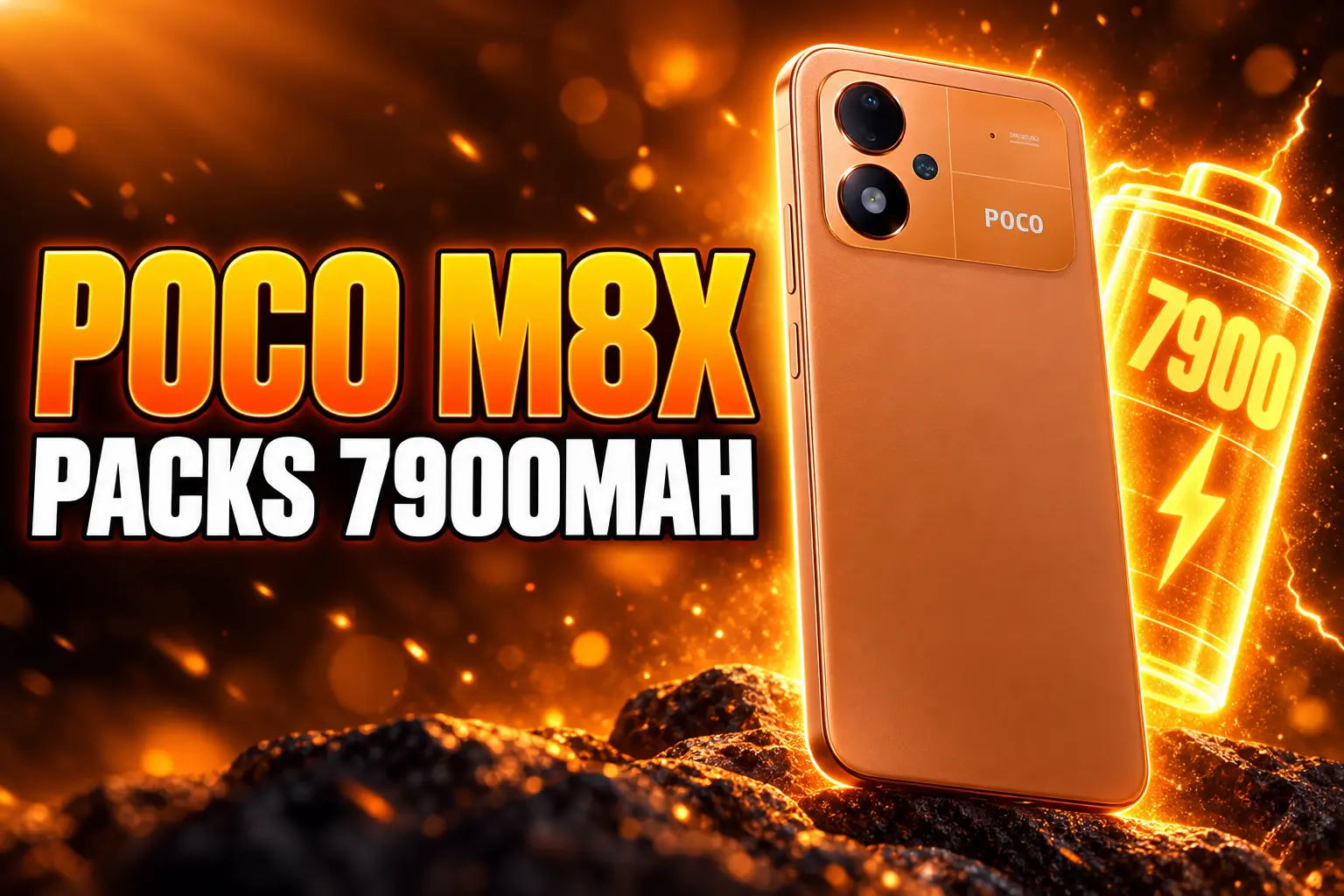
A 7,900mAh Cell Pays for the Cuts
The M8x 5G is built around a 7,900mAh pack, the largest cell in the M8 line after the M8 Power’s 8,000mAh silicon-carbon battery. Poco rates it for 45W wired charging and 22.5W reverse wired charging, and the company spent the launch week selling stamina rather than cameras or glass.
Your day doesn't exactly believe in taking it easy.
From endless scrolling and gaming to clicking every random moment worth remembering, its 7900mAh battery is ready to keep going.
Check it out!
Sale Live from 27th August, only on Flipkart#POCOIndia #POCO #POCOM8x pic.twitter.com/RbnMFnnzdb
— POCO India (@IndiaPOCO) August 22, 2026
Lab numbers back the pitch. A PCMark battery run on the M8x 5G lasted 22 hours 19 minutes, ahead of the Poco M8’s 18 hours on the same test. Charging from 20 percent to 100 percent took 1 hour 12 minutes.
BATTERY LAB SNAPSHOT
- Cell size: 7,900mAh lithium polymer pack.
- PCMark run: 22 hours 19 minutes of mixed use.
- Top-up time: 1 hour 12 minutes from 20 percent to 100 percent.
- Wired speeds: 45W in, 22.5W reverse out.
Poco’s own figures talk about 35 hours of social apps, 13 hours of GPS and 64 hours of music. Those are branded endurance claims, not lab scores, and they sit next to a phone that weighs 232 g and measures 170.1 x 78.4 x 8.8 mm. The cell is why the slab is thick.
Why 254 Pixels per Inch Still Ships at This Price
The panel is a 6.9-inch IPS LCD at 720 x 1,600 pixels, 120Hz, with a 240Hz touch sample rate. Pixel density is 254 ppi. Gorilla Glass 7i covers it, peak brightness in high-brightness mode is 825 nits, and typical brightness sits at 675 nits.
At 6.9 inches, 720p is a 2014-era density on a 2026 price tag. Icons look soft. Text is usable. A 120Hz refresh makes scrolling feel quick without making the image sharp. Hands-on notes after launch kept returning to that gap: the Hertz number sounds current, the pixel grid does not.
Poco already sells AMOLED M8 phones. The M8 5G uses a 6.77-inch Full HD+ panel. The M8 Power uses a 6.83-inch Full HD+ AMOLED rated at 1,800 nits. The M8x is the one model in the trio that still uses an LCD, and it is also the one with the lowest resolution. The money went into the cell and the new Qualcomm part, not into pixels.
Snapdragon 4 Gen 5 Arrives First in India
Qualcomm announced the Snapdragon 4 Gen 5 on May 7, naming Honor, OPPO, realme and REDMI as the first wave of brands. Poco’s India unit got the chip into a retail phone first. The 4nm Kryo setup is two Cortex-A78 cores at 2.4GHz plus six Cortex-A55 cores at 2.0GHz.
On paper the jump is mostly graphics. Qualcomm says the Adreno GPU is 77 percent faster than the previous 4-series part and that the platform is the first in that series to hold 90 FPS in games. It also claims 43 percent faster app launches and 25 percent less stutter through Smooth Motion UI, plus a 10 percent power saving.
Achieve stable framerates and responsive gameplay from start to finish with a 77% more powerful Adreno GPU, while first-in-series 90 FPS support delivers smooth, consistent performance across your favorite mobile games.
Qualcomm, Snapdragon 4 Gen 5 product page
WHAT THE 4 GEN 5 ADDS
- Process and CPU: 4nm Kryo clocks up to 2.4GHz on two Cortex-A78 cores.
- Graphics claim: 77 percent faster Adreno GPU than the last 4-series chip.
- Game mode: Qualcomm’s first 90 FPS to the Snapdragon 4-series, rated at HD.
- Modem: sub-6 5G with 2.8 Gbps down and 900 Mbps up, plus Dual SIM Dual Active.
- Radios: Wi-Fi 5 and Bluetooth 5.1, not Wi-Fi 6.
That 90 FPS rating is for HD. The M8x’s 720p panel matches the chip’s game target, which is a neat fit and a low ceiling. A 91mobiles Wild Life Extreme run after 30 minutes of gaming scored 401 on the M8x 5G, against 3,237 on the Snapdragon 6 Gen 3 Poco M8. AnTuTu on the M8x 5G landed at 653,645, with a 28-second boot. Daily apps should be fine. Heavy games will not be.
4GB of RAM Meets Four Years of Updates
Both retail variants use LPDDR4X memory and 128GB of UFS 2.2 storage. The chip can talk to UFS 3.1. Poco did not. The 4GB phone is the one Poco priced at ₹20,999. The 6GB phone is ₹22,999. Storage expands through a dedicated microSD slot.
HyperOS 3 on Android 16 is the software, with four years of OS upgrades and six years of security patches. That promise runs into a 4GB floor. A 6.9-inch desktop of widgets, Android 16’s background work and four future OS jumps all share a memory budget that budget Androids were already leaving behind. The 6GB SKU is the safer buy if the phone is meant to last those four upgrades. The 4GB SKU is the one Poco put on the lead price tile.
Early owners have already described typing lag, heat and clumsy multitasking on the 4 Gen 5, which is a modest 100MHz bump on the same Cortex-A78 plus Cortex-A55 layout as Snapdragon 4 Gen 4. The new chip’s real gift is the GPU and the 90 FPS HD path, not a new CPU design. Pair that with 4GB and the phone behaves like a long-battery appliance, not a small computer.
How the M8x Sits Beside the M8 and M8 Power
Poco now has three M8 phones on Indian shelves, and they do not stack in a straight line. The January M8 5G is the sharp, thin one. The August M8 Power is the AMOLED stamina phone at a higher price. The M8x is the cheap stamina phone with the new chip and the soft screen.
M8 FAMILY AT LAUNCH PRICE
| Phone | Display | Chip | RAM floor | Battery | Base list price |
|---|---|---|---|---|---|
| Poco M8 5G | 6.77-inch FHD+ AMOLED | Snapdragon 6 Gen 3 | 6GB | 5,520mAh | ₹18,999 |
| Poco M8x 5G | 6.9-inch HD+ LCD | Snapdragon 4 Gen 5 | 4GB | 7,900mAh | ₹20,999 |
| Poco M8 Power 5G | 6.83-inch FHD+ AMOLED | Snapdragon 4 Gen 4 | 6GB | 8,000mAh | ₹24,999 |
The M8 5G, launched on January 8, still looks like the better screen buy. It uses a 6.77-inch 120Hz Flow AMOLED at 2,392 x 1,080 with 3,200 nits peak brightness, a Snapdragon 6 Gen 3, a 20MP front camera and a 7.35 mm body. Its 5,520mAh cell is the smallest of the three, and 45W charging is in the box.
The M8 Power, launched on August 4, is the one to beat on glass and battery together: 6.83-inch FHD+ AMOLED, 1,800 nits, Snapdragon 4 Gen 4, 8,000mAh, 6GB as the floor, ₹24,999 before offers. The M8x undercuts it by ₹4,000, adds the newer 4 Gen 5, and gives up the AMOLED, the extra RAM floor and 100mAh.
Leather Green Comes With a Headphone Jack
The camera is a 50MP f/1.8 wide with PDAF and an auxiliary lens, plus an 8MP f/2.0 front camera. Video tops out at 1080p30 on both sides. There is no OIS. Daylight shots are the brief. Night work is not.
Poco put a side fingerprint reader, IP64 sealing, dual stereo speakers and an IR-free India spec in the frame. Colours are Leather Green, Black and Blue. The green phone uses a vegan leather back; the other two use plastic. Buttons sit on the right. The camera island is a square in the top-left corner with gold-coloured trim, matching the August teaser.
THE TWO RETAIL VARIANTS
- 4GB + 128GB: ₹20,999 list, ₹18,999 with the ₹2,000 coupon.
- 6GB + 128GB: ₹22,999 list, ₹20,999 with the same coupon.
- Colours: Leather Green, Black and Blue, all on both memory cuts.
The headphone jack and the microSD slot are the old Poco extras that still matter on a commute phone. They also underline the brief. This is a battery brick with a new Qualcomm name on the box, sold on Flipkart from August 27, and it asks you to accept 254 ppi and a 4GB start so the 7,900mAh cell can be the headline.
Frequently Asked Questions
Does the Poco M8x 5G Have a Headphone Jack?
Yes. The M8x 5G keeps a 3.5mm jack, dual stereo speakers and 24-bit/192kHz Hi-Res audio, so wired earphones and a speaker pair both work without a dongle. USB Type-C still handles charging and OTG.
What Does the IP64 Rating on the Poco M8x 5G Cover?
IP64 means the shell is dust tight and rated for water splashes, not baths or sinks. A splash on the commute is in spec. Holding the phone under a tap or dropping it in a bucket is not, and fogged camera glass after a water test is a repair job, not a feature.
Is Poco M8x 5G Storage Expandable?
Yes, through a dedicated microSDXC slot that sits beside two nano-SIM trays rather than sharing space with the second SIM. Internal storage is 128GB UFS 2.2 on both RAM cuts, so the card slot is the only way to add space after purchase.
What Software Does the Poco M8x 5G Ship With?
It ships HyperOS 3 on Android 16. Poco’s written promise is four major OS upgrades and six years of security patches, which is the same support window it already attached to the M8 Power.
Is the Leather Green Back Real Leather?
No. The Leather Green model uses a vegan leather finish, listed as a silicone polymer eco-leather back, while Black and Blue use a standard plastic rear. The square camera island and gold-coloured rim are the same on all three colours.
Flipkart has been selling both memory cuts since August 27, in Leather Green, Black and Blue. The 6GB phone is the one that matches the four-year software window. The 4GB phone is the one Poco put on the poster, behind that 7,900mAh cell and a 6.9-inch LCD that still draws 720p.

Instagram Plus Tests a Read-Only Mode That Cuts Stories

Altman Asks the Public to Accept Some AI Harm

Google Freezes OSS VRP Product Reports After AI Flood

AI Agents Make Payment Rails the Scarce Prize

Turkey’s Crypto Boom Now Runs Through Three Banks

Fable 5 Came Back Under a Commerce On-Off Switch

Google’s SpaceX GPU Lease Has a Sept. 30 Deadline

Plasma One’s XPL Locks Face a 1.81 Billion Cliff

DGO’s Rs 549 World Cup Pass Cost Fans Sleep and Data

Moonshot AI’s $30 Billion Ask Became a $35 Billion Close
-
 AI4 months ago
Fable 5 Came Back Under a Commerce On-Off Switch
-
 AI4 months ago
Google’s SpaceX GPU Lease Has a Sept. 30 Deadline
-
 CRYPTO4 months ago
Plasma One’s XPL Locks Face a 1.81 Billion Cliff
-
 APPS4 months ago
DGO’s Rs 549 World Cup Pass Cost Fans Sleep and Data
-
 AI4 months ago
Moonshot AI’s $30 Billion Ask Became a $35 Billion Close
-
 NEWS4 months ago
ColorOS 17 Device List Spans Oppo, OnePlus and Realme
-

 GAMING4 months ago
Xbox Cuts 3,200 Jobs After Five Years of Thin Returns
-

 GAMING4 months ago
The RTX 4050 Under Rs 70,000 Hides a Wattage Gap