
AI
Bezos Defies the AI Doom Narrative With a Labour-Shortage Bet
Bezos told VivaTech AI will create a labour shortage. Challenger’s May report counts 97,006 U.S. job cuts, with AI as the top reason.

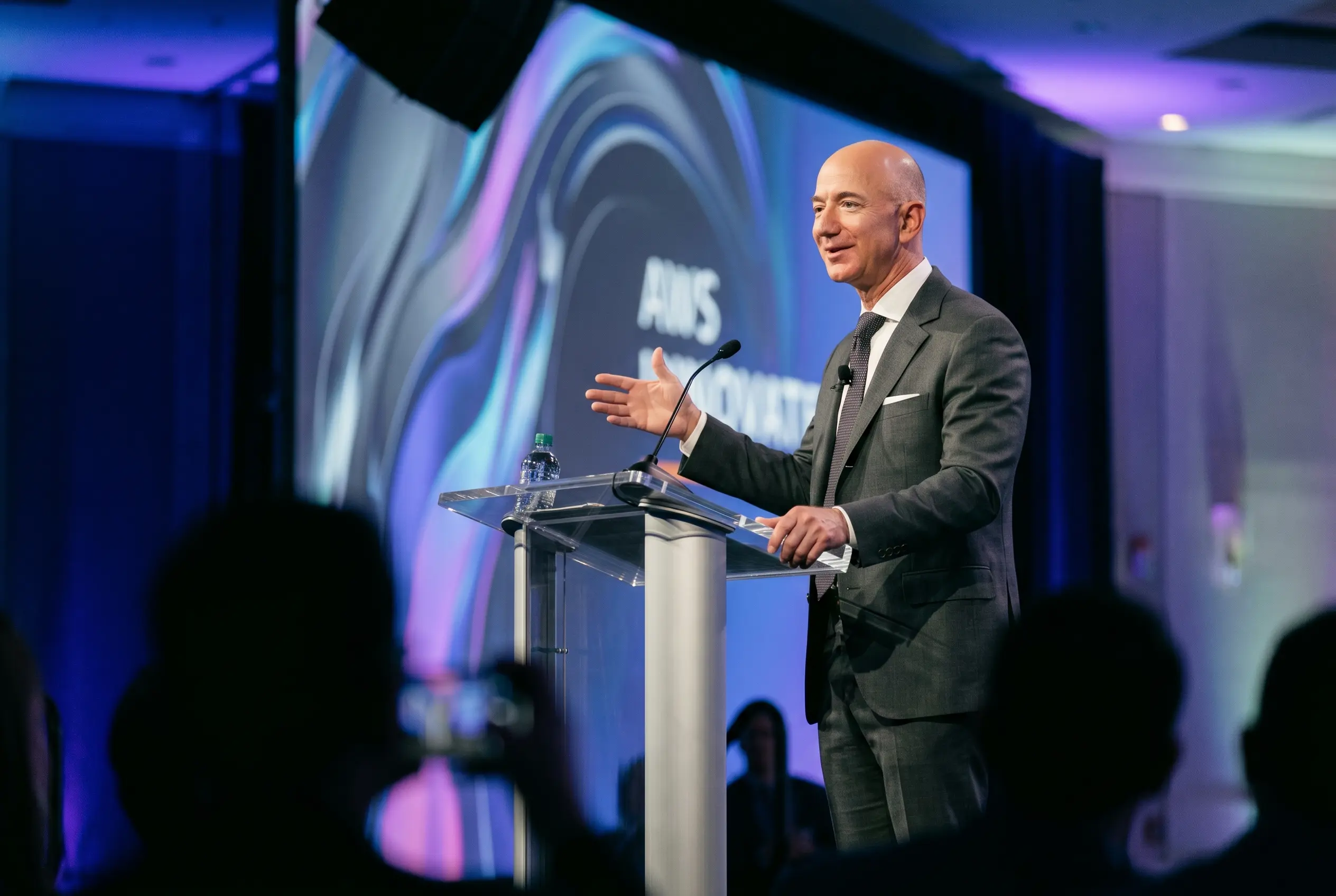
Jeff Bezos took the stage at the VivaTech conference in Paris and made a confident case that artificial intelligence will not destroy jobs but create a labour shortage. “I totally disagree with this point of view,” Bezos said of the popular worry that AI will make humans redundant. “And I think, in fact, AI is going to create a labour shortage.”
The case arrived with a hard counter behind it. The same month, outplacement firm Challenger, Gray & Christmas counted 97,006 announced U.S. job cuts, with AI cited as the leading reason for a third straight month. Amazon, the company Bezos founded, has shed 30,000 corporate roles since October 2025.
Bezos’s Labour-Shortage Case Meets the Layoff Counter
Bezos picked the most charged question in tech to address at Europe’s largest tech conference, his appearance at Paris’s VivaTech conference. He framed the worry of mass AI-driven unemployment as a misread of how technology actually reshapes work. “I know there’s a lot of concern that many people have, including many smart people, that AI is going to make humans redundant,” he said, before laying out his counter-thesis. People are limited not by ambition, he argued, but by barriers such as time, resources, and capability, and AI is the tool that removes them.
That thesis now sits next to a hard data set. The May 2026 Challenger job-cut report counted 97,006 announced U.S. job cuts, the highest May total since 2020. AI was cited as the reason for 38,579 of them, accounting for 40% of all cuts that month, the highest share Challenger has ever recorded for the category.
For the year so far, AI has been cited in 87,714 cuts, or 22% of all 2026 layoffs, already more than the 54,836 attributed to AI across the whole of 2025. Andy Challenger, the firm’s chief revenue officer, said employers are “restructuring aggressively as they reposition for an AI-driven economy.” That is the same economy Bezos says will end up short of humans, and the same year his own company is shrinking its corporate workforce. The founder’s optimism and the labour data are running in opposite directions.
- 38,579: AI-attributed job cuts announced in May 2026
- 80,472: U.S. planned hires announced in the first five months of 2026
- 16%: month-on-month jump in total announced cuts from April to May 2026
Amazon’s Own Cuts Are the Hardest Counter
Amazon has become the most public test of the thesis. In October 2025, the company announced 14,000 corporate job cuts, its largest round in years. In January 2026, it followed with 16,000 more, taking the combined total since October to 30,000, or about 10% of Amazon’s roughly 350,000 corporate and tech workforce. The company described both rounds as part of an effort to “reduce layers, increase ownership, and remove bureaucracy,” and tied them to a broader push to invest in AI. Amazon has guided to $125 billion in capital expenditures for 2026, the highest spending forecast among the megacap companies, much of it earmarked for AI and data centres. The January announcement is detailed in Amazon’s January announcement of 16,000 cuts.
The contradiction runs through Amazon’s own leadership. CEO Andy Jassy said in June 2025 that efficiency gains from AI would likely shrink Amazon’s corporate headcount. “We will need fewer people doing some of the jobs that are being done today, and more people doing other types of jobs,” Jassy said at the time. The same employer is now running a workforce reduction programme that its founder, on a Paris stage, says the broader economy will not need at the scale the data suggests. Other companies have run similar AI-driven restructurings, including Cloudflare’s shift to an AI-first operating model.
What Bezos Actually Argues
Bezos’s labour-shortage case rests on a productivity argument. When AI removes the friction of turning ideas into products, he says, the economy does not shrink but expands. New products create new demand, and new demand creates new work, a feedback loop the layoff data, on its face, contradicts.
He made the case to the VivaTech audience by leaning on his own entrepreneurial history. He said people are constrained by a lack of time, resources, and capability, not a lack of ideas. AI gives small teams and solo founders leverage to build things that used to take whole companies, and the resulting surge in product creation draws in more labour, not less. The argument puts him in a small but loud group of tech leaders who reject the doomsaying on AI employment.
Most of the public conversation in 2026 has run the other way. Former UK prime minister Rishi Sunak, now an adviser to Microsoft and AI firm Anthropic, said recently that AI is having an impact on young people’s job prospects. The UK’s Trades Union Congress warned that AI could repeat “the disaster of deindustrialisation” as shareholders get richer while jobs are “degraded or displaced.” Anthropic CEO Dario Amodei has refused to walk back warnings that AI could wipe out entry-level white-collar roles, a stance laid out in Anthropic CEO Amodei’s stand on AI job loss. The two camps are speaking past each other, and the public is reading the same labour data through two opposite lenses.
Bezos’s framing leans on the long history of past technology cycles. New tools, from the steam engine to the spreadsheet, have eventually produced more work than they destroyed, even when the transition cost whole categories of jobs. The difference this time, his critics argue, is the speed and breadth of the change, a critique that has not yet been settled by any side.
Bezos’s $41 Billion Bet on Physical AI
Most of the AI money Bezos is putting behind the thesis is going into a startup he leads rather than Amazon. Prometheus, the industrial AI company he co-leads with former Google executive Vik Bajaj, raised $12 billion in a Series B round at a $41 billion valuation in June 2026, the figure from Prometheus’s $12B Series B and $41B valuation. Investors include JPMorgan, BlackRock, Goldman Sachs, DST Global, and Arch Venture Partners, with Bezos himself the largest backer of the prior $6.2 billion Series A. Around 150 employees are working on tools for designing and manufacturing physical products, from jet engines to medical devices.
Prometheus has no corporate ties to Amazon or Blue Origin, and Bezos calls Blue Origin a “case study for a customer of Prometheus.” Bajaj frames the bet in terms of the same labour-shortage logic his co-founder laid out at VivaTech, arguing that a faster dream-to-manufacturing cycle will pull more engineers and operators into the physical economy rather than push them out.
The startup’s bet on physical AI runs alongside a separate, reported effort to raise $100 billion for an affiliated holding company that would buy legacy industrial firms and feed their data into Prometheus. Neither Bezos nor Bajaj commented on the holding-company plan.
The pace of our physical creation right now is nowhere near the pace of human imagination.
Vik Bajaj, co-CEO of Prometheus, in an interview with Axios.
- Founded: November 2025, with a $6.2 billion Series A round led in part by Bezos
- Series B: $12 billion in June 2026 at a $41 billion valuation
- Headcount: Around 150 employees
- Investors: JPMorgan, BlackRock, Goldman Sachs, DST Global, Arch Venture Partners, and Bezos
- Goal: An “artificial general engineer” for physical manufacturing, from jet engines to medical devices
From the Moon to a Gut Punch at the Cape
Space got equal billing with AI at VivaTech. Bezos framed the cosmos as a place where demand is endless but supply is the binding constraint. Access, not appetite, is the bottleneck to growth, and rocket reliability remains the lever to pull.
He pointed to the Moon as the natural starting point. Proximity to Earth and lower gravity make it the practical first step, he said, before any push to Mars. He also pointed to lunar resources such as oxygen and fuel that could one day be processed on the surface to refuel rockets. Bezos told the audience humanity’s expansion into space begins with a permanent presence on the lunar surface.
We’re going to the Moon to stay, not just to visit.
Jeff Bezos, at the VivaTech conference in Paris, June 2026.
The plan has real contracts behind it. NASA awarded Blue Origin a $188 million contract to help build a Moon Base, the agency announced a day before the New Glenn explosion. The Artemis program is targeting 2028 for the next American astronaut landing on the Moon.
The space work is still recovering from a real setback. A New Glenn rocket exploded on May 28 during a static fire test at Cape Canaveral, Florida, with no injuries reported. Bezos called it “a gut punch for the whole team” but said critical launch infrastructure survived. Blue Origin CEO Dave Limp said reconstruction is underway and launches should resume before the end of 2026. The rocket was preparing to deploy 48 satellites for Amazon’s Leo internet service, the first of 24 New Glenn launches Amazon has booked. The full picture is in the New Glenn explosion and Amazon’s satellite backlog.
Reading the Layoff Data Behind the Wager
For the third straight month, AI has been the leading reason cited for U.S. job cuts. May’s 40% share, the highest Challenger has ever recorded for the category, up from 7% in January, is the clearest single marker of how far AI is now wired into corporate restructuring decisions. The trajectory is the part that matters: the share of cuts attributed to AI has climbed every month since the start of 2026.
Bezos and his critics are both looking at the same numbers and reading them differently. The most consequential data point, the one that decides which view ages better, is whether the second half of 2026 brings the surge in product creation and new demand that the labour-shortage case requires. Through May 2026, U.S. employers have announced 80,472 planned hires, narrowly topping the 79,741 announced at the same point in 2025, a flat line that does not yet confirm the predicted surge.
- Jeff Bezos, Amazon founder (VivaTech, June 2026): Pushes an optimistic case, predicting AI will create a labour shortage, not mass unemployment.
- Andy Jassy, Amazon CEO (June 2025): Stays with the bottom line, telling staff that AI would shrink Amazon’s corporate headcount over time.
- Rishi Sunak, former UK PM, adviser to Microsoft and Anthropic: Points to early effects, saying AI is having an impact on young people’s job prospects.
Frequently Asked Questions
What did Jeff Bezos say about AI and jobs at VivaTech 2026?
At VivaTech in Paris, Bezos pushed back on fears that AI will cause mass unemployment. “I totally disagree with this point of view. And I think, in fact, AI is going to create a labour shortage,” he said. He framed AI as a tool that removes barriers of time, resources, and capability, letting more people turn ideas into products and businesses.
How many corporate jobs has Amazon cut since late 2025?
Amazon cut 14,000 corporate roles in October 2025 and 16,000 more in January 2026, for a combined 30,000 since October. The company described the moves as part of an effort to “reduce layers, increase ownership, and remove bureaucracy.” CEO Andy Jassy said in June 2025 that efficiency gains from AI would likely shrink Amazon’s corporate headcount.
What is Prometheus, Bezos’s AI startup?
Prometheus is an industrial AI startup co-led by Bezos and former Google executive Vik Bajaj. The company raised $12 billion in a Series B round at a $41 billion valuation, announced in June 2026. Prometheus has around 150 employees and is building what it calls an “artificial general engineer” for physical manufacturing, from jet engines to medical devices.
What happened with Blue Origin’s New Glenn rocket?
Blue Origin’s New Glenn rocket exploded on May 28, 2026, during a static fire test at Cape Canaveral. No injuries were reported. Bezos called it “a gut punch for the whole team” but said the company “got really lucky.” Blue Origin CEO Dave Limp said reconstruction is underway and the company expects launches to resume before the end of 2026.
What do AI layoff numbers show so far in 2026?
Challenger, Gray & Christmas reported 97,006 announced U.S. job cuts in May 2026, the highest May total since 2020. AI was cited as the reason for 38,579 of them, or 40% of the total, a record high share. For the year so far, AI has been cited in 87,714 cuts, up from 54,836 attributed to AI across all of 2025.


Zuckerberg Bets Personal Superintelligence Beats Centralized AI Control

Sound Waves Bring Back the Keyboard Without Any Keys

OpenAI Loses Its Only Ethicist After a Year of Safety Exits

Samsung Smart Switch Now Lets iPhones Jump Without the App Tax

Galaxy S26 FE Price Leak Puts It Too Close to Flagships

Coforge Turns Its PE Deal Playbook Into a Nuuron Business Unit

OCBC Lets Retail Buy Platinum and Palladium From 0.01 Ounce

Xiaomi’s Safer 67W Power Banks Preview China’s 2027 Cull

Galaxy Z Fold 8 Settings That Turn Battery Gains Into Years

PlayStation Discount Codes Hide a Stickier Savings Trap

Fable 5 and Mythos 5 Return as US Lifts Anthropic Export Controls

Oracle Cuts 21,000 Jobs in a Year, Cites AI in 10-K Filing

SpaceX’s Google Deal Turns a Rocket Company Into a Cloud Landlord

CD Projekt Red Co-CEO: Redemption Arc Isn’t Done, Witcher 4 in 2027

XPL Rallies 30% Ahead of Plasma One Card Tier Launch

Google Search Profiles Build a Follow Graph Inside Discover

DGO App Brings Rs 549 Mobile Pass for FIFA World Cup 2026 in Nepal

Moonshot AI Targets $30 Billion in China’s Fastest AI Funding Sprint

Microsoft Xbox Layoffs Start in July as Sharma Slams 3% Margin

Oppo’s ColorOS 17 Eligibility List Leaves A-Series Buyers Behind
-
 AI1 month ago
Fable 5 and Mythos 5 Return as US Lifts Anthropic Export Controls
-
 AI2 months ago
Oracle Cuts 21,000 Jobs in a Year, Cites AI in 10-K Filing
-
 AI2 months ago
SpaceX’s Google Deal Turns a Rocket Company Into a Cloud Landlord
-
 GAMING2 months ago
CD Projekt Red Co-CEO: Redemption Arc Isn’t Done, Witcher 4 in 2027
-
 CRYPTO2 months ago
XPL Rallies 30% Ahead of Plasma One Card Tier Launch
-
 NEWS2 months ago
Google Search Profiles Build a Follow Graph Inside Discover
-
 APPS2 months ago
DGO App Brings Rs 549 Mobile Pass for FIFA World Cup 2026 in Nepal
-
 AI2 months ago
Moonshot AI Targets $30 Billion in China’s Fastest AI Funding Sprint