
AI
Macron and Modi Pitch ‘Cooperative AI’ After US Curbs Anthropic
Macron and Modi unveil an Innovation Roadmap 2030 and a joint AI Working Group in Nice, days after US curbs forced Anthropic to disable Fable 5 and Mythos 5.

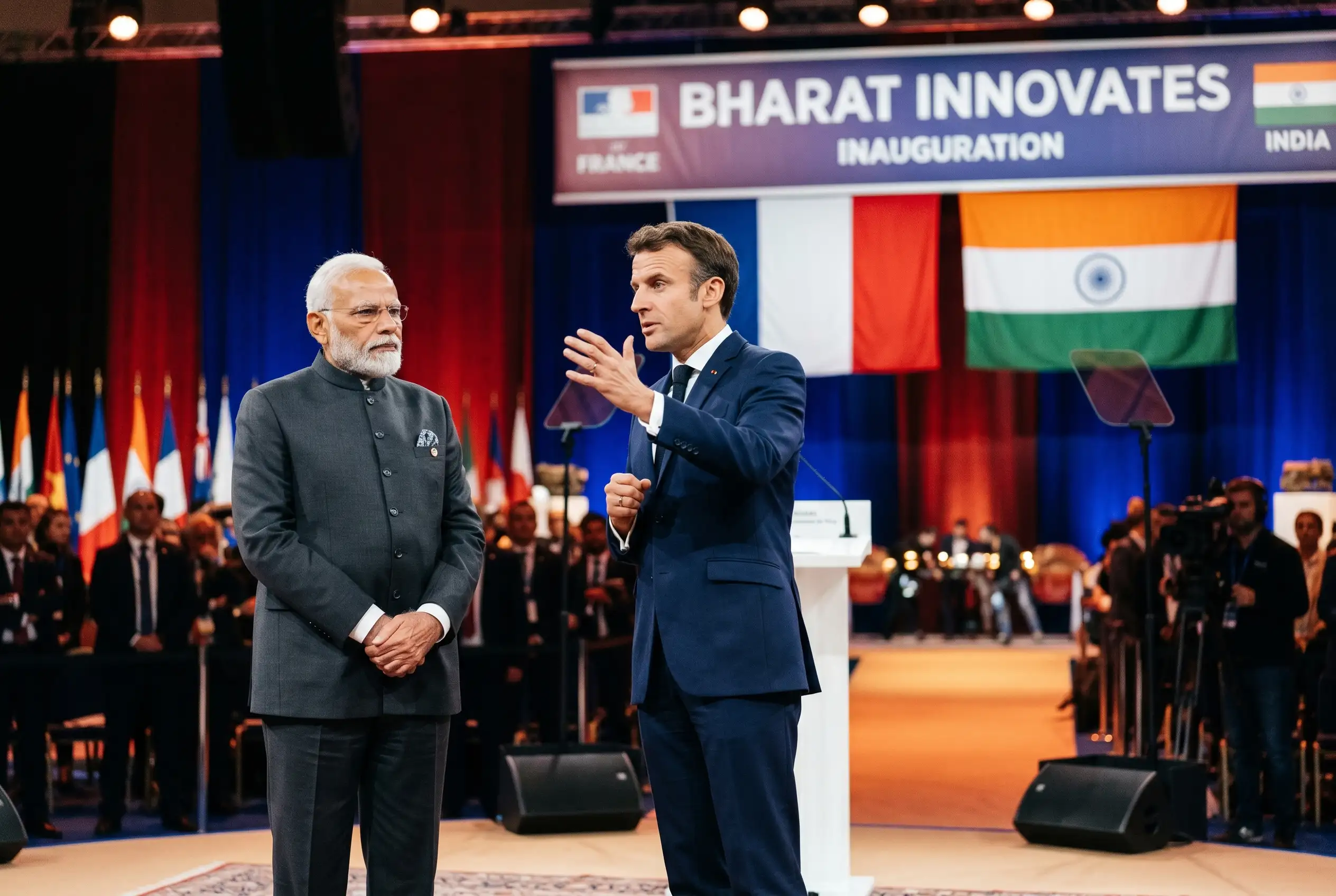
French President Emmanuel Macron and Indian Prime Minister Narendra Modi used the Bharat Innovates 2026 summit in Nice on Sunday to announce a joint France-India cooperative AI agenda, complete with an Innovation Roadmap 2030 and a new Joint India-France AI Working Group. The push came two days after a US export control directive forced Anthropic to disable its two most advanced models, Fable 5 and Mythos 5, for customers worldwide. Macron named the US move from the podium and framed the French-Indian response as the alternative.
Bharat Innovates 2026 is the first time the Indian government has staged its flagship deep-tech showcase outside India, a three-day run at the Palais des Expositions de Nice backed by India’s Ministry of Education. Macron is endorsing 120 Indian deep-tech startups and 15 higher education institutions on display, and the US curbs on Anthropic are what made the bilateral timing newsworthy.
Macron’s Cooperative AI Pitch, in Full
Macron opened the inauguration on Sunday with the line France came to Nice to deliver. “In recent days we have seen the temptation to close up the AI models and to make them a power tool and to stop any cooperation,” he said, naming the US action without naming the United States. “India and France believe in ‘true partnerships’, in multilateralism, and respect for cooperative AI,” Macron added, framing the partnership as a direct counter to AI built behind national firewalls.
Modi widened the frame. The world is looking for “trusted, inclusive and human-centric technologies,” Modi said, and at moments of geopolitical churn “the world seeks trusted and reliable partners, and that is what India brings to the table.” Commerce and Industry Minister Piyush Goyal made the connection more direct in his introductory remarks, telling the audience that “right now, the upheaval in geopolitics is meeting the upheaval in technology.” Goyal’s framing matters because it is the first time an Indian cabinet minister has explicitly tied the two upheavals together on a public stage.
Macron went further on France’s own positioning. He claimed France was the only country whose development of LLMs (Large Language Models, a type of AI) could compete with that of China and the U.S., and he added: “India is not a country full of contractors alone but a country of innovation and technological disruption.”
Bharat Innovates is an invitation to the world to co-create the next chapter of global innovation with India.
That was Modi at the Bharat Innovates 2026 inauguration in Nice on June 14, 2026, with the line designed to land with European investors in the room. The crowd had been primed by Macron’s earlier “cooperative AI” framing, and Modi’s invitation extended the same logic to the Indian side.
Eleven high-level panel discussions, masterclasses, and B2B matchmaking sessions are scheduled across the three days, with the G7 Summit opening in Évian-les-Bains on Monday. The Bharat Innovates Innovation Pavilion showcased 120 cutting-edge technologies across AI, semiconductors, biotechnology, healthcare, energy, advanced manufacturing, mobility, and space, with 50+ startups running investor pitch sessions, per the official release on the Bharat Innovates 2026 launch in Nice. Macron used his speech to make the case for France as an AI partner.
The Anthropic Trigger Behind the Cooperative AI Pitch
On Friday, June 12, 2026, the US made a move that turned a routine bilateral into a US-vs.-the-rest framing, two days before the Nice summit. Commerce Secretary Howard Lutnick sent a letter to Anthropic CEO Dario Amodei that day, telling him the company’s Fable 5 and Mythos 5 models would be subject to export controls to any location outside the US and to all foreign persons within the country, per the Lutnick letter to Anthropic and the rationale behind it.
- February 17, 2026: Macron and Modi launch the 2026 India-France Year of Innovation in Mumbai and elevate ties to a “Special Global Strategic Partnership.”
- Early June 2026: The Trump administration releases an executive order on pre-deployment testing of advanced AI models, voluntary and avoiding a licensing regime.
- Friday, June 12, 2026: Commerce Secretary Howard Lutnick sends a letter to Anthropic CEO Dario Amodei, ordering export controls on Fable 5 and Mythos 5.
- Friday, June 12, 2026 (evening): Anthropic disables the two models for all customers worldwide and calls the action a “misunderstanding.”
- Sunday, June 14, 2026: Macron and Modi jointly inaugurate Bharat Innovates 2026 in Nice, announce the Innovation Roadmap 2030 and the Joint AI Working Group.
Anthropic’s understanding, per the company, is that the Commerce Department acted after another company demonstrated a method of bypassing, or “jailbreaking,” Fable 5’s safeguard against software-vulnerability discovery. Anthropic says the government provided only “verbal evidence of a potential narrow, non-universal jailbreak,” which the company has reviewed and disputes as cause for a global suspension. The company was forced to cut off the two models for all customers, including its own foreign-national staff, to comply with the licensing requirement.
There is no fixed end date for the directive, but the US framing is not permanent. Per Axios, an administration official said the model needs to remain locked down “until the U.S. government’s national security apparatus is hardened,” and that this “could happen in the next few weeks.” Anthropic says it is “working to restore access as soon as possible” and calls the action a “misunderstanding.” Anthropic also noted that the level of capability displayed in the disputed report “is widely available from other models (including OpenAI’s GPT-5.5), and is used every day by the defenders who keep systems safe.” If the capability is widely available, the US restriction does not bind the rest of the world, which is the space the India-France partnership is now positioning itself in.
What the Innovation Roadmap 2030 Actually Commits To
The Innovation Roadmap 2030 is the operative document behind the rhetoric. Adopted at the Nice bilateral talks on Sunday, it sets a long-term direction for India-France cooperation in technology, with the Joint India-France AI Working Group as its first concrete deliverable. Per the Indian government press release, the two sides also noted the signing of 19 agreements between entities in the two countries’ innovation networks, covering research, training, and joint projects, per the Innovation Roadmap 2030 and the 19 signed agreements.
Outside the AI file, the roadmap couples to a trade target. The two sides agreed to set up a High-Level Mechanism to double bilateral trade within five years, Foreign Secretary Vikram Misri told reporters in Nice. A separate Dialogue on Economic Security will focus on critical minerals and supply chain resilience, picking up a thread the two governments have been pulling since the February 2026 joint statement renamed their partnership a “Special Global Strategic Partnership.”
AI Working Group and the 19 Agreements
The Joint AI Working Group is the institutional peg under the cooperative AI label, and the 19 signed agreements give it operational weight. The 19 agreements sit across Indian and French universities, startups, and research bodies, and cover AI, semiconductors, biotechnology, healthcare, energy, advanced manufacturing, mobility, and space. The Innovation Roadmap 2030 is calibrated to India’s New Education Policy, with Modi inviting French universities to open campuses in India. The combined package turns the cooperative AI label into a pipeline of joint projects with budget lines attached.
Trade Targets and the Critical Minerals Push
Set against a recent baseline, the trade target runs alongside the Economic Security Dialogue. The two sides called for early implementation of the India-EU Free Trade Agreement, which was signed in February this year, as the underlying enabler. The Economic Security Dialogue slots critical minerals in alongside semiconductors and pharmaceuticals, three categories the US-China rivalry has already put under stress. Modi separately thanked Macron for the speedy implementation of visa-free transit for Indians at French airports, a small but visible cut in friction for Indian researchers and investors heading to France.
What India Brings to the France-India AI Plan
The Indian side brought a real constituency to Nice. Macron used his opening address to congratulate Modi on becoming “the Prime Minister with the longest serving time since the Independence of India,” a milestone Modi hit in the days before the summit. The Bharat Innovates 2026 platform itself is built on the 120 Indian deep-tech startups, 15 higher education institutions, and 50+ investor pitch sessions the Indian Ministry of Education assembled for the three-day run.
At the same podium, Modi reframed India as a net exporter of innovation, not a back office for it. “India now acts as a solution contributor rather than a solution consumer,” he told the audience, a line designed to land with the European investors in the room. Citing the Chandrayaan-3 Lunar mission of 2023, Macron said it demonstrated not just Indian innovation but “also industrial application.” France is offering capital, talent, and access to the EU single market; India is offering the engineering depth and the scale.
On the French side, the case rests on a hiring stat. Per a LinkedIn study reported by Les Échos at the VivaTech fair and cited by Euronews, France is the EU country that has created the most jobs in artificial intelligence, with nearly 20,000 AI-related positions created in Paris since 2023, more than Berlin, Madrid, Munich, or Dublin. Macron’s bigger claim, that France is “the only country whose development of LLMs (Large Language Models, a type of AI) could compete with that of China and the U.S.,” is more contested. The Bharat Innovates 2026 partnership is the mechanism to operationalize that claim by tying French model training to Indian data and deployment, but the technical deliverables in the Innovation Roadmap 2030 are still aspirational.
What the Restrictions Mean for Anthropic and the Global AI Stack
Anthropic is fighting the directive in public, not in court. The company called the action a “misunderstanding” in a Friday night post on X, said it was “working to restore access as soon as possible,” and laid out a public case against the rationale, in Anthropic’s full statement on the Fable 5 and Mythos 5 directive. Anthropic’s own review of the underlying report the government cited says the capability shown “is widely available from other models (including OpenAI’s GPT-5.5),” and the company argues that “if this standard was applied across the industry, we believe it would essentially halt all new model deployments for all frontier model providers.”
For Anthropic, the timing is brutal. The company confidentially filed for a US IPO last month, edging ahead of rival OpenAI in the race to reach public markets, per the Guardian. The Pentagon had already placed Anthropic on a supply chain blacklist, set to take effect later in the year, after Anthropic refused to let the US military use its AI models for domestic surveillance and fully autonomous weapons. The export-control directive is the second front in a fight that has now spread to the Commerce Department.
We are complying with the government’s legal directive and are removing access to Fable 5 and Mythos 5 for all users.
That was Anthropic, in a statement published the evening of June 12, 2026, hours after the Commerce Department directive. The compliance language sits alongside Anthropic’s public disagreement with the rationale for the directive, which the company has framed as a “misunderstanding.”
The second-order effect is the one Macron is building on. The US is escalating from controlling the chips that train AI to controlling the AI systems themselves, with Commerce imposing a licensing regime that White House chief AI adviser David Sacks had negotiated to keep voluntary. The Bharat Innovates 2026 announcement lands in the middle of that tug-of-war, with Macron and Modi openly positioning cooperative AI as the alternative when the largest US lab is no longer accessible to half the world. For context on the Fable 5 launch and the Mythos-class tier, see Claude Fable 5’s June 9 launch and the Mythos-class framing.
What ‘Cooperative AI’ Still Has to Prove
The Nice announcements are real, but they sit on top of a 15-year history of Indian nuclear projects still in negotiation. Foreign Secretary Misri confirmed in Nice that discussions between French power giant EDF and the Nuclear Power Corporation of India Limited for the six-reactor Jaitapur nuclear power plant “were still on-going.” The Jaitapur file has been under discussion for more than 15 years, per the Hindu, a reminder that India-France joint projects have a long planning horizon and a slow execution record. The 19 signed agreements at Bharat Innovates 2026 are smaller in dollar terms than Jaitapur, EDF, or even the 114 Rafale jets France is offering to build under Make in India, and most of their value depends on funding that has not yet been committed.
Macron’s policy frame also rests on a technical claim France has yet to deliver. The French LLM ecosystem is the strongest in the EU by Macron’s own count, but the country has not yet produced a frontier large language model with the global reach of OpenAI’s GPT-5.5 or Anthropic’s Claude Opus 4.8, the two systems Macron’s LLM claim implicitly competes with. Until the Innovation Roadmap 2030 names a specific model, dataset, or training-compute arrangement, the policy frame is still aspirational, and the Bharat Innovates 2026 summit was a political launch.
Frequently Asked Questions
What is Bharat Innovates 2026?
Bharat Innovates 2026 is the first edition of India’s flagship deep-tech showcase to be staged outside the country, running from June 14 to 16, 2026 at the Palais des Expositions de Nice. Organized by the Government of India as an initiative of the Union Ministry of Education, the three-day event brought 120 Indian deep-tech startups and 15 Indian higher education institutions to Nice, alongside 11 high-level panel discussions, 50+ investor pitch sessions, masterclasses, and curated B2B matchmaking meetings.
Why did the US suspend access to Fable 5 and Mythos 5?
US Commerce Secretary Howard Lutnick sent a letter to Anthropic CEO Dario Amodei on Friday, June 12, 2026, putting Fable 5 and Mythos 5 under export controls to any location outside the US and to all foreign persons within the country. The trigger, per an Axios report, was another company demonstrating a method of “jailbreaking” Mythos. Anthropic says the underlying capability “is widely available from other models (including OpenAI’s GPT-5.5)” and that the government provided only “verbal evidence of a potential narrow, non-universal jailbreak.”
What is the India-France Innovation Roadmap 2030?
The Innovation Roadmap 2030 is the long-term cooperation framework that Macron and Modi adopted at their bilateral talks in Nice on June 14, 2026, building on the India-France Year of Innovation that the two leaders launched in Mumbai on February 17, 2026. Its core deliverables are a Joint India-France AI Working Group, 19 agreements signed between Indian and French entities in the innovation networks, a High-Level Mechanism to double bilateral trade within five years, and a Dialogue on Economic Security focused on critical minerals and supply chain resilience.
Is the Anthropic Fable 5 and Mythos 5 suspension permanent?
Not necessarily. Per Axios, an administration official said the models need to remain locked down “until the U.S. government’s national security apparatus is hardened,” and that this “could happen in the next few weeks.” Anthropic has disputed the directive publicly, calling it a “misunderstanding.” Until then, Fable 5 and Mythos 5 remain disabled for all customers worldwide, per Anthropic’s compliance statement.
How big is the AI workforce France is bringing to the partnership?
France is the EU country that has created the most jobs in artificial intelligence, according to a LinkedIn study reported by Les Échos at the VivaTech fair and cited by Euronews. Nearly 20,000 AI-related positions have been created in Paris since 2023, more than the comparable totals in Berlin, Madrid, Munich, or Dublin. Macron has separately claimed that France is “the only country” outside the US and China whose LLM development can compete at the frontier, and the 20,000 figure is the labour-market evidence behind that claim.


Gen Z’s Flight From Smartphones Is Spreading Fastest on TikTok

Aakhar App Launches to Preserve Uttarakhand’s Endangered Languages

Samsung’s Galaxy A27 Price Jump Traces Back to a Chip Shortage

ZOTAC RTX 5090 SOLID Catches Fire Near the PCIe Slot, Not the Cable

StepFun’s STEPX Neo Debuts as an AI Phone With Doubao’s Old Problem

Halo Studios Cancels Project Ekur Amid Leadership Abuse Claims

Sandisk Stock Sinks 8% as Wall Street Keeps Raising Price Targets

VCT Pacific Bans Crypto Sponsors, but Riot Keeps One Exception

A New 133-Study Review Finds Video Games Boost the Brain, Barely

XRP Tests $1 Support a Year After Ripple’s SEC Victory

Google Search Profiles Build a Follow Graph Inside Discover

Microsoft Xbox Layoffs Start in July as Sharma Slams 3% Margin

Oracle Cuts 21,000 Jobs in a Year, Cites AI in 10-K Filing

Oppo’s ColorOS 17 Eligibility List Leaves A-Series Buyers Behind

Google DeepMind and A24 Sign $75 Million AI Partnership Deal

OCC Issues AML Consent Order Against Wise and Crypto.com Sponsor Bank

Meta’s Iris AI Chip Enters Production in September, Tests Clean

DGO App Brings Rs 549 Mobile Pass for FIFA World Cup 2026 in Nepal

Anthropic Tells Senators Alibaba Ran the Largest Claude Distillation Attack

Apple Strikes Preliminary Deal For Intel To Make iPhone And Mac Chips
-
 NEWS1 month ago
Google Search Profiles Build a Follow Graph Inside Discover
-
 GAMING1 month ago
Microsoft Xbox Layoffs Start in July as Sharma Slams 3% Margin
-
 AI3 weeks ago
Oracle Cuts 21,000 Jobs in a Year, Cites AI in 10-K Filing
-
 NEWS1 month ago
Oppo’s ColorOS 17 Eligibility List Leaves A-Series Buyers Behind
-
 AI3 weeks ago
Google DeepMind and A24 Sign $75 Million AI Partnership Deal
-
 AI5 days ago
Meta’s Iris AI Chip Enters Production in September, Tests Clean
-
 CRYPTO2 months ago
OCC Issues AML Consent Order Against Wise and Crypto.com Sponsor Bank
-
 APPS1 month ago
DGO App Brings Rs 549 Mobile Pass for FIFA World Cup 2026 in Nepal