
CRYPTO
OKX Brings Gold to Event Contracts, First TradFi Underlying
OKX launched the XAU (Gold) Event Contract on June 16, 2026, the first event contract with a TradFi asset. Settlement uses a 1-minute arithmetic mean.

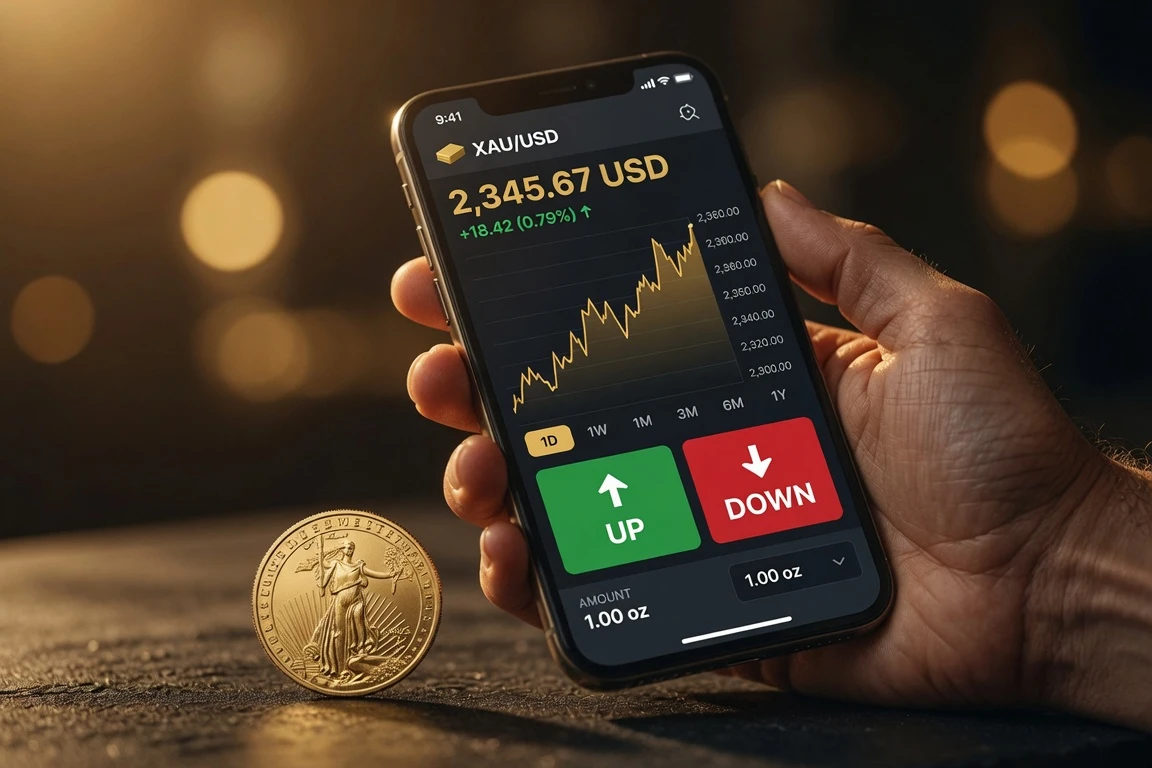
OKX launched XAU (Gold) Event Contracts on its New Money App on June 16, 2026, becoming the first venue to put a traditional-finance asset through its binary event-contract format. Users buy Up or Down shares starting at 0.01 USDT, with each winning share redeemable for up to 1 USDT at settlement. OKX filed the public announcement on June 15, 2026.
Until now, OKX event contracts settled only against crypto pairs: BTC, ETH, and SOL trades resolved against a USDT index on a 24/7 market. Gold changes the boundary. The XAU contract settles against the OKX XAU-USDT Spot Index, and the exchange has written a separate rule book to handle gold’s fixed trading hours, holiday calendar, and unscheduled halts. Those rules are the most detailed OKX has published for any event-contract market, and they show how much crypto plumbing had to bend to fit a TradFi asset.
First Event Contract With a TradFi Underlying
OKX describes the XAU contract as “the first event contract with a traditional finance (TradFi) asset as its underlying,” according to its Event Contracts FAQ. The product went live on June 16, 2026, a day after OKX filed the public announcement on June 15, 2026. The launch extends a product line that, until now, listed only crypto pairs.
Event contracts are binary outcome trades. Buyers pick a direction (Up or Down), pay the current quote in USDT, and collect 1 USDT per share if the contract settles in their favor. If they pick the wrong direction, the share becomes worthless and no settlement fee is charged. Each contract represents a specific numerical question, such as whether an index will be above or below a target at a set time.
How the Settlement Price Gets Built
The XAU contract’s settlement price is the arithmetic mean of OKX XAU-USDT Spot Index close prices, sampled once per second, across the one-minute window right before the daily reference time of 5:00:00 PM U.S. Eastern Time. That window produces 60 data points, which are then averaged and rounded to four decimal places. OKX says the design is meant to “mitigate the impact of short-term price manipulation on the settlement outcome,” per its complete XAU Contract Rules.
The reference time observes daylight saving automatically, switching between EST and EDT without manual intervention. The rule book uses the index open at 5:00:00 PM ET as the target price for Daily Up/Down contracts, which means the target is set at the moment the settlement window opens. Gold’s underlying TradFi market closes earlier than 5:00 PM ET, leaving the final 60-second window to draw from after-hours and overnight pricing.
OKX’s crypto event contracts settle against the live index throughout the day, with no separate averaging window. The XAU rule book splits that model in two: one price marks the target, and a separate averaged price decides the outcome. The arithmetic mean is the contract’s most consequential parameter, because every trader’s P&L flows from where that number lands.
| Element | XAU Event Contract Specification |
|---|---|
| Underlying index | OKX XAU-USDT Spot Index |
| Reference time | 5:00:00 PM ET (observes EST/EDT) |
| Window | 1 minute before reference time |
| Data points | 60 (one per second) |
| Settlement price | Arithmetic mean of per-second closes |
| Rounding | 4 decimal places |
A user who buys one Up contract at the minimum price of 0.01 USDT risks 0.01 USDT and stands to receive 1 USDT if Up settles. The inverse for a Down contract at 0.99 USDT: 0.99 USDT risked, with 0.01 USDT returned on a correct call. Quotes sit between 0.01 and 0.99 USDT in 0.01-USDT ticks, and the mid-price approximates the market’s probability estimate for the direction.
Two Ways to Bet on Gold’s Day
OKX offers two XAU contract shapes: Daily Up/Down and Daily Above. Both settle once a day against the same one-minute averaged window. They differ in how the winning side is determined.
Daily Up/Down uses the index open at 5:00:00 PM ET as the target. If the averaged settlement price is above the target, Up wins. If it is below, Down wins. If the two are equal after rounding, Up is the declared outcome. Daily Above uses a strike price that OKX publishes at listing; settlement at or above the strike pays Up, settlement below it pays Down.
The TradFi Calendar Forces New Rules
Crypto event contracts trade 24/7 with no scheduled downtime. XAU does not, because gold’s underlying TradFi market closes on weekends and U.S. listed holidays. OKX references what it calls the XCEC Holiday Calendar to flag scheduled non-trading days. Contracts whose expiry would fall on a non-trading day are not listed in the first place.
The rule book draws a sharp line between scheduled and unscheduled closures. A known XCEC or Pyth holiday is Case A: the contract is pre-emptively excluded at the listing layer and never trades. A whole-day unscheduled closure (Case B) cancels the affected trading day and routes settlement to the most recent prior trading day’s averaged window. An early close (Case C) pulls the averaging window back to right before the early-close time. A mid-session halt or system incident (Case D) uses the longest available tradeable window before the halt, subject to OKX’s data-quality rules.
Three of the four cases (B, C, and D) all flow into the same dispute review process. Only Case A is excluded at listing. Each case has a defined settlement price determination, but the exchange reserves the right to pause settlement and review when the data looks abnormal.
Dispute Triggers and Manual Settlement
OKX’s rules treat any settlement where fewer than 50% of the required per-second data points are usable as a dispute trigger. The threshold means fewer than 30 of the 60 one-second closes inside the window. When that happens, settlement is paused and an independent review decides the final price.
Disputes can also be triggered manually, either by an automated risk rule or a user complaint ticket. Once triggered, a multi-round review is conducted, and an authorized operator enters the final settlement price, the reference timestamp, and the reason for any manual settlement. The platform then re-credits positions, cancels resting orders, and closes the affected market.
For every contract settled under the manual or early settlement procedure, OKX commits to a public announcement. The announcement covers the affected contract, the reason for the adjustment, the settlement price, and how open orders and open positions were treated. The exchange reserves the right to suspend settlement or adjust parameters without prior notice, citing market risks.
The dispute machinery is heavier than what OKX’s crypto event contracts use, where the underlying market runs continuously and a one-second snapshot is normally enough to settle. XAU introduces a window where stale prices, halts, and holidays can all break the data feed. The exchange’s own rule book admits the settlement price “may differ from the price at any single moment.”
- Case A (Scheduled non-trading day): Contract not listed; pre-emptively excluded at the listing layer.
- Case B (Whole-day unscheduled closure): Settlement uses the most recent prior trading day’s 1-minute window.
- Case C (Early close): Settlement window pulled back to right before the actual early-close time.
- Case D (Mid-session halt or system incident): Longest available tradeable window before the halt, subject to OKX’s data-quality rules.
Cost, Margin, and the Most You Can Lose
XAU event contract shares are priced between 0.01 and 0.99 USDT, in 0.01-USDT ticks, against a 1 USDT face value. OKX uses full margin: the buyer pays the full share price up front and cannot be force-liquidated. The maximum loss on any contract is the USDT amount paid at purchase. The maximum gain is the difference between the purchase price and 1 USDT, minus fees.
The fee schedule is unified across user tiers for now, and was updated effective May 6, 2026. The settlement rules themselves were updated May 14, 2026, OKX’s FAQ notes. No additional fees are charged at settlement beyond the standard settlement fee on winning shares.
Positions can be closed early on the order book before expiry. Selling at a price above the buy price locks in a gain; selling below locks in a loss. The exchange’s worked example: 100 Up shares bought at 0.40 USDT (cost 40.00 USDT) sold at 0.72 USDT produces a realized PnL of about +32.00 USDT before fees. Holding to expiry, with the judgment correct, pays 100 USDT before settlement fee, about +60.00 USDT before fee.
From Crypto Pairs to a Gold Index
OKX first marketed Event Contracts on the New Money App in a post centered on crypto pairs: BTC, ETH, and SOL, with five-minute and one-day expiries. The XAU launch is the first time the format has been pointed at an asset outside the crypto complex. The product page on the App Store describes OKX as “the new money app where your money moves at the speed of crypto,” now extended to a metal whose market doesn’t. The full announcement, dated June 15, 2026, sits in OKX’s public announcements feed.
OKX trades on a unified order book where Up and Down orders are auto-mapped to the opposite side via the formula (1 minus price), sharing liquidity across both directions. An Up ask at 0.66 USDT prints a Down bid at 0.34 USDT. The structure means a single trade provides depth to both sides of the binary event.
Frequently Asked Questions
What is the OKX XAU (Gold) Event Contract?
A binary outcome contract on OKX’s New Money App that pays 1 USDT per share when the trader’s Up or Down call on the OKX XAU-USDT Spot Index is correct at 5:00 PM ET, and zero when it isn’t. XAU is the first event contract OKX has listed with a traditional finance asset as its underlying.
When did OKX launch the XAU Event Contract?
OKX filed the announcement on June 15, 2026, and the XAU contract went live on June 16, 2026. Contracts expire daily at the 5:00 PM U.S. Eastern reference time, with settlement drawn from the 60 seconds before that moment.
How is the XAU Event Contract settlement price calculated?
OKX averages one OKX XAU-USDT Spot Index close per second across the 60 seconds before 5:00 PM ET, giving 60 data points that are rounded to four decimal places. Daily Up/Down compares that average to the index open at 5:00 PM ET; Daily Above compares it to a strike price published at listing.
What happens if the gold market is closed when settlement is due?
Contracts whose expiry would land on a known XCEC or Pyth holiday are not listed at all. For unscheduled closures, early closes, or mid-session halts, OKX routes settlement to the most recent prior trading day’s window, the actual early-close time, or the longest available tradeable window before the halt.
How much does an XAU Event Contract share cost?
Shares trade between 0.01 and 0.99 USDT in 0.01-USDT ticks against a 1 USDT face value. There is no leverage: buyers pay the full price up front, and the maximum loss equals the USDT paid at purchase.
Can an XAU Event Contract position be liquidated?
No. Event contract positions are full-margin and do not participate in account-level liquidation. Traders can also sell shares on the order book before expiry to lock in gains or cut losses.


Pixel 11 Prices Climb and End Google’s Bargain Era

Zuckerberg Bets Personal Superintelligence Beats Centralized AI Control

Sound Waves Bring Back the Keyboard Without Any Keys

OpenAI Loses Its Only Ethicist After a Year of Safety Exits

Samsung Smart Switch Now Lets iPhones Jump Without the App Tax

Galaxy S26 FE Price Leak Puts It Too Close to Flagships

Coforge Turns Its PE Deal Playbook Into a Nuuron Business Unit

OCBC Lets Retail Buy Platinum and Palladium From 0.01 Ounce

Xiaomi’s Safer 67W Power Banks Preview China’s 2027 Cull

Galaxy Z Fold 8 Settings That Turn Battery Gains Into Years

Fable 5 and Mythos 5 Return as US Lifts Anthropic Export Controls

Oracle Cuts 21,000 Jobs in a Year, Cites AI in 10-K Filing

SpaceX’s Google Deal Turns a Rocket Company Into a Cloud Landlord

CD Projekt Red Co-CEO: Redemption Arc Isn’t Done, Witcher 4 in 2027

XPL Rallies 30% Ahead of Plasma One Card Tier Launch

Google Search Profiles Build a Follow Graph Inside Discover

DGO App Brings Rs 549 Mobile Pass for FIFA World Cup 2026 in Nepal

Moonshot AI Targets $30 Billion in China’s Fastest AI Funding Sprint

Microsoft Xbox Layoffs Start in July as Sharma Slams 3% Margin

Oppo’s ColorOS 17 Eligibility List Leaves A-Series Buyers Behind
-
 AI1 month ago
Fable 5 and Mythos 5 Return as US Lifts Anthropic Export Controls
-
 AI2 months ago
Oracle Cuts 21,000 Jobs in a Year, Cites AI in 10-K Filing
-
 AI2 months ago
SpaceX’s Google Deal Turns a Rocket Company Into a Cloud Landlord
-
 GAMING2 months ago
CD Projekt Red Co-CEO: Redemption Arc Isn’t Done, Witcher 4 in 2027
-
 CRYPTO2 months ago
XPL Rallies 30% Ahead of Plasma One Card Tier Launch
-
 NEWS2 months ago
Google Search Profiles Build a Follow Graph Inside Discover
-
 APPS2 months ago
DGO App Brings Rs 549 Mobile Pass for FIFA World Cup 2026 in Nepal
-
 AI2 months ago
Moonshot AI Targets $30 Billion in China’s Fastest AI Funding Sprint