
AI
Nvidia Turns AI Compute Into a $500 Billion Asset Class
Nvidia partners with Apollo, BlackRock and peers to mobilize over $500 billion in third-party capital, making AI factories an investable infrastructure class.

Nvidia signed memorandums of understanding with Apollo, BlackRock, Blackstone, Brookfield, Goldman Sachs and KKR on August 10, 2026, to create independent compute financing platforms that aim to mobilize over $500 billion of third-party capital for AI infrastructure over time. The platforms will give the chipmaker’s customers dedicated pools of capital at attractive rates to build AI factories.
The move treats NVIDIA compute as a scarce, long-duration asset that can attract institutional money the same way power plants or toll roads once did. It arrives as capital, not just chips, has become the binding constraint on the next phase of AI growth.
The six firms already manage trillions in assets. Their role is to turn that dry powder into dedicated vehicles that underwrite AI factories as infrastructure, while Nvidia steers customers toward the pools without carrying the bulk of the debt itself.
Six Firms, Independent Platforms, One Goal
Each partner will establish its own financing platform. Nvidia will match customers that need computing capacity with those pools. The capital targets AI labs, enterprises and AI cloud providers across the company’s ecosystem. Final agreements are still required, so the $500 billion figure remains a ceiling rather than committed cash.
| Firm | Stated Focus | Scale Marker |
|---|---|---|
| Apollo | Flexible long-term capital for mission-critical compute | ~$1.05T AUM (June 30, 2026) |
| BlackRock | Connect long-term capital to essential infrastructure | AI Infrastructure Partnership deepening |
| Blackstone | Global investor across NVIDIA ecosystem | Over $1.3T AUM |
| Brookfield | Scale AI factories as core infrastructure pillar | More than $1T AUM |
| Goldman Sachs | Create market for credit backed by NVIDIA compute | Investment and distribution roles |
| KKR | Long-duration capital plus infrastructure delivery | Helix Digital Infrastructure founding investor link |
Apollo President Jim Zelter called modern compute a “scarce, mission-critical asset class.” Blackstone President and COO Jon Gray said the firm remains an enormous investor across the NVIDIA ecosystem. The structure keeps the platforms independent so the capital sits outside Nvidia’s own balance sheet.
Independence matters for both sides. Each firm can set its own underwriting standards, hold periods and risk appetite. Nvidia keeps the matching role and the ecosystem pull without consolidating the platforms as captive finance arms. That separation is what lets pensions, insurers and other long-duration holders treat the exposure as infrastructure credit rather than vendor paper.
Why Capital Turned Into the Chokepoint
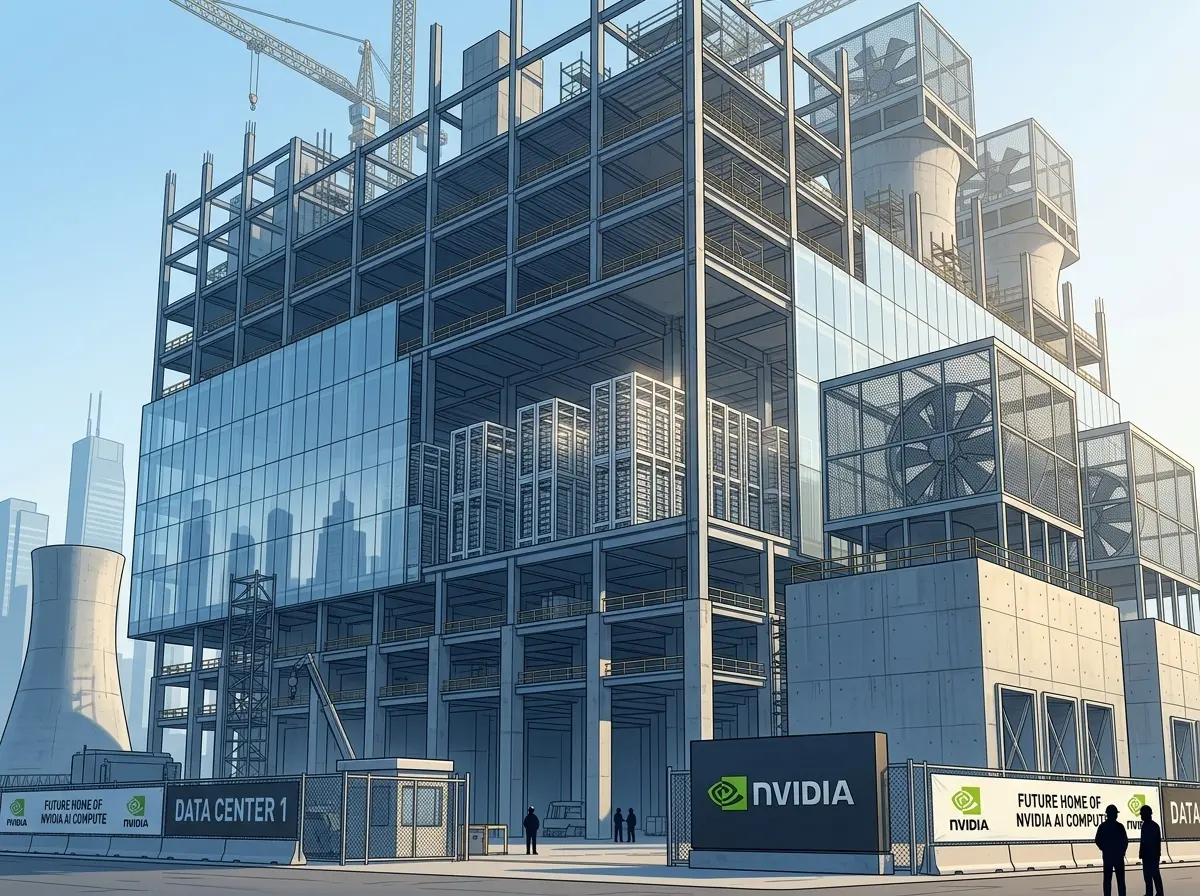
Building an AI factory requires far more than GPUs. Land, power generation and transmission, cooling, networking and skilled labor multiply the bill. McKinsey research projects companies will need $5.2 trillion in AI data-center capital by 2030, part of a wider $6.7 trillion compute-power outlay. That figure assumes roughly 125 incremental gigawatts of AI-related capacity.
- Hyperscaler consensus: Wall Street analysts now put 2026 capital spending for the big AI cloud builders near $527 billion, already revised higher several times.
- Historical comparison: Goldman Sachs Research notes AI capex still sits below prior tech-boom peaks relative to GDP; $700 billion in 2026 would match late-1990s telecom intensity.
- Funding mix: Outside capital is expected to cover more than half of additional hyperscaler compute needs in the coming years, with private credit taking a large share.
Cash-rich hyperscalers can still self-fund. Many frontier labs, enterprises and pure-play AI clouds cannot write multi-billion-dollar checks without leverage. That gap threatened to slow purchases of Nvidia systems even while demand stayed strong. The platforms attack the gap directly.
Put beside one another, the headline figures show why a single supplier’s balance sheet could never close the gap alone.
| Measure | Scale |
|---|---|
| Platform capital target over time | Over $500 billion |
| Hyperscaler 2026 capex consensus | Near $527 billion |
| AI data-center capital need by 2030 | $5.2 trillion |
| Wider compute-power outlay | $6.7 trillion |
| Telecom-intensity benchmark for 2026 | $700 billion |
The platforms are sized against the near-term financing hole, not the full multi-trillion path to 2030. Even so, mobilizing more than half of incremental hyperscaler compute needs from outside capital would mark a structural shift in who funds the buildout.
Compute Is Revenue, and Now an Asset
We began by building chips; today, we are helping create a new class of productive, investable infrastructure: AI factories. In AI, compute is revenue.
Nvidia founder and CEO Jensen Huang said the company’s compute is broadly adopted, flexible across models, fungible across customers and continuously improved through CUDA software, which extends useful life and improves economics. That combination, he argued, makes it uniquely suited for long-term institutional underwriting.
BlackRock Chairman and CEO Larry Fink said the AI buildout requires “unprecedented investment” and a skilled workforce. Goldman Sachs Chairman and CEO David Solomon framed the moment as a historic investment cycle and said Nvidia’s position can help create “a market for credit backed by NVIDIA compute.” Brookfield CEO Bruce Flatt called compute “the essential layer of infrastructure.” KKR Co-CEOs Joe Bae and Scott Nuttall pointed to delivery, not ambition, as the hard part and linked the work to their Helix Digital Infrastructure effort.
The second-order shift is financial. Once compute carries usage-linked revenue streams and residual value support, it can be packaged, rated and held by pensions, insurers and sovereign funds the way other infrastructure already is. Nvidia sits at the center of that packaging without putting the bulk of the capital on its own books.
Fungibility across customers is the underwriting hinge. A pool that can be reassigned when one offtaker slows is easier to rate than a single-tenant box of hardware. CUDA’s continuous improvement story is meant to support residual value over a longer hold. Together those traits are what the partners are selling to institutions that already own toll roads and power plants.
Nvidia Already Put Its Own Capital In
The platforms sit on top of earlier direct bets that already blurred the line between supplier and financier.
- September 2025: Nvidia announced plans to invest up to $100 billion in OpenAI progressively as OpenAI deployed at least 10 gigawatts of Nvidia systems.
- January 2026: Nvidia invested $2 billion in AI cloud company CoreWeave to support more than 5 gigawatts of AI factories by 2030.
- Earlier structure: Nvidia acted as anchor limited partner in a financing vehicle supporting a $5.4 billion data-center transaction involving xAI and Nvidia GPUs.
- August 2026: Reports detailed Nvidia’s planned up to $3 billion Lancium power stake tied to the Stargate campus, showing the company is also buying into the energy layer.
Those moves kept demand flowing when customers needed balance-sheet help. The new platforms scale the same logic through third-party capital and reduce Nvidia’s direct cash outlay while still steering the infrastructure toward its stack.
The pattern is consistent. Direct equity and anchor LP stakes proved demand could be financed. The August memorandums push the heavier lifting onto Apollo, BlackRock, Blackstone, Brookfield, Goldman Sachs and KKR so Nvidia can reserve its own cash for selective anchors and the power layer rather than every factory in the queue.
Power Constraints and the Circularity Question
Capital is only one bottleneck. Electricity is the other. Data-center power demand is climbing so fast that energy markets themselves are responding with record energy IPOs chasing AI power demand. Without firm interconnection and generation, even fully funded GPU clusters sit idle.
Market reaction on the announcement day included a dip in Nvidia shares. Some traders and analysts treated the news as confirmation of concentration risk rather than pure upside. On X and in market commentary, the sharpest skepticism focused on circularity: when a supplier helps arrange financing for buyers of its own products, reported demand can look stronger than organic cash-paying demand. Residual-value support or guarantees, if present in final terms, would amplify that loop.
- MOUs are not term sheets; committed capital and first closes remain ahead.
- Utilization rates and token revenue must ultimately service the debt.
- Power delivery timelines can stretch years past financing closings.
- If AI revenue growth slows, private-credit holders absorb more of the stress than pure equity investors once did.
Nvidia and the partners frame the platforms as independent underwriting of a productive asset. The structure still leaves utilization and power as residual risks that now sit more heavily with long-duration capital providers.
The Lancium stake tied to Stargate shows Nvidia already treats electrons as part of the same problem set as GPUs. Financing platforms that ignore interconnection queues will still strand capital. That is why delivery language from KKR and power-market responses sit beside the capital headlines rather than behind them.
What Changes for Customers and the Credit Markets
Customers gain access to larger, longer-duration pools at rates the platforms claim will be attractive. Frontier labs and AI clouds that previously stretched corporate credit or equity can match multi-year offtake agreements with matching finance. Enterprises that want on-premises or dedicated capacity without full balance-sheet ownership get a clearer path.
For the credit markets the platforms try to create a new reference asset: NVIDIA compute backed by CUDA stickiness, multi-model flexibility and a deep offtaker ecosystem. Goldman’s Solomon explicitly mentioned a market for that credit. If the first deals clear and performance data accumulates, more managers can enter and secondary trading can develop.
Hyperscalers with strong free cash flow remain free to self-fund. The platforms matter most for everyone else and for the speed at which total installed capacity can grow. McKinsey’s scenarios show that even the base case requires trillions; the Goldman hyperscaler 2026 capex consensus near $527 billion already assumes heavy spending. Outside capital is the difference between that spending happening on schedule or slipping.
Attractive rates only hold if the asset behaves. Lenders will watch utilization, token-linked revenue and residual values on Nvidia systems as the real covenants. Customers that can show diversified offtake and secured power will clear first. Those that cannot will still face expensive or unavailable leverage, platforms or not.
Platforms Package Compute for Long-Term Investors
The product the six firms are building is familiar in infrastructure and new in AI. Long-duration capital wants contracted or contracted-like cash flows, a path to residual value, and an operator ecosystem deep enough to remarket capacity if one tenant falters.
Huang’s framing supplies the pitch in four traits already on the record:
- Broad adoption across labs, enterprises and AI clouds, widening the offtaker base.
- Flexibility across models, so hardware is not stranded on a single training recipe.
- Fungibility across customers, supporting re-leasing and pool-level recovery.
- CUDA-driven life extension, which is meant to protect economics over a longer hold.
Goldman Sachs brings investment and distribution muscle aimed at a market for credit backed by that stack. BlackRock stresses connecting long-term capital to essential infrastructure. Apollo emphasizes flexible long-term capital for mission-critical compute. Brookfield treats AI factories as a core infrastructure pillar. KKR pairs capital with delivery through its Helix Digital Infrastructure link. Blackstone remains a global investor across the NVIDIA ecosystem with over $1.3T in AUM behind it.
None of that converts an MOU into a rated bond. First closes, disclosed covenants and observed utilization will decide whether pensions and insurers treat NVIDIA compute like other infrastructure or like venture risk with a longer tenor.
Outside Capital Shifts Who Carries Buildout Risk
When more than half of additional hyperscaler compute needs are expected to come from outside capital, and private credit takes a large share, stress migrates. Equity holders once absorbed more of a slowdown inside a single corporate balance sheet. Long-duration credit holders now stand closer to utilization shortfalls and power delays.
That shift is the point of the structure for Nvidia. Earlier checks (up to $100 billion progressive for OpenAI against at least 10 gigawatts, $2 billion into CoreWeave toward more than 5 gigawatts by 2030, an anchor LP role on a $5.4 billion xAI-related transaction, and the planned Lancium power stake up to $3 billion) kept selected projects alive on Nvidia’s own capital. The platforms extend the same demand support across AI labs, enterprises and AI cloud providers while leaving underwriting losses, if any, with the independent vehicles.
Circularity concerns will track the fine print. If residual-value support or related guarantees appear in final terms, reported demand and financed demand will be harder to separate. If the platforms truly underwrite on stand-alone asset performance, institutional holders bear more honest infrastructure risk. The memorandums do not settle that question. Term sheets will.
The Platforms Will Be Judged by Delivery
Nvidia began as a chip company. It now designs the full stack, invests in key customers and power developers, and brokers the institutional capital that buys the factories. The $500 billion target is the largest single financing ambition attached to AI infrastructure to date. It is also still a set of memorandums.
The second-order outcome is already visible in the language: compute is revenue, compute is an asset class, credit can be backed by NVIDIA systems. Whether that language hardens into durable cash flows depends on final legal documents, first capital calls, energized megawatts and actual utilization. Private credit has taken the seat next to the GPU. The next test is whether the factories earn enough to keep both comfortable.


Samsung Smart Switch Now Lets iPhones Jump Without the App Tax

Galaxy S26 FE Price Leak Puts It Too Close to Flagships

Coforge Turns Its PE Deal Playbook Into a Nuuron Business Unit

OCBC Lets Retail Buy Platinum and Palladium From 0.01 Ounce

Xiaomi’s Safer 67W Power Banks Preview China’s 2027 Cull

Galaxy Z Fold 8 Settings That Turn Battery Gains Into Years

PlayStation Discount Codes Hide a Stickier Savings Trap

Free Fire Max Codes Today Feed the Free Tier and the Scammers

Kazakhstan Crypto Amnesty Feeds State Reserve Machine

Nvidia Turns AI Compute Into a $500 Billion Asset Class

Fable 5 and Mythos 5 Return as US Lifts Anthropic Export Controls

Oracle Cuts 21,000 Jobs in a Year, Cites AI in 10-K Filing

SpaceX’s Google Deal Turns a Rocket Company Into a Cloud Landlord

CD Projekt Red Co-CEO: Redemption Arc Isn’t Done, Witcher 4 in 2027

XPL Rallies 30% Ahead of Plasma One Card Tier Launch

DGO App Brings Rs 549 Mobile Pass for FIFA World Cup 2026 in Nepal

Google Search Profiles Build a Follow Graph Inside Discover

Moonshot AI Targets $30 Billion in China’s Fastest AI Funding Sprint

Microsoft Xbox Layoffs Start in July as Sharma Slams 3% Margin

Oppo’s ColorOS 17 Eligibility List Leaves A-Series Buyers Behind
-
 AI1 month ago
Fable 5 and Mythos 5 Return as US Lifts Anthropic Export Controls
-
 AI2 months ago
Oracle Cuts 21,000 Jobs in a Year, Cites AI in 10-K Filing
-
 AI2 months ago
SpaceX’s Google Deal Turns a Rocket Company Into a Cloud Landlord
-
 GAMING2 months ago
CD Projekt Red Co-CEO: Redemption Arc Isn’t Done, Witcher 4 in 2027
-
 CRYPTO2 months ago
XPL Rallies 30% Ahead of Plasma One Card Tier Launch
-
 APPS2 months ago
DGO App Brings Rs 549 Mobile Pass for FIFA World Cup 2026 in Nepal
-
 NEWS2 months ago
Google Search Profiles Build a Follow Graph Inside Discover
-
 AI2 months ago
Moonshot AI Targets $30 Billion in China’s Fastest AI Funding Sprint