
CRYPTO
South Korea Forces Crypto Firms to Register Every Cross-Border Transfer

South Korea just put every cross-border crypto transfer under direct government surveillance. Lawmakers passed an amendment to the Ministry of Economy and Finance amendments to the Foreign Exchange Transactions Regulations that forces any firm moving virtual assets in or out of the country to register with the finance minister before it can operate.
The trigger isn’t theoretical. Roughly $110 billion in crypto left South Korea during 2025, almost half of it routed through stablecoins, and Seoul’s Financial Intelligence Unit (FIU) admitted it could no longer track the flows under the old forex rulebook. The new law is the regulator’s attempt to close that gap before a won-pegged stablecoin market goes live later this year.
What the Amendment Actually Does
The bill creates an entirely new business category called “virtual asset transfer services.” Any company that buys, sells, exchanges, or moves digital assets between South Korea and another country falls inside it. Registration with the Minister of Economy and Finance is mandatory before operations begin, and existing virtual asset service providers (VASPs) must re-register under the forex framework even if they already cleared the Specific Financial Information Act.
The National Assembly Strategy and Finance Committee approval of the FX law revision attached real teeth. Registered firms must build systems to relay, concentrate, and exchange transaction data with regulators in something close to real time. Authorities can revoke a registration outright, strengthen penalties on payment violations, and pull licenses from money changers operating only on paper.
Stablecoins get a specific carve-out. When used in a cross-border transaction, they will be classified as a “means of payment” under the Foreign Exchange Transactions Act, which subjects them to the same reporting obligations a traditional remittance would face.
Who Has to Register
Domestic exchanges, custody firms, and any operator running a wallet service that touches a foreign counterparty are now caught by the rule. The FIU has scheduled meetings with the major won-based platforms after the legislative notice period closes on May 11, 2026. An FIU official told local press the agency wants rules “that the industry can comply with and accept.”
That softer language masks a hard deadline. Firms that miss the registration window face license revocation, not just fines.

The $110 Billion Leak the Regulator Is Chasing
The numbers behind the law are blunt. CoinDesk’s January 2026 reporting on the $110 billion 2025 crypto outflow from South Korea tied the bulk of the movement to traders routing capital to Binance and Bybit, where dollar-denominated stablecoin pairs dominate the order books. Domestic exchanges are limited to spot trading, so anyone who wants futures or higher leverage has to leave.
- $19.5 billion in stablecoin outflows in Q1 2025 alone
- 47.3% of total crypto outflows moved through stablecoins
- 26.87 trillion won in stablecoin transfers booked in a single quarter
- 11.13 million domestic crypto investors, roughly 21% of the population
Tiger Research’s 2026 South Korea Cryptocurrency Industry Guide on retail retreat and institutional inflows recorded average daily trading volume on local exchanges falling to 5.4 trillion won, down 15% from the first half of 2025. Operating profits at the major platforms dropped 38% in the same window. Money was leaving, and so was the activity that funded the regulator’s oversight of the industry.
Bithumb Punches Back in Court
Three weeks before lawmakers approved the new transfer rules, the FIU hit Bithumb with the heaviest sanction ever imposed on a Korean won-based exchange: a 36.8 billion won fine, roughly $24.6 million, plus a six-month partial business suspension that would have blocked new customer deposits and withdrawals starting March 27.
The regulator alleged 6.65 million violations of the Specific Financial Information Act. About 3.55 million were KYC failures. Another 3.04 million were transactions the exchange should have intercepted but didn’t. CEO Lee Jae-won was named in the disciplinary action.
Judge Gong Hyeon-jin cited potential irreparable harm to the exchange if its core functions remained restricted, and accepted Bithumb’s injunction request on April 30, 2026.
The Seoul Administrative Court’s decision, detailed in CoinDesk’s coverage of the Seoul court reversing Bithumb’s six-month suspension, lets the exchange keep onboarding customers while the underlying case proceeds. The 36.8 billion won fine remains unpaid more than four weeks past the deadline, and Bithumb is expected to challenge that too. The exchange forfeited a 20% early payment discount the FIU had offered.
The Pattern Across the Big Four
Bithumb isn’t isolated. Of the four major won-based platforms targeted by the FIU’s enforcement wave, only Korbit hasn’t filed a legal challenge.
- Upbit operator Dunamu: 35.2 billion won fine and three-month partial suspension in 2025; won at first instance on April 9, 2026, with the FIU appealing
- Bithumb: 36.8 billion won fine, six-month suspension; suspension stayed on April 30, 2026
- Coinone: 5.2 billion won fine and partial suspension for KYC violations; first hearing scheduled for May 12, 2026
- Korbit: 2.73 billion won penalty plus institutional warnings; no legal challenge filed
The Dunamu first-instance ruling matters because the court noted exchanges had built compliance programs themselves “in the absence of clear regulatory guidelines.” That language reads like a warning shot. The FX amendment is partly an attempt to give those guidelines a statutory foundation before more cases land in front of judges willing to side with the platforms.
Why Stablecoins Are the Real Target
South Korea is the only major Asian jurisdiction without a dedicated stablecoin law. The country’s CoinGecko 2026 Asia stablecoin market overview noted that no won-pegged stablecoin has received regulatory approval, even as projects keep launching outside the regulatory perimeter. KRWQ went live on Coinbase’s Base network in October 2025. BDACS launched KRW1 on Avalanche in September. KakaoBank moved its own won-pegged project to active development.
Eight of South Korea’s top banks have committed to a joint won-pegged stablecoin issuance by 2026, the first coordinated move by traditional banks into the digital asset space. The Digital Asset Basic Act, proposed in April, would force any approved stablecoin to hold 100% or more reserves at banks or approved institutions and would open the door to spot crypto ETFs.
Eddie Xin, a research analyst at OSL Research, told The Block’s reporting on Japan and South Korea leading Asia’s local stablecoin push that Northeast and Southeast Asia are likely to evolve into a multi-currency stablecoin corridor over the next 18 months. “The most compelling opportunities are payments-first use cases, including cross-border payments, working-capital management and trade settlement,” Xin said.
The FX Act revision is the regulatory rail that makes that corridor governable. Without it, a won stablecoin launches into a legal vacuum where the FIU has no statutory authority to monitor the wallets receiving it abroad.
The Tax Hammer Lands in 2027
Layered on top of the registration rule is a separate fiscal squeeze. Crypto gains will be taxed starting January 1, 2027. Profits above 2.5 million won face a 22% rate, and the National Tax Service will pull transaction data directly from PwC’s Korea corporate tax summary on crypto reporting obligations covering Upbit, Bithumb, and Korbit.
The combination matters. A trader who today routes funds offshore through USDT to escape the spot-only restriction at home will, from 2027, face a domestic tax bill on those gains and a registered service provider reporting the wallet movement to the FIU under the new transfer rules. Both ends of the trade get logged.
That kind of two-front compliance picture is what some DeFi platforms have already discovered when courts demand transparency on cross-border crypto flows in unrelated proceedings, and South Korea is now writing it into statute.
What Domestic Exchanges Have to Build
The technical lift is heavier than the political language suggests. Exchanges have to stand up systems that relay transaction data, concentrate it for regulator query, and link directly into the FIU’s monitoring network. Those aren’t bolt-on compliance modules. They require redesigning how withdrawal addresses are screened, how counterparty exchanges are identified, and how off-chain context gets attached to on-chain transactions.
Personal Information Protection Commission investigators are separately probing whether Upbit, Bithumb, and others shared order book data with overseas platforms. That probe overlaps the FX revision because the new law also tightens what data crosses borders, which means firms could face conflicting privacy and reporting demands from two different regulators looking at the same transaction.
Frequently Asked Questions
When does the new registration requirement take effect?
The legislative notice period for the FX Transactions Act amendment ends on May 11, 2026, after which the FIU will meet with domestic exchanges to finalize compliance details. Firms handling overseas crypto transfers must register with the Minister of Economy and Finance before continuing operations. Watch the FSC and Ministry of Economy and Finance websites for the implementing decree, which sets the precise registration window and fee schedule.
Will I still be able to send crypto from Upbit or Bithumb to a foreign exchange?
Yes, but expect heavier friction. Domestic exchanges will pass detailed counterparty data to the FIU on every cross-border transfer. Withdrawals to non-registered overseas wallets may be delayed or rejected outright while exchanges upgrade their reporting systems. If you actively trade on Binance or Bybit, keep transaction records, exchange screenshots, and timestamps so you can answer a tax or reporting query later.
Is the 22% crypto tax already in force?
No. The 22% rate on profits above 2.5 million won begins January 1, 2027. The National Tax Service will collect data from Upbit, Bithumb, and Korbit automatically. Gains realized before that date stay outside the new regime, but losses booked now do not carry forward into the 2027 tax base, so timing of disposals before year-end 2026 matters for anyone holding large positions.
Does the law apply to peer-to-peer transfers between personal wallets?
The amendment targets companies operating virtual asset transfer services, not individuals moving funds between self-custody wallets. However, if a personal wallet interacts with a registered VASP, that VASP will report the transaction. Pure on-chain transfers between two private wallets remain outside the registration regime today, though the Digital Asset Basic Act under discussion could expand reporting to certain peer-to-peer flows above a value threshold.
What happens to the Bithumb fine if the court sides with the exchange?
The April 30, 2026 ruling only stayed the six-month suspension, not the 36.8 billion won fine. Bithumb is expected to file a separate challenge to the financial penalty. If the court eventually overturns the suspension on its merits, the fine could be reduced or vacated in parallel proceedings, but a final judgment is unlikely before late 2026 given the schedule of related cases like Coinone’s May 12 hearing.
The bigger picture for Seoul is that crypto policy has crossed from financial regulation into foreign exchange policy, and the two regimes have very different enforcement cultures. Forex law is built around prior approval and registration, not after-the-fact AML checks. That shift will reshape how every Korean platform handles a withdrawal request from now on, whether the destination is a Binance hot wallet or a wallet sitting on a friend’s phone in Bangkok.
Disclaimer: This article reports on regulatory developments in South Korea and does not constitute legal, tax, or investment advice. Cryptocurrency transactions carry significant compliance and market risks, and rules cited here are accurate as of publication and may change as implementing decrees are issued. Readers with specific exposure to Korean exchanges or cross-border transfers should consult a licensed Korean attorney or tax professional before making decisions based on the information provided.

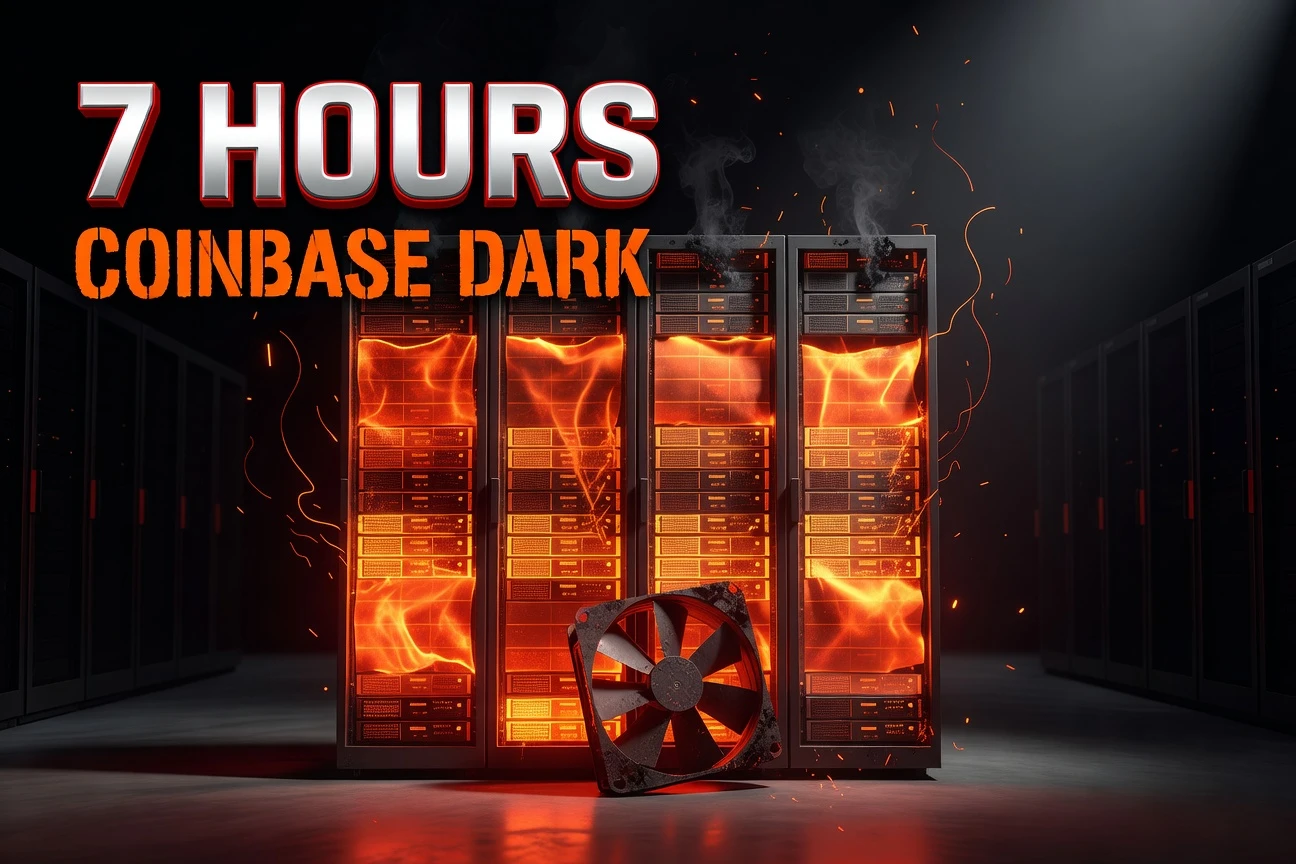
Coinbase went dark for almost seven hours on Thursday night because a room got too hot in Northern Virginia. The world’s largest U.S. crypto exchange could not match orders, settle trades, or process transfers between roughly 8 p.m. ET on May 7 and 5:29 a.m. PDT on May 8, after multiple chillers failed inside an Amazon Web Services data hall and AWS availability zone use1-az4 lost power. The timing was savage. CEO Brian Armstrong had spent Tuesday telling 700 laid-off employees that AI now does their work in days, then spent Thursday telling Wall Street that non-technical staff would soon ship code to production. Hours later, the centralized exchange he runs collapsed because of a single physical room.
The outage was confined to one of six availability zones in AWS’s US-EAST-1 region, the oldest and most heavily loaded cloud hub on the internet. Most Coinbase services rode it out. The exchange did not. Armstrong has now promised a review of the latency-versus-resilience tradeoffs that left the matching engine inside one room.
Customer funds were never at risk. The reputational damage is another story.
What Actually Broke Inside the Virginia Data Hall
AWS engineers logged the first thermal anomaly in availability zone use1-az4 at 5:25 p.m. PDT on May 7, according to the AWS Health Dashboard event archive. Multiple chillers in a single data hall failed at roughly the same time. Temperatures climbed past safe operating thresholds. Power tripped off the racks to protect the hardware. EC2 instances and EBS volumes hosted in the affected zone went down with it.
By 6:47 p.m. PDT, AWS was warning that other services depending on the impaired EC2 and EBS resources would degrade too. By 8:06 p.m. PDT, the company conceded recovery was “slower than originally anticipated” and told customers to launch in unaffected zones or restore from EBS snapshots. The Register’s running incident log shows engineers were still recovering racks more than 12 hours after the initial event, working in what AWS described as a controlled and safe manner.
This is the second physical-layer failure to take chunks of the internet offline through US-EAST-1 in seven months. An October 2025 DNS race condition inside DynamoDB knocked more than 70 AWS services and a long list of dependent platforms offline for roughly 15 hours.
The Exchange Failed Because Coinbase Designed It That Way
Here is the part most coverage glided past. AWS lost one zone out of six. The standard cloud architecture playbook says: distribute across zones, survive single-zone failure, move on. Coinbase’s general infrastructure did exactly that. The matching engine did not.
Armstrong said so himself. “Exchanges have unique architectures that optimize for latency and co-location of clients,” he wrote in a public post on X explaining the root cause. “It is possible to make exchanges resistant to AZ failures, but this can introduce latency delays that are not desirable along with breaking customer co-location.”
Translation: the matching engine sits in one zone on purpose. Institutional traders pay for co-location, the practice of parking their own servers in the same physical building as the exchange’s matching engine to shave microseconds off round-trip times. Spread that engine across three zones for fault tolerance and you slow it down. Slow it down and the algorithmic desks who generate the volume Coinbase needs go elsewhere.
So the company chose speed. That choice held up fine until a chiller failed.
Coinbase’s own initial messaging tried to widen the blame, claiming failures “across multiple AWS zones.” Amazon disputed that account directly to Decrypt, saying only one availability zone was affected. The company’s backup procedures, which are supposed to isolate exactly this scenario, did not fire automatically. Engineers ended up running disaster recovery by hand.
A Brutal Week, Compressed
Strip the AWS angle out and the calendar tells its own story.
- Tuesday, May 5: Armstrong sends a 7 a.m. email cutting roughly 700 jobs, about 14 percent of the company. System access for affected staff is revoked before some finish reading the message.
- Thursday, May 7 (after market): Coinbase posts a $394 million GAAP net loss on $1.41 billion in revenue, a 30.5 percent year-on-year decline. Earnings per share come in at a $1.49 loss against analyst expectations of a 27 cent profit.
- Thursday, May 7 (evening): AWS use1-az4 overheats. Coinbase begins logging elevated error rates across multiple services around 8 p.m. ET.
- Friday, May 8 (5:29 a.m. PDT): All markets re-enabled for trading on web and mobile after roughly six and a half hours in cancel-only or fully halted state.
The Earnings Call Quote That Aged Badly
On the same day the chiller failed, Armstrong was telling investors his vision for AI inside the company. He compared the rollout of agentic coding to self-driving cars, suggesting AI agents are “getting to a place where they’re actually safer than human drivers.”
There will be a point, I think, in the future, where nontechnical people will be able to write code, AI agents will be able to review it and check it for security, and improve the quality of it. And actually, in certain situations, have it go to production, but that’s not yet the case today.
Armstrong said this on Coinbase’s Q1 2026 conference call, captured in the company’s Q1 2026 earnings transcript. He clarified that today, human engineers still review every line before it ships, with multiple reviews on sensitive systems. The qualifier did not survive the news cycle.
The Tuesday layoff email had already lit the fuse. Armstrong wrote that engineers ship in days what used to take teams weeks, that non-technical teams are “shipping production code,” and that the goal was to rebuild Coinbase as “an intelligence, with humans around the edge aligning it.” That phrasing is preserved in Fast Company’s full-text reproduction of the layoff memo.
Then the matching engine went offline.
Gergely Orosz, the former Uber and Skype engineer who writes The Pragmatic Engineer, did the obvious thing. “Unfortunate optics for Coinbase to have an hours-long outage when customers could not trade, a few days after their CEO said how non-technical teams are shipping code to production,” Orosz wrote on X to his 310,000-plus followers. He pointed out that the dependency on a single AWS region was a deliberate engineering choice, not an accident, and called the timing “terrible advertising.”
Why Co-location Is Worth Defending Anyway
The reason exchanges chase low latency is competitive, not vain. High-frequency market makers are how a venue keeps spreads tight and order books deep. They will not co-locate against an exchange that runs its matching engine on a multi-zone architecture if it costs them a millisecond of edge. Coinbase’s own derivatives connectivity documentation confirms the platform sits inside US-EAST-1 specifically so professional clients can co-locate.
The October 2025 outage already demonstrated the same lesson. Recurring failures inside the same region by the same provider raise the obvious question of whether US-EAST-1’s age, density, and load have made it structurally riskier than newer AWS regions. Coinbase has been answering that question with silence and a re-architecture promise.
The Numbers Coinbase Did Not Want Stacked This Week
- $394 million: Q1 2026 GAAP net loss, versus a $65.6 million profit in the year-ago quarter.
- $1.41 billion: Q1 2026 revenue, down 30.5 percent year over year and 21 percent sequentially.
- $482 million: Unrealized losses on crypto assets held for investment, mostly tied to Bitcoin’s slide.
- 700 employees: Headcount cut in the May 5 layoff round, roughly 14 percent of the workforce.
- $50 to $60 million: Restructuring charge expected in Q2 2026, per Coinbase’s SEC disclosures captured in CNBC’s Q1 2026 earnings recap.
- 52 percent: Coinbase share price decline from its October 2025 high through Thursday’s close.
- 8.6 percent: Coinbase’s all-time-high share of global crypto trading volume reported during the quarter, the lone bright spot in the deck.
The Decentralization Contradiction Nobody Solves
An industry built on the rhetoric of removing single points of failure runs almost entirely on three of them: AWS, Microsoft Azure, and Google Cloud. The May 7 chiller failure exposed the gap between the marketing and the wiring diagram. CME Group’s derivatives platform was disrupted alongside Coinbase. FanDuel was knocked offline. Quartz’s coverage of the AWS data center outage noted the pattern: companies that had fully distributed across zones recovered quickly, while those with single-zone dependencies sat dark for hours.
For crypto specifically, the contradiction cuts deeper because the asset class sells itself on the absence of central intermediaries. The custodian failed. Customer funds were safe. But for nearly seven hours, holders of those funds could not act on them, and that is the part the marketing rarely acknowledges.
What Armstrong Actually Promised To Change
Armstrong’s X post committed to two specific things. First, Coinbase will revisit the latency-versus-resilience tradeoffs that kept the exchange in one zone. Second, the company will work to shorten future outages caused by an availability zone migration, even if it cannot eliminate them entirely. Neither commitment includes a deadline. Neither specifies whether co-location customers will be moved or whether the matching engine itself will be restructured.
The detailed technical postmortem has not been published. Coinbase said it will appear once the AWS retrospective lands. Until then, the company is asking customers to trust that the same engineering organization that designed a single-zone matching engine will now redesign it without breaking the institutional revenue stream that depends on the original choice.
Coverage from Gergely Orosz at The Pragmatic Engineer has been particularly sharp on the gap between Armstrong’s AI-native messaging and the actual reliability bar a regulated trading venue has to clear.
How This Connects to the Wider AI-Agent Push
Armstrong’s vision for billions of AI agents transacting on-chain, much of it through Coinbase’s Base network, is real strategy, not just rhetoric. The x402 payments protocol Coinbase contributed to the Linux Foundation now lists Cloudflare, AWS, Stripe, Shopify and Google among its participants, and 99 percent of x402 transactions in Q1 settled in USDC. The plumbing is being built.
That plumbing depends on the exchange staying online when it matters. The same week Coinbase laid off 14 percent of staff, the broader industry race to make AI agents real money-movers continued, as we covered in our breakdown of Meta’s Hatch and Google’s Remy launches in the agentic AI wars. Coinbase’s prediction-market revenue is forecast to hit $100 million annualized by year-end, and the Deribit acquisition closed at $4.29 billion during the quarter. The strategic surface is expanding while the engineering organization shrinks.
For the on-chain agent thesis specifically, our reporting on the Solana and Google Cloud Pay.sh launch enabling AI agents to pay in USDC shows how fast the rest of the field is moving. None of it works if the venues those agents route through cannot tolerate a failed chiller.
What Comes After the Postmortem
The detailed technical summary Armstrong promised will land in the next few weeks. The most consequential paragraph in it will be the one explaining what changed about the matching engine, if anything. The second-most consequential will be whatever it says about co-location customers and whether they were consulted on the redesign.
Frequently Asked Questions
Were My Coinbase Funds At Risk During The Outage?
No. Coinbase confirmed in its post-incident X update on May 8 that customer balances remained safe throughout the disruption. The outage affected order matching, trade execution, and wallet transfers, but custody of underlying assets is held in cold storage and segregated wallets that were not impaired by the AWS zone failure. If you see lingering discrepancies in your transaction history, contact Coinbase support directly through the help portal because the company is still reconciling delayed activity.
Why Did Coinbase Go Down When Other Crypto Exchanges Stayed Up?
Coinbase runs its primary matching engine inside a single AWS availability zone, use1-az4 in Northern Virginia, to keep latency low for institutional clients who pay for server co-location. Competitors that route across multiple zones or use different cloud providers were not affected. CEO Brian Armstrong confirmed this design choice in his May 8 post on X and promised an architecture review, though he did not commit to a timeline for when changes would ship.
Can I Get Compensated For Trades I Could Not Make?
Coinbase’s user agreement does not guarantee uptime and historically the company has not issued blanket compensation for outage-related missed trades. Affected users with specific evidence of financial harm, such as a stop-loss order that could not execute, should file a formal support ticket and document the timestamp, intended trade, and market price difference. Class actions over previous outages have generally settled or been dismissed, so the practical path is direct engagement with support.
Is This Going To Happen Again?
Probably yes, until Coinbase rearchitects the matching engine. The same AWS US-EAST-1 region took down a long list of services in October 2025 through a separate DNS failure, and physical-layer issues like chiller failures are not unique events. AWS operates six availability zones in US-EAST-1, and best practice is to distribute across all of them. Until Coinbase completes the latency-versus-resilience review Armstrong promised, the same single-zone exposure remains in place.
What Was Brian Armstrong’s AI Coding Comment And Why Did It Blow Up?
On the May 7 earnings call, Armstrong said non-technical employees will eventually be able to write code that AI agents review, security-check, and in some cases push to production. He stressed this is not the case today and that human engineers still review every line. The comment landed badly because Coinbase had laid off 700 staff two days earlier citing AI productivity gains, then suffered a multi-hour outage hours after the call ended. Critics including Gergely Orosz called it terrible optics.
Where Can I Check If Coinbase Is Down Right Now?
The official source is status.coinbase.com, which posts component-level updates within minutes of an incident being detected. For underlying cloud issues, the AWS Health Dashboard at health.aws.amazon.com publishes regional and availability-zone alerts that often surface problems before exchange-level symptoms appear. Third-party trackers like Downdetector show user-reported spikes but lag the official sources. Bookmark the Coinbase status page if you trade actively because it is the authoritative timeline.
The longer arc is harder to brush off. A company that just told its workforce AI is the future spent seven hours unable to match trades because a piece of physical infrastructure no AI agent can patch from a chat window failed in Virginia. Whatever the postmortem says, the lesson sits in plain view: latency is a competitive moat, resilience is a regulatory floor, and Coinbase just proved it had been measuring one and ignoring the other.
SpaceX is asking Wall Street for $75 billion at a $1.75 trillion valuation, and Cathie Wood thinks the offering is already too small. Speaking on Bloomberg’s Bloomberg Talks podcast on May 6 from the Milken Institute Global Conference in Beverly Hills, the ARK Invest founder predicted a “voracious” appetite for what would be the largest IPO in history, while warning the debut itself will be “volatile.” Her firm’s $1.75 trillion model, published on April 21, deliberately leaves out the line item Wood believes could lift SpaceX revenue 10 to 20 times beyond current estimates.
That gap matters because the demand is not theoretical. SpaceX is already the single largest position in ARK Venture Fund’s official holdings page, sitting at 17.02% of net assets as of March 31. The fund has crossed $850 million in size, and Wood said retail buyers chasing pre-IPO Elon Musk exposure are the reason.
The pitch lands one day after Musk dissolved his AI company entirely and folded its products into the very firm he is taking public.
What Wood Actually Said About The Demand
Wood’s word for the order book was “voracious.” She used it twice in the Bloomberg sit-down with Carol Massar and Joe Mathieu, and she repeated it when describing the inflows ARK Venture has absorbed from investors hunting for a sliver of SpaceX before it lists.
Only $75 billion. Yes, it’s a big IPO, but just think about how SpaceX has reawakened the dream of space exploration.
That framing matters for anyone trying to model the first day of trading. A $75 billion raise is roughly 2.5 times Saudi Aramco’s final $29.4 billion proceeds, the current record. Wood’s argument is that the float is still too thin against the demand pool, which she said includes institutional buyers who cannot get pre-IPO secondary access and retail buyers who route through her venture fund as a workaround.
Her conclusion was unambiguous. “In the beginning, there will be a supply-demand imbalance,” she said, “and it will be a volatile IPO.” Translation in plain English: expect a pop, then turbulence.

Inside ARK’s $1.75 Trillion Number
The April 21 ARK report, available on ARK’s official SpaceX IPO guide, builds the headline figure on three pillars rather than one cash-flow model. The structure is unusual for a pre-IPO valuation because two of the three pillars are revenue lines that barely exist on the income statement today.
Here is how the components stack up against where SpaceX actually earns money in 2026:
| Pillar | 2026 Revenue Estimate | Status |
|---|---|---|
| Starlink internet | $20 billion | Operating, 10M+ subscribers |
| Launch services | $5 to 7 billion | Operating, 95% cost cut since 2008 |
| Orbital economy and space-based AI | Not yet modeled | Pre-revenue thesis |
Starlink is the cash engine. SpaceX confirmed it crossed 10 million active subscribers in February 2026, up from 9 million in December 2025 and 4 million in September 2024. Quilty Space projects 2026 revenue at $20 billion with EBITDA near $14 billion, a margin profile that rivals top-tier telecom but at four times the growth rate.
The Number Wood Says Her Own Model Is Missing
The most interesting line in Wood’s Bloomberg appearance was a confession. ARK’s $1.75 trillion case does not include orbital data centers at all, and Wood believes that omission could be a 10x to 20x understatement of long-term SpaceX revenue.
“We have not added data centers, orbital data centers in,” Wood said. “However, our preliminary work suggests that that part of the business could take SpaceX from a revenue generation point of view, orders of magnitude higher. Ten, 20 times higher.”
Her supporting argument was geographic, not technical. Wood pointed to Memphis, Tennessee, where Musk’s existing Colossus 1 supercomputer cluster of more than 220,000 NVIDIA GPUs has triggered local complaints about electricity prices and land use. Space removes the political problem entirely. Solar power is constant. Cooling is free in vacuum. There are no neighbors to push back. If the technology works, SpaceX has a path to compute capacity that no terrestrial data center operator can replicate at any price.
The xAI Dissolution Changes What Investors Are Buying
The day before Wood’s podcast taping, Musk posted on X that he was dissolving xAI as a separate company and consolidating all of its products under SpaceX as “SpaceXAI.” The post is on his verified account from May 5.
This was not a small reshuffle. Every one of xAI’s 11 original co-founders had left by March 28, leaving Musk as the sole founder. He acknowledged the failure publicly, saying xAI “was not built right first time around.” Hours before the dissolution announcement, SpaceX revealed a compute-sharing deal with Anthropic, granting one of Musk’s longest-running rivals access to over 300 megawatts of Colossus 1 capacity to expand Claude Pro and Claude Max usage limits.
Anthropic’s news page notes the partnership also covers exploratory work on orbital data centers and multi-gigawatt AI computing. That is the connective tissue Wood was pointing at. SpaceX is no longer just a rocket company that owns a satellite ISP. It is the substrate underneath one of the world’s leading AI labs, with a stake in the next layer of compute infrastructure.
For IPO buyers, the practical effect is this: the company that lists in late June carries an AI division consuming roughly $1 billion per month in infrastructure and training costs, against a launch business and a cash-positive Starlink. The S-1 will need to explain that asymmetry.
The all-stock xAI merger that closed in February valued the combined entity at $1.25 trillion. The current $1.75 trillion target represents a $500 billion repricing in roughly three months, before any business has changed.
Why Tesla Sits Inside The Same Argument
Wood spent a meaningful portion of the podcast on Tesla rather than SpaceX, and the bridge was vertical integration. Her argument: the same operational philosophy that lets SpaceX cut launch costs 95% since 2008 is what gives Tesla its robotaxi cost edge over Alphabet’s Waymo.
The numbers from ARK Invest’s Cybercab research put hard figures on the gap:
| Metric | Tesla Cybercab | Waymo 6th Gen |
|---|---|---|
| Per-mile operating cost (2030) | $0.20 | $0.40 |
| Hardware sourcing | In-house | Third-party OEMs |
| Sensor stack | Cameras only | LiDAR + cameras |
Wood’s read is that Waymo’s reliance on outside automakers and expensive sensors locks in a structural cost penalty that compounds over millions of miles. Tesla holds 11,509 Bitcoin on the balance sheet alongside its auto operations, and its 10-Q filings on SEC EDGAR show the holding has been intact across recent quarters. ARK believes robotaxis will represent close to 90% of Tesla’s enterprise value by 2029.
Tether’s USAT Gets A Wood Endorsement
Wood used the same podcast to weigh in on stablecoins, and her line on Tether’s USAT was that it “has a shot.” Coming from someone who runs the largest non-Tether stablecoin advocate fund family on Wall Street, that is not a casual remark.
USAT launched on January 27, 2026 through Anchorage Digital Bank, the first federally chartered crypto bank, with Cantor Fitzgerald serving as reserve custodian and primary dealer. Tether’s official launch announcement confirms the structure: Anchorage handles minting, burning and redemption; Cantor handles reserves; Tether contributes brand, distribution and engineering. Bo Hines, former executive director of the White House Crypto Council, runs the new entity as CEO.
The token is the first stablecoin built specifically inside the Guiding and Establishing National Innovation for US Stablecoins Act. The GENIUS Act text on Congress.gov requires 100% reserves in cash or short-duration Treasuries, monthly attestations and Bank Secrecy Act compliance. USAT begins with a $10 million initial supply on Ethereum and has since expanded to Celo. Solana support is targeted by year-end.
The Retail Slice Is The Real Story
Buried inside the IPO mechanics is a number that has not gotten the attention it deserves. SpaceX is reserving up to 30% of the offering for retail investors, against a typical 5% to 10%. CFO Bret Johnsen told a virtual analyst meeting that retail will be a “bigger part than any IPO in history,” per Reuters reporting on the April analyst session.
The mechanics of the rollout, taken from public reporting on SpaceX’s bank syndicate and roadshow plans:
- Week of June 8: roadshow begins, executives pitch to institutions across multiple cities.
- June 7: approximately 125 analysts from the 21 banks on the deal meet SpaceX leadership.
- June 11: SpaceX hosts an investor event for around 1,500 retail buyers.
- Late June or early July: trading debut targeted on Nasdaq.
Morgan Stanley, Goldman Sachs, Bank of America, Citigroup and JPMorgan are the active bookrunners, with 16 additional banks in supporting roles spanning institutional, retail and international channels. Retail allocations will extend beyond the United States to the United Kingdom, European Union, Australia, Canada, Japan and South Korea.
One detail flattens any narrative about retail control. The S-1 confirms a dual-class structure that leaves Musk holding roughly 42% of equity and 79% of voting power through super-voting shares. Retail gets the upside and the downside. It does not get a say.
The Stats That Frame The Bet
- $1.75 trillion: ARK Invest’s April 21 SpaceX valuation, deliberately excluding orbital data centers.
- 10 to 20 times: Wood’s preliminary estimate of the revenue uplift if orbital data centers are added to the model.
- 10 million: Starlink subscribers as of February 2026, up from 1 million in December 2022.
- 95%: reduction in SpaceX launch costs since 2008, per ARK’s research.
- 17.02%: SpaceX’s share of ARK Venture Fund’s net assets at March 31, 2026.
- 30%: share of the SpaceX IPO reserved for retail buyers, three to six times the normal allocation.
Frequently Asked Questions
How Can A Regular Investor Buy SpaceX Before The IPO?
The most direct route today is ARK Venture Fund (ARKVX), which holds SpaceX as 17.02% of net assets and accepts retail subscriptions through brokerages including Fidelity and Schwab. Baron Partners Fund holds an even larger 33% SpaceX position. Both are mutual fund vehicles with daily NAV. Pre-IPO secondary platforms like EquityZen or Forge Global require accredited investor status and minimums above $25,000.
When Does SpaceX Actually Start Trading?
SpaceX is targeting late June or early July 2026 on Nasdaq. The roadshow begins the week of June 8, with a retail investor event on June 11. The S-1 must be made public at least 15 days before the roadshow opens, so expect the full prospectus by roughly May 24. Watch the SEC EDGAR system for the public filing once the confidential review concludes.
Will SpaceX Stock Be Volatile On Day One?
Wood predicted exactly that, calling the listing a “volatile” debut driven by a supply-demand imbalance. Mega-cap IPOs historically underperform the S&P 500 in their first 12 months, with most large IPOs experiencing post-listing declines. If you are buying for a long hold, waiting 60 to 90 days for the lockup chatter to settle has historically been the lower-risk entry path.
What Happens To Grok And xAI After The Merger?
Grok continues development under the SpaceXAI umbrella, with major compute shifting toward a planned Colossus 2 cluster. The xAI brand and corporate entity disappear, but the products remain live. Anthropic now rents over 300 megawatts of Colossus 1 capacity. SpaceX retains a clause to reclaim compute if Anthropic systems “engage in actions that harm humanity,” per Musk’s public statement.
Is The $1.75 Trillion Valuation Realistic?
It values SpaceX at roughly 95 times trailing revenue, which has no public-market comparable at that scale. Skeptics argue $1.5 trillion is the more defensible target. Wood’s counter-argument is that orbital data centers, not yet in any model, could justify the premium and then some. The S-1 disclosures will matter more than any pre-IPO model when retail money actually has to commit.
How Much Voting Power Will Public Shareholders Have?
Effectively none on big decisions. The dual-class structure gives Musk roughly 79% of voting power against approximately 42% economic ownership. Public shareholders own the cash-flow rights and price exposure. Strategic control, including the ability to remove Musk, sits with Musk himself. Read the S-1 governance section carefully before sizing any position.
The Bloomberg sit-down doubled as Wood’s pitch deck for the only Musk company she can already sell investors. Her math says the official ARK valuation undercounts what SpaceX will become. Whether the public market agrees in late June will set the terms for every Musk financing event that follows.
Disclaimer: This article reports on analyst opinions, IPO mechanics and pre-listing financial commentary. It does not constitute investment advice. IPO investments, particularly mega-cap debuts, carry substantial risk including the potential for significant losses, lockup-related volatility and dual-class governance limitations. Readers should consult a licensed financial advisor before making any investment decision. All valuations, allocations and timeline figures are accurate as of publication on May 9, 2026 and are subject to change as the SpaceX S-1 becomes public.
For the first time since it began publicly trading, TeraWulf earned more money renting compute to AI customers than it did mining Bitcoin. The Maryland-based operator reported $21 million in high-performance computing lease revenue against just under $13 million from digital asset mining for the three months ended March 31, 2026, flipping a decade-old revenue mix that defined the public miner cohort. Total quarterly revenue came in at $34 million, roughly flat year over year, but the composition tells the real story.
That mix shift, disclosed on May 8 in TeraWulf’s Q1 2026 earnings release, lands in the middle of an industry-wide scramble. Hut 8, IREN, Core Scientific, and Riot Platforms have all signed multi-year AI hosting deals worth tens of billions in contracted revenue. TeraWulf is the first to show that pivot landing on the income statement at majority weight.
The Quarter HPC Finally Beat Bitcoin
HPC leasing contributed roughly 62% of total Q1 revenue. Mining contributed the rest. A year earlier the split was inverted, with bitcoin mining bringing in $34.4 million against essentially zero HPC contribution. The mining line collapsed 62% year over year as TeraWulf deliberately throttled hash capacity to free up power for data center buildout.
CEO Paul Prager framed the shift on the earnings call as a milestone the company has been engineering for two years. “This is the first period where HPC leasing is meaningfully reflected in our financials,” he said. CFO Patrick Fleury followed with the harder claim, telling analysts the company is moving from “volatile bitcoin mining revenue to stable, contracted HPC revenue streams” backed by investment-grade counterparties. The phrasing matters because it signals to bondholders, not just equity holders, that the cash flow profile has changed.
HPC lease revenue rose 117% quarter over quarter. That’s the operational number worth tracking. Mining revenue is no longer the lead figure on TeraWulf’s investor deck.

Inside The $427 Million Loss That Isn’t Really A Loss
Read the headline net loss and the quarter looks catastrophic. TeraWulf reported a $427.6 million loss for Q1, or $1.01 per share, against a $61.4 million loss the year before. Strip out the non-cash items and the picture inverts.
Three accounting charges drove almost the entire deficit. A $216.3 million loss on the change in fair value of warrants. A $101.4 million stock-based compensation expense. A $25.7 million impairment charge tied to retired mining gear. Together that’s $343.4 million of charges that moved no cash, according to the company’s 8-K filing detailing Q1 2026 results.
The warrant line is the awkward one. WULF shares are up roughly 650% over the trailing twelve months. Because TeraWulf’s outstanding warrants are classified as liabilities rather than equity, the company must mark them to market each quarter. When the stock rips, the warrant liability balloons, and the difference flows through the income statement as a loss. Investors who care about cash generation back it out. GAAP investors cannot.
Adjusted EBITDA tells a cleaner story. The loss narrowed slightly to $4.1 million in Q1 2026 from $4.7 million a year earlier, even as the company carried elevated buildout costs. Liquidity is also unusually deep for a company this size.
- $2.63 billion in cash and cash equivalents at quarter end
- $462.7 million in restricted cash earmarked for project debt
- $250 million revolving credit facility closed during the quarter
- $13 billion in cumulative contracted HPC revenue under signed agreements
That cash pile is what changes the analyst conversation. Most pivoting miners are selling Bitcoin to fund the swap. TeraWulf raised structured equity and debt against future lease cash flows instead, giving it room to build without dumping treasury holdings into the spot market.
Lake Mariner Becomes The Anchor, Not The Side Project
Lake Mariner sits on a former coal plant site in upstate New York with dual 345 kV transmission lines and a freshwater lake feeding cooling systems. As of March 31, the campus had 60 megawatts of critical IT capacity energized and generating revenue for Core42, the Abu Dhabi infrastructure unit of G42. That single deal is now producing the bulk of HPC lease income.
The Fluidstack expansion is the bigger swing. In August 2025 TeraWulf signed agreements covering more than 200 MW of critical IT load at Lake Mariner with the Google-backed compute platform, plus a CB-5 expansion adding another 160 MW. A separate 168 MW Texas joint venture in Abernathy followed in October. Google backstopped roughly $3.2 billion of the lease obligations and took warrants that put its pro forma equity at about 14% of TeraWulf, per TeraWulf’s October 28 partnership announcement.
| Project | Tenant | Critical IT MW | Status |
|---|---|---|---|
| CB-1 + CB-2 | Core42 | 60 | Energized, revenue-generating |
| CB-3 | Fluidstack | 42 | Construction near complete |
| CB-4 | Fluidstack | 162 | On track for 2026 delivery |
| CB-5 | Fluidstack | 160 | Targeting H2 2026 |
| Abernathy JV | Fluidstack | 168 | Q4 2026 delivery target |
Add it up and TeraWulf has roughly 592 MW of contracted critical IT load across two campuses, more than nine times the capacity currently producing revenue. The execution risk is no longer about winning customers. It’s about energizing buildings on schedule.
Why Activists Are Forcing The Same Pivot Across The Sector
The same week TeraWulf reported, Riot Platforms posted Q1 revenue of $167.2 million, including $33.2 million from a brand-new data center segment. The split is striking: bitcoin mining still produced $111.9 million of Riot’s quarter, but data center revenue is the line analysts are repricing the stock against.
Activist investor Starboard Value has made that explicit. Starboard expanded its WULF and RIOT positions through Q1 and pressed Riot to accelerate AI conversion at its 1.7 GW Texas footprint, arguing the company could generate more than $1.6 billion in annual EBITDA if it monetized power at recent benchmark rates.
Markets are signaling clearly which version of these companies they prefer. Miners with secured AI contracts now trade at 12.3x forward sales. Pure-play Bitcoin miners trade at just 5.9x.
That valuation gap, documented by independent crypto-mining analyst Jaran Mellerud in his April market note, is roughly double. It explains why every operator with surplus power and a pre-energized substation is racing to convert. The economics aren’t subtle. A megawatt dedicated to AI hosting under a 10 to 15-year fixed lease can generate three to five times the gross profit of the same megawatt running ASICs at current hashprice levels of about $36 per petahash per day.
The catch is capital intensity. Building AI-grade infrastructure costs roughly $8 million to $15 million per megawatt, against $700,000 to $1 million for bitcoin mining. The miners that can credibly raise that money on contracted cash flows survive the transition. The ones that can’t end up acquired or wound down.
The Hawesville Bet And The 2.8 GW Question
In February, TeraWulf bought the idled Hawesville aluminum smelter in Hancock County, Kentucky, from Century Aluminum for $200 million in cash plus a 6.8% minority equity stake in the development entity Raylan Data Holdings. The smelter shut in 2022 because power costs broke its economics. Its 480 MW of grid-connected capacity, dual high-voltage transmission, and on-site substation now anchor what TeraWulf says will be a $3 billion to $4 billion campus targeting Phase 1 operations in late 2027.
Fluor signed on for preconstruction. The site adds roughly 250 buildable acres on a brownfield that needs cleanup but skips the 18 to 36-month interconnect queue that kills greenfield data center projects. After folding in Hawesville, Lake Hawkeye in Lansing, and Chesapeake Data in Maryland, TeraWulf claims a 2.8 GW infrastructure portfolio across five sites.
The Kentucky local response has been mixed. Lane Boldman, executive director of the Kentucky Conservation Committee, told the Kentucky Lantern that data centers won’t revitalize industrial communities the way the Department of Energy intended when it awarded Century a $500 million green-smelter grant. Hawesville lost more than 600 manufacturing jobs when the smelter idled. The TeraWulf campus will employ roughly 100 permanent skilled workers once running, plus several hundred construction roles during phased buildout. The trade-off, jobs for property tax revenue and rural broadband investment, will define how rural America views the AI buildout for the rest of this decade.
Power Constraints Are The New Hashrate
For a decade, the metric that defined a public miner’s competitive position was exahash per second on the network. The new equivalent metric is megawatts of pre-energized, customer-ready critical IT load. Three operational variables now determine whether a miner-turned-AI-host hits its contracted delivery dates.
- Transformer and switchgear lead times. Utility-side equipment is on 18 to 30-month backorder for high-voltage classes, the single biggest schedule risk on every active conversion project.
- Liquid cooling readiness. Modern AI training racks pull 100 kW or more, well beyond what air-cooled mining halls were designed for. Retrofit costs run into millions per building.
- Counterparty credit quality. Lenders are pricing project debt off the tenant. A Google backstop or Microsoft direct lease prices roughly 200 basis points tighter than an unrated AI startup tenant.
TeraWulf scores well on all three. The Google warrant structure effectively credit-enhances the Fluidstack lease, the Lake Mariner buildings are being delivered as liquid-cooled from day one, and the company secured switchgear orders against its 2026 buildings before the broader sector rush. That’s why WULF gained roughly 50% in April ahead of the print, and why the immediate post-earnings fade reflected GAAP optics rather than operational concerns.
Frequently Asked Questions
Is TeraWulf still mining Bitcoin at all?
Yes, but at deliberately reduced scale. Q1 2026 mining revenue came in just under $13 million, down 62% year over year, as the company redirected megawatts toward HPC tenants. Management has not announced a full mining exit. Hash capacity remains a transitional cash source while AI buildings energize. Investors should expect mining revenue to keep declining as a share of total through 2026 and 2027.
Why did TeraWulf report a $427 million loss if HPC revenue is growing?
Most of that loss is non-cash accounting. A $216.3 million charge came from marking warrant liabilities to market because the stock surged. A further $101.4 million was stock-based compensation, and $25.7 million was retired mining gear written down. Strip those out and Adjusted EBITDA was negative $4.1 million, slightly better than a year earlier. Cash on hand actually rose during the quarter.
What does Google’s stake in TeraWulf actually mean?
Google holds warrants that, if fully exercised, would give it roughly 14% of TeraWulf’s pro forma equity. It also backstops about $3.2 billion of Fluidstack’s lease obligations to TeraWulf. Google is not a TeraWulf tenant directly. It is the credit anchor making the Fluidstack contracts financeable, and the warrants compensate Google for that risk. Functionally, Google has skin in the game on every Fluidstack megawatt that energizes.
When will TeraWulf’s full HPC pipeline be online and generating revenue?
The 60 MW already running for Core42 will be joined by CB-3 in mid-2026 and CB-4 plus CB-5 by the end of 2026, adding roughly 364 MW at Lake Mariner. The 168 MW Abernathy joint venture in Texas targets Q4 2026 delivery. Hawesville in Kentucky is the longer build, with Phase 1 not expected until late 2027. Tracking quarterly energization disclosures is the cleanest way to monitor execution.
The pivot question for the rest of 2026 is no longer whether AI infrastructure will eclipse Bitcoin mining as the public miners’ primary business. TeraWulf has answered that. The question is which operators can actually deliver megawatts on contracted schedules, and which ones run out of cash, transformers, or counterparty patience first. By Q4 earnings season, that ranking will look very different from today’s market caps.


Anthropic Traced Claude’s Blackmail Behavior to the Internet’s AI Villain Scripts

GTFOICE.org Leak Exposes 17,662 Anti-ICE Activists On Open API

vivo X300 Ultra Lands In India At INR 1,59,999 With 400mm ZEISS Lens Kit

Andreessen Horowitz Bets $2.2B on Crypto’s Quiet Cycle

Google’s Buried Page Reveals 500 Niche Websites Still Making Cash

Asha Sharma Reshuffles Xbox Leadership In Race To Project Helix
-
 CRYPTO4 days ago
Andreessen Horowitz Bets $2.2B on Crypto’s Quiet Cycle
-
APPS4 days ago
Google’s Buried Page Reveals 500 Niche Websites Still Making Cash
-
 GAMING4 days ago
Asha Sharma Reshuffles Xbox Leadership In Race To Project Helix
-

 NEWS3 days ago
SEBI Names Claude Mythos, Sets Up cyber-suraksha.ai Task Force
-

 COMPUTERS3 days ago
PCB Shortage Hits China After Saudi Strike Sends Prices Up 40%
-

 NEWS3 days ago
Samsung’s 500 PPI Sensor OLED Reads Pulse And Blocks Snoopers
-

 AI4 days ago
Subquadratic Launches A 12-Million-Token AI Model And Says The Wall Is Gone
-

 CRYPTO4 days ago
Wells Fargo Says Circle Is Crypto’s Underappreciated Winner