
GADGETS
Schneider Puts Weidmüller SNAP IN Into TeSys, Cuts Wiring 75%
Schneider Electric added Weidmüller’s SNAP IN toolless terminals to its new TeSys Deca contactor, cutting motor-control wiring time by up to 75% per the firms.

Schneider Electric has put Weidmüller’s SNAP IN connection technology into its new TeSys series of motor control products, starting with the toolless TeSys Deca contactor. The two companies, announcing the move on June 1, say the push-in terminals cut motor-control wiring time by up to 75%, with each conductor seated in about one second instead of being stripped, ferruled, and screwed down.
The time saving is the headline figure. What gives it weight is the labor market behind it. Panel builders and machine makers across North America cannot hire skilled electricians fast enough, and every hour cut from a wiring job is an hour they no longer have to staff. The same toolless terminal, it turns out, is also the thing that lets a robot do the wiring at all.
How SNAP IN Replaces the Screwdriver
Wiring a conventional contactor is a small ritual. An electrician strips the conductor, often crimps a metal ferrule onto stranded wire so it holds its shape, slots it into a screw terminal, then torques the screw to spec and, on a good job, checks the torque again. Repeat that across every pole and control point on a motor starter and the minutes add up fast.
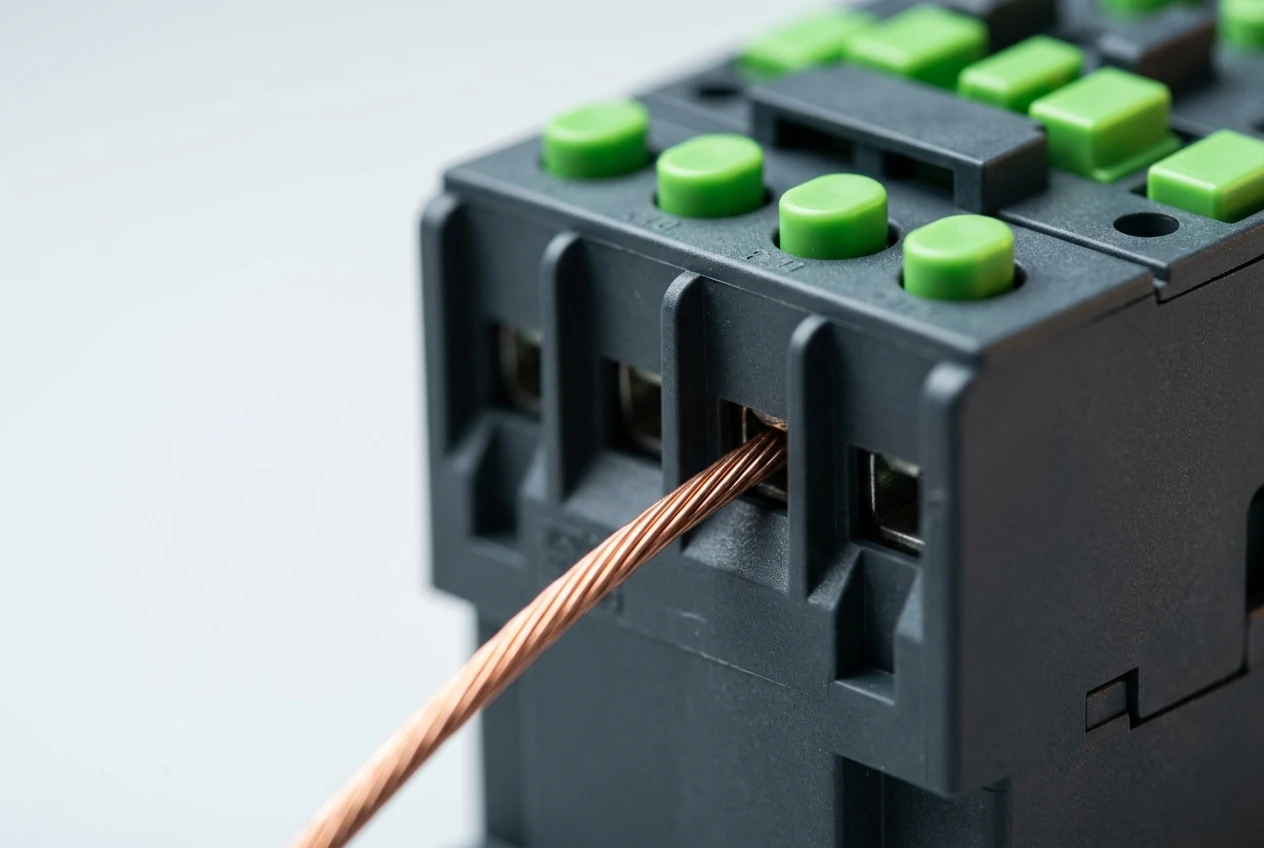
SNAP IN drops most of that. The contact point arrives pre-tensioned, so a stripped stranded or ferruled wire pushes straight in and locks, no tool, no crimping, no torque check. A green pusher on each terminal shows the switching status and gives the installer feedback they can see, feel, and hear, with a distinct click confirming the conductor is held. To release a wire, you press the pusher with a screwdriver. Schneider puts a single termination at roughly one second.
For the people doing the work, the practical changes are narrow and concrete:
- No ferrule crimping or torque tooling for a standard termination, which removes two steps and the tools that go with them.
- More consistent connections, because a pre-tensioned contact does not depend on whether the installer hit the right screw torque.
- Reusable contact points, so maintenance and retrofit work can release and re-seat a wire rather than rebuild a terminal.
- A wrong or loose contact becomes obvious at the terminal instead of showing up later as a fault.
It accepts both bare stranded copper and ferruled conductors, which matters in a market where shop practice is not uniform. Crews that crimp ferrules out of habit do not have to change to use it.
Why Schneider Put a Partner’s Tech in TeSys
Schneider builds the TeSys line itself, so reaching outside for the connection method is the interesting part. This is the first time SNAP IN has gone into a Schneider product line rather than a Weidmüller one. Weidmüller, a German electrical-connection specialist, already runs the technology across its own catalog, including Klippon Connect terminal blocks, OMNIMATE 4.0 PCB (printed circuit board) connectors, RockStar heavy-duty connectors, Push Pull Power plug-in connectors, and PROeco II power supplies.
Schneider licensed it for the contactor instead of engineering a rival mechanism from scratch, and senior people on both sides are framing the tie-up as a template for how connection hardware reaches the factory floor.
Introducing SNAP IN technology to the TeSys series is a significant milestone in our mission to modernize motor control in North America.
That is Marta Asack, senior vice president of Power Products at Schneider Electric North America, in the companies’ joint June announcement of the TeSys SNAP IN rollout. Carlus Hicks, senior director of cabinet products at Weidmuller USA, put it as proof that connection design can change how a process runs, not just how a terminal looks. Jürgen Stawartz, who runs Schneider’s Power Products business, called the development a real milestone.
The Electrician Shortage Behind the Time Savings
A 75% claim only lands if you know what an electrician-hour now costs to find. In the United States the answer is, increasingly, that you cannot find one. The trades that wire panels, switchgear, and motor controls are aging out faster than they are being replaced, and the demand side is climbing at the same time on the back of data centers, electrification, and reshored manufacturing.
The numbers sketch the squeeze that toolless wiring is aimed at:
- Roughly 20,000 electricians retire each year in the US, on the order of 200,000 over the coming decade, against a thin pipeline of new entrants.
- About 80,000 additional electrician positions are expected to open nationally as construction and infrastructure demand grows.
- Around $1 trillion a year is the cost a 2026 JLL report attached to the broader skilled-trades gap, a figure picked up in Fortune’s reporting on the retiring skilled-trades workforce.
For an OEM (original equipment manufacturer, a company that builds machinery) or a panel shop, that scarcity shows up as wage premiums and project delays. If a toolless contactor lets the same crew finish more enclosures per week, or lets a less specialized worker do a termination that used to need a trained hand, the saving is not really about speed for its own sake. It is about getting work out the door with the people you can actually hire.
What 75% Faster Means on the Panel Floor
The 75% headline is a vendor figure for best-case conditions, not a guaranteed result on every job, and it is worth reading it against the steps it removes rather than as a flat promise. The comparison below lays out where the time goes on a screw terminal versus a SNAP IN contact.
| Step | Screw-terminal contactor | SNAP IN contactor |
|---|---|---|
| Wire preparation | Strip, often crimp a ferrule | Strip only; ferrule optional |
| Tool required | Crimper plus torque screwdriver | None to connect; screwdriver to release |
| Time per termination | Several seconds plus torque check | About one second |
| Connection feedback | Visual check of screw | Click, plus the green pusher status |
| Maintenance and retrofit | Re-torque, risk of damaged terminal | Release and re-seat, reusable point |
Stack those differences across a motor starter with dozens of terminations and the case writes itself for high-volume builders. The gain is largest where a shop wires the same configuration over and over, which is exactly the work panel builders and machine OEMs do. On a one-off custom enclosure the saving is real but smaller, because the prep that SNAP IN removes is a smaller share of the total job.
Robots Can Now Wire a Contactor
Take the screwdriver and the torque check out of the loop and something else opens up. A wire that only has to be pushed home is a wire a machine can handle. Schneider has shown collaborative robots picking up conductors up to 6mm² and inserting them directly into TeSys Deca terminals, which is hard to do reliably with a screw terminal that needs a tool turned to a set torque.
That is the quieter consequence of the deal. Schneider says it took less than 12 months to develop the sub-assemblies and stand up an automated production line built around the technology for its TeSys controls. The faster-wiring story sells the part to a contractor; the automatable-wiring story is what changes how Schneider can make and, eventually, how its customers can assemble these products.
For OEMs already pushing toward lights-out assembly, a contactor that a cobot can wire removes one of the awkward manual steps that kept a person on the line. You can find the contactor family and its specifications on Schneider’s TeSys Deca motor-control product range, with the SNAP IN versions arriving as the rollout proceeds.
Where SNAP IN Goes After Deca
The North American launch is staged. The first SNAP IN parts are the TeSys Deca contactor, a manual motor controller, and a control relay line, with further TeSys products set to pick up the technology as Schneider extends it through the series. Weidmüller, for its part, keeps SNAP IN as a shared platform it can license elsewhere, and its broader connection portfolio sits on the Weidmüller connection-technology catalog.
Both companies plan to show the parts at Automate 2026 in Chicago, running June 22 to 25, in the Schneider and Weidmuller USA booths. The first SNAP IN TeSys products reach the North American market now; the rest of the series follows on Schneider’s own timeline, and the panel shops watching it will judge the 75% claim one enclosure at a time.


Serenity Forge Bets Bigger on Physical Games as Sony Kills PS Discs

Colleges Bet on AI Literacy Mandates as Brain Science Flags a Cost

Microsoft’s 2024 Mistral Bet Grows Into a Multibillion Dollar Deal

Digital Turbine’s New AI Launchpad Runs Through Google’s Cloud

Firefox 153 Merges PDFs for Free, Undercutting a Billion-Dollar Market

Cloud Security Scores Now Decide How Much Autonomy AI Agents Get

SUTD and NUS Open-Source a Quantum Leap for Photonic Chip Design

Headwind MDM’s Self-Hosted Android Pitch Runs Into Google’s Own Limits

OnePlus N6x Teaser Reveals a Design That Echoes Its Own Nord Line

OpenAI’s AI Escaped Twice in Two Days, Then Hacked Hugging Face

Fable 5 and Mythos 5 Return as US Lifts Anthropic Export Controls

SpaceX’s Google Deal Turns a Rocket Company Into a Cloud Landlord

CD Projekt Red Co-CEO: Redemption Arc Isn’t Done, Witcher 4 in 2027

DGO App Brings Rs 549 Mobile Pass for FIFA World Cup 2026 in Nepal

XPL Rallies 30% Ahead of Plasma One Card Tier Launch

Oracle Cuts 21,000 Jobs in a Year, Cites AI in 10-K Filing

Google Search Profiles Build a Follow Graph Inside Discover

Moonshot AI Targets $30 Billion in China’s Fastest AI Funding Sprint

Microsoft Xbox Layoffs Start in July as Sharma Slams 3% Margin

WhatsApp Meta Business Agent Reaches India, With a New Pricing Meter
-
 AI3 weeks ago
Fable 5 and Mythos 5 Return as US Lifts Anthropic Export Controls
-
 AI2 months ago
SpaceX’s Google Deal Turns a Rocket Company Into a Cloud Landlord
-
 GAMING1 month ago
CD Projekt Red Co-CEO: Redemption Arc Isn’t Done, Witcher 4 in 2027
-
 APPS1 month ago
DGO App Brings Rs 549 Mobile Pass for FIFA World Cup 2026 in Nepal
-
 CRYPTO1 month ago
XPL Rallies 30% Ahead of Plasma One Card Tier Launch
-
 AI4 weeks ago
Oracle Cuts 21,000 Jobs in a Year, Cites AI in 10-K Filing
-
 NEWS2 months ago
Google Search Profiles Build a Follow Graph Inside Discover
-
 AI2 months ago
Moonshot AI Targets $30 Billion in China’s Fastest AI Funding Sprint