
GAMING
Jensen Huang Opened NVIDIA’s Seoul Blitz With a Signed RTX 5090
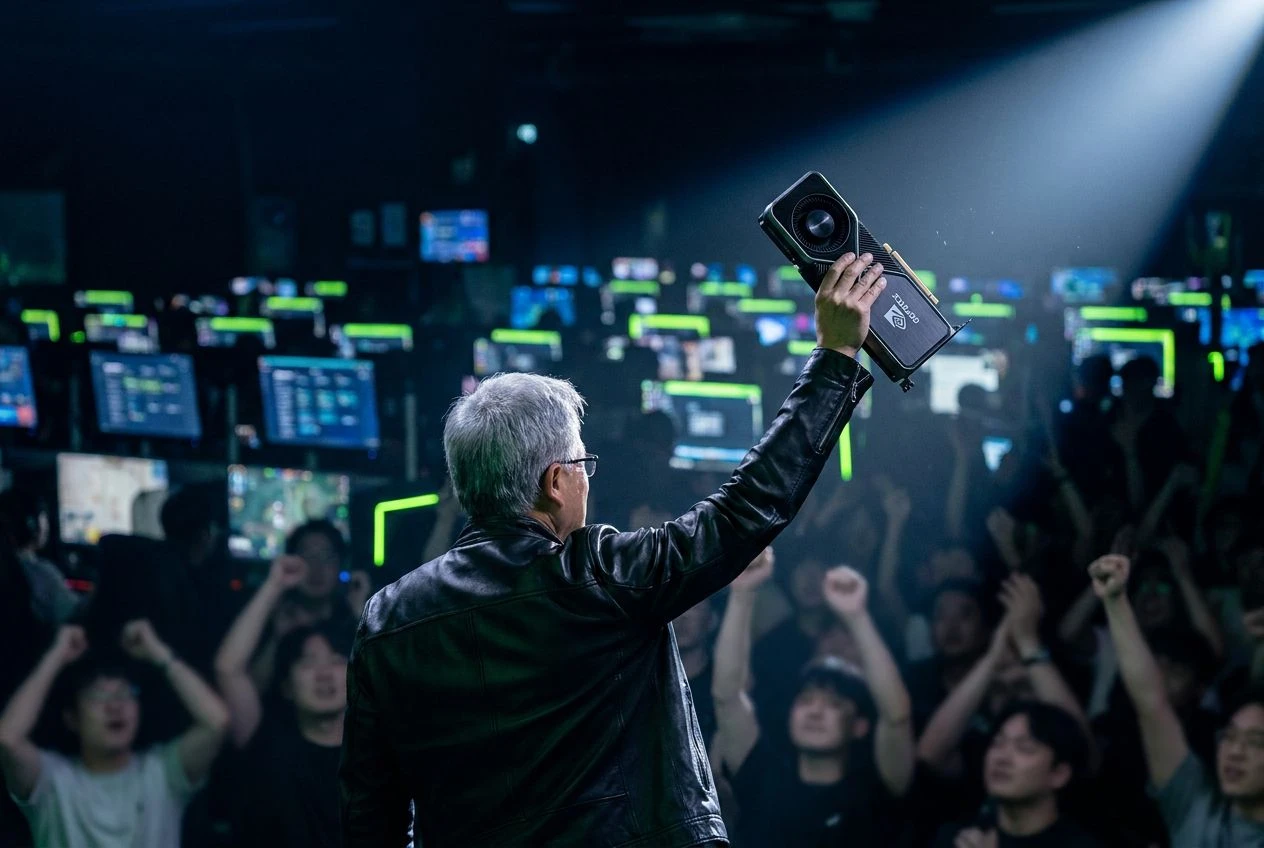
Jensen Huang gifted Faker a co-signed RTX 5090 at T1 Base Camp in Seoul, distributed RTX Spark vouchers to fans, then sat with Korea’s top chaebol chairs in a packed four-day Korea agenda.

Jensen Huang’s private jet set down at Gimpo International Airport at around 1 p.m. on June 5, and he went straight to a gaming café. Some 500 fans had packed into T1 Base Camp, a PC bang (internet gaming café) run by esports organization T1, in Seoul’s Mapo district, to watch the NVIDIA chief executive meet Lee “Faker” Sang-hyeok, the 29-year-old six-time League of Legends World Champion widely considered the greatest player in the game’s history. Huang moved through the crowd to where T1’s five-man roster waited, then presented Faker with a GeForce RTX 5090 graphics card bearing both their signatures. “Only one in the world,” he told the room. “This might be worth a million dollars.”
Faker handed back a signed jersey. Both struck their respective signature poses for photographs, the images circulating across Korean social media within the hour. The four-day Seoul schedule behind the café stop runs through a chaebol dinner that same evening, a closed-door session with AI and robotics startup founders on Monday, and a planned visit to Seoul National University’s robotics research center.
The RTX Spark Pitch Behind the Gift
T1 Base Camp’s PCs run RTX 4070 units. Faker’s personal machine runs an RTX 5070, per Huang’s own remark to the crowd. He called the venue hardware “antiques” before presenting the co-signed RTX 5090, the only unit in existence carrying both signatures. A dual-signed RTX 5090 without Faker’s addition has previously sold at auction for $12,501.
The signed vouchers distributed to fans are each redeemable for an RTX Spark device at launch. The RTX Spark is NVIDIA’s first laptop superchip, unveiled at Computex Taipei on June 1. It pairs a 20-core ARM CPU and a Blackwell GPU on a single TSMC 3-nanometer package, with up to 128 gigabytes of LPDDR5X memory and 1 petaFLOP of FP4 AI performance. ASUS, Dell, HP, Lenovo, Microsoft, and MSI devices go on sale in fall 2026. He confirmed the timeline on stage: “It will be released this fall. If you bring the card, you will get the RTX Spark.” The RTX Spark’s N1X chip architecture, unveiled days earlier at Computex Taipei, is the same Blackwell silicon the Base Camp vouchers will put into fans’ hands by the holiday season.
South Korea’s roughly 9,000 PC bangs are among the most GPU-intensive consumer venues globally, upgrading hardware at institutional scale. They have historically been among NVIDIA’s most consistent GeForce sales channels in Asia. He credited Korean gamers with building GeForce into a major business: “Because all of you were so good and wanted to win, you chose the best GPU, which is the Nvidia GPU.” He called Korea “the country that not only made gaming, but also spectating the game,” citing its StarCraft-era broadcast culture as the origin of modern esports spectatorship. NVIDIA had already held a GeForce Gamer Festival in Seoul at the APEC summit in October 2025, where NCSOFT gave attendees hands-on previews of unreleased titles built on NVIDIA technology and Krafton’s PUBG team showcased an AI co-playable character powered by NVIDIA ACE.
T1 Chief Operating Officer Ahn Woong-ki traced the T1/NVIDIA relationship to a Valorant social media event the two co-hosted, saying T1 had “had many business discussions with NVIDIA.” The Base Camp visit was kept secret until the early hours of June 5.
- ~500 fans packed T1 Base Camp for the June 5 event
- $12,501, the prior auction price of a dual-signed RTX 5090 without Faker’s co-signature
- Fall 2026: RTX Spark consumer launch window, confirmed at T1 Base Camp
SK Square’s Stake in the Spectacle
The SK Group Chain to SK Hynix
T1 Entertainment and Sports is a joint venture. SK Square, the investment holding company that emerged from SK Telecom’s 2021 corporate restructuring, holds 55.4% of T1. Comcast Spectacor, the sports and entertainment arm of media conglomerate Comcast, holds 34.3%. Faker became a part-owner in February 2020. The organization traces its origins to a StarCraft team that SK Telecom began sponsoring in 2004, rebranded to T1 in 2019 when SK Telecom and Comcast Spectacor formed the joint venture.
SK Square sits inside SK Group. SK Group runs SK Hynix.
SK Hynix is NVIDIA’s primary supplier of HBM (high-bandwidth memory, the stacked chip architecture powering AI accelerators). By October 2025, the company had sold out its entire 2026 production of DRAM, HBM, and NAND flash, much of it contracted to NVIDIA. In the third quarter of 2025, SK Hynix held 53% of the global HBM market against Samsung Electronics’ 35%. SK Group Chairman Chey Tae-won had already met Huang three times this calendar year, in Silicon Valley, San Jose, and Taipei, before the Seoul dinner made it four meetings in six months.
When the NVIDIA chief executive walked into T1 Base Camp and the crowd cheered, he was standing in a venue majority-owned by the holding company of his most critical memory supplier. The crowd footage travels across social media in minutes; the supply agreements behind it travel in a different register entirely.
Comcast’s 34 Percent and What Follows
Comcast Spectacor holds 34.3% of T1. Ownership negotiations between SK Square and Comcast over T1’s majority stake are reportedly underway, with Comcast positioned to exercise an existing right to acquire SK Square’s shares. Comcast’s potential majority control would hand a U.S. media conglomerate ownership of a global esports brand that now carries NVIDIA’s most prominent gaming product endorsement going into the fall 2026 hardware launch window.
The Chaebol Dinner After T1
That same evening, Huang sat down to Korean barbecue with four of South Korea’s most powerful corporate figures. SK Group Chairman Chey Tae-won, LG Group Chairman Koo Kwang-mo, Hyundai Motor Group Executive Chair Euisun Chung, and Naver founder and Chairman Lee Hae-jin all joined him at a Seoul restaurant. The dinner was disclosed publicly; its specifics were not.
The commercial context is less opaque. At GTC Taipei 2026 on June 1, NVIDIA confirmed its Vera Rubin AI platform entered full production with Samsung Electronics, SK Hynix, and Micron Technology as HBM4 (high-bandwidth memory, fourth generation, the current stack for AI accelerators) suppliers. SK Hynix’s M15X fabrication facility targets utilization by mid-2027. Samsung’s P5 plant in Pyeongtaek is expected operational by 2028. Chey Tae-won, speaking at Computex Taipei, said SK Hynix plans to double wafer production capacity over five years and that memory shortages will persist through 2030.
| Dinner Guest | Existing NVIDIA Relationship | Likely Agenda Focus |
|---|---|---|
| SK Group / SK Hynix | Primary HBM4 supplier for Blackwell and Vera Rubin | Vera Rubin supply volumes, 2027 HBM pricing |
| LG Group | Electronics manufacturing, AI devices | Physical AI deployments and robotics |
| Hyundai Motor Group | Automotive AI and factory automation | NVIDIA drive-stack, autonomous systems |
| Naver | Korean AI models and cloud infrastructure | AI model work, data center cooperation |
LG Electronics gained nearly 30% on the Seoul exchange in the days following the Vera Rubin supplier announcement at GTC Taipei, tracking investor expectations of a deeper physical AI and robotics partnership with NVIDIA. Hyundai Motor Group has been building factory-floor physical AI programs that intersect with NVIDIA’s Isaac robotics platform. Naver’s Korean-language AI models and cloud infrastructure give it a role in any Korea-facing NVIDIA AI deployment that requires local language capability.
NVIDIA’s Korea Dependency Has Hardened
At a Computex dinner with Korean tech executives, the company’s founder put it plainly: “Korea is a critical part of our ecosystem.” The structural conditions behind that framing have grown more pronounced over the past two years.
China’s semiconductor export restrictions have progressively closed the accessible market for NVIDIA’s advanced chips in mainland China, pushing the company toward deepening alternative partnerships with greater urgency. Global tech supply chains are under additional scrutiny following the Iran war. Korea’s two dominant memory chipmakers (SK Hynix and Samsung Electronics) supply the HBM stacks that go into every Blackwell and Vera Rubin accelerator shipped anywhere. Citi Research projects the global HBM market at $43 billion by 2027, with NVIDIA’s Korean supply chain at the center of that trajectory.
The APEC summit in Gyeongju in October 2025 produced a concrete marker of that dependency: NVIDIA pledged more than 250,000 advanced GPUs toward South Korea’s AI infrastructure, alongside Samsung, SK Hynix, and Hyundai Motor. That visit was seven months ago. NVIDIA has been requesting next-generation 16-Hi HBM4 deliveries from Samsung and SK Hynix by the fourth quarter of 2026, the densest HBM stack commercially attempted, with both South Korean companies beginning full-scale development for that order. SK Group separately announced an NVIDIA-powered AI factory for semiconductor research and production.
On the Seoul exchange on June 5, Samsung Electronics fell 3.98% and SK Hynix dropped 7.22%, tracking overnight U.S. chip stock losses from Broadcom’s earnings. Both companies’ capacity expansion timelines run on schedules set by contracts that predate any single session’s price movement.
The Robotics Rooms Open Monday
Sunday’s confirmed events run from a baseball diamond to a television studio to a gaming company’s conference room. His publicly confirmed agenda includes:
- Throwing the ceremonial first pitch at a Doosan Bears home baseball game in Seoul (confirmed by the team)
- Recording an episode of “You Quiz on the Block,” one of South Korea’s highest-rated variety talk shows (confirmed by the channel)
- A meeting with Kim Taek-jin, chief executive of NC Corp, the South Korean game and AI company, with gaming and AI cooperation on the agenda
- A closed-door session Monday with founders and executives from South Korean AI and robotics startups, the first meeting of this kind the NVIDIA chief executive has held specifically in South Korea
- Visits to Seoul National University’s AI institute and robotics research center, planned for later in the week
The Monday session draws the most attention from industry sources. NVIDIA’s Isaac robotics platform, built around the same Blackwell and Vera Rubin compute infrastructure the Korean dinners are negotiating, needs hardware partners and startup ecosystems that can deploy physical AI into real manufacturing and logistics environments. South Korea’s automation sector feeds Hyundai’s factory lines and Samsung’s fabrication capacity, positioning local startups as natural integration partners. Krafton’s senior management, the PUBG games company that has already co-developed NVIDIA ACE-powered AI characters for its flagship title, is also reportedly on the week’s schedule.
Before the plane landed, fans had built a website in Korean called “Jensen Huang’s Footprints” mapping his expected locations and meetings across Seoul by the hour.
Seoul National University’s robotics center is the last confirmed stop on the public itinerary.


South Korea Retail Investors Face Reckoning After KOSPI AI Rally Collapses

Surrey AI Maps Three Heart Attack Paths and Their Molecular Roots

Germany Locks Neutral Apple ATT Prompts Across Most of Europe

Apple’s 5% EU Fee Quietly Rewrites Alternative App Store Math

Apple’s EU Fee Truce Cuts Complexity but Leaves Rivals Fuming

Pixel 11 Pro Fold Trades Thinness for Durability and Seven-Year Stay

Mayo AI Flags HCM Obstruction From Everyday Ultrasound Videos

Indian Brands Quietly Scale Landmark Screens and Home Tech

Navin Vatsa Turns Grief Into a Lifetime of Quiet Seeing

Google Bets Pixel 11 Agentic AI Will Redefine Phones

Oracle Cuts 21,000 Jobs in a Year, Cites AI in 10-K Filing

Fable 5 and Mythos 5 Return as US Lifts Anthropic Export Controls

SpaceX’s Google Deal Turns a Rocket Company Into a Cloud Landlord

CD Projekt Red Co-CEO: Redemption Arc Isn’t Done, Witcher 4 in 2027

XPL Rallies 30% Ahead of Plasma One Card Tier Launch

Google Search Profiles Build a Follow Graph Inside Discover

DGO App Brings Rs 549 Mobile Pass for FIFA World Cup 2026 in Nepal

Moonshot AI Targets $30 Billion in China’s Fastest AI Funding Sprint

Oppo’s ColorOS 17 Eligibility List Leaves A-Series Buyers Behind

Microsoft Xbox Layoffs Start in July as Sharma Slams 3% Margin
-
 AI2 months ago
Oracle Cuts 21,000 Jobs in a Year, Cites AI in 10-K Filing
-
 AI2 months ago
Fable 5 and Mythos 5 Return as US Lifts Anthropic Export Controls
-
 AI3 months ago
SpaceX’s Google Deal Turns a Rocket Company Into a Cloud Landlord
-
 GAMING2 months ago
CD Projekt Red Co-CEO: Redemption Arc Isn’t Done, Witcher 4 in 2027
-
 CRYPTO3 months ago
XPL Rallies 30% Ahead of Plasma One Card Tier Launch
-
 NEWS3 months ago
Google Search Profiles Build a Follow Graph Inside Discover
-
 APPS3 months ago
DGO App Brings Rs 549 Mobile Pass for FIFA World Cup 2026 in Nepal
-
 AI3 months ago
Moonshot AI Targets $30 Billion in China’s Fastest AI Funding Sprint