
AI
Zoho Bets Free AI Classes 2.0 Will Win Over India’s Schools
Zoho’s Classes 2.0 gives every government school in India free access to an AI course builder, a 24/7 tutor and support for 22 languages.

Zoho will not charge a single rupee in licensing fees to any government school, college or university in India that adopts its new classroom software. The Chennai-based company launched Classes 2.0 on July 15. It is an AI-powered learning management system (LMS) that turns a syllabus into a full course in under 30 seconds and gives every student a tutor that never clocks out.
The free tier stops at the border of India’s public institutions. Private schools pay by the teacher, and Zoho has offered free classroom software to the country before, during the first pandemic lockdown.
Every Government School in India Gets the AI Version Free
Zoho announced the launch through its official account, describing a system that unifies teaching, learning and institutional administration in one product rather than a stack of separate apps.
The company is making Classes 2.0 available at no product licensing cost to every Central and State government school, college and university in the country. Any individual teacher handling up to 100 students can also use the full platform for free.
We believe access to modern educational technology should never be limited by an institution’s resources.
Mani Vembu, chief executive of Zoho, said the free licences for government institutions reflect that philosophy. He added that the company hopes the move helps more institutions use technology to improve learning outcomes.
Classes 2.0 supports all 22 scheduled Indian languages. Zoho says the AI layer works directly in those languages rather than simply translating a fixed interface, letting assessments and generated lessons reach students in whichever language they learn best.
Building a Course From a Syllabus in Under 30 Seconds
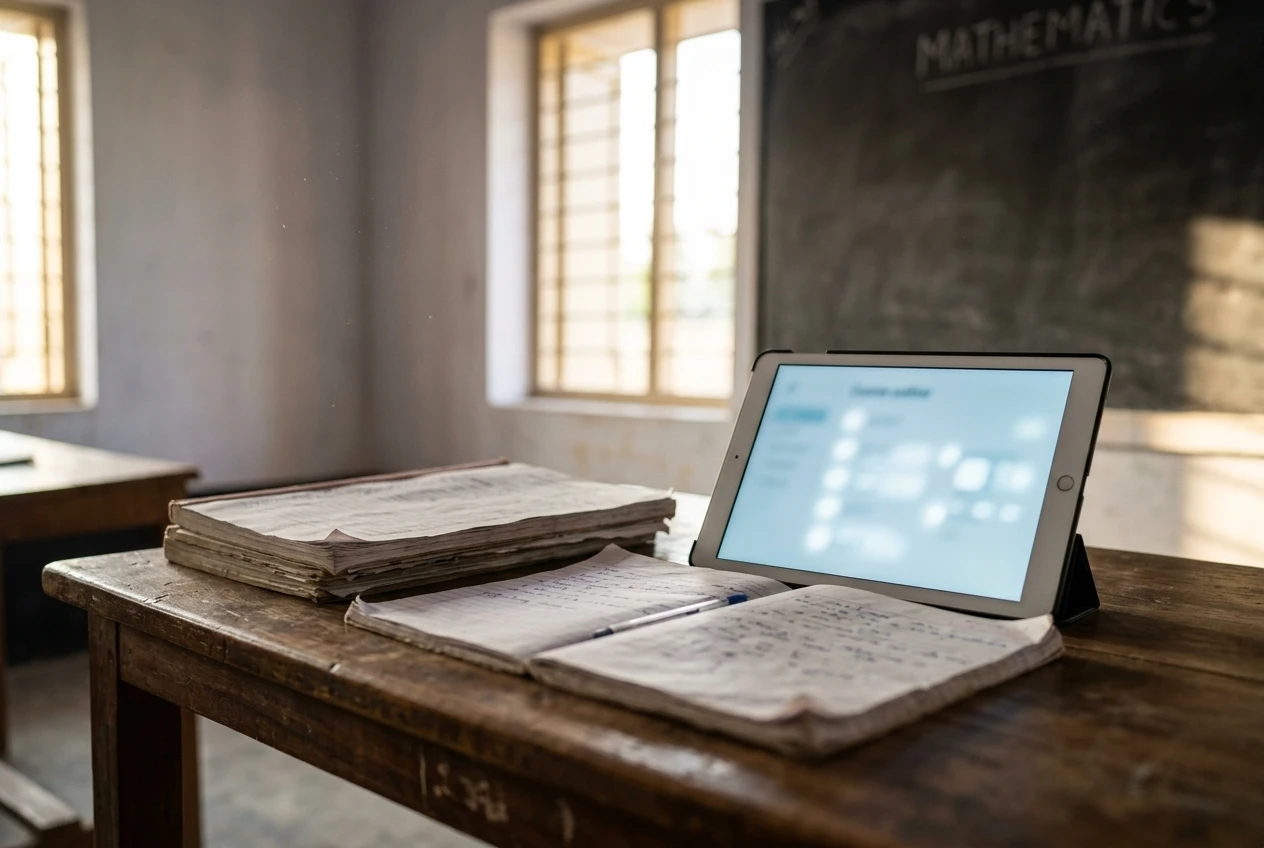
The centerpiece is an AI Course Builder. A teacher uploads a syllabus, a topic or a rough lesson outline, and the system returns a structured course in less than half a minute.
Zoho’s own product page for Classes describes each student’s AI Tutor as acting as their own teacher, available whenever a question comes up outside class hours.
The generated course includes several distinct pieces:
- Suggested video lesson structures for each unit
- Reading resources tied to the topic
- Assignments complete with assessment rubrics
- Adaptive practice tests students can retake
- Direct mapping to Course Outcomes and Programme Outcomes, the benchmarks colleges use to prove accreditation compliance
Teachers can lock modules until a set stage of the term or schedule releases in advance, which supports flipped classroom teaching where students study material before a discussion session. Zoho has also built a library of more than 100,000 curriculum templates for teachers to draw from instead of starting blank.
“That is the gap we set out to bridge,” said Dev Anand Ramasamy, vice president of product management at Zoho. He said the platform’s AI layer is meant to automate lesson planning, grading and reporting so teachers spend more time actually teaching.
Institutional Intelligence Flags Struggling Students Early
Classes 2.0 does not stop at the classroom door. Zoho built the system to track a student from enrollment through completion, folding institutional administration into the same platform as teaching.
An AI layer scans learning patterns to flag students who may be falling behind, according to the company. That gives institutions a chance to step in before a failed exam makes the problem obvious.
A Low-Code Micro App Builder lets schools assemble their own tools for admissions, syllabus administration and internal workflows without hiring a development team.
The system is built to align with India’s accreditation frameworks, including the National Assessment and Accreditation Council (NAAC), the National Board of Accreditation (NBA) and the University Grants Commission (UGC), while tracking against the goals of the National Education Policy (NEP) 2020. Zoho said it is also working with state government bodies to extend digital access to out-of-school students and government polytechnic colleges, aiming at statewide networks rather than single campuses.
Medical Colleges Get a Compliance Layer of Their Own
Medical schools get a separate set of tools built around Competency-Based Medical Education (CBME), the framework India’s National Medical Commission (NMC) uses to train doctors.
The platform tracks clinical competencies, logs results from the OSPE (Objective Structured Practical Examination) and OSCE (Objective Structured Clinical Examination) formats, and keeps documentation ready for outside audits. Chettinad Health City, a hospital and medical education network, already runs the system, according to Zoho.
All of it sits on Zoho’s own infrastructure. The company says Classes 2.0 stores data inside India and complies with the Digital Personal Data Protection (DPDP) Act, the law governing how Indian firms handle personal data.
Zoho Has Run This Playbook Before
This is not Zoho’s first free giveaway in Indian education. The company first launched Zoho Classes during the COVID-19 pandemic, when the priority was helping teachers collect assignments online while classrooms sat empty, then made it free for government schools under a relief program launched in 2020 as lockdowns shut campuses worldwide.
The platform has grown well past that emergency use. Zoho says its current numbers include:
- More than 1 million assignment submissions processed on the platform
- Over 8 million notifications sent to students and teachers
- More than 2TB of educator-created video content stored
SRM Institute, Sishya School, Chettinad Health City and Vidya Mandir already run on the system, alongside Grace International School and a handful of government education bodies.
Zoho’s relationship with education runs deeper than software. The company has spent years training school leavers who skip conventional college entirely at its own campuses in Tamil Nadu, betting that hands-on work experience beats a lecture hall.
What Does Zoho Get Out of Giving This Away?
Zoho earns nothing from the government licences themselves. The payoff comes from elsewhere: private institutions paying a monthly per-teacher fee, a global rollout still to come, and a generation of Indian schools and colleges built around Zoho’s tools before a rival gets the chance.
| Tier | Who Qualifies | Cost |
|---|---|---|
| Government institutions | Central and State schools, colleges and universities | Free, no licensing cost |
| Individual teachers | Classes of up to 100 students | Free |
| Private institutions | Schools and colleges outside the free tiers | Roughly Rs 500 per teacher, per month (about $6) |
Only one outlet in our review put a rupee figure on the private tier: Analytics Insight reported it at roughly Rs 500 per teacher every month. Zoho’s own announcement and coverage elsewhere described the tier without stating the amount directly, which is why that number carries a single-source caveat here.
Zoho has used a similar wedge before in its enterprise product, Zoho Learn, which extends training to external and internal audiences beyond a company’s own staff for a modest monthly fee. Classes follows a similar shape: give away the core product, then charge the accounts that can pay.
Classes 2.0 is live in India now. Zoho says other markets will follow over the coming months, each with features adjusted to local education systems. For now, the free version exists in exactly one country.
Frequently Asked Questions
Does Zoho Classes 2.0 work without an internet connection?
Partially. Students can view saved lessons offline for a short period, though the app does not support full downloads, according to reporting on the platform’s mobile features.
Can a school turn off the AI tools for students?
Yes. Schools and colleges can decide for themselves whether students get access to the AI features at all, rather than having it forced on every classroom.
Will the AI Tutor answer questions outside a student’s syllabus?
No. Zoho has built the AI Tutor to stick to classroom-related subjects, a guardrail the company added specifically to keep the tool from wandering into unrelated queries.
Which institutions already use Zoho Classes?
SRM Institute, Sishya School, Chettinad Health City, Vidya Mandir and Grace International School run on the platform today, alongside several government education bodies and large state-level initiatives.
When will Zoho Classes 2.0 reach schools outside India?
There is no fixed date yet. Zoho says the international rollout will happen over the coming months, with capabilities adapted to each region’s own education requirements rather than a single global version.


South Korea Retail Investors Face Reckoning After KOSPI AI Rally Collapses

Surrey AI Maps Three Heart Attack Paths and Their Molecular Roots

Germany Locks Neutral Apple ATT Prompts Across Most of Europe

Apple’s 5% EU Fee Quietly Rewrites Alternative App Store Math

Apple’s EU Fee Truce Cuts Complexity but Leaves Rivals Fuming

Pixel 11 Pro Fold Trades Thinness for Durability and Seven-Year Stay

Mayo AI Flags HCM Obstruction From Everyday Ultrasound Videos

Indian Brands Quietly Scale Landmark Screens and Home Tech

Navin Vatsa Turns Grief Into a Lifetime of Quiet Seeing

Google Bets Pixel 11 Agentic AI Will Redefine Phones

Oracle Cuts 21,000 Jobs in a Year, Cites AI in 10-K Filing

Fable 5 and Mythos 5 Return as US Lifts Anthropic Export Controls

SpaceX’s Google Deal Turns a Rocket Company Into a Cloud Landlord

CD Projekt Red Co-CEO: Redemption Arc Isn’t Done, Witcher 4 in 2027

XPL Rallies 30% Ahead of Plasma One Card Tier Launch

Google Search Profiles Build a Follow Graph Inside Discover

DGO App Brings Rs 549 Mobile Pass for FIFA World Cup 2026 in Nepal

Moonshot AI Targets $30 Billion in China’s Fastest AI Funding Sprint

Oppo’s ColorOS 17 Eligibility List Leaves A-Series Buyers Behind

Microsoft Xbox Layoffs Start in July as Sharma Slams 3% Margin
-
 AI2 months ago
Oracle Cuts 21,000 Jobs in a Year, Cites AI in 10-K Filing
-
 AI2 months ago
Fable 5 and Mythos 5 Return as US Lifts Anthropic Export Controls
-
 AI3 months ago
SpaceX’s Google Deal Turns a Rocket Company Into a Cloud Landlord
-
 GAMING2 months ago
CD Projekt Red Co-CEO: Redemption Arc Isn’t Done, Witcher 4 in 2027
-
 CRYPTO3 months ago
XPL Rallies 30% Ahead of Plasma One Card Tier Launch
-
 NEWS3 months ago
Google Search Profiles Build a Follow Graph Inside Discover
-
 APPS3 months ago
DGO App Brings Rs 549 Mobile Pass for FIFA World Cup 2026 in Nepal
-
 AI3 months ago
Moonshot AI Targets $30 Billion in China’s Fastest AI Funding Sprint