
CRYPTO
Digital Asset’s $355 Million Canton Raise Is a DTCC Bet
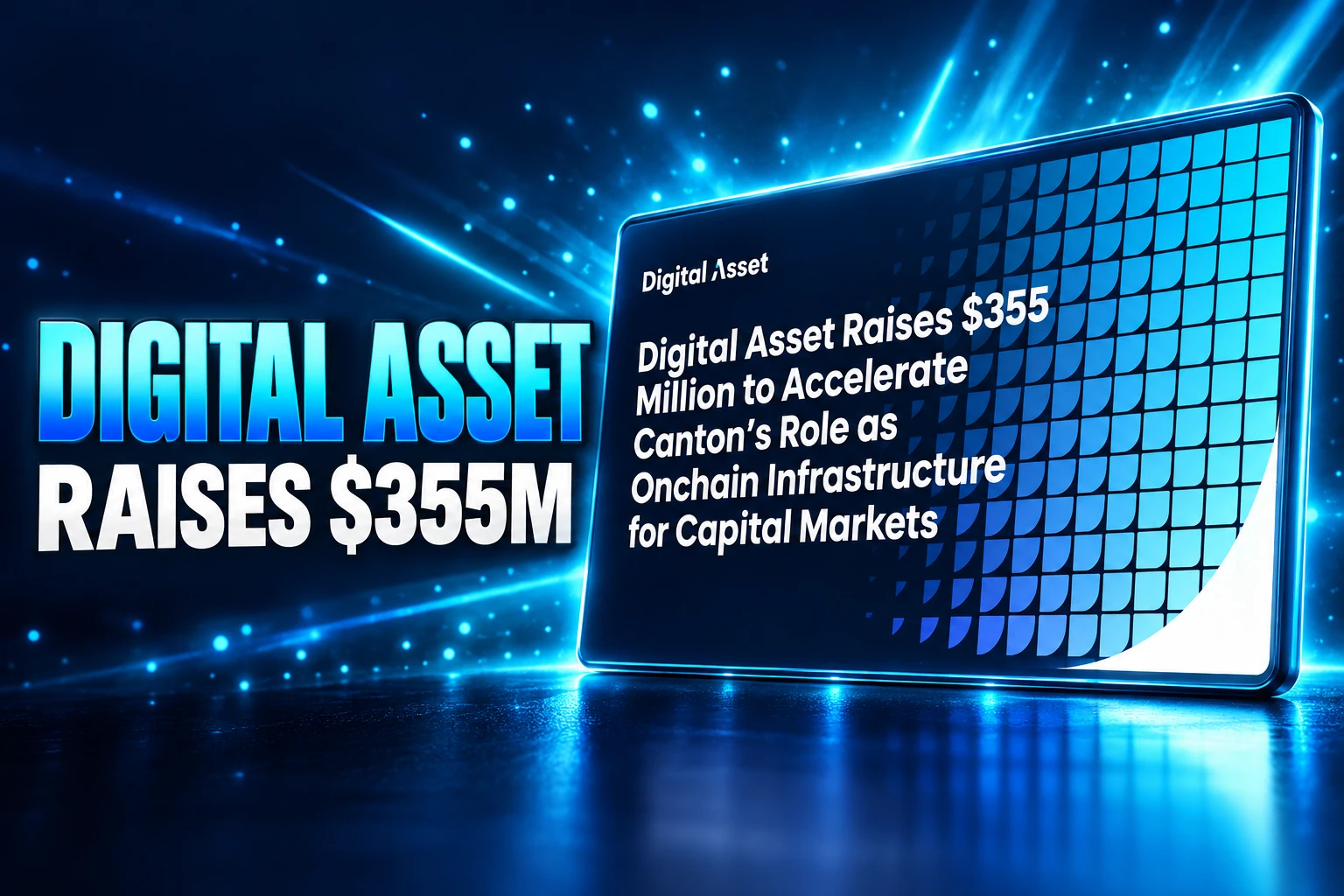
Digital Asset’s $355 million Canton Network round at $2 billion is a cheaper Wall Street bet than Tempo, with DTCC’s October launch as the test.

Digital Asset closed a $355 million funding round for Canton Network on June 11, led by a16z crypto, at about $2 billion. The target had been $300 million. HSBC, BNP Paribas, Citadel Securities, CME Ventures, and the Abu Dhabi Investment Authority were among the names on the cap table.
a16z crypto put in a $100 million investment and called the deal a partnership, not a one-off check. The wager now runs through DTCC, which plans to open its Tokenization Service in October 2026 with Canton as one of the public rails.
Banks Bought a Seat on a Live Ledger
Most large crypto rounds sell a roadmap. This one sold a network that Broadridge, Tradeweb, DTCC, and Goldman Sachs were already using. Yuval Rooz, co-founder and CEO of Digital Asset, said the extra cash is for more assets, more apps, and more firms on Canton, plus help from a16z on company building, policy, and research.
Rooz also said Digital Asset is already profitable, and that a thicker balance sheet gives the firm freedom to buy companies and fund partner rollouts rather than recycle capital through token deals. On July 21, Shinhan Financial Group and Standard Chartered’s SC Ventures added $10 million at the same about $2 billion price, taking the round to $365 million.
Blockchain adoption will be defined by practical, production-grade applications in the world’s largest markets.
Yuval Rooz, co-founder and CEO of Digital Asset, June 11, 2026 statement
Ali Yahya, a general partner at a16z crypto, wrote that the interesting onchain work is no longer theoretical because real-world assets and bank workflows are already moving. His partner on the note, Noah Levine, signed the same thesis: privacy was the barrier that still blocked regulated desks after speed and rules got easier.
A Cap Table Built From Clearinghouses and Banks
The investor list is the tell. It is not a crypto fund plus a couple of banks for decoration. Clearinghouses, trading firms, asset managers, and exchanges wrote checks into the same vehicle, which is how a shared ledger gets adopted without a bake-off memo.
Digital Asset first published the full roster when the June round closed. FT Partners advised. Many of the same houses had already been in earlier Canton checks, including a $135 million round in June 2025 led by DRW Venture Capital and Tradeweb, and a $50 million round in December 2025 from BNY, Nasdaq, S&P Global, and iCapital. Those four rounds sum to $550 million.
WHO WROTE THE CHECKS
- Lead check: a16z crypto led and put in $100 million, then opened a broader partnership on policy and research.
- Bank balance sheets: HSBC, BNP Paribas, ABN Amro, and an Abu Dhabi Investment Authority subsidiary joined as direct backers.
- Market plumbing: Broadridge, CME Ventures, Tradeweb, S&P Global, Citadel Securities, and Optiver sat on the same list.
- Crypto-native names: Coinbase Ventures and Polychain participated alongside SoFi, Apollo Funds, and SBI Group.
That mix is how you get a coordination device. A bank that already owns a slice of the operator is less likely to strand a tokenized Treasury book on a private island that nobody else will accept as collateral.
Digital Asset Spent 12 Years on This Design
Digital Asset was founded in 2014. Rooz and Eric Saraniecki came out of DRW and Citadel. Shaul Kfir came from cryptography and built libsnark, the library that later powered Zcash. a16z’s note says the three started with one rule: if capital markets were going onchain, privacy could not be optional.
The company spent the next decade writing Daml, a contract language aimed at multi-party financial workflows, and Canton, a public Layer 1 that keeps those workflows on shared rails without printing every position to every node. Yahya’s version of the history is blunt. Most chain teams tried to make banks behave like crypto users. Digital Asset bent the chain toward the way desks already trade.
U.S. rules helped the timing. a16z pointed to the GENIUS Act as law and to a clearer bank playbook than the one that existed for most of Canton’s life. The software still had to match a repo desk, not a white paper, which is why the 12-year wait sits behind the $2 billion price.
How Canton Privacy Works for Bank Trades
Canton lets two firms settle on a shared public network while showing each party only the slice of the trade it is allowed to see. A repo between two banks can be final for both without broadcasting size, names, or inventory to every other validator. That is the product banks would not give up for a fully public chain.
Sub-transaction privacy is the mechanism. A contract can span custodians, a clearinghouse, and two trading firms, and each one sees the fields it needs for its job. The rest stays dark. Atomic settlement still holds across those apps, so a Treasury token and a cash token can move together without a clerk reconciling the legs later.
Yahya used a simple test. If a bank is trading Treasuries with another bank, it cannot have positions, counterparties, or volumes on a public feed. Canton was built so that requirement is default behavior, not an add-on mixer. The Global Synchronizer is the shared layer Super Validators run to keep those private apps in sync, and a16z counted more than 40 of them at the time of the check.
$9 Trillion a Month Already Moves on the Network
Canton is not waiting on the October launch to prove load. The network’s own September 8 note said it is already processing $9 trillion in tokenized assets monthly. a16z’s June 11 investment note said Broadridge processes more than $400 billion in daily U.S. Treasury repo volume on a Canton subnet, and that Tradeweb already runs 24/7 repo trading and settlement on the network.
CANTON AT PRODUCTION SCALE
- Monthly tokenized load: Canton said the network processes $9 trillion-plus in tokenized real-world assets each month.
- Daily repo book: a16z said Broadridge’s U.S. Treasury repo on a Canton subnet tops $400 billion a day.
- Network fees: DefiLlama’s chain row listed 30-day chain fees of $49.95 million, with $10.94 million over seven days and $1.49 million in 24 hours.
- Firm count: Rooz said Digital Asset is working with more than 700 banks, trading firms, and infrastructure providers on Canton.
Those fee figures are gas-style network fees, not Digital Asset’s equity revenue. They still show a chain that is being paid to move, which is the gap most “Wall Street onchain” pitches never close. JPMorgan is migrating a tokenized deposit product onto Canton, per a16z. Goldman Sachs has already issued debt instruments and a money market fund on the network and has said it plans to run a Super Validator.
Franklin Templeton went further in August and joined as a Super Validator, arguing that large asset managers should operate the rails they intend to use.
Financial institutions shouldn’t just use blockchains. They should help run them.
TradFi and DeFi are becoming one. @CantonNetwork is one of the players accelerating that convergence through its chain, purpose-built for institutional finance.
So we’re deepening our commitment… pic.twitter.com/VeyYiXDiK4
— Franklin Templeton Digital Assets (@FTDA_US) August 3, 2026
Visa, Apollo, Circle, and Chainlink were already in the Super Validator set a16z described in June. The point of that roster is control: the same class of firm that needs privacy also wants a vote on how the shared layer runs.
The July 15 Production Tape
DTCC put the design in front of live books 34 days after the raise. The depository said it converted DTC-held securities into tokens and used them in real production trades, with the tokenized trades processed on July 15 across LFDT’s Besu private network and Canton. Frank La Salla, DTCC’s president and CEO, said the firm can apply the same rigor to tokenization that it applies to traditional assets.
JULY 15 TRADE TYPES
- Collateral pledge: Tokenized DTC assets were posted as collateral in a production setting, not a sandbox replay.
- Securities lending: Intraday loans of tokenized Treasuries moved between nodes without a next-day wait.
- Treasury and equity DVP: Delivery-versus-payment trades settled the asset and cash legs together.
- CCP margin: Tokenized U.S. Treasuries were delivered to meet exchange margin calls during the day.
DTCC named more than 30 firms on that tape, including BlackRock, J.P. Morgan, Goldman Sachs, Vanguard, CME Group, Nasdaq, the New York Stock Exchange, Citadel Securities, Broadridge, and Circle. Brian Steele, DTCC’s president of Clearing & Securities Services, said the tokens keep the same investor protections, entitlements, and ownership rights as the securities they represent. The working group around the service had grown to more than 100 members and partners by July.
Canton’s recap of those sessions is the specimen that makes the efficiency claim concrete. Intraday U.S. Treasury repo lasted about 15-20 minutes instead of a 1-day minimum. Cash and asset legs settled at once. Margin could move from a wallet to an exchange without unwinding the underlying position.
With tokenization and repo done on the Canton Network, you can do a repo for four hours. You can do a repo over the weekend. A lot of time, treasurers have money come in late in the day. The ability to manage money around the clock as opposed to doing it once a day is a benefit for the full ecosystem.
Steven Hood, Head of Clearing, Americas, Marex, DTCC Canton session
THE JUNE-TO-OCTOBER TAPE
- June 11, 2026: Digital Asset closes the $355 million a16z-led round at about $2 billion.
- July 15, 2026: DTCC runs live production trades in tokenized Treasuries, equities, and ETFs on Canton and Besu.
- July 21, 2026: Shinhan and SC Ventures add $10 million, taking the round to $365 million at the same price.
- August 3, 2026: Franklin Templeton says it is becoming a Canton Super Validator.
- October 2026: DTCC plans to open the Tokenization Service for commercial use.
The legal on-ramp sits behind that calendar. DTC received a Securities and Exchange Commission no-action letter in December 2025 that lets it run a defined tokenization service for three years. Nadine Chakar, DTCC’s global head of digital assets, said the path still runs through trusted market infrastructures rather than around them.
WHAT WE KNOW
- Live trades: July 15 used real DTC-custodied assets, not simulated balances, on two chains at once.
- Launch window: DTCC has said the service will open in October 2026 after that production test.
- Asset scope: The first wave is built around U.S. Treasuries, with equities and ETFs already in the July mix.
WHAT IS UNCONFIRMED
- Share of the vault: Canton said a portion of DTCC’s $114 trillion in custody assets will be available onchain, not the whole vault on day one.
- Chain split: DTCC has not said how much October volume will sit on Canton versus Besu or later public networks.
- Run-rate after launch: Intraday minutes in a demo do not yet equal a standing market for weekend collateral.
A SODA survey cited by Canton found 90% of investment banks expect collateral mobility to reshape liquidity management within five years, and 70% expect better liquidity usage or LCR. That is the internal budget case. Trapped cash and extra haircuts are the costs desks already know. A 15-20 minute repo is how you spend less on the same book.
Tempo and Arc Cleared Higher Prices for Payments
The Canton check looks small next to the other institutional chain raises that set the comps. Tempo, the payments chain from Stripe and Paradigm, raised $500 million at $5 billion. Circle’s Arc chain raised $222 million at $3 billion. Canton’s about $2 billion price is the cheap seat if the job is settlement and collateral, not consumer payments.
THREE CHAINS, THREE PRICE TAGS
| Network | Raise | Price | Job on the tape |
|---|---|---|---|
| Canton (Digital Asset) | $355 million, later $365 million | about $2 billion | Repo, collateral, DTC tokenization |
| Tempo (Stripe / Paradigm) | $500 million | $5 billion | Payments |
| Arc (Circle) | $222 million | $3 billion | Stablecoin and payments rail |
Tempo’s $5 billion price is two and a half times Canton’s about $2 billion. Arc still cleared a higher company price on a smaller check. That spread is the bet: a16z and the banks paid less for a chain that already had Broadridge’s daily repo book and a DTCC production date than the market paid for payments narratives.
Visa has already treated them as a set, adding Canton to a stablecoin settlement pilot beside Base, Polygon, Arc, and Tempo. The overlap is the risk. DTCC is also running a multi-chain shop. Besu handled part of the July tape, and DTCC later put Stellar on the eligible-network list for the same tokenization service. Canton bought a seat. It did not buy an exclusive franchise on $114 trillion.
The Missing Bid for Canton Coin
The equity round and the token are not the same claim. Digital Asset’s about $2 billion price is a company price. Canton Coin is the utility token for Global Synchronizer traffic, holding fees, and rewards. After CIP-0078, most transfer and lock fees came off, which makes CC cheaper to move and weaker as a toll on every Daml contract.
That split is why fee leadership can coexist with a slack token. DefiLlama’s chain row still showed $49.95 million in 30-day network fees, and Canton is still posting $9 trillion-plus a month in tokenized assets, yet a large share of bank flow can clear inside private apps without the kind of public-gas burn that squeezes a floating coin. Reward minting also still pays validators for work, so usage can rise while net supply does not tighten.
Holders keep asking the same question the cap table does not have to answer. If Broadridge, DTCC, and Goldman Sachs win, does CC win. The honest read is that the June checks bought Digital Asset and a Super Validator map, not a hard-cap bet on the coin. Draft governance items to add a16z crypto and Goldman Sachs as Super Validators were still proposals, not seated votes, in September.
DTCC said its subsidiaries processed $4.7 quadrillion in securities transactions in 2025 and that its depository held $114 trillion. In October, a slice of that vault is slated to be mintable as tokens that move in minutes. Canton will be on that list. Besu will be too. The $2 billion check was for a live seat on that conversion, and the conversion is the part of the wager that still has a date.
Disclaimer: This article is news reporting and analysis of a private funding round and related market infrastructure, and it is for information only. It does not constitute investment advice, a solicitation to buy or sell Canton Coin, Digital Asset equity, Tempo, Arc, or any other security or digital asset, and it is not legal advice on tokenization, custody, or bank regulation. Readers should consult a licensed financial adviser and, where the product is a security or a bank workflow, qualified legal counsel before acting on any figure or launch date. Amounts, participant lists, fee totals, and service timelines reflect the company, investor, DTCC, and data-provider materials cited here and may change as the October launch, later funding, and governance votes proceed.

Lunit Turns Routine H&E Slides Into a Lung Pre-Screen

Meta’s Muse Agent Wants Your Inbox and Your Card

Police Chase Mules as AI Chatbots Run Romance Scams

ChatGPT Mil and Grok Take the Desk Anthropic Lost

Chewy Turns Vet Clinics Into the New Pet Aisle

Fable 5 Came Back Under a Commerce On-Off Switch

Google’s SpaceX GPU Lease Has a Sept. 30 Deadline

Plasma One’s XPL Locks Face a 1.81 Billion Cliff

DGO’s Rs 549 World Cup Pass Cost Fans Sleep and Data

Moonshot AI’s $30 Billion Ask Became a $35 Billion Close
-
 AI3 months ago
Fable 5 Came Back Under a Commerce On-Off Switch
-
 AI3 months ago
Google’s SpaceX GPU Lease Has a Sept. 30 Deadline
-
 CRYPTO3 months ago
Plasma One’s XPL Locks Face a 1.81 Billion Cliff
-
 APPS3 months ago
DGO’s Rs 549 World Cup Pass Cost Fans Sleep and Data
-
 AI3 months ago
Moonshot AI’s $30 Billion Ask Became a $35 Billion Close
-

 NEWS3 months ago
ColorOS 17 Device List Spans Oppo, OnePlus and Realme
-

 GAMING3 months ago
Xbox Cuts 3,200 Jobs After Five Years of Thin Returns
-
 GAMING3 months ago
The RTX 4050 Under Rs 70,000 Hides a Wattage Gap