
GADGETS
Xiaomi’s Safer 67W Power Banks Preview China’s 2027 Cull
Xiaomi’s new 20,000mAh 67W and 45W power banks with built-in cables meet GB 47372-2026 needle tests early.

Xiaomi put two new 20,000mAh power banks on sale in China on August 11, 2026: a 67W model at 599 yuan (about $89) and a 45W model at 499 yuan (about $74). Both carry integrated USB-C cables, pass China’s new needle-penetration safety tests, and can top up phones, tablets and some laptops.
The pair expands a 2026 lineup built for the coming mandatory standard. Full enforcement of GB 47372-2026 hits April 1, 2027. Xiaomi is already shipping compliant packs more than eight months early.
That head start matters because the rules rewrite who can stay in the category. Cells, protection hardware and traceability all move from optional marketing claims to factory-gate requirements. Brands that already cleared the bar keep shipping while others retool or leave.
What the Two China Models Deliver
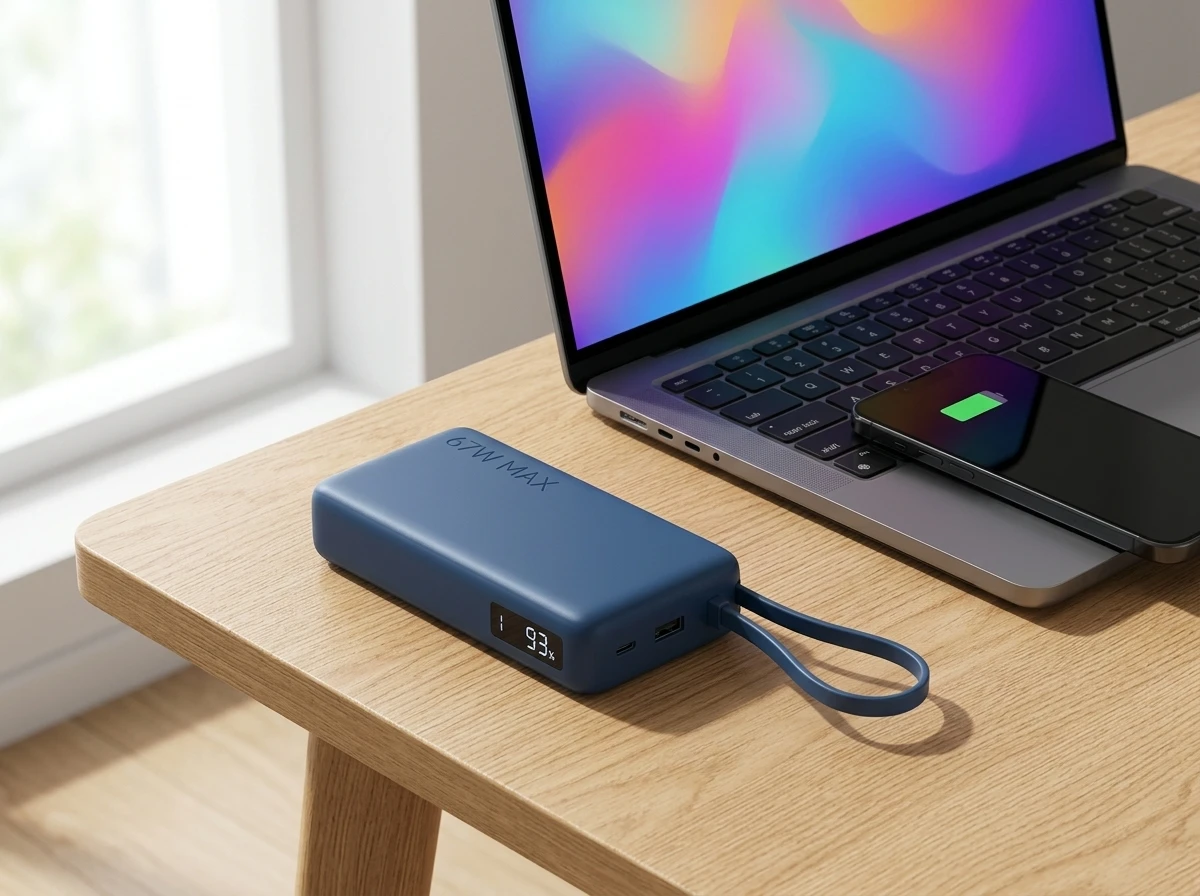
The Xiaomi Power Bank 20000 67W with Built-in Cable and the 45W sibling share the same core layout. An integrated USB-C cable doubles as a short lanyard. Separate USB-C and USB-A ports let you charge three devices at once. Both support battery health checks through a simple web app on a PC or laptop.
The 67W unit adds a smart digital display that shows remaining percentage to the single digit. The 45W version sticks with four status LEDs. Peak output jumps from the earlier 22.5W 20,000mAh bank to 67W or 45W, enough for many thin laptops.
| Feature | 67W Model | 45W Model |
|---|---|---|
| Price (China) | 599 yuan (~$89) | 499 yuan (~$74) |
| Max output | 67W | 45W |
| Display | Smart percentage screen | Four LEDs |
| Cells / energy | Three 6,700mAh / 74.37Wh | Similar high-capacity pack |
| Self-charge | Up to 65W, ~2.5 hours | Supported bidirectional |
Official global pages for the related 67W 20000 unit list three 6,700mAh cells and 74.37Wh rating, well under the 100Wh air-travel limit. Rated capacity sits at 12,000mAh at 5V/3A. Xiaomi claims a Xiaomi 15 reaches 67% in 30 minutes and a MacBook Air 13-inch (M4) hits 37% in the same window.
The shared chassis keeps tooling simple while the wattage and display tiers give buyers a clear step up. Three-device output and the built-in cable cut the accessory pile travelers usually carry. Health data over a wired PC link turns the pack into something you can inspect, not only recharge.
The Standard That Changed the Timeline
China’s first mandatory national power-bank standard, GB 47372-2026, was released March 31, 2026. CCC applications under the new rules opened in July 2026. After April 1, 2027, non-certified units cannot leave the factory or be sold.
The biggest new hurdle is the nail penetration test. A 4 mm steel needle drives through the geometric center of a fully charged cell at roughly 20 mm/s and stays for minutes. The cell must not catch fire or explode. Minor deformation, temperature rise and electrolyte leak are allowed.
- Nail penetration, zero fire or explosion required
- Cycle aging plus lithium plating check, no obvious dendrites after specified cycles
- Hardware intelligent protection, over-charge, over-discharge, short-circuit, over-temperature must be hardware-based
- Unique product coding, full lifecycle traceability via QR or serial
- Enhanced drop, compression, thermal abuse and short-circuit tests
The calendar itself shows how tight the window became:
- March 31, 2026: GB 47372-2026 released
- April 2026: Xiaomi begins shipping early compliant packs
- July 2026: CCC applications open under the new rules
- August 11, 2026: 67W and 45W 20,000mAh models go on sale in China
- April 1, 2027: full enforcement; non-certified units barred from factory exit and sale
Analysts have estimated that roughly 70% of existing production capacity may struggle to clear the bar. Xiaomi began shipping compliant models as early as April 2026, including pocket 10,000mAh units and these larger banks. The company also added battery health monitoring that surfaces cycle count and anomalies over a wired PC connection, matching a transparency push in the standard.
Hardware-based protection is no longer a software promise. Unique coding ties each pack to a traceable life cycle. Together those rules favor makers that already control cell quality and factory process data.
Built-in Cables and the Health Data Layer
The integrated cable is not new for Xiaomi, but the execution is tighter. The TPU cable stores in a groove and becomes a carrying loop. Lab swing tests claim 5,000 cycles at ±150 degrees with a 420 g weight. Low-current mode for earbuds and bands is available on both ports.
Nine layers of protection sit behind the cells: temperature, short-circuit, reset, input/output over-voltage and over-current, plus over-charge and over-discharge. Dual NTC sensors handle thermal control. These features respond directly to a string of real-world failures.
Anker recalled more than a million units across 2024-2025 after fires and burns. Xiaomi itself issued a voluntary recall for certain 33W 20,000mAh integrated-cable units made in late 2024 after overheating reports, including one train cabin fire. In late July 2026 a power bank ignited in an overhead bin on a China Eastern flight after landing. Airlines in the UAE tightened rules almost immediately. Airport security in China already seizes non-CCC packs.
Safety comes first when you’re charging on the go.
Xiaomi India’s official account pushed that line while promoting the related 5i 67W 20,000mAh model, which carries 12-layer protection marketing and similar triple-port layout.
The health readout closes a gap the recalls exposed. Cycle count and anomaly flags give owners a reason to retire a pack before it fails. Wired PC access keeps the feature simple and hard to spoof. Paired with unique product coding under the new standard, the data layer supports both consumer trust and regulator traceability.
67W Changes What a Power Bank Can Do
Older 22.5W banks topped up phones. These units aim at mixed loads. Single-port 67W covers most USB-C laptops that accept 65W PD. Multi-port total drops when three devices draw at once, often to 15W shared in theory, so priority goes to the hungriest device.
Key performance claims from Xiaomi labs:
- Xiaomi 15, 67% in 30 minutes, full charge roughly 2.6 times from one bank
- MacBook Air 13 M4, 37% in 30 minutes, just over one full charge
- Self-recharge, up to 65W input, empty to full in about 2.5 hours with a matching adapter
- Protocols, PD 3.0 PPS, QC 3.5 and legacy Apple/Samsung modes
Actual numbers vary with temperature, cable and device negotiation. Still, the jump from 22.5W to 67W moves the product from phone backup to genuine multi-device travel brick.
Bidirectional input up to 65W means the same high-watt adapter that feeds a laptop can refill the bank in a long coffee stop. Protocol breadth reduces the chance a device falls back to slow defaults. The practical limit remains shared multi-port power, so users still sequence the hungriest load first.
Who Gains When Cheap Packs Disappear
Xiaomi, Huawei, Anker, Ugreen and other large brands co-drafted parts of the standard and already hold cell supply relationships that can pass puncture and aging tests. Smaller no-name factories face higher cell costs, new BMS hardware, unique coding systems and factory audits. Many will exit or become white-label suppliers.
The split looks roughly like this:
- Large brands: early compliant SKUs, existing cell contracts, shelf continuity past April 2027
- Small factories: higher cell and BMS costs, coding systems, audits, exit or white-label roles
- Consumers: safer packs and health data, higher average prices than older 20,000mAh models
- Travelers: packs under 100Wh that clear CCC checks and airline Wh screens
- Airlines and regulators: fewer thermal-runaway incidents and clearer seizure rules
Consumers get safer packs and clearer health data. They also face higher average prices. The 599 yuan 67W bank sits well above older 20,000mAh Xiaomi models. Travelers gain packs that clear both Chinese CCC checks and international Wh limits. Airlines and regulators gain fewer thermal-runaway incidents.
The same China-centric pressure shows up elsewhere. Xiaomi pricing pressure in other markets already forces careful SKU choices; power banks that meet the toughest home standard become easier to export later.
Travel Rules Are Already Moving
Chinese domestic flights and airports increasingly demand visible CCC marks and scannable codes. Non-compliant banks are confiscated on the spot. After the July China Eastern incident, several Gulf carriers tightened cabin storage and watt-hour checks. The pattern is familiar: one high-visibility fire, then blanket restrictions that hit every passenger carrying a generic pack.
Xiaomi’s early compliance and digital display give the company a ready answer. The bank is under 100Wh, carries the right marks, and shows exact remaining capacity so security officers and passengers both see the state of charge. Similar certified launches from Huawei (100W, 12,000mAh, offline locate) show the category is racing toward the same destination.
Software companions keep evolving in parallel. Users who already live inside Xiaomi’s latest HyperOS software updates will find the web-based health readout a natural extension of the same ecosystem approach.
Exact percentage on the 67W model removes guesswork at the checkpoint. Four LEDs on the 45W unit still signal state of charge, if with less precision. Either way, visible compliance marks and sub-100Wh energy ratings become the minimum ticket for cabin carry as rules keep tightening.
Mixed Loads Push Banks Past Phone Duty
The move from 22.5W to 45W and 67W is not only a spec sheet win. It changes what one brick can cover on a work day or a flight connection. A single 67W port can feed thin USB-C laptops that accept 65W PD while the remaining ports handle a phone and earbuds in low-current mode.
Shared output still forces tradeoffs. When three devices draw together, total power often falls sharply, with theory pointing near 15W split across ports. The bank therefore behaves best when the laptop takes priority and smaller loads follow. That sequencing is a habit shift for users who once treated power banks as phone-only spares.
Self-recharge up to 65W shortens the downtime between legs of a trip. Empty to full in about 2.5 hours with a matching adapter means a lunch stop can restore the pack. Protocol support across PD 3.0 PPS, QC 3.5 and legacy Apple and Samsung modes lowers the odds of a stubborn slow handshake.
Lab claims put a Xiaomi 15 at 67% in 30 minutes and a MacBook Air 13-inch M4 at 37% in the same window. Real results still hinge on heat, cable quality and negotiation. Even so, one 74.37Wh pack that stays under airline limits while feeding mixed silicon is a different product category than the older phone-centric banks.
Early Compliance Buys Shelf Space Now
Shipping nail-penetration-ready hardware more than eight months before full enforcement is a commercial move as much as a safety one. Retail buyers need stock that will remain legal after April 1, 2027. A brand already on shelves with certified 10,000mAh and 20,000mAh units fills that slot while rivals rework cells and BMS boards.
Co-drafting parts of the standard gave large makers advance sight of the puncture, aging and hardware-protection bars. Cell supply relationships that already survive those tests become a moat. Unique coding and factory audits add cost layers that smaller shops may not absorb without raising prices past what no-name shoppers will pay.
Health monitoring over a simple web app on a PC mirrors the standard’s transparency push. Cycle counts and anomaly flags give both owners and support teams a shared record. That record pairs with QR or serial traceability so a problem pack can be isolated without a full category recall.
India’s related 5i 67W 20,000mAh model, sold at a lower local price with 12-layer protection marketing, shows how the same architecture can travel. Global pages for the related 67W unit already publish the three-cell, 74.37Wh layout. Other regions can follow once China-side supply settles on the new cells and protection circuits.
The Quiet Market Reset Underway
These two 20,000mAh banks are incremental products on paper: more watts, built-in cable, better display options. Their real weight is timing. By shipping GB 47372-2026 nail penetration requirements compliant hardware in volume today, Xiaomi locks in shelf space and brand trust before the April 2027 sales cliff removes most of the bargain competition.
Global availability remains unannounced. India already sells a close 5i 67W sibling at a lower local price. Other regions will likely receive detuned or rebranded versions once the China supply chain settles on the new cells and protection circuits.
For now the message from Beijing’s factories is clear. Safer cells, higher continuous output, traceable health data and integrated cables are no longer premium extras. They are becoming the price of admission. Xiaomi simply arrived first with the 20,000mAh versions that can actually keep a laptop and two phones alive on the same trip.
After April 2027 the bargain tier that could not pass puncture, aging and hardware-protection tests leaves the open market. What remains is a narrower field of certified packs, higher average prices and fewer overhead-bin surprises. The 599 yuan and 499 yuan models are early proof of that thinner, stricter shelf.


Samsung Smart Switch Now Lets iPhones Jump Without the App Tax

Galaxy S26 FE Price Leak Puts It Too Close to Flagships

Coforge Turns Its PE Deal Playbook Into a Nuuron Business Unit

OCBC Lets Retail Buy Platinum and Palladium From 0.01 Ounce

Xiaomi’s Safer 67W Power Banks Preview China’s 2027 Cull

Galaxy Z Fold 8 Settings That Turn Battery Gains Into Years

PlayStation Discount Codes Hide a Stickier Savings Trap

Free Fire Max Codes Today Feed the Free Tier and the Scammers

Kazakhstan Crypto Amnesty Feeds State Reserve Machine

Nvidia Turns AI Compute Into a $500 Billion Asset Class

Fable 5 and Mythos 5 Return as US Lifts Anthropic Export Controls

Oracle Cuts 21,000 Jobs in a Year, Cites AI in 10-K Filing

SpaceX’s Google Deal Turns a Rocket Company Into a Cloud Landlord

CD Projekt Red Co-CEO: Redemption Arc Isn’t Done, Witcher 4 in 2027

XPL Rallies 30% Ahead of Plasma One Card Tier Launch

DGO App Brings Rs 549 Mobile Pass for FIFA World Cup 2026 in Nepal

Google Search Profiles Build a Follow Graph Inside Discover

Moonshot AI Targets $30 Billion in China’s Fastest AI Funding Sprint

Microsoft Xbox Layoffs Start in July as Sharma Slams 3% Margin

Oppo’s ColorOS 17 Eligibility List Leaves A-Series Buyers Behind
-
 AI1 month ago
Fable 5 and Mythos 5 Return as US Lifts Anthropic Export Controls
-
 AI2 months ago
Oracle Cuts 21,000 Jobs in a Year, Cites AI in 10-K Filing
-
 AI2 months ago
SpaceX’s Google Deal Turns a Rocket Company Into a Cloud Landlord
-
 GAMING2 months ago
CD Projekt Red Co-CEO: Redemption Arc Isn’t Done, Witcher 4 in 2027
-
 CRYPTO2 months ago
XPL Rallies 30% Ahead of Plasma One Card Tier Launch
-
 APPS2 months ago
DGO App Brings Rs 549 Mobile Pass for FIFA World Cup 2026 in Nepal
-
 NEWS2 months ago
Google Search Profiles Build a Follow Graph Inside Discover
-
 AI2 months ago
Moonshot AI Targets $30 Billion in China’s Fastest AI Funding Sprint