
AI
AI Shrinks Solar Inspection Crews While Paying Hybrid Skills Far More
AI vision cuts manual checks in Indian solar plants yet drives 12-30% green-sector salary jumps for workers who can calibrate and retrain the systems.

Industry estimates put green-sector salary gains at 12-15 per cent for entry-level roles, 18-22 per cent at mid-level and 25-30 per cent for seniors in 2026 as AI takes over routine defect checks on Indian solar lines. The same factories now hunt for people who can calibrate vision systems, read the data and retrain models when conditions shift.
That premium arrives while manual inspection crews shrink. India’s solar plants are giving an early, concrete look at how AI remakes factory work: fewer repetitive hands, scarcer hybrid skills, and a green jobs wave that pays better at the top of a thinner ladder.
What Changes on a Solar Production Line
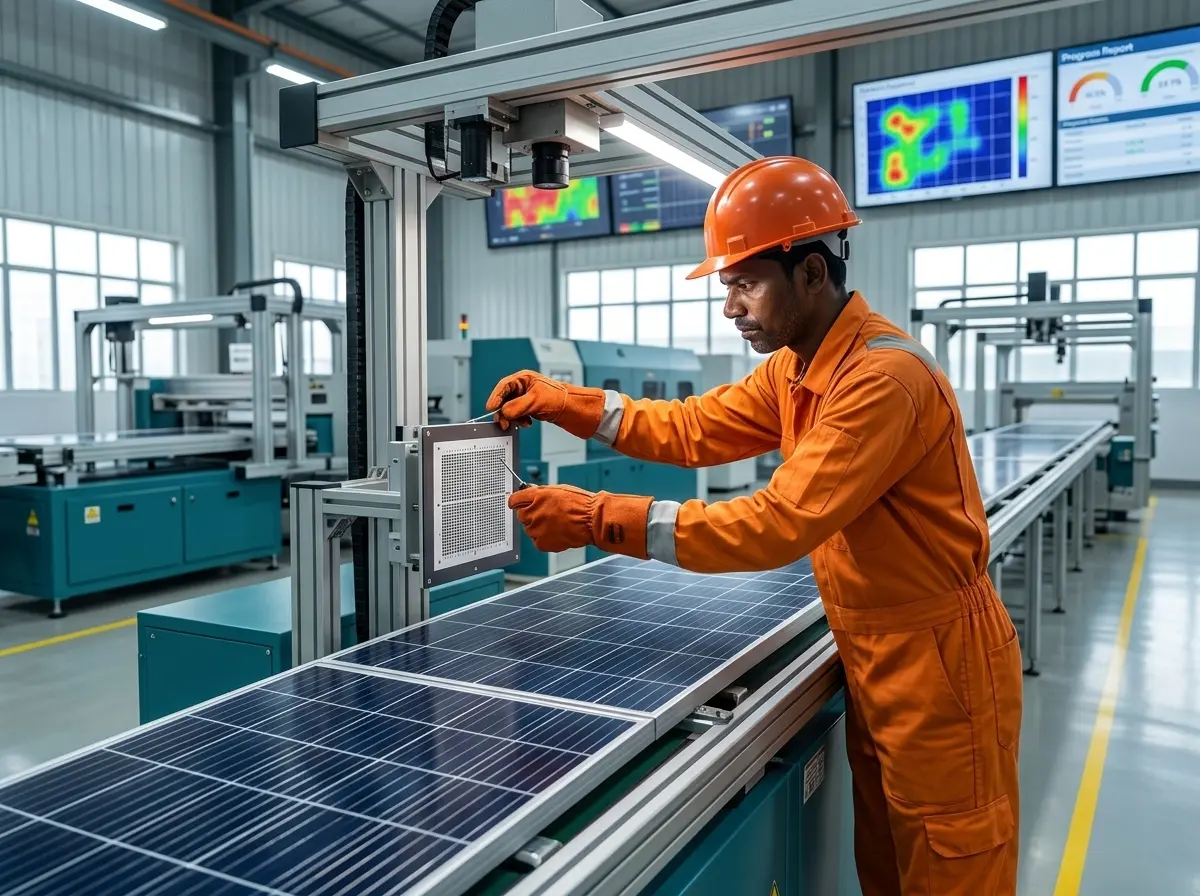
Automated vision systems scan modules for defects. Predictive quality tools flag problems before they cascade. Some lines adjust themselves from the signals they receive. Earlier, several workers stood at stations doing those checks by eye and hand.
The machines still need humans. Workers must monitor the defect systems, keep cameras and lighting calibrated, interpret the streams of data and, when production recipes or materials change, retrain the models. The job title may stay similar. The daily work does not.
- Monitor AI defect-detection dashboards in real time
- Calibrate cameras, lighting and mechanical handlers
- Interpret quality data and escalate process drift
- Retrain or fine-tune models when conditions shift
The shift is less about removing people from the building and more about relocating judgment. A camera that never blinks still cannot decide whether a new encapsulant batch needs a fresh training set. Lighting drift, mechanical wear and recipe changes all push the model off its original map. Someone on the floor has to notice and correct course.
Vijay Menon, COO of Navitas Solar, put the industry framing plainly. He said companies should view AI adoption in solar manufacturing through the value and skill level of the jobs created, not only the jobs lost.
Pay Climbs Fastest Where Hybrid Skills Are Scarce
The salary estimates for 2026 sit on a simple shortage: too few people who know both shop-floor manufacturing and AI, automation or advanced process controls. Concrete plant-level numbers from manufacturers already show the gap opening.
| Level | Estimated 2026 rise | Plant-level examples reported |
|---|---|---|
| Entry-level green roles | 12-15% | Solar entry packages now ~₹4-4.45 lakh, matching many IT starts |
| Mid-level | 18-22% | Quality operators moved from ₹20,000-25,000/month toward ₹50,000-75,000 |
| Senior / plant leadership | 25-30% | Plant managers from ~₹75,000/month toward ₹3-5 lakh |
Neeti Sharma, CEO of TeamLease Digital, told Saur Energy that salary parity with IT is emerging for fresh engineering graduates. Shravan Gupta, MD of Cosmic PV Power, described the operator and manager jumps as capacity scaled from small lines to multi-gigawatt output. A 1 GW module plant typically needs roughly 350-800 people across production and support, with the exact headcount falling as automation rises.
Other green-sector tracking has already logged average salary increases around 20 per cent over one to two years, with Tier-1 city packages running substantially higher. The AI layer simply sharpens the premium for anyone who can sit between the line and the model.
Read across the three bands and the pattern is steep. Entry gains stay close to the broader green-sector average near 20 per cent. Mid-level and senior jumps pull ahead because those seats combine process authority with model literacy. Plants pay for the combination, not for either skill alone.
The People Factories Need
Knowing how to run a machine is no longer enough. Employers want staff who understand the data the machine throws off and can improve its performance. That hybrid profile is rare.
Cell, wafer and ingot lines widen the shortage further. New entrants into upstream manufacturing often lean on equipment suppliers for rapid training because experienced Indian cell-line talent is thin. Digital and analytics roles in predictive maintenance, performance optimisation and energy management are also rising as plants and fleets grow.
The same scarcity shows up in three hiring channels at once:
- Campus and ITI pipelines that still emphasise legacy machine operation
- Upstream cell, wafer and ingot lines that depend on supplier-led crash courses
- Plant digital teams that need predictive maintenance and energy-management analytics
The pattern matches what is already visible in white-collar work elsewhere. AI cutting and adding roles in finance and tech has compressed entry ladders while bidding up specialised and domain-heavy talent. Solar manufacturing is running a physical-world version of the same split.
How Big the Green Jobs Wave Is
India’s clean energy transition is projected to generate more than 35 million green jobs by 2047, or roughly 1.6 million a year on a straight average. The Skill Council for Green Jobs vision to 2047 frames that range as 30-35 million additional roles across renewables, storage, green hydrogen, biofuels, EV charging, pollution control and related fields, backed by more than 10 million skills trainings.
A June 2026 CEEW-NRDC study, guided by the Ministry of New and Renewable Energy, estimated that India’s 500 GW non-fossil target and green hydrogen goals could support over 44 lakh clean-energy FTE jobs by 2030. Rooftop solar alone accounts for about 43 per cent of that total because distributed installation is far more labour-intensive per megawatt: roughly 45 FTE job-years per MW versus about 1 for ground-mounted solar.
| Segment or horizon | Scale already cited |
|---|---|
| Green jobs by 2047 | More than 35 million (about 1.6 million a year) |
| Skill Council long-range frame | 30-35 million additional roles; 10 million-plus trainings |
| Clean-energy FTE by 2030 | Over 44 lakh |
| Rooftop share of 2030 total | About 43 per cent |
| Labour intensity | ~45 FTE job-years per MW rooftop vs ~1 ground-mounted |
| Recent segment hiring (FY23-FY26) | Over 6.5 lakh workers added |
Select clean-energy segments already added over 6.5 lakh workers between FY23 and FY26, with rooftop the largest share. Manufacturing and long-life operations and maintenance roles make up a durable slice of the future total. Inside manufacturing, 80-90 per cent of jobs are highly skilled or semi-skilled. That is the band where AI literacy becomes non-negotiable.
Installation and factory floors will not absorb people in the same proportions. Distributed rooftop work still multiplies hands per megawatt. Automated module lines do the opposite: they cut repetitive stations while protecting a thinner set of hybrid seats. Both sit inside the same national totals, which is why headline job counts can rise even as individual plants run leaner crews.
Training Capacity Still Trails the Machines
The Skill Council for Green Jobs, set up in 2015 under the Ministry of Skill Development and Entrepreneurship with MNRE and industry backing, has built 44 nationally approved qualifications and a network of hundreds of centres. Partners have trained more than 500,000 candidates, including over 100,000 in solar and other renewables. By 2030 the council aims to facilitate training for one million candidates in clean energy technologies plus two million via virtual or blended upskilling, with 20 centres of excellence and 7,500 certified trainers.
Its 30-35 million additional green jobs handbook sits behind the long-range headline. On the ground, manufacturers still report that mid- and senior-level experience is the tightest bottleneck, and that many campus and ITI hires need months of internal machine-specific training before they are safe and productive on automated lines.
Arpit Sharma, CEO of the Skill Council, has described ongoing work on Suryamitra-style installer training, module manufacturing curricula and trainer development. The gap that remains is precisely the AI-and-automation layer now moving onto shop floors.
Volume training and plant-ready hybrid skill are not the same product. Hundreds of centres and half a million candidates already show reach. Months of internal coaching after hiring show what those programmes still leave unfinished once vision systems and predictive tools arrive on the line.
The real constraint for us isn’t automation, it’s building a workforce that can work alongside increasingly intelligent manufacturing systems.
Menon of Navitas Solar said that after noting that early investment in training and specialised talent can lift both quality and productivity while creating higher-value careers. Companies that treat the people pipeline as optional will feel the constraint first in yield, downtime and wage inflation.
Who Gains and Who Gets Squeezed
Winners are clear: technicians and engineers who can already speak both manufacturing and data, plant leaders who have scaled automated lines, and firms that lock in training partnerships early. They capture the 18-30 per cent band of raises and the performance incentives many renewables employers now tie to output and quality.
Losers are also clear. Purely repetitive inspection and basic operator roles thin out. Workers who only know legacy machines face a harder path into the new lines. Entry rungs that once let large numbers of 10th- or 12th-pass candidates into factories become narrower when the first useful step already assumes digital fluency. Women remain only about 11 per cent of the surveyed solar and wind workforce, and most of those roles sit in non-technical functions, so the high-skill band risks staying even more skewed.
Global labour research on AI exposure shows the same compression. PwC’s barometer finds that AI-exposed roles change skills twice as fast as the least exposed ones, and that junior AI-exposed jobs demand traditionally senior skills far more often. Solar plants are simply applying that logic to physical production.
The squeeze is therefore double. Headcount per gigawatt falls as automation rises inside the 350-800 range typical of a 1 GW module plant. At the same time the remaining posts ask for skills that once appeared later in a career. Workers without a bridge into data and calibration lose rungs; employers without a training bridge pay the 25-30 per cent senior premium in a thinner market.
Where Installation Labour and Factory Labour Diverge
National green-jobs totals blend two labour systems that behave differently under technology pressure. Rooftop solar still needs roughly 45 FTE job-years per megawatt. Ground-mounted utility work needs about 1. That gap is why rooftop already supplies about 43 per cent of the 44 lakh clean-energy FTE jobs projected by 2030 and why it took the largest share of the 6.5 lakh workers added between FY23 and FY26.
Factory employment follows another curve. Inside manufacturing, 80-90 per cent of roles are already highly skilled or semi-skilled. AI vision, predictive quality and self-adjusting lines push that band further toward hybrid literacy. A plant can hit multi-gigawatt output with fewer people on repetitive stations while still bidding aggressively for the operators and managers who keep models aligned with materials and recipes.
Installer pathways and module-line pathways will therefore not share the same wage story. Distributed installation remains labour-intensive per megawatt and closer to the older green-jobs narrative of broad access. Automated manufacturing concentrates pay in the 18-30 per cent uplift bands and narrows the door for candidates whose only credential is speed on a legacy station.
Policy targets such as the 500 GW non-fossil goal and green hydrogen build-out enlarge both pools at once. They do not erase the split. Workers, trainers and employers who treat “green jobs” as a single ladder will misread where the scarcity, and the raises, actually sit.
How the Timeline of Targets Stacks Up
The institutions and studies behind the headline numbers arrived in stages. Placed in order, they show capacity building racing a demand curve that keeps steepening.
- 2015 – Skill Council for Green Jobs established under the Ministry of Skill Development and Entrepreneurship with MNRE and industry backing.
- FY23 to FY26 – Select clean-energy segments add over 6.5 lakh workers, rooftop the largest share.
- June 2026 – CEEW-NRDC study, guided by MNRE, puts clean-energy FTE support above 44 lakh by 2030 against the 500 GW non-fossil and green hydrogen goals.
- 2030 aims – Council plans to facilitate training for one million candidates in clean energy technologies plus two million through virtual or blended upskilling, with 20 centres of excellence and 7,500 certified trainers.
- 2047 horizon – More than 35 million green jobs projected, framed by the council as 30-35 million additional roles backed by more than 10 million skills trainings.
Against that clock, partners have already trained more than 500,000 candidates and over 100,000 in solar and other renewables across 44 nationally approved qualifications. The open question is not whether training volume rises. It is whether curricula catch the AI-and-automation layer fast enough to ease the mid- and senior-level bottleneck manufacturers already report.
The Factory That Pays More Employs Differently
India’s solar manufacturing build-out, ALMM expansion and schemes such as PM Surya Ghar keep demand for modules and installers rising. IRENA data already placed India second only to China in solar employment. Yet every new automated line that removes manual check stations simultaneously bids up the remaining hybrid seats.
The ironic result is baked into the technology choice itself. AI improves quality and throughput and supports the clean-energy build that is supposed to deliver tens of millions of livelihoods. At the same time it concentrates the best pay and the most secure factory careers among people who can already operate, debug and improve intelligent systems. The 35 million figure and the 44 lakh nearer-term estimate remain large. The share of those roles that look like traditional, quickly trained manufacturing work is smaller than many earlier green-jobs narratives assumed.
Factories that invest early in the hybrid layer will ship better modules with fewer people on the floor. Workers who close the manufacturing-plus-AI gap will take home the raises the estimates describe. Everyone else will find the green factory of the future a harder door to walk through than the one that opened a decade ago.


Coreum Bridge Multisig Signed Off on Its Own 200k XRP Drain

AI Shrinks Solar Inspection Crews While Paying Hybrid Skills Far More

Intel Graphics Driver Fixes Still Fight Windows and OEMs

Codex Now Runs Your Mac Apps and Remembers Across Days

Mercado Takes DOH as Dual Leadership Faces Health Funding Test

Gmail Keeps Breaking in iPhone Mail for a Deeper Reason

Golaman Ties Tourist Tee Times to Filipino Junior Golf Funding

Gemini App Hits 1 Billion Users on Google’s Distribution Edge

Binge with AI Turns Noida Food Hub into Free Family Tech Lab

Claude’s Invisible Marks Now Tag Light AI Help Worldwide

Fable 5 and Mythos 5 Return as US Lifts Anthropic Export Controls

Oracle Cuts 21,000 Jobs in a Year, Cites AI in 10-K Filing

SpaceX’s Google Deal Turns a Rocket Company Into a Cloud Landlord

CD Projekt Red Co-CEO: Redemption Arc Isn’t Done, Witcher 4 in 2027

XPL Rallies 30% Ahead of Plasma One Card Tier Launch

Google Search Profiles Build a Follow Graph Inside Discover

DGO App Brings Rs 549 Mobile Pass for FIFA World Cup 2026 in Nepal

Moonshot AI Targets $30 Billion in China’s Fastest AI Funding Sprint

Microsoft Xbox Layoffs Start in July as Sharma Slams 3% Margin

Oppo’s ColorOS 17 Eligibility List Leaves A-Series Buyers Behind
-
 AI1 month ago
Fable 5 and Mythos 5 Return as US Lifts Anthropic Export Controls
-
 AI2 months ago
Oracle Cuts 21,000 Jobs in a Year, Cites AI in 10-K Filing
-
 AI2 months ago
SpaceX’s Google Deal Turns a Rocket Company Into a Cloud Landlord
-
 GAMING2 months ago
CD Projekt Red Co-CEO: Redemption Arc Isn’t Done, Witcher 4 in 2027
-
 CRYPTO2 months ago
XPL Rallies 30% Ahead of Plasma One Card Tier Launch
-
 NEWS2 months ago
Google Search Profiles Build a Follow Graph Inside Discover
-
 APPS2 months ago
DGO App Brings Rs 549 Mobile Pass for FIFA World Cup 2026 in Nepal
-
 AI2 months ago
Moonshot AI Targets $30 Billion in China’s Fastest AI Funding Sprint