
NEWS
Instagram Plus Sells $3.99 Extras as Meta Meters AI
Instagram Plus at $3.99 copies Snapchat-style extras so Meta can later charge $7.99 and $19.99 for extra Meta AI.

Instagram Plus and Facebook Plus cost $3.99 a month, and WhatsApp Plus costs $2.99, after Meta’s May 27, 2026 global rollout. The paid extras are optional. The core apps stay free.
The same day, Meta began testing Meta One plans that meter its assistant at $7.99 and $19.99. The cheap social add-ons look like stickers and longer Stories. They also open a card on file that those AI caps can later fill.
The Snapchat+ Feature Pack, Repriced for Instagram
Snap already ran this experiment. Snapchat+ launched in late 2022 as a paid layer on a free chat app, selling story extras, custom icons, and small controls that make the app feel owned rather than rented.
On February 18, 2026, Snap said that paid community had 25 million members and a $1 billion run rate across Snapchat+, Lens+, Snapchat Premium, and Memories storage. Snapchat then counted more than 946 million monthly active users. That is a 2.6% take-up on the monthly base, built over more than three years.
Instagram Plus lands in the same aisle. Rewatch counts, custom app icons, extra pins, and longer Stories are the pack Snap already trained people to buy. Meta is bringing that catalog to a Family daily base of 3.60 billion people as of June 2026, up 3% from a year earlier.
HOW THE PAID LAYER ARRIVED
- Late 2022: Snapchat+ launches as a paid extras tier on a free app.
- 2023: Meta Verified sells a badge, impersonation monitoring, and support as a separate product.
- March 2026: Instagram Plus tests begin in a handful of countries.
- May 27, 2026: Meta rolls out Instagram Plus, Facebook Plus, and WhatsApp Plus globally and names Meta One as the future home for AI and professional plans.
- June 4, 2026: Instagram Plus gets a full iPhone feature list, 11 extras in all.
- June 2026: Meta One AI tests are slated for Singapore, Guatemala, and Bolivia.
- July 29, 2026: Meta reports June Family daily active people of 3.60 billion and full-year capex guidance of $130 billion to $145 billion.
Snap’s own note on why people pay is blunt about the small stuff. Pinning a best friend and swapping chat wallpapers sound minor on a spec sheet, the company said, and still hold because they sit on chats people open every day. Meta is betting the same habit will transfer to Stories, pins, and WhatsApp themes.
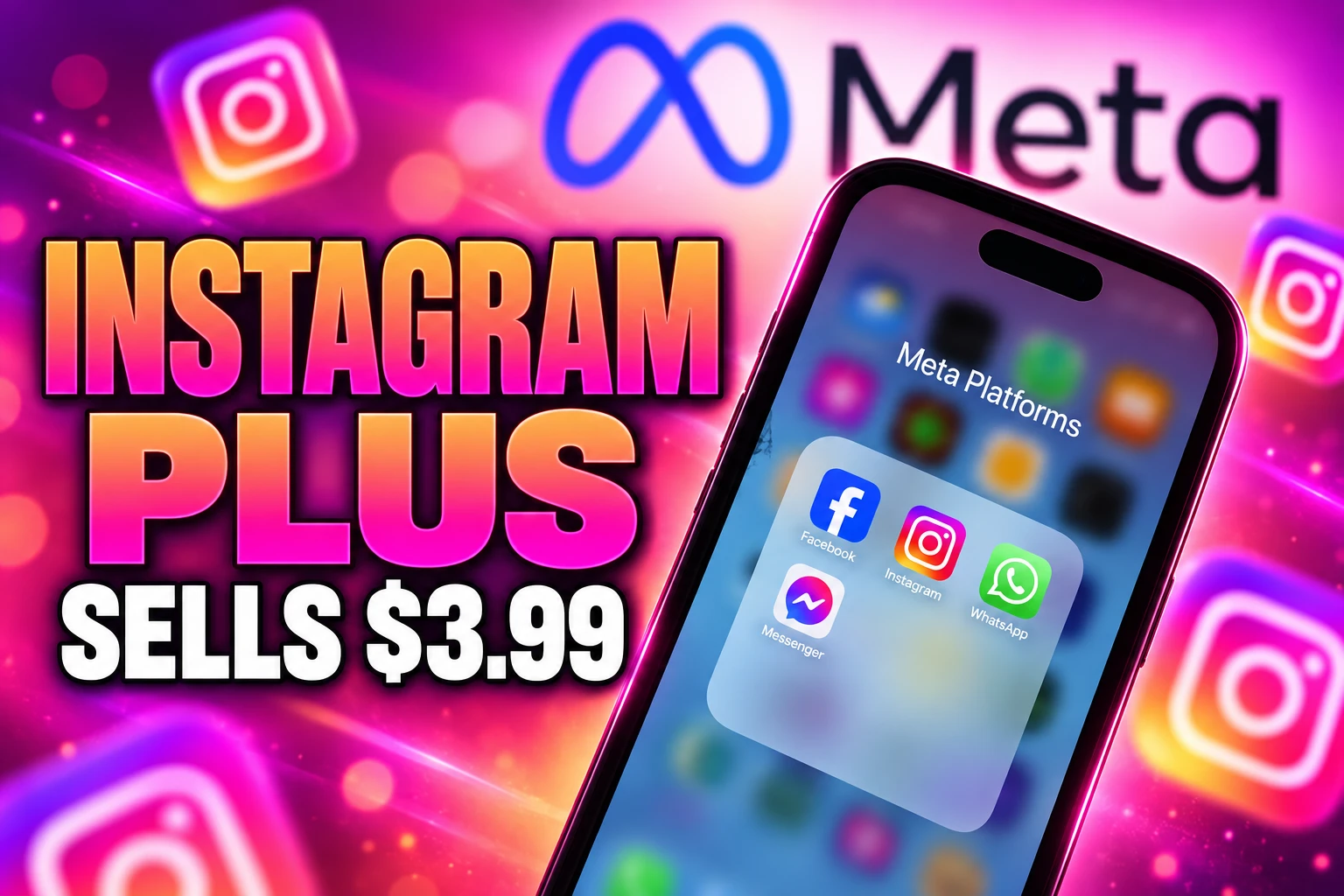
Eleven Paid Features, and Ads Stay On
Instagram Plus is the deepest of the three social plans. Meta’s June 4 announcement listed 11 extras. None of them turns ads off. YouTube Premium and Snapchat Platinum sell quiet. This SKU sells control over Stories and a few cosmetic switches.
INSTAGRAM PLUS FEATURES
- Story Spotlight: One story a week gets priority in friends’ trays.
- Super Hearts: Animated hearts burst across a friend’s story.
- Multiple audiences: Extra story lists beyond Close Friends, with no cap stated.
- Story Extend: A story can last 48 hours instead of 24.
- Story Preview: A look at a story without showing up as a viewer.
- Rewatch insights: An aggregate count of how many times stories were replayed.
- Search viewer list: Find whether a named person opened a story.
- Custom app icon: Alternate home-screen icons from Instagram and creators.
- Custom bio font: A different typeface on the profile bio.
- More profile pins: Up to 6 pinned posts.
- Post to profile only: A post or highlight can skip followers’ feeds.
Facebook Plus tracks the same story tools: 48-hour expiry, rewatch counts, a searchable viewer list, Super Reactions, a mini preview that does not mark you as a viewer, and a custom app icon on Facebook or Messenger. WhatsApp Plus is a different product. It sells themes, extra pinned chats, premium stickers, ringtones, and list controls, not story reach.
The anonymous preview is the extra people argue about, because it changes a social norm, not a color. On Facebook, posters are told the preview exists. The rest of the catalog is status and convenience. Instagram says more Plus features will arrive in the coming months, which is how a $3.99 plan stays sticky after the first week of icons.
Why Meta Priced the Extras at Four Dollars
Naomi Gleit, Meta’s head of product, announced the rollout in an Instagram video on May 27. She framed the plans as optional extras on apps the company still calls free.
“These subscription plans offer richer ways to express and connect across our apps, with more fun features to be added,” Gleit said. She also said Meta was testing plans “for those who want to unlock more from our apps and AI glasses,” and that Meta One is meant to become the single home for those bills.
While we’re still testing and learning, eventually we see Meta One as the one place that brings our subscriptions together across all of our apps. This is just the beginning with a lot more value to come.
Naomi Gleit, Head of Product, Meta, May 27 Instagram announcement
That is the second move hiding in the first. A $3.99 Instagram plan and a $2.99 WhatsApp plan are easy to approve on a phone. Once the store account is live, Meta can add capacity caps, glasses features, and a $19.99 reasoning tier without asking someone to enter a card for the first time. The social extras are the on-ramp. The meter is the business.
The three social plans do not bundle. Paying for Instagram Plus does not switch on Facebook Plus or WhatsApp Plus. Power users who want the full set pay three times, which is how a “few dollars” stack into a real monthly bill before AI is added.
What Meta One Charges for Extra AI
Meta AI stays free for casual use. The test plans sell more of the expensive part: extra image and video generation, longer or heavier queries, and, on the top consumer tier, more room for “thinking mode” on complex tasks. Glasses perks are supposed to follow in later weeks of the test.
Meta One Plus is $7.99 a month. Meta One Premium is $19.99 a month. Both share features; Premium buys more capacity on high-compute jobs. Tests were set to start in June 2026 in Singapore, Guatemala, and Bolivia. Separate creator and business tests were lined up the same week as the May launch in Saudi Arabia, Morocco, Thailand, and Bangladesh.
THE META SUBSCRIPTION LADDER
| Plan | Monthly price | What it sells | Ads |
|---|---|---|---|
| WhatsApp Plus | $2.99 | Themes, stickers, extra pins, ringtones | Not an ad product |
| Instagram Plus | $3.99 | 11 story, preview, and profile extras | Stay on |
| Facebook Plus | $3.99 | Story extras, Super Reactions, app icon | Stay on |
| Meta One Plus | $7.99 | More Meta AI capacity (test) | Not an ad product | Meta One Premium | $19.99 | Heavier reasoning and more generation (test) | Not an ad product |
| Meta One Essential | $14.99 | Badge, impersonation protection, link sheet (test) | Stay on |
| Meta One Advanced | $49.99 | Essential plus search lift, scheduling, reuse alerts (test) | Stay on |
Essential is priced on top of the badge Meta already sells. Advanced adds feed and search placement, a bolder Follow button on Reels, auto follow invites, links in posts and Reels, deeper analytics, scheduling, shared access without a shared password, and alerts when someone reuses a Reel. Those tests are not the global consumer SKU. They show where Gleit’s “one place” is headed: social extras, identity, and AI compute on one invoice.
The same habit is being wired into Meta’s Muse agent and in-app checkout tools, so an assistant can finish a task inside the apps rather than dump someone into a separate window. A card saved for Super Hearts is a card an agent can spend.
Meta Verified Still Costs Extra
Plus does not replace Meta Verified. Meta has said the badge product stays. Verified is identity, impersonation takedowns, and support. Plus is Stories, icons, and chat chrome. They do not stack by default.
The Meta Verified Standard plan at $14.99 a month is the in-app price per profile. The same Standard plan is $11.99 on the web. Higher creator tiers list at $49.99, $149.99, and $499.99 a month. Facebook and Instagram are billed as separate profiles unless they are linked for a discount in Accounts Center.
That split is already messy at checkout. A Verified subscriber who moved to Instagram Plus described the badge plan cancelling itself, then landing on a waitlist inside an automated support loop with no fast human handoff. One anecdote is not a policy paper. It is what happens when two paid catalogs share a store and a support bot.
Meta One Essential at $14.99 sells the badge, impersonation protection, and an expanded link sheet, which is Verified’s job in different clothes. If that test holds, the older Verified SKU is the product most exposed to the new ladder, not the free app.
$31.08 Billion Went Out in One Quarter
The social extras will not pay for the compute bill. Meta’s July 29, 2026 results put the gap in plain figures.
META’S SECOND-QUARTER BILL
- Revenue: $60.80 billion, up 28% from a year earlier, still almost all ads.
- Capex: $31.08 billion in the quarter, including finance-lease principal.
- Free cash flow: $784 million, after $31.86 billion of operating cash flow.
- Full-year capex: 2026 capital expenditures of $130 billion to $145 billion, with the floor raised from $125 billion.
Research and development was $21.656 billion in the quarter, up 67% from $12.942 billion a year earlier. Total costs and expenses were $42.03 billion, up 55%, a figure that includes $2.40 billion of legal charges and $1.18 billion of severance from the May 2026 headcount cut. Net income was $15.85 billion, down 14%. Cash and marketable securities were $90.26 billion against $83.66 billion of long-term debt.
Mark Zuckerberg, Meta’s founder and CEO, said on the results release that AI is “accelerating our core business today, powering our next generation of products, and opening the door to entirely new enterprise opportunities.” Ads still throw off the cash. Family ad impressions rose 14% and average price per ad rose 12%. The Plus plans are a second cash register, not a replacement.
Even Snap’s entire 25 million paid community, copied onto Meta’s scale as a headcount rather than a rate, would be a thin slice of 3.60 billion daily people. At $3.99, that slice is a rounding error next to a $130 billion to $145 billion build. The build is the constraint. The $4 plan is how Meta starts charging the people who already live in the apps.
WhatsApp Users Mix Plus Up With a Required Fee
Months after the May launch, the plans are still arriving in phases, and the free tier is where the fight is. People keep treating WhatsApp Plus as a fee for WhatsApp itself. The company has not made the messenger a paid app. The $2.99 SKU is themes and pins. That distinction dies in a settings screen that asks for a card.
Everyday gestures are drifting behind the plan too. Long-press actions and other small chat controls that used to feel native now show up as Plus prompts in some clients, which is how a free app starts to feel metered without a homepage price. The objection is not that $2.99 is expensive. It is that the gesture was already there.
Traders read the May 27 prices as a way to recoup AI spend. Users read them as another monthly bill for apps they already feed with time. Both readings can be true at once. The social SKUs are too small to fund the data centers. They are large enough, at 3.60 billion daily people, to normalize paying Meta for things that used to be included.
Singapore, Guatemala, and Bolivia were the first listed markets for the $7.99 and $19.99 AI caps. Meta has not published conversion figures from those tests. Until it does, the public product is still Super Hearts, 48-hour Stories, and a WhatsApp theme pack, sitting in front of a meter Gleit has already named.

Google Says AI Agents Now Compress Thefts Into Hours

Average People Feel AI First on the Power Bill

Suno Turns the Warner Settlement Into Licensed v6 Models

Lunit Turns Routine H&E Slides Into a Lung Pre-Screen

Meta’s Muse Agent Wants Your Inbox and Your Card

Fable 5 Came Back Under a Commerce On-Off Switch

Google’s SpaceX GPU Lease Has a Sept. 30 Deadline

Plasma One’s XPL Locks Face a 1.81 Billion Cliff

DGO’s Rs 549 World Cup Pass Cost Fans Sleep and Data

Moonshot AI’s $30 Billion Ask Became a $35 Billion Close
-
 AI3 months ago
Fable 5 Came Back Under a Commerce On-Off Switch
-
 AI4 months ago
Google’s SpaceX GPU Lease Has a Sept. 30 Deadline
-
 CRYPTO4 months ago
Plasma One’s XPL Locks Face a 1.81 Billion Cliff
-
 APPS4 months ago
DGO’s Rs 549 World Cup Pass Cost Fans Sleep and Data
-
 AI4 months ago
Moonshot AI’s $30 Billion Ask Became a $35 Billion Close
-

 NEWS4 months ago
ColorOS 17 Device List Spans Oppo, OnePlus and Realme
-

 GAMING4 months ago
Xbox Cuts 3,200 Jobs After Five Years of Thin Returns
-

 GAMING3 months ago
The RTX 4050 Under Rs 70,000 Hides a Wattage Gap