
GADGETS
Starlink’s New V5 Dish Is Smaller, Cheaper to Build, and a Bit Slower
Starlink’s V5 dish weighs 2.4 pounds, uses 35 to 50 watts, and ships in select U.S. areas, trading peak speed for a lighter, cheaper build.

SpaceX began shipping its new Starlink V5 dish on July 14, 2026, and the pitch has almost nothing to do with faster downloads. The residential terminal weighs about 2.4 pounds, down from roughly 6.4 to 6.5 pounds on the outgoing V4, and it draws as little as 35 watts instead of 75 to 100. Peak hardware speed actually falls, from 400+ Mbps on the V4 to 375+ Mbps on the new dish.
The trade shows up in the hardware’s internals too. An engineering teardown cited by Mobile Internet Resource Center counted roughly 820 antenna elements inside the V5’s phased array, about half the 1,536 packed into the V4. SpaceX has not confirmed that figure, but it fits a dish built for far higher production volume, not a faster one.
Lighter Dish, Smaller Draw, Slower Peak Speed
SpaceX’s own comparison of the two terminals lists every major spec side by side. The V5 measures about 12.05 by 15.12 inches and 1.34 inches thick, next to a V4 footprint of roughly 23.4 by 15.1 inches. That is close to a third narrower, and the weight drop is sharper still: 2.4 pounds against 6.4 to 6.5 pounds.
Average power consumption falls from 75 to 100 watts down to 35 to 50 watts. SpaceX also lists sharply improved mounted wind resistance, while the dish keeps the same 110 degree field of view and IP67 weatherproof rating as the V4.
| Spec | Starlink V4 | Starlink V5 |
|---|---|---|
| Weight | About 6.4 to 6.5 lb | About 2.4 lb |
| Dimensions | 23.4 x 15.1 x 1.5 in | 12.05 x 15.12 x 1.34 in |
| Average power draw | 75 to 100 W | 35 to 50 W |
| Peak hardware speed | 400+ Mbps | 375+ Mbps |
| Mounted wind rating | 60 mph | Reported as high as 165 mph |
| Bundled router | Router 3 | Router Mini |
The new dish now sits close in weight to Starlink’s portable Mini terminal. SpaceX still reserves in-motion use for the Mini and the pricier Performance dish, not the V5.
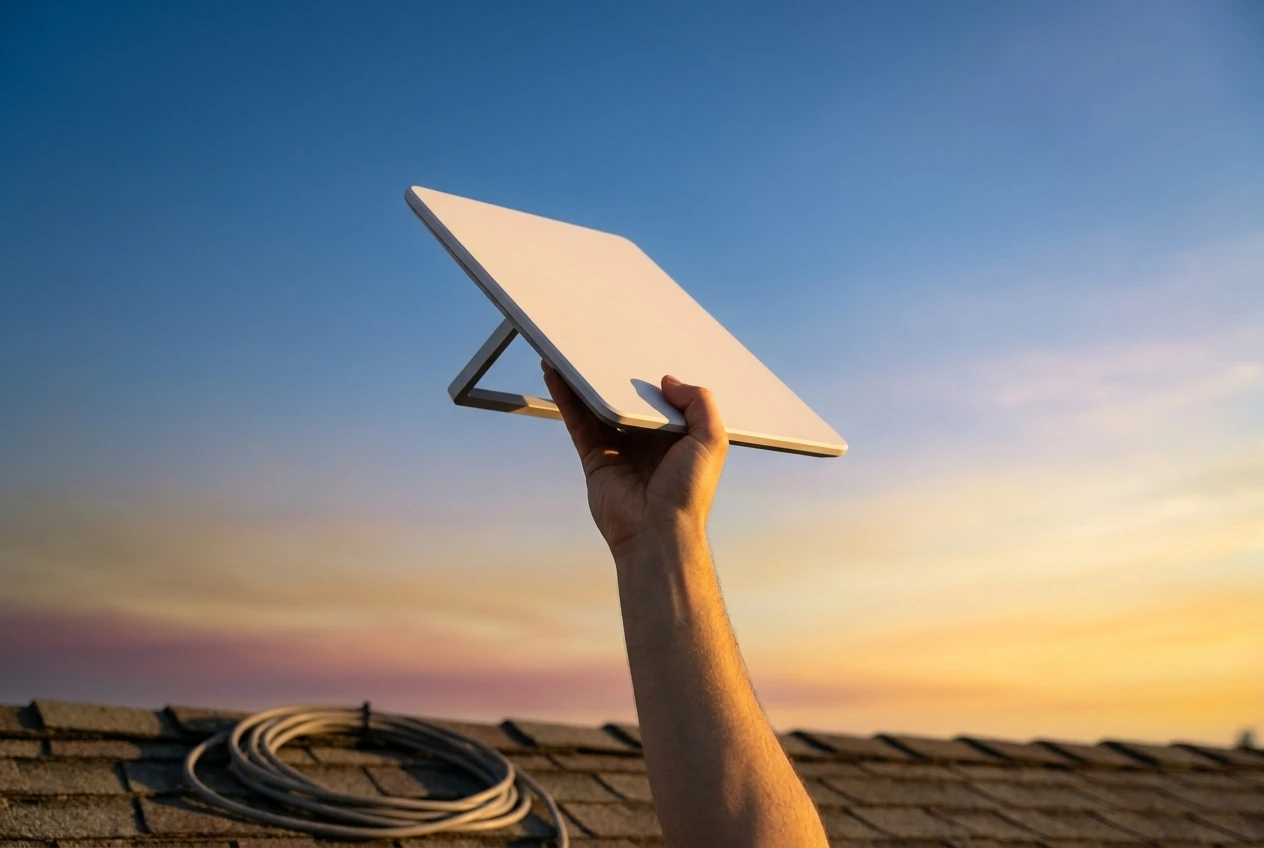
Starlink V5 has a smaller form factor and lightweight design with greater power efficiency than the Starlink V4. With speeds up to 375+ Mbps, Starlink V5 delivers seamless connectivity for streaming, video calling, gaming and more.
Starlink posted that description on X on July 14, 2026, the same day the dish appeared in its ordering app and on its support pages.
Half the Antenna, Half the Cost
SpaceX has not published a technical breakdown of the V5’s internals, but the outline is visible in the numbers already out. A phased array with roughly half the antenna elements of the V4 costs less to build, draws less power by design, and produces a smaller effective aperture, which lines up with the modest dip in peak throughput.
Elon Musk previewed the terminal during an interview more than a month before the formal reveal, in the run-up to SpaceX’s stock market listing. He said on X that the new dish would be built in “much higher volume than the current terminals.”
That run-up has produced its own drama away from the hardware. Trading in SpaceX shares ahead of the listing has already left pre-IPO perpetual futures traders sitting underwater, even as the exchanges running those markets keep collecting fees.
Fewer antenna elements, a smaller enclosure and a lighter shipping weight all point the same direction: a dish built to be manufactured fast and cheap, in numbers large enough to fill Starlink’s next wave of sign-ups. The company’s broader subscriber base has already grown to roughly 12 million connections worldwide, up from 6 million a year earlier, the kind of scale that rewards a cheaper terminal over a marginally faster one.
Which Households Can Order Starlink V5 Today?
Starlink V5 is currently limited to select launch zones in the United States, and early sign-ups show a clear pattern: it ships with Starlink’s cheapest residential tier first, not its fastest. In Drummond, Montana, V5 comes only with the $55-a-month, 100 Mbps plan, while faster tiers still ship the older V4 with Router 3.
The kit itself is a packaging change as much as a hardware one. It arrives with the smaller Router Mini rather than Router 3, plus a pipe adapter for rooftop mounts included in the box instead of sold separately.
Pricing remains murky. In one Boise, Idaho, order flow, the V5 appeared as a rental with a $349 upfront hardware charge stacked on top of Starlink’s $10 monthly residential rental fee, a combination Mobile Internet Resource Center flagged as a possible early listing error rather than a finished price.
What we know: the confirmed details so far.
- Available in select U.S. regions since July 14, 2026, with wider access promised as production increases.
- Uses a separate external power supply brick rated for outdoor installation, apart from the router.
- Tied to Starlink’s lowest-tier, 100 Mbps Residential plan in at least one confirmed region.
- Not rated by Starlink for use while a vehicle or vessel is in motion.
What’s unconfirmed: the open questions outlets are still chasing.
- Official standalone hardware pricing has not been published.
- A firm international rollout date beyond “as production ramps.”
- The exact mounted wind rating, cited as either 165 mph or 99+ mph depending on the outlet.
- Whether the reported antenna-element count has been verified by SpaceX itself.
Local availability still runs through Starlink’s own ordering tool. Plan tiers and hardware options can differ address to address, so the app or website remains the only reliable check for a given home.
Rural and Off-Grid Users Stand to Gain Most
None of this makes the V5 an automatic upgrade for existing customers. A household already running a V4 dish on a faster plan loses a little peak speed by switching, and gains a lighter box on the roof, a trade that matters most to a specific set of buyers.
- Off-grid and solar-powered homes, where cutting average power draw nearly in half stretches battery and panel capacity further.
- Self-installers in rural areas, since a 2.4-pound dish and an included pipe adapter cut down on the two-person rooftop jobs the heavier V4 often required.
- Households in hot climates, where a cooler-running, lower-wattage unit may reduce the heat-related throttling that has affected earlier Starlink hardware, though SpaceX has not published thermal specs to confirm it.
- Buyers who need mobility, who should look at the Starlink Mini or Performance dish instead, since SpaceX excludes the V5 from in-motion use entirely.
For existing V4 owners on faster residential tiers, there is little reason to rush; the V4 keeps selling in any area where V5 stock has not yet arrived.
V3 Satellites and a Cheaper Mini Are Next in Line
The V5 dish is only one piece of a wider hardware and network refresh moving at the same time. SpaceX has said its first batch of next-generation Starlink V3 satellites is riding the next Starship test flight, a launch that outlets tracking the program placed within days of the dish’s reveal.
Those satellites, not the dish, are what unlock the gigabit speeds Starlink has promised. Even the heavier, faster V4 stays capped well below that ceiling until V3 satellites reach meaningful numbers in orbit.
Firmware strings uncovered by Notebookcheck point to a next-generation Mini dish with its own built-in battery, referencing fields like PowerSource_BATTERY and DishBatteryStats to track charge levels. That would free the portable Mini from third-party power banks, an upgrade separate from the V5 rollout but clearly timed alongside it.
Starlink terminals do not all live quiet lives on suburban roofs. The same hardware family has turned up in far higher-stakes settings, including a stolen-terminal edge that exposed 400 square kilometers of contested territory in Ukraine.
For now, Starlink’s lineup breaks cleanly into tiers. The Mini handles travel, the V5 covers the average home, the V4 fills the gap until supply catches up, and the $2,000 Performance dish serves gigabit-hungry customers already paying for it.
Frequently Asked Questions
Is the Starlink V5 dish available outside the United States?
Not yet, based on public information. SpaceX’s product materials say only that coverage will expand as production scales up, and no international rollout date has been announced. Buyers outside the U.S. currently continue to receive V4 hardware.
Can I use the Starlink V5 dish on an RV or boat?
No. Starlink excludes the V5 from in-motion use entirely. Customers who need connectivity while moving are directed toward the Starlink Mini or the Roam, Local Priority and Global Priority service plans, which support in-motion use up to 100 mph in authorized locations.
Do I own the Starlink V5 dish, or am I renting it?
It depends on timing and region. Some order flows show a $349 upfront hardware charge on top of Starlink’s separate $10 monthly rental fee, introduced for new residential customers in mid-June. That is a change from outright ownership; the V4 has sold as a one-time $349 purchase through retailers like Amazon.
What’s included in the Starlink V5 kit?
The box includes the dish, a kickstand, a Router Mini with its own stand, a pipe adapter rated for metal poles between 31 and 50 millimeters wide, a 15-meter Starlink cable, a 1.5-meter AC power cable, and a 2-meter Ethernet cable.
Will existing Starlink V4 customers be able to upgrade to V5?
SpaceX has not announced a trade-in or upgrade program for current V4 owners. The V4 dish continues to be sold in any region where V5 inventory has not yet arrived, with no indication that will change soon.


South Korea Retail Investors Face Reckoning After KOSPI AI Rally Collapses

Surrey AI Maps Three Heart Attack Paths and Their Molecular Roots

Germany Locks Neutral Apple ATT Prompts Across Most of Europe

Apple’s 5% EU Fee Quietly Rewrites Alternative App Store Math

Apple’s EU Fee Truce Cuts Complexity but Leaves Rivals Fuming

Pixel 11 Pro Fold Trades Thinness for Durability and Seven-Year Stay

Mayo AI Flags HCM Obstruction From Everyday Ultrasound Videos

Indian Brands Quietly Scale Landmark Screens and Home Tech

Navin Vatsa Turns Grief Into a Lifetime of Quiet Seeing

Google Bets Pixel 11 Agentic AI Will Redefine Phones

Oracle Cuts 21,000 Jobs in a Year, Cites AI in 10-K Filing

Fable 5 and Mythos 5 Return as US Lifts Anthropic Export Controls

SpaceX’s Google Deal Turns a Rocket Company Into a Cloud Landlord

CD Projekt Red Co-CEO: Redemption Arc Isn’t Done, Witcher 4 in 2027

XPL Rallies 30% Ahead of Plasma One Card Tier Launch

Google Search Profiles Build a Follow Graph Inside Discover

DGO App Brings Rs 549 Mobile Pass for FIFA World Cup 2026 in Nepal

Moonshot AI Targets $30 Billion in China’s Fastest AI Funding Sprint

Oppo’s ColorOS 17 Eligibility List Leaves A-Series Buyers Behind

Microsoft Xbox Layoffs Start in July as Sharma Slams 3% Margin
-
 AI2 months ago
Oracle Cuts 21,000 Jobs in a Year, Cites AI in 10-K Filing
-
 AI2 months ago
Fable 5 and Mythos 5 Return as US Lifts Anthropic Export Controls
-
 AI3 months ago
SpaceX’s Google Deal Turns a Rocket Company Into a Cloud Landlord
-
 GAMING2 months ago
CD Projekt Red Co-CEO: Redemption Arc Isn’t Done, Witcher 4 in 2027
-
 CRYPTO3 months ago
XPL Rallies 30% Ahead of Plasma One Card Tier Launch
-
 NEWS3 months ago
Google Search Profiles Build a Follow Graph Inside Discover
-
 APPS3 months ago
DGO App Brings Rs 549 Mobile Pass for FIFA World Cup 2026 in Nepal
-
 AI3 months ago
Moonshot AI Targets $30 Billion in China’s Fastest AI Funding Sprint