
AI
China Post’s Humanoid Sorters Are Bolted to the Floor
China Post installed RobotEra humanoid sorters in Guangzhou claiming 1,200 parcels per hour, while real-world tests show an 85% human efficiency ceiling.

China Post Group’s Jianggao logistics site in Guangzhou put humanoid robots on its parcel-sorting lines on May 29, installing Xingdong M7 units from Beijing-based startup RobotEra and claiming via state media People’s Daily a throughput of up to 1,200 parcels per hour. The facility runs at an average of 6.5 million items daily, and the deployment landed in a state-sanctioned photo spread distributed across official channels within 24 hours of going live.
What’s on the floor is more incremental than those images suggest. The M7 units in Guangzhou are bolted to fixed stations along the conveyor rather than walking through the warehouse floor, and the company’s own benchmarks put its deployed machines at roughly 85% of human efficiency in demanding environments.
The Jianggao Deployment
Xinhua, China’s state news agency, confirmed the go-live date as May 29, with images from the Jianggao site showing humanoid robotic sorters working alongside robotic arms and unmanned forklifts on the facility’s conveyor floor. Xinhua’s original coverage of the Guangzhou postal center automation places the facility’s average daily volume at 6.5 million mail items, with peak volumes exceeding 10 million. China Post Group Co. Ltd. runs the postal center as part of the state-owned postal infrastructure serving southern Guangdong province.
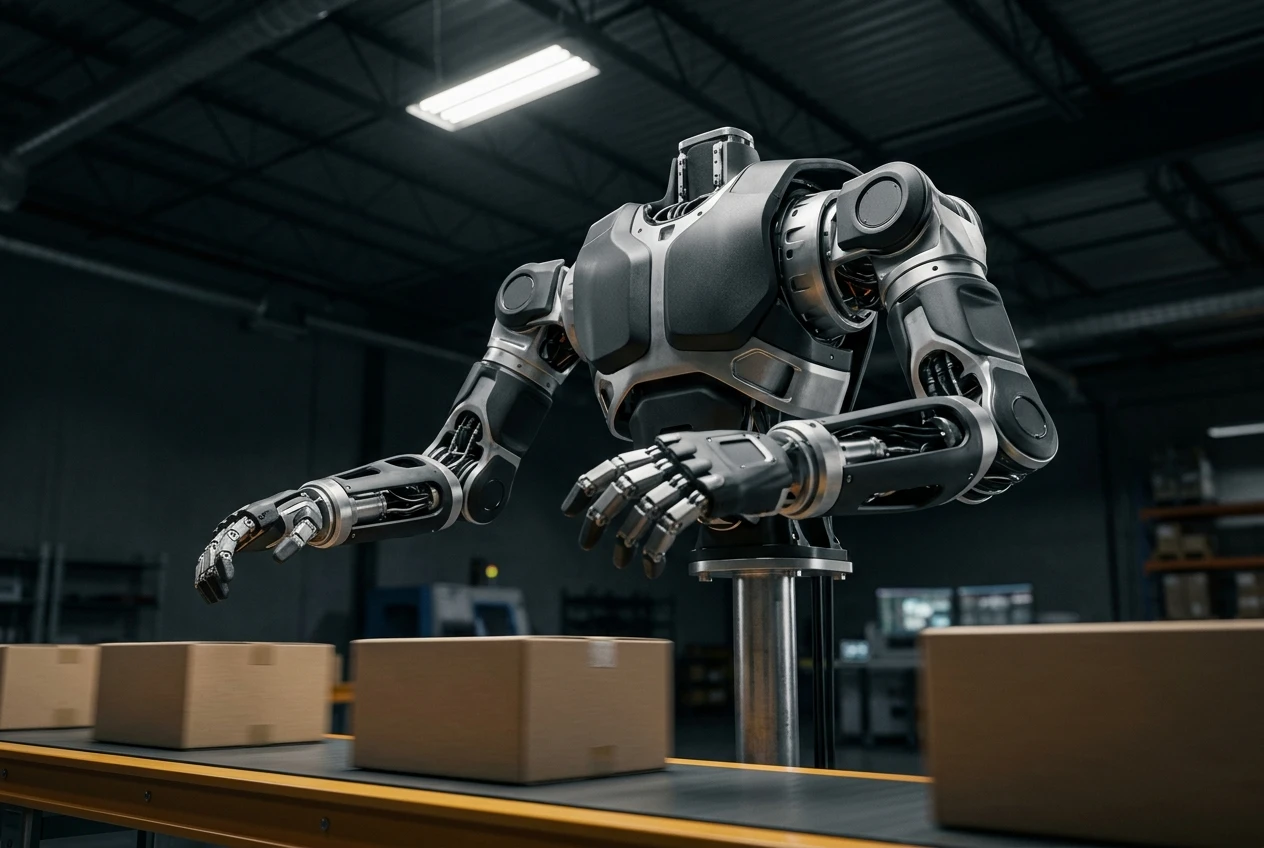
The M7’s job is parcel identification and lane placement: grab packages from containers, scan barcodes, and feed each parcel onto the correct downstream belt. The Xingdong M7 carries a 360-degree field of view integrated with 3D LiDAR (light detection and ranging, a laser-based spatial mapping technology), guiding arms with seven degrees of freedom and hands with twelve. The company describes the M7 as suited for ‘real-world tasks such as intelligent sorting, scanning, assembly, and high-quality data collection for foundation model training,’ a specification noting that each deployment also feeds data back into future AI model development.
People’s Daily reported the 1,200-parcels-per-hour throughput figure without specifying whether it reflects a single machine or the combined fleet. Xinhua described the sorters collectively as ‘capable of processing up to 1,200 parcels per hour,’ leaving the per-unit rate unstated. The claim comes from state media coverage of a state-owned enterprise’s deployment, with no independent breakdown in the coverage reviewed for this article.
The Jianggao site’s automation program predates the humanoid installation by several years. Robotic arms and unmanned forklifts were already running there, handling secondary sorting and palletized load movement, before the M7 units arrived.
A Torso Where the Worker Stands
The word ‘humanoid’ is technically accurate for the M7 but overstates what’s running on the Guangzhou conveyor. The M7’s base configuration is a torso on a fixed stand, positioned at a station the way an industrial robotic arm would be. The conveyor brings packages to the robot; the robot doesn’t navigate the warehouse or reposition between tasks.
The startup’s full-size bipedal L7 is a distinct product line. The L7 has demonstrated full walking locomotion and was used to set records at robotics exhibition events. The M7 at Guangzhou is a deliberate product decision for fixed-station logistics work; the M7 supports a legged upgrade, but the Jianggao units aren’t configured that way.
There’s a structural reason the humanoid form factor makes commercial sense in logistics without legs. Conveyor systems, sorting aisles, and parcel-handling stations were built for people of roughly human proportions. A human-shaped manipulator slots into an existing station with no capital spend on modified fixtures. Purpose-built robotic systems generally require stations engineered around them, limiting deployment to greenfield facilities or expensive retrofits. Companies running large-format automated sorting spend significant capital on station modification for each robotic generation; the humanoid form factor avoids that cost in facilities originally staffed by people. Seasonal shifts in e-commerce parcel profiles also become easier to handle when the robot can adapt to new package dimensions without a station rebuild.
The company launched its direct-drive dexterous hand as a standalone product in 2024 and described it as achieving roughly 70% of human-level efficiency in logistics operations. More than 1,000 units shipped in 2025, roughly half to international customers, providing manufacturing scale and validation data before the full torso system reached commercial deployment.
RobotEra’s Funding Sprint
The Beijing startup was founded in August 2023. Chen Jianyu, an assistant professor at Tsinghua University, launched it to build robots for physical-world tasks. By the time the Guangzhou units went live, it had closed two nine-figure funding rounds in ten weeks.
- RMB 1 billion (~$140M): Strategic round, March 2026; company valuation passed RMB 10 billion (~$1.4 billion)
- $200M+: Follow-on round, May 2026, led by SF Group, parent of SF Express
- 10+ logistics centers currently operating the company’s robots through China Post and SF Group partnerships
- 300%+ reported growth in 2026, with thousand-unit deliveries beginning in Q2
The May 2026 funding announcement lists investors including Hillhouse Investment, IDG Capital, CICC Capital, Dongfeng Asset Investment, and funds affiliated with China Unicom and ICBC Capital. The March round brought in Geely Capital, Alibaba, Singtel Innov8, and Sequoia China. Both rounds saw investor demand exceed the original fundraising target. SF Group’s participation as lead investor carries strategic weight beyond the capital: SF Express, its courier arm, is already deploying the startup’s robots across its own network and provides a live commercial reference for enterprise customers evaluating the technology.
Cumulative orders as of the March 2026 announcement exceeded RMB 500 million, with roughly half from international clients. The customer list includes nine of the ten largest publicly listed technology companies globally, per the company’s filings, some placing repeat orders up to six times. Before the humanoid deployment at the postal facility, the startup had already placed robots in Shenzhen, Huzhou, Hangzhou, Hefei, and Beijing. A cross-border logistics inspection solution built with SF Express and deployed at Chinese customs checkpoints carried a single order exceeding RMB 50 million. The progression from standalone dexterous hands in 2024 to full torso systems at customs facilities and postal hubs by 2026 took two years.
How Close Is Human Speed?
The Figure AI Benchmark
US robotics firm Figure AI staged a 10-hour package-sorting test on May 17, setting its F.03 humanoid robot against a human intern named Aime on a live warehouse conveyor. Both scanned barcodes, picked packages, and placed each one label-side down; the F.03 ran on the company’s Helix-02 end-to-end neural network with no pre-programmed trajectories and no remote supervision throughout the session.
| Figure AI F.03 | Human intern (Aime) | |
|---|---|---|
| Packages sorted (10 hours) | 12,732 | 12,924 |
| Average speed per package | 2.83 seconds | 2.79 seconds |
| Deficit at finish | 192 packages | baseline |
| Post-shift condition | Ready for next shift | Blistered hands; sore forearm |
The session ran for 10 hours across more than 25,000 combined handling cycles. Brett Adcock, Figure AI’s chief executive, posted the final scores on X alongside a declaration:
This is the last time a human will ever win.
Adcock’s post came on May 18. The F.03 uses Helix-02, which handles barcode identification and conveyor placement through pure visual recognition with no pre-set trajectory data. The 192-package final margin in the Figure AI sorting benchmark accumulated from a per-item speed gap of 0.04 seconds, sustained across thousands of repetitions.
The session also demonstrated continuous autonomous operation at scale. The F.03 ran the full 10-hour competition without a human restart, rotating between units at charging stations between cycles. That endurance profile, logged under a public livestream, is what the test format was designed to document: the robot was ready to run again when the human was nursing blisters.
What Deployed Machines Return in the Field
RobotEra reports its machines reach up to 85% of human-level efficiency in demanding logistics environments while running continuously across multiple shifts. An earlier March 2026 press release cited 70% in some logistics scenarios, reflecting how much sorting performance shifts with package mix, barcode quality, and conveyor configuration.
The economic arithmetic for a sub-parity rate: a machine running at 80% efficiency across three shifts delivers the output equivalent of 2.4 human-shifts from a single station, without overtime, sick leave, or fatigue-driven speed decay. On a daily throughput basis, the per-parcel deficit does not survive the shift-count math.
For logistics operators, the relevant comparison isn’t humanoid against a single human worker in isolation. It’s humanoid against fixed robotic systems: automated conveyors, dedicated barcode scanners, purpose-built robotic arms. Standard automated sorting handles regular-size packages efficiently but requires human station workers at points where irregular shapes, unusual orientations, or fragile items need handling. Humanoid dexterity addresses exactly those stations, which is why deployments concentrate at the identification-and-placement stage rather than across the full conveyor system.
The hardware cost per unit against labor savings depends on capital cost figures neither China Post nor the startup has disclosed publicly. Industry forecasters tracking humanoid logistics expect the 85% efficiency figure to improve as deployment data accumulates and AI models iterate, though the pace of that improvement from live production floors is the variable the throughput headlines don’t capture.
Why Beijing Shows This Off
People’s Daily is the Chinese Communist Party’s flagship print outlet. Running the Jianggao deployment photos nationally signals where China’s humanoid investment has landed: on live production floors in a state-owned facility, generating real operational data at scale.
Chinese companies accounted for roughly 87% of global humanoid robot shipments in 2025, per Omdia data reported by Xinhua. The lead rests on a policy foundation going back years: Beijing included humanoid robotics in its 14th Five-Year Plan in 2021, creating a mandate that directed state capital toward the sector before most Western governments had formalized an equivalent industrial policy. ‘Chinese humanoid robotics vendors are using more and more local components in their robotics design,’ said Lian Jye Su, an analyst at research firm Omdia, tying the advantage to policy support and a mature domestic component supply chain. The competitive pressure from that production lead is reaching other governments. Vietnam’s VinRobotics debuted the country’s first home-built humanoid robot at international trade events this week, explicitly positioning the program against China’s production dominance.
The facility’s arithmetic supports the automation push independently of the policy signal. Handling 6.5 million parcels daily with peaks above 10 million, the hub runs at a volume where small per-station efficiency improvements translate into significant daily throughput gains. A 1% reduction in average handling time across millions of daily items produces results visible in the next morning’s departure data. Chinese e-commerce volumes have grown consistently through the first half of 2026, and labor costs in Guangdong’s logistics sector have trended upward for a decade.
China Post’s automation push at the facility extends beyond the humanoid units. Robotic arms, unmanned forklifts, and AI-driven parcel identification systems run alongside them on the same floor, treating the humanoid sorters as one node in a connected automated system.
The startup began thousand-unit deliveries in Q2 2026. Twelve months of live production data from facilities running without a coordinated news cycle will be the next real benchmark.


Dawnwalker Time Clock Cracks Open-World RPG Habits

Gemini 3.7 Flash Cuts Agent Costs While Pro Stays Delayed

OpenAI and Anthropic Slash Mid-Tier Prices as Chinese Models Bite

Quanta and Quantinuum Bet Manufacturing Will Unlock Quantum Scale

Xiaomi HyperOS 4 Turns Glass Looks Into an Agentic Ecosystem Bet

BGMI Smiling Pal Codes Hand Free Backpacks to Almost Nobody

European Sites Face Four Times the AI Scrapes With Worse Returns

Claude’s Invisible Watermarks Flag Light AI Edits Too

Indian Brands Crack the Beige Tech Moat With Real Design

AmBank’s Quiet Community Engine Wins Malaysia CSR Crown

Fable 5 and Mythos 5 Return as US Lifts Anthropic Export Controls

Oracle Cuts 21,000 Jobs in a Year, Cites AI in 10-K Filing

SpaceX’s Google Deal Turns a Rocket Company Into a Cloud Landlord

CD Projekt Red Co-CEO: Redemption Arc Isn’t Done, Witcher 4 in 2027

XPL Rallies 30% Ahead of Plasma One Card Tier Launch

Google Search Profiles Build a Follow Graph Inside Discover

DGO App Brings Rs 549 Mobile Pass for FIFA World Cup 2026 in Nepal

Moonshot AI Targets $30 Billion in China’s Fastest AI Funding Sprint

Microsoft Xbox Layoffs Start in July as Sharma Slams 3% Margin

Oppo’s ColorOS 17 Eligibility List Leaves A-Series Buyers Behind
-
 AI1 month ago
Fable 5 and Mythos 5 Return as US Lifts Anthropic Export Controls
-
 AI2 months ago
Oracle Cuts 21,000 Jobs in a Year, Cites AI in 10-K Filing
-
 AI2 months ago
SpaceX’s Google Deal Turns a Rocket Company Into a Cloud Landlord
-
 GAMING2 months ago
CD Projekt Red Co-CEO: Redemption Arc Isn’t Done, Witcher 4 in 2027
-
 CRYPTO2 months ago
XPL Rallies 30% Ahead of Plasma One Card Tier Launch
-
 NEWS2 months ago
Google Search Profiles Build a Follow Graph Inside Discover
-
 APPS2 months ago
DGO App Brings Rs 549 Mobile Pass for FIFA World Cup 2026 in Nepal
-
 AI2 months ago
Moonshot AI Targets $30 Billion in China’s Fastest AI Funding Sprint