
COMPUTERS
NRF Triples Its SQC Factory Bet With $40 Million
NRFC added $40 million to Silicon Quantum Computing for atomic chip making, tripling its cheques while Canberra’s larger photonic project broke ground a week later.

The National Reconstruction Fund Corporation added $40 million (US$28 million) to Silicon Quantum Computing on June 11, 2026, taking its total to $60 million. The extra cash is for quantum chip manufacturing, 79 days after a $20 million first cheque.
The same morning, London quantum fund Firgun Ventures made its first Australian investment in the Sydney firm. Canberra is backing a factory thesis: keep the chip line in-house, iterate in days, and try to beat a much larger photonic build that only broke ground a week later.
A $40 Million Follow-On for Chip Manufacturing
NRFC, Australia’s $15 billion sovereign manufacturing investor, described the June cheque as sitting on top of its original $20 million. Both cheques are part of a larger SQC round that was still open when the follow-on was posted. Existing backers named on the notice include CBA, Telstra, UNSW, the NSW government and the Commonwealth.
THE NRFC CHEQUES
- First cheque: $20 million on March 24, 2026.
- Follow-on: $40 million on June 11, 2026.
- NRFC total: $60 million, triple the March amount.
- Use of funds: Development and expansion of quantum chip manufacturing.
On June 11 the corporation announced an additional $40 million investment and said the money would go to SQC’s manufacturing capability. Senator Tim Ayres, Minister for Industry and Innovation and Minister for Science, said the cheque “backs Australian ingenuity and ensures world-leading quantum technologies are designed, built, and commercialised here at home.”
NRFC chief executive David Gall tied the bet to speed on the line, not to a new science grant.
Australia leads the world in quantum computing, and SQC’s in-house manufacturing allows the company to iterate significantly faster, and with greater accuracy, than its competitors. This gives SQC a critical edge in forging the fastest and most cost-effective path to a commercial-scale quantum computer.
David Gall, Chief Executive, National Reconstruction Fund Corporation
SQC founder and chief executive Michelle Simmons AC, a former Australian of the Year, put the same point in mission language: build a commercial-scale silicon machine in Australia, and treat the factory as the edge.
From day one, SQC’s mission has been clear: To build the world’s first commercial-scale quantum computer in silicon, right here in Australia. Our globally unique manufacturing capability gives us a decisive advantage in the global race, and NRFC’s investment allows us to accelerate that mission.
Michelle Simmons AC, Founder and Chief Executive, Silicon Quantum Computing
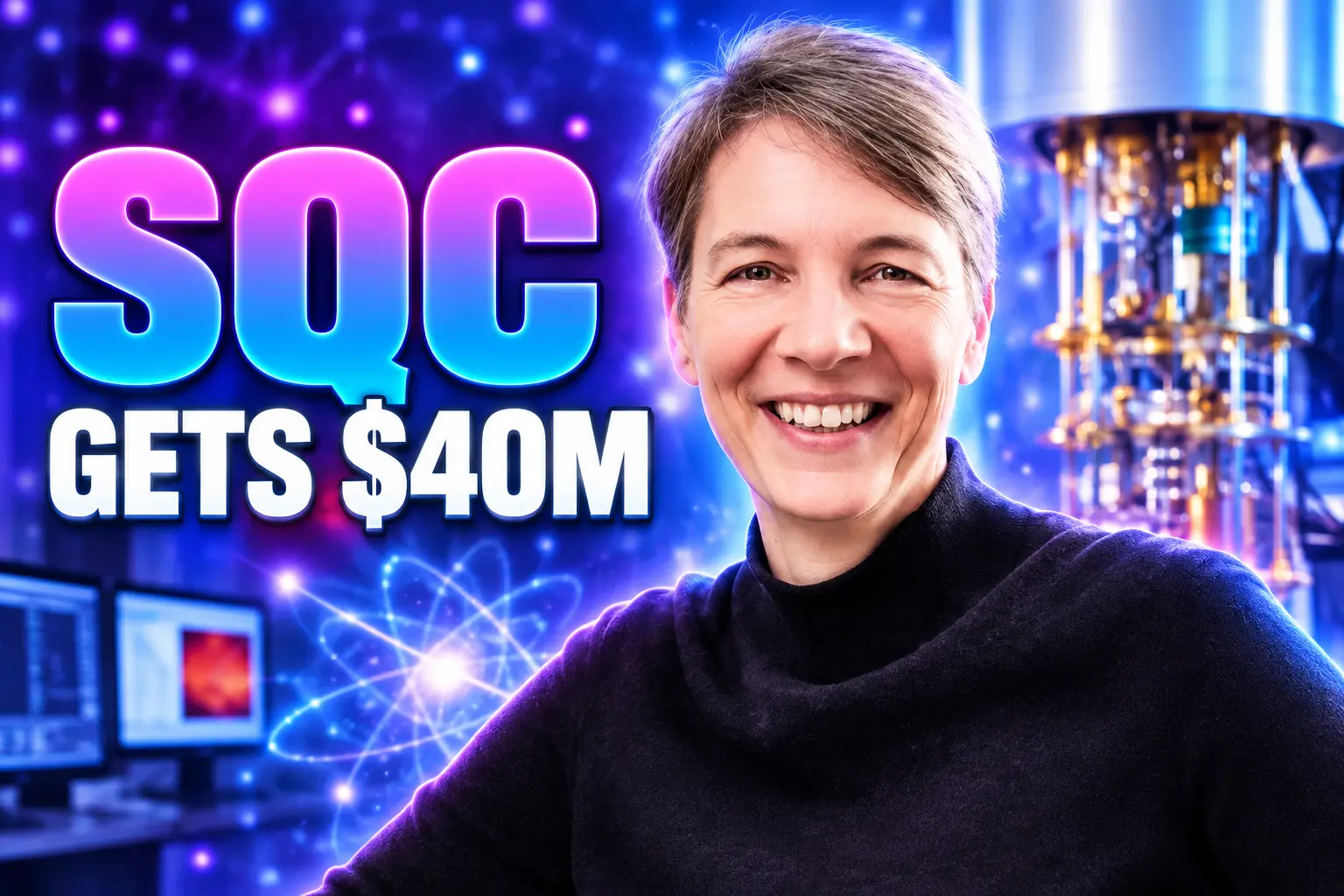
PAQMan Turns a Microscope Into a Chip Line
NRFC’s own notice says the cash is for expanding its proprietary PAQMan process, short for Precision Atom Qubit Manufacturing. SQC’s method uses adapted scanning tunnelling microscopes to place phosphorus atoms in silicon at 0.13 nanometer accuracy, a scale the company calls 100 times smaller than the best classical processes. Silicon is element 14 and phosphorus is 15, which is why the firm brands the architecture 14|15.
The company says it has spent 25 years and nine generations of lithography turning that microscope into a single-tool production system. Because the line sits in-house, SQC says it can design, produce and test a new quantum chip in under a week. NRFC repeats that cycle time in its investment copy and treats it as the reason a Sydney lab can move faster than rivals that wait on outside foundries.
NRFC also describes SQC as the only company in the world that can manufacture quantum chips with atomic precision while already selling quantum-enhanced AI products. That “only” is the fund’s and the company’s language. Other groups work with related silicon techniques, and the products SQC is selling now are not a universal gate machine.
WHAT THE LINE ALREADY SHIPS
- Watermelon: A quantum machine learning system. Telstra used it on network prediction and matched deep-learning accuracy after training measured in days rather than weeks.
- Quantum Twins: A materials and chemistry simulator launched in February 2026, built from 15,000 qubit registers and paired with a Nature paper.
- Cycle time: SQC says it can design, produce and test a new quantum chip in under a week on the same in-house tools.
In November 2025 the company said it patterned 250,000 qubit registers in eight hours. A Watermelon chip render on its September manufacturing note shows 70 precision-placed quantum dots sealed in pure silicon. Customers named in the NRFC notice sit in energy, logistics, defence and telecommunications. SQC employs more than 100 people across Australia, Europe and the US, with headquarters in Sydney, and says the NRFC money should add jobs in sales, chip design, quantum engineering and hardware.
The $940 Million Photonic Site at Moreton Bay
The June follow-on landed while Canberra’s other quantum cheque was changing postcode. PsiQuantum, the Palo Alto photonic company, had dropped a Brisbane Airport plan in May 2026 and moved the build to Moreton Bay Central at Petrie. On June 18, a week after NRFC’s SQC notice, PsiQuantum broke ground there with Ayres, Queensland science minister Andrew Powell, and Moreton Bay mayor Peter Flannery in attendance.
Ayres said that day the federal government had committed $470 million and so had the state government, a $940 million package. PsiQuantum’s own construction note said the first job is preparing the site for a large cryoplant, ordered in late 2024 from Linde Engineering and due in the second half of 2027, before cabinets of photonic chips are networked with optical fibre. The original public pitch had pointed to an operating machine by the end of 2027. The cryoplant date now sits in that same window, with cabinets after it.
TWO PUBLIC BETS, ONE WEEK APART
| Item | Silicon Quantum Computing | PsiQuantum in Queensland |
|---|---|---|
| Public money named | $60 million from NRFC | $940 million from Canberra and Queensland |
| What it buys | Atomic-precision chip manufacturing in Sydney | A utility-scale photonic machine at Moreton Bay |
| June 2026 status | $40 million follow-on on June 11 | Ground broken on June 18 |
| US defence track | DARPA QBI Stage B | Final phase of DARPA’s US2QC pilot |
The National Quantum Strategy still sets the civic target those cheques are supposed to serve. Official estimates say quantum computing, communications and sensing could add $6.1 billion to Australia’s GDP by 2045 and directly employ 19,400 people. NRFC cites that strategy in its SQC notice. The fund is writing relatively small, fast cheques into a Sydney factory. The PsiQuantum package is a site, a cryoplant and a claim on the first utility-scale machine.
Those are different products. SQC is selling chips and two application boxes from a lab it owns. PsiQuantum is pouring a building for a machine whose cooling plant has not yet arrived. Both are on the public books at the same time.
Who Already Owns Silicon Quantum Computing?
The Commonwealth already holds about one third of SQC from $40 million of older equity, including $25 million in 2017. NRFC’s $60 million sits on top of that holding, with CBA, Telstra, UNSW and NSW still on the register, and Firgun joining on a SAFE note the same day as the June follow-on.
SQC was formed in May 2017 at UNSW around Simmons’ atomic-electronics work. The early consortium was the Commonwealth, NSW, UNSW, Telstra and CBA. When the company raised a Series A on July 24, 2023, those names came back: $50.4 million at a $195.3 million valuation. Chair Stephen Menzies said at the time the firm had taken an up-round in a tight market and deferred a bigger raise. Simmons had earlier talked about seeking about $130 million.
HOW PUBLIC MONEY ENTERED SQC
- May 2017: SQC is founded at UNSW with the Commonwealth, NSW, UNSW, Telstra and CBA in the original consortium.
- 2017: The Commonwealth invests $25 million, later counted inside a $40 million federal holding of about one third.
- July 24, 2023: Series A raises $50.4 million at a $195.3 million valuation from the same public-and-corporate group.
- March 24, 2026: NRFC invests $20 million as part of a larger round still described as open.
- June 11, 2026: NRFC adds $40 million. Firgun Ventures invests the same day via a SAFE note, amount undisclosed.
Firgun is a $250 million London quantum fund founded by Zeynep Koruturk, a former Goldman Sachs executive, and Dr Kris Naudts. SQC said the cheque is Firgun’s first Australian investment and that SQC joins a book that already holds Photonic Inc, Quantum Elements, Quantum Motion and Oxford Quantum Circuits. Koruturk said Firgun was backing “world-class semiconductor manufacturing capability” as a path to fault-tolerant systems. Simmons said Firgun’s money accelerates manufacturing and the rollout of Watermelon and Quantum Twins, “already in the hands of customers today.”
The June notices do not price the open round or say what stake NRFC will hold once the SAFE notes convert. “Trebled” describes the dollar cheques, $20 million to $60 million, not a filed equity percentage. Simon Segars, former chief executive of Arm, chairs SQC. On June 30 the company named Karna Nisewaner, a long-time Cadence Design Systems lawyer based in Palo Alto, as chief legal officer, effective June 1.
11 Teams, One 2033 Utility-Scale Deadline
SQC’s own about copy now aims at a commercial-scale system in 2033. That is also the year DARPA’s Quantum Benchmarking Initiative uses for “utility-scale” operation, defined as computational value above cost. As of November 6, 2025, DARPA had selected 11 companies to enter Stage B, a year-long look at research plans and risk-reduction prototypes. SQC is on that list as “precision atom qubits in silicon.”
So is Diraq, the other Sydney silicon name, listed for CMOS spin qubits. Quantum Motion in London and Photonic Inc in Vancouver are on the same stage with other silicon approaches. IBM, IonQ, Quantinuum, QuEra, Atom Computing, Nord Quantique and Xanadu fill out the 11. DARPA is explicit that Stage B is not a bake-off with one winner. Multiple teams, one team, or none may show a path by 2033.
PsiQuantum is not in that Stage B cohort. DARPA’s Stage B page says Microsoft and PsiQuantum had already entered the final phase of US2QC, the pilot that QBI grew out of, a verification track with the same technical goal as QBI Stage C. On the US defence ladder, the photonic company Canberra is paying to house in Queensland is further along than SQC. NRFC is still paying SQC to own the tools that make the chips.
Watermelon complicates the sales pitch in a different way. It is a quantum reservoir, a feature generator for machine-learning models, not a large fault-tolerant gate computer. Analog and reservoir machines can post useful numbers on narrow tasks and still stall as universal systems, a pattern older annealing hardware already taught the field. SQC is also expanding the same patterning tools toward gate-based processors, and it has published an 11-qubit atom processor in Nature. The $40 million does not pick one of those products. It pays to make the line faster for both.
Scripts Now Pattern a Watermelon Chip in Minutes
Ninety days after the follow-on, SQC published the first hard factory update the cheque was meant to buy. On September 9, 2026, it said machine-learning scripts written by Joris Keizer, head of atomic fabrication, now pattern a Watermelon device in minutes. That job used to take an atomic fabrication scientist hours, placing each quantum dot by hand. The scripts run inside Quokka, SQC’s control software, and feed command sequences straight into the microscope. Most of the pass now runs without a person in the loop.
SQC said it is pushing the same automation onto gate-based chips and wants computer vision to knock out the remaining manual checks. Atomic precision as a routine step, it argued, is what moves the work from craft to industry. The June notices never named a close date for the larger round, and no priced close had been posted by mid-September. Firgun’s SAFE and NRFC’s extra $40 million are still, on the public paper, dry powder for a line that just got quicker.
The photonic site at Moreton Bay will spend the next stretch waiting on a cryoplant. The Sydney line is already shipping two products and shaving hours off a patterning step. That is the wager NRFC tripled, and it is still a wager on 2033.

The Yemen Cell Kept Claude’s Flight Code After the Ban

Unofficial AI Pages Beat Marshall County’s Sheriff to Every Scare

The SEC Crypto Rule Leaves Exchanges Still Exposed

Brian Bengs Bets His Senate Race on an AI Stop

Agentic Workflows Turn Cheap Tokens Into Larger AI Bills

Fable 5 Came Back Under a Commerce On-Off Switch

Google’s SpaceX GPU Lease Has a Sept. 30 Deadline

Plasma One’s XPL Locks Face a 1.81 Billion Cliff

DGO’s Rs 549 World Cup Pass Cost Fans Sleep and Data

Moonshot AI’s $30 Billion Ask Became a $35 Billion Close
-
 AI3 months ago
Fable 5 Came Back Under a Commerce On-Off Switch
-
 AI4 months ago
Google’s SpaceX GPU Lease Has a Sept. 30 Deadline
-
 CRYPTO4 months ago
Plasma One’s XPL Locks Face a 1.81 Billion Cliff
-
 APPS4 months ago
DGO’s Rs 549 World Cup Pass Cost Fans Sleep and Data
-
 AI4 months ago
Moonshot AI’s $30 Billion Ask Became a $35 Billion Close
-

 NEWS4 months ago
ColorOS 17 Device List Spans Oppo, OnePlus and Realme
-

 GAMING4 months ago
Xbox Cuts 3,200 Jobs After Five Years of Thin Returns
-
 GAMING3 months ago
The RTX 4050 Under Rs 70,000 Hides a Wattage Gap