
CRYPTO
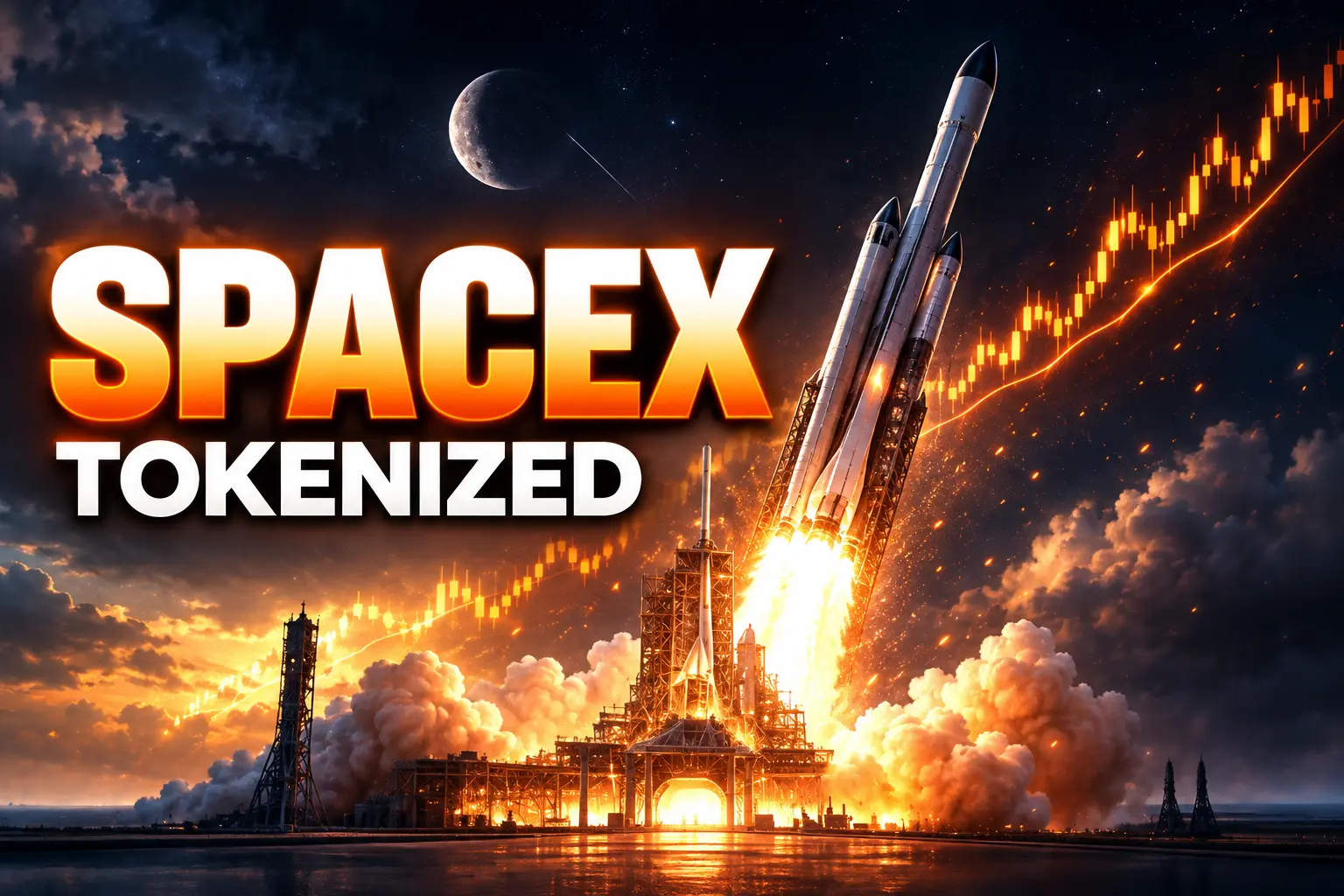
The SpaceX IPO Came Back as a Crypto Token
SpaceX listed at $135 in June and was cast as a crypto drain. The same ticker now trades on-chain, while the wrappers remain a rounding error.

SpaceX priced 555,555,555 Class A shares at $135 on June 11, 2026, raising $75 billion in the largest IPO on record. The stock opened on Nasdaq the next morning as SPCX. Crypto desks had already treated the sale as a rival bid for the same speculative cash that usually sits in tokens.
The listing did pull attention, and Bitcoin had a brutal June. The punchline arrived on the same tape: wrappers of SPCX went live on-chain that morning, and they are still trading. They are also a rounding error next to the company they shadow.
SpaceX Priced the Largest Listing on Record
The free-writing prospectus put the sale at $74,999,999,925, a $135 public price on a primary deal, with a greenshoe of 83,333,333 extra Class A shares. Joint bookrunners included Goldman Sachs, Morgan Stanley, BofA Securities, Citigroup, and J.P. Morgan. Trading started June 12. The shares were due to settle June 15 under CUSIP 84615Q 103.
Indications put the open at $150, an 11% premium to the IPO price, and the first session finished at $161, up 19%. That print implied a value near $1.77 trillion at the offer and about $2.1 trillion by the close, among the most expensive U.S. listings ever attempted. Elon Musk, founder and chief executive, kept about 82% of the votes through a dual-class structure in which Class B shares carry 10 votes. About 30% of the marketed shares were set aside for retail buyers.
Scott Painter, the TrueCar founder and a longtime Musk adviser, sat on Bloomberg’s Open Interest show on June 10, while the book was still being filled. He walked through a company that had come close to dying more than once before it became the bid everyone wanted. That origin story is now a public-market duration trade, not a private round.
Starlink is still the part that earns. Connectivity brought in $11.39 billion of the $18.67 billion SpaceX booked in 2025, about 61% of sales, and $4.42 billion of operating income. Second-quarter 2026 sales were $7.81 billion, up 92% from a year earlier, with a net loss of $541 million. Trailing twelve-month sales now sit at $23.04 billion against a net loss of $8.89 billion, so the public tape is still paying for growth and for the AI-compute build, not for current profit.
The June Slide in Bitcoin and Stablecoins
The capital-rotation pitch was simple: a clean, listed Musk vehicle would siphon risk budget out of coins. June’s tape did look like a drain, though it had more than one cause, including ETF outflows, a hawkish rate path, and a Bitcoin sale by Strategy. CoinGecko’s second-quarter review put total crypto value at $2.1 trillion by quarter-end. Bitcoin closed that quarter at $58,551 after slipping under $60,000 on June 25, more than 50% below its October 2025 peak of $126,080.
JUNE MARKET SNAPSHOT
- Crypto value: Total market cap finished the second quarter at $2.1 trillion, a third straight quarterly decline.
- Bitcoin: The coin closed the quarter at $58,551 after breaking below $60,000 on June 25.
- Stablecoins: Supply fell $7.70 billion, or 2.39%, to $312 billion, the largest monthly drop since TerraUSD in 2022.
- On-chain stocks: Tokenized equity volume jumped 145% to a record $3.86 billion, with SpaceX wrappers at $1.19 billion.
Stablecoin trading on centralized exchanges still rose 10.8% to $981 billion, so cash was moving even as supply shrank. Tokenized treasuries grew to $17.0 billion inside a $30.1 billion real-world-asset stack, and tokenized public stocks hit $1.53 billion. The fear in coins was real enough to show up in three weeks of extreme fear readings, and SPCX gave that mood a named place to hide. It did not need to be the only reason Bitcoin fell for the rotation story to get told on every desk.
A Token Ticker Appeared the Same Morning
The June fever piece said there was no meaningful, compliant on-chain SpaceX share, so cash had to leave crypto rails to buy the IPO. That was the setup on listing morning. It did not survive the afternoon. Ondo Finance put SPCXon live the same day across Solana, Ethereum, and BNB Chain, and said a trillion-dollar IPO was on-chain on day one.
SpaceX just landed onchain. The largest IPO in history, tokenized on day one.
Ondo Finance, official account, June 12, 2026
SpaceX just landed onchain.
The largest IPO in history, tokenized on day one. SPCXon is live on Ondo Global Markets across @solana, @ethereum, and @BNBCHAIN.
For the first time, a trillion-dollar IPO is onchain on the same day it goes public. pic.twitter.com/FwonIV7fFS
— Ondo Finance (@Ondo) June 12, 2026
Backpack Securities issued a Solana token the same session. xStocks listed SPCXx. On-chain stock volume for June ran $3.86 billion, with xStocks names at $1.59 billion, Backpack at $1.42 billion, and Ondo Stocks at $815 million. Tokenized SPCX itself did $1.19 billion, and Backpack’s line took $1.08 billion of that. The wrappers did not capture the $75 billion primary sale. They captured the spectator sport around it.
Coinbase arrived later. SPCXc, a 1:1 B20 token on Base, listed on September 4 in a second wave of tokenized names. Token Terminal recorded $6.6 million of DEX volume in a single session, 23% of the $28.5 million printed in the first nine days. Aerodrome handled most of that flow. Base tokenized-stock volume crossed $100 million on September 12. The product is still closed to U.S. users.
Pre-IPO Tickets Came Back as Refunds
Before Nasdaq opened, crypto venues had already built a synthetic book. SpaceX pre-IPO perpetuals did about $3.2 billion of volume from May 17 to June 10 across eight exchanges, $2.1 billion of it on Binance, with implied prints above $200 against a $135 IPO price. That was leverage on a future, not a claim on the shares Goldman was allocating.
Several large platforms marketed tokenized “IPO access” that routed through xStocks. When that desk could not secure an allocation in a book that was more than four times covered, the campaigns were pulled and balances were sent back. Dune figures on the Binance Wallet SPCXx drive showed about $557 million of USDC from 27,689 addresses in 28 hours, most of it in cheques of $20,000 or less, before the refunds. The bid was real. The inventory was not.
That episode is the cleanest rebuttal to the idea that crypto had found a side door into the primary. Traders could punt the narrative on a perpetual. They could not get the stock. When the real shares finally listed, the on-chain market that mattered was the one that formed after the open, backed by custody, not the one that promised a seat in the IPO and then returned the stablecoins.
$10 Million Shadows a $75 Billion Sale
Three months later the irony is in the scale. Nasdaq SPCX last closed at $151.21 on September 11, 12% above the IPO price and 33% below its $225.64 high, with a market value of $2.05 trillion. Ondo’s SPCXon, the wrapper with a public dashboard, held $10.15 million of tokenized SpaceX. That is 0.0135% of the primary raise, on 67,541.17 tokens at a $150 net asset value.
WHERE THE TICKER ACTUALLY LIVES
| Market | First listing | Who can buy | Size of the book |
|---|---|---|---|
| Nasdaq SPCX | June 12, 2026 | Brokerage accounts | $2.05 trillion value |
| Ondo SPCXon | June 12, 2026 | Non-U.S. investors | $10,148,399 total value; 32,716 holders |
| Coinbase SPCXc | September 4, 2026 | Non-U.S. users on Base | $28.5 million DEX volume in nine days |
Holders on the Ondo line have more than doubled in 30 days, up 111.47% to 32,716, and monthly transfers are $21.27 million. Supply sits mostly on Ethereum (44,684.94) and BNB Chain (21,707.12), with only 1,149.12 on Solana. The float is busy for its size and still cannot move the listed company. Solana’s whole tokenized-equity supply hit $684 million on September 11. That is a market. It is not SpaceX.
The more honest use of these tokens is as plumbing. On newer chains, tokenized SPCX is already a quote asset, a fee token, and collateral, which is how a memecoin ends up paying out in a claim on Musk’s listed vehicle. That is a second-order market around the ticker. It is not the $75 billion that left the book. Anyone treating SPCXon like a slice of Starbase is reading a dashboard, not a shareholder register.
Lockups Keep Feeding the Public Float
The live supply story is on Nasdaq, not on Base. SpaceX staged its lockup instead of dropping it on a single day. The 424B4 prospectus filed June 12 set a 180-day clock to December 8, with 7% slices along the way and larger blocks tied to earnings. The stock has already seen the first of those waves, including a slide to $104.83 into early August around the first earnings unlock.
THE SPCX UNLOCK CALENDAR
- June 12, 2026: SPCX lists on Nasdaq at $135; the public float starts as a thin slice of the company.
- August 6, 2026: The first large earnings-linked block becomes eligible after the August 4 report, with the stock coming in near the $104.83 low.
- September 9, 2026: Up to 319.0 million Class A shares unlock, a block worth about $49 billion at the September 8 close of $153.47; the stock fell about 4% on the day.
- September 10, 2026: A separate 59.1 million Rule 144 affiliate block becomes eligible.
- September 24, 2026: Up to 328.4 million more shares, the next 7% slice, are scheduled to unlock.
- December 8, 2026: The standard 180-day lockup ends, with still-larger earnings-linked supply in the queue before that date.
September 11 volume was 79.3 million shares, and the session range ran $145.92 to $151.85. Thirty-six analysts carry a Buy and a $220.68 target, which would be 46% above that close if the target is right. Targets do not absorb 328.4 million extra shares. Token volume will follow whatever the listed tape does on those dates, because the wrappers price off the stock, not the other way around.
Who Can Hold the On-Chain Version?
Ondo’s own docs are blunt about the buyer set: non-U.S. investors mint tokenized stocks that track the economic result of the listed share, including reinvested dividends net of withholding. SPCXon is a British Virgin Islands product under Regulation S, with Alpaca Securities as broker and BitGo as crypto custodian. Coinbase’s Base tokens use the same geographic fence. A U.S. retail account that wants SpaceX still buys SPCX at a broker.
WHAT THE TOKEN DOES NOT GIVE YOU
- No Nasdaq share: The token is economic exposure, not the Class A common stock listed under SPCX.
- No Class B control: Dual-class votes stay with the listed cap table; Musk’s 10-vote shares are not going on-chain.
- No U.S. retail mint: The large wrappers are built for non-U.S. users, so the IPO’s retail sleeve and the token buyer are different populations.
- No claim on the raise: The $75 billion went to SpaceX through underwriters, not through a mint function on Solana or Base.
Pricing is a total-return construction, not a free-floating memecoin oracle. Chainlink publishes total-return feeds for Ondo stocks that multiply the cash equity price by a corporate-action factor. That is how a wrapper can trade at $150 while Nasdaq last printed $151.21 and still be doing its job. It is also why a 24/7 token print can gap when the cash market is closed, then snap back when Nasdaq opens.
Ondo now lists more than 430 tokenized U.S. stocks and ETFs and has crossed $1 billion of value locked across that book, with 24/7 mint and redeem on a first set of names. SpaceX is the headline inside that machine, not the machine. The June argument was that speculative cash could not split itself between a rocket IPO and altcoins. Cash did leave coins in June. Some of it also came back as a token that follows SPCX, pays no vote, and still cannot seat a holder at the shareholder meeting.
Up to 328.4 million more Class A shares become eligible on September 24. The on-chain tickers will track that price. They will not absorb that supply, and they will not turn a $10.15 million wrapper into a substitute for a $2.05 trillion listing.
Disclaimer: This article is news reporting and analysis of public filings, market data, and token dashboards, and it is for information only. It is not investment advice, a solicitation to buy or sell SpaceX stock, Bitcoin, or any tokenized wrapper such as SPCXon or SPCXc, and it is not a recommendation of any brokerage or on-chain venue. Readers should consult a licensed financial adviser or securities attorney in their jurisdiction before acting, especially where tokenized stocks are limited to non-U.S. persons. Figures, listings, lockup dates, and token values reflect the cited sources as of the dates given in the piece and can change with the next session, unlock, or redemption.

Instagram Plus Tests a Read-Only Mode That Cuts Stories

Altman Asks the Public to Accept Some AI Harm

Google Freezes OSS VRP Product Reports After AI Flood

AI Agents Make Payment Rails the Scarce Prize

Turkey’s Crypto Boom Now Runs Through Three Banks

Fable 5 Came Back Under a Commerce On-Off Switch

Google’s SpaceX GPU Lease Has a Sept. 30 Deadline

Plasma One’s XPL Locks Face a 1.81 Billion Cliff

DGO’s Rs 549 World Cup Pass Cost Fans Sleep and Data

Moonshot AI’s $30 Billion Ask Became a $35 Billion Close
-
 AI3 months ago
Fable 5 Came Back Under a Commerce On-Off Switch
-
 AI4 months ago
Google’s SpaceX GPU Lease Has a Sept. 30 Deadline
-
 CRYPTO4 months ago
Plasma One’s XPL Locks Face a 1.81 Billion Cliff
-
 APPS4 months ago
DGO’s Rs 549 World Cup Pass Cost Fans Sleep and Data
-
 AI4 months ago
Moonshot AI’s $30 Billion Ask Became a $35 Billion Close
-

 NEWS4 months ago
ColorOS 17 Device List Spans Oppo, OnePlus and Realme
-
 GAMING4 months ago
Xbox Cuts 3,200 Jobs After Five Years of Thin Returns
-
 GAMING4 months ago
The RTX 4050 Under Rs 70,000 Hides a Wattage Gap