
AI
Meta Breaks Ground on $13 Billion AI Data Center in Alberta
Meta broke ground on a C$13 billion, 1-gigawatt AI data center in Sturgeon County, Alberta, its 33rd facility, days after it confirmed a cloud business.

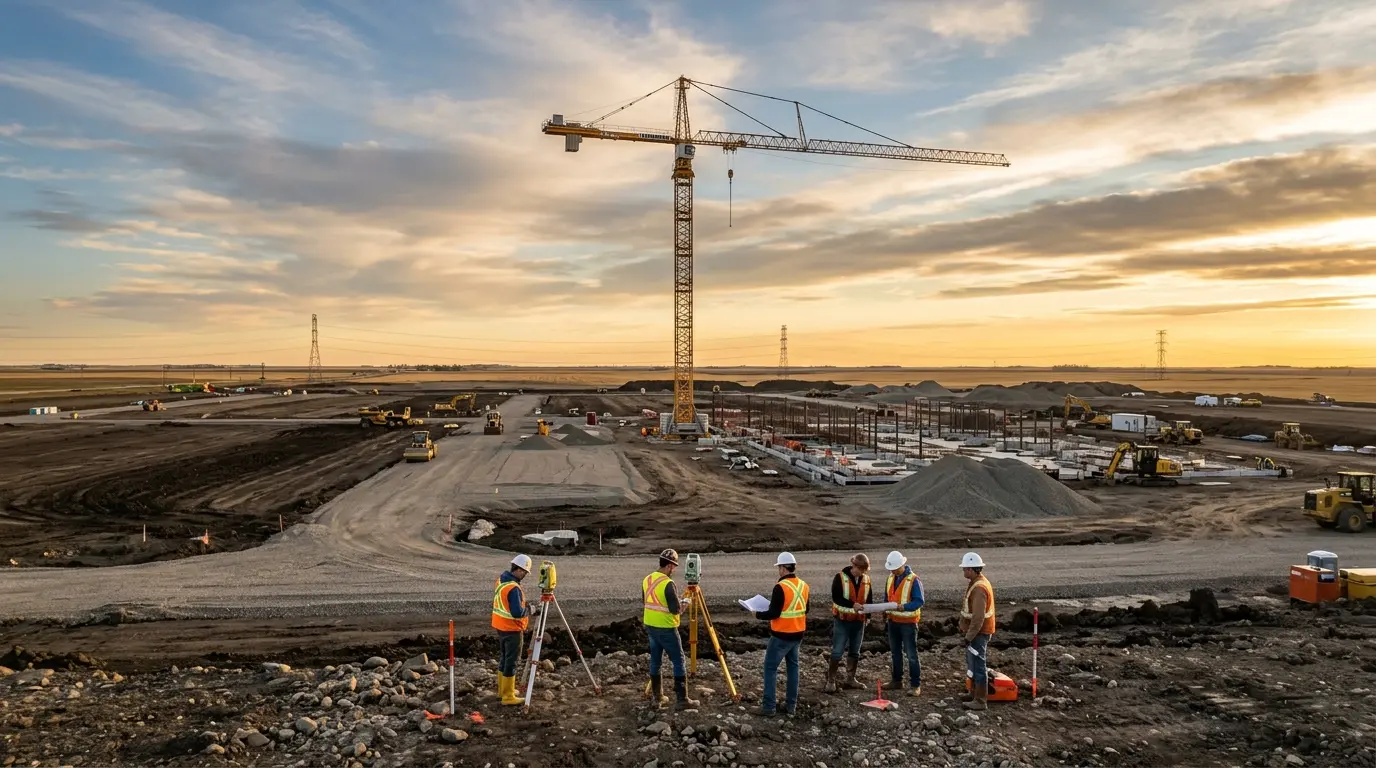
Meta broke ground on Wednesday on a C$13 billion, 1-gigawatt artificial intelligence campus in Sturgeon County, Alberta, the company’s first data center in Canada and its 33rd facility worldwide. The build is expected to take two to three years.
The project lands in the middle of an AI infrastructure race that has lifted Meta’s 2026 capital expenditure guidance to as much as $145 billion and pushed the company to start positioning a cloud business to sell some of the resulting spare capacity to outside buyers. Construction will support more than 3,000 workers at peak with more than 300 operational roles once the campus is running. Meta is also committing roughly CAD $60 million to local infrastructure in the region.
Meta Breaks Ground on a C$13 Billion AI Campus
The Sturgeon County project represents an investment of more than CAD $13 billion, per Meta’s C$13 billion Sturgeon County project announcement, describing the campus as its “first data center in Canada and 33rd in our global fleet.” The 1-gigawatt facility is optimized for AI workloads and is being built by Frost Collective, a joint venture between Clark Builders and PCL Construction. No completion date has been set.
Beyond the building itself, Meta is committing roughly CAD $60 million to local roads and water infrastructure. The company’s Sturgeon County project page lays out plans to launch Meta’s annual Data Center Community Action Grants in the region this fall, and the campus will run on a closed-loop, liquid-cooled system with dry cooling, a design Meta says eliminates operational water use in the cooling loop and limits total water use to domestic needs, fire protection, and equipment maintenance. Power for the site will be matched by new renewable additions to the Alberta grid. Meta will fund the new generation and transmission rather than tap existing supply.
The project adds Canada to a global fleet Meta has been expanding aggressively over the last two years to handle surging AI training and inference workloads. Meta framed the capacity around its family of social, advertising, and wearables businesses alongside AI. The 33-facility tally, set against a projected 2026 capex of up to $145 billion, puts the Canadian entry in context.
Why Sturgeon County Got the Project
Alberta landed the project because it offered a combination Meta’s site-selection criteria treat as essential: heavy industrial zoning, a robust provincial grid, and what the company called a “friendly regulatory environment.” The Sturgeon County site has been zoned for industrial use for years and sits in an area with the capacity for additional energy infrastructure. Meta has separately committed to fund a dedicated Alberta gas plant to power the campus, in what would be a first for a hyperscaler North American site. Meta named the construction and energy partners the project has lined up, including Frost Collective and the four grid and generation counterparts tasked with making the site run. Meta’s project page describes the campus’s grid upgrades as wholly company-funded rather than supported by Alberta ratepayers.
| Partner | Role in the Sturgeon County project |
|---|---|
| Frost Collective (Clark Builders + PCL Construction) | General contractor for the campus build |
| Alberta Electric System Operator (AESO) | Grid operator coordinating energy planning |
| Altalink | Transmission infrastructure partner |
| Capital Power | Generation partner |
| Greenlight Limited Partnership | Energy planning partner |
| Pembina Pipelines | Utility infrastructure partner |
| ALUS | 200-acre grasslands conservation partnership in the North Saskatchewan River watershed |
Energy planning for the campus has been underway for years, with Meta saying it worked closely with Alberta Electric System Operator, Capital Power, Altalink, and Greenlight Limited Partnership “to plan for and meet our energy needs years in advance of this data center coming online.” Meta is funding the new generation itself and says the additions will benefit all Alberta ratepayers rather than displace existing supply. Sustainability commitments include a partnership with ALUS to conserve 200 acres of grasslands, trees, and wetlands in the North Saskatchewan River watershed. The design choices on water and renewables respond directly to a Canadian Broadcasting Corp. report in June that flagged emissions, water consumption, and noise concerns around large data centers in the province.
The Year Meta Is Spending Up to $145 Billion on AI
The C$13 billion Alberta campus is one of more than two dozen AI projects the company is racing to deliver this year. Meta told investors in April that 2026 capital expenditure will land between $125 billion and $145 billion, a range the company raised by $10 billion at the high end from an earlier $115 billion to $135 billion outlook. Construction crews at Sturgeon County will be the on-the-ground expression of that guidance, and a multi-year one given the two- to three-year timeline.
That raise triggered a roughly 6% after-hours selloff in Meta’s stock when it was reported in late April. The market’s reaction was on a capex figure large enough that investor questions have shifted from how much Meta should spend on AI to whether any of it will ever pay off. Part of the new spending is funded through a $25 billion bond sale Meta issued alongside the Q1 earnings report. Since then Meta’s stock has traded in a tighter range, with the late-April lows serving as a reference point for capex-skeptics.
Meta sits inside a hyperscaler capex cohort that has been lifting aggregate spending well past $700 billion this year. Amazon, Microsoft, Alphabet, and Meta together are committing to a combined AI infrastructure footprint several analysts now frame as the largest single category of corporate capital spending in modern history. The Sturgeon County project, at a C$13 billion scale, would have looked unusual two years ago. In 2026 it is one line on a much longer capex list, and Meta’s stock is down roughly 9% on the year against a Nasdaq up 11%.
The Canadian campus will take two to three years to construct, and Meta’s Canadian footprint is starting from zero. Pairing the project with the still-pending monetization strategy makes the Alberta build a referendum on whether Meta’s AI capex can be redirected into revenue before the next cycle. Most of the construction, and most of the cloud pivot’s first revenue, will land in 2027 and 2028.
The Cloud Pivot Designed to Soak Up the Spare Capacity
A week before the groundbreaking, Bloomberg reported Meta is building a cloud business to sell excess AI computing capacity to outside customers, a plan Mark Zuckerberg confirmed in May was “definitely on the table” at the company’s annual shareholder meeting. On a Q4 2025 earnings call, Zuckerberg said companies are regularly “asking if we have compute that they could buy from us at some premium to what we’ve bought it at,” the comment CNBC called the closest thing to a public roadmap for the cloud pivot. Meta is debating whether to offer access to AI models hosted on its infrastructure or to sell raw computing power, the report said.
Meta’s stock jumped 9% on the cloud-news report, its sharpest rally in more than five months. The move ended a run of four straight quarterly drops that had wiped almost a quarter of Meta’s share price over that stretch. “Making this as a revenue stream has been part of their road map,” said Karan Ramchandani, managing director at advisory firm Post Oak Group, calling cloud sales a “no-brainer” for the company.
- $125-145 billion: Meta’s 2026 capex range, raised in April from $115-135 billion.
- 9%: the single-day jump in Meta’s stock on the cloud-news report, its sharpest rally in five months.
- 82% and 41%: Meta’s latest-quarter gross margin and operating margin, the highest in its peer set.
- 18%: Google Cloud’s Q1 2026 operating margin, an early comparison for any Meta cloud effort.
- $2 billion+: the combined monthly revenue SpaceX is reportedly earning from selling xAI compute to Google, Anthropic, and Reflection AI.
CoreWeave and Nebius, the publicly traded neoclouds that depend on reselling Nvidia-powered compute, both fell by double digits the same day. Evercore analyst Mark Mahaney framed Meta as following SpaceX’s playbook of monetizing spare AI infrastructure after a foundation-model run failed to break through. Mahaney sees Meta more likely competing with neoclouds like CoreWeave and Nebius than directly challenging AWS, Azure, or Google Cloud. Brian Schechter, a partner at Primary Venture Partners, used the SpaceX parallel to argue that “compute can function more like a commodity” once the training run is over. The pivot will be measured by Meta’s ability to land multi-year compute contracts at scale.
Bubble Worries, Margin Drag, and the Chinese Open-Source Shock
Three forces are converging on the Sturgeon County bet even before its first megawatt flows.
I think that this is a response to complaints that the company may be overspending and skepticism that Meta will ever earn a commensurate return on its capex. The problem with this company is that it only builds, or only thus far, capacity for itself, and it’s not really monetizing any AI apps yet.
That was Paul Meeks, head of technology research at Freedom Capital Markets, in a CNBC interview about Meta’s cloud pivot. Meeks’s framing captures the wider pressure on hyperscaler AI capex, including Meta’s, which several analysts now track well above $700 billion for 2026. The market’s open question is whether AI infrastructure is being financed faster than AI demand will absorb. The concern has been building since the late-April capex raise, when Meta’s stock sold off roughly 6% in after-hours trading.
The second pressure is margin drag. Meta’s 82% gross margin is the highest in its peer set, and the company recorded a 41% operating margin in its latest quarter. Google Cloud reached 18% operating margin only after twelve years of building, did not register a profit until Q1 2023, and remains dwarfed by Google’s own ad business. Selling compute to enterprises also requires a sales and support structure Meta has never operated. Meeks warned that “anything Meta enters outside of online ads would be dilutive to their business and would lower their margins from their glory days.”
The third pressure is the price floor Zhipu’s GLM 5.2 is setting on AI compute. The Zhipu release sits within a percentage point of Anthropic’s Opus 4.8 on a widely tracked agentic benchmark at roughly one-fifth the cost, with OpenRouter token traffic climbing faster than after DeepSeek’s V4 release in April, per CNBC. Gabe Pereyra, co-founder of Harvey, told CNBC the shift is forcing companies to ask how to get the most for their money. CNBC’s analysis of Zhipu’s GLM 5.2 closing in on Anthropic’s Opus 4.8 lays out the cost gap in detail.
All three pressures hit the same weak point in Meta’s positioning. The company has built, as Meeks put it, mostly capacity “for itself.” First megawatt at Sturgeon County lands no earlier than 2028, given the two- to three-year construction timeline Meta has stated.
Frequently Asked Questions
What is Meta building in Sturgeon County, Alberta?
Meta is building its first Canadian data center, a C$13 billion, 1-gigawatt AI-optimized campus designed to support more than 3,000 construction jobs at peak and more than 300 operational roles once running. The campus is Meta’s 33rd data center worldwide.
How much is Meta planning to spend on AI infrastructure in 2026?
Meta told investors in April that 2026 capital expenditure will land between $125 billion and $145 billion, up from an earlier forecast of $115 billion to $135 billion. The company funded part of that increase through a $25 billion bond sale issued alongside the Q1 earnings report.
Why is Meta building a cloud business instead of just using the compute itself?
Bloomberg reported on July 1, 2026, that Meta is preparing to sell access to AI models hosted on its infrastructure and to raw compute power, framing it as a way to monetize spare capacity as the company’s 2026 capex comes online. Mark Zuckerberg told shareholders in May the cloud business was \”definitely on the table,\” and the news pushed Meta’s stock up 9% in a single session.
Could Chinese AI models undercut Meta’s investment?
Open-source Chinese models such as Zhipu’s GLM 5.2 and DeepSeek’s V4 are closing the performance gap to U.S. frontier systems while undercutting them on token pricing. Zhipu’s GLM 5.2 sits within a percentage point of Anthropic’s Opus 4.8 on a widely tracked agentic benchmark at roughly one-fifth the cost.
Disclaimer: This article discusses publicly disclosed corporate capital expenditure plans, stock price movements, and competitive market dynamics for informational purposes only. It is not financial advice. Stock prices and AI infrastructure demand can shift rapidly, and figures cited are accurate as of publication on July 10, 2026. Readers should consult a qualified financial professional before making investment decisions.


AI Risk and Regulation Reshape Australia’s Cybersecurity Providers

Nelson Mandela Bay Switches On R27m CCTV, Drone and Fibre Network

JT’s Meta Apps Outage Stretches Past a Week With No End in Sight

Pixel 11 vs iPhone 18 Pro: What 2026’s Flagship Battle Looks Like

ATO Crypto Tax Warning Emails Hit Thousands of Aussie Inboxes

Nebula’s One-Click Android 17 Root Runs on a 15-Year-Old Kernel Bug

Lance Gokongwei Joins PhilWeb Board Two Weeks After P2 Billion Deal

Wuthering Waves Myriad Snare Rustfire Chassis Boss Guide

Faithful Heart Tested at Skyfall Quest Guide for Wuthering Waves 3.5

A 4.2% Print Meets a 4.345% Bond: The Crypto Hurdle Rate

Microsoft Xbox Layoffs Start in July as Sharma Slams 3% Margin

Google Search Profiles Build a Follow Graph Inside Discover

Google DeepMind and A24 Sign $75 Million AI Partnership Deal

Oracle Cuts 21,000 Jobs in a Year, Cites AI in 10-K Filing

OCC Issues AML Consent Order Against Wise and Crypto.com Sponsor Bank

DGO App Brings Rs 549 Mobile Pass for FIFA World Cup 2026 in Nepal

Oppo’s ColorOS 17 Eligibility List Leaves A-Series Buyers Behind

Anthropic Tells Senators Alibaba Ran the Largest Claude Distillation Attack

Apple Strikes Preliminary Deal For Intel To Make iPhone And Mac Chips

Andreessen Horowitz Bets $2.2B on Crypto’s Quiet Cycle
-
 GAMING4 weeks ago
Microsoft Xbox Layoffs Start in July as Sharma Slams 3% Margin
-
 NEWS1 month ago
Google Search Profiles Build a Follow Graph Inside Discover
-
 AI3 weeks ago
Google DeepMind and A24 Sign $75 Million AI Partnership Deal
-
 AI2 weeks ago
Oracle Cuts 21,000 Jobs in a Year, Cites AI in 10-K Filing
-
 CRYPTO2 months ago
OCC Issues AML Consent Order Against Wise and Crypto.com Sponsor Bank
-
 APPS4 weeks ago
DGO App Brings Rs 549 Mobile Pass for FIFA World Cup 2026 in Nepal
-
 NEWS1 month ago
Oppo’s ColorOS 17 Eligibility List Leaves A-Series Buyers Behind
-
 AI2 weeks ago
Anthropic Tells Senators Alibaba Ran the Largest Claude Distillation Attack