
COMPUTERS
Eindhoven’s Strontium Tweezer Setup Replaces 2D Trap
A Dutch team swaps the standard 2D trap for a single-beam deflection stage, lifting strontium tweezers closer to quantum-grade stability and longer runs.

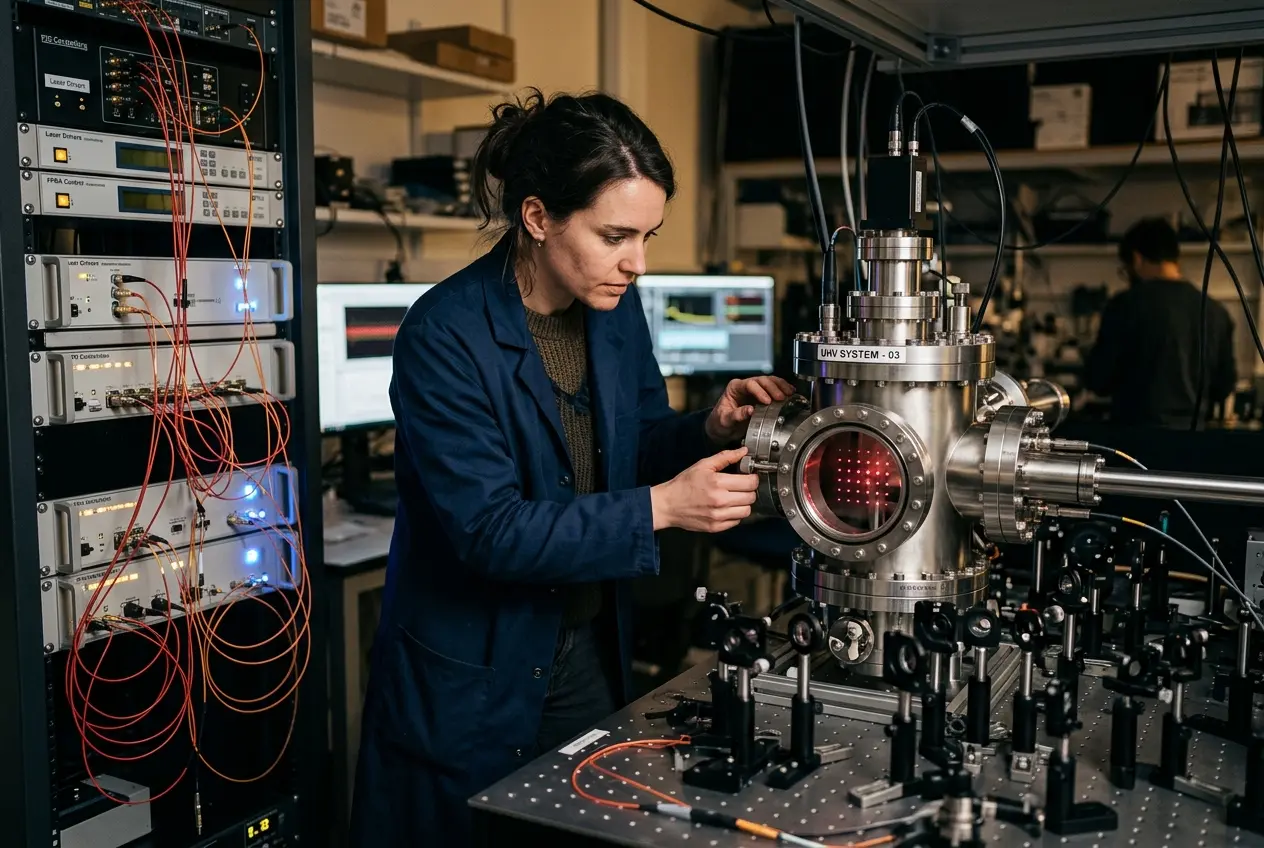
A team at Eindhoven University of Technology has built a strontium optical-tweezer apparatus for quantum computing that swaps the standard two-dimensional magneto-optical trap for a single-beam deflection stage. The setup can run for weeks without intervention, and it leans on a frequency reference piped in over optical fiber from the Dutch Metrology Institute about 100 kilometers away. The work, by Marijn Venderbosch and 13 co-authors, was published in AIP Advances and is positioned as a building block for a multi-hardware platform called Quantum Inspire.
Neutral-atom quantum computing has become one of the most-watched branches of the field, in part because strontium’s narrow clock transition can be used as a qubit while its Rydberg states make fast two-qubit gates possible. The Eindhoven apparatus focuses on the unglamorous engineering underneath: vacuum isolation, single-atom loading, and the laser stability that qubits actually demand. The interesting trade is that those gains come with a new kind of dependency, on a national metrology lab, that would be unusual in any other kind of computing stack.
Why Strontium, and Why Tweezers
Strontium has two valence electrons and a useful ladder of optical transitions, including an ultra-narrow clock line that the team uses as its qubit transition. The same atom also reaches a Rydberg state through a single-photon transition, which the authors say offers high Rabi frequencies for high-fidelity entanglement gates. Venderbosch and colleagues describe strontium as an “attractive candidate” for tweezer-based platforms because of that combination.
Optical tweezers are highly focused laser beams that trap single atoms in arrays of arbitrary geometry, a configuration the authors cite for both scalability and connectivity. Several strontium setups have already demonstrated continuous magneto-optical trap loading, single-atom preparation, motional ground-state cooling, qubit manipulation, and entanglement, according to the paper.
The Eindhoven setup is meant to sit alongside those existing strontium rigs rather than replace them, and to plug into Quantum Inspire, an openly accessible quantum platform. The platform currently runs a Rydberg emulator as a digital twin of the apparatus. As a near-term goal, the team is implementing a full-stack approach that bundles hardware, control software, and a user-facing programming layer.
The Deflection Stage Swap
The paper’s clearest engineering departure is the choice to drop the two-dimensional magneto-optical trap, a fixture of most cold-atom labs, in favor of a single-beam deflection stage. The deflection stage is based on transverse optical molasses and uses a single retro-reflected laser beam, which the authors describe as forgiving with respect to beam alignment. That single beam directs a controlled flux of strontium atoms into the science chamber while physically separating the hot oven from the cold atoms.
The reason for the swap is vacuum. The science chamber operates at a vacuum pressure of 3×10⁻¹¹ mbar, the kind of environment qubits need to keep their coherence. A 2-D MOT typically leaves a direct line of sight between oven and chamber, which leaks heat and stray atoms into the cold region. The deflection stage removes that line of sight, which lets the team keep the oven hot and the chamber cold at the same time.
The single retro-reflected beam also makes the upstream atom source easier to swap or tune without disturbing the cold-atom chamber downstream. The setup’s compactness, with rack-mounted laser systems and a 19-inch enclosure for the acousto-optic components, is part of the same modularity story.
The result is a setup that the authors say can run for multiple days without intervention, and in some cases for weeks. Continuous operation is the metric that separates an apparatus from a science project, and the team is targeting it from the start.
We need cold atoms at micro-Kelvin temperatures because only then is their kinetic energy low enough to stay inside the tweezers.
Rianne Lous is an author on the paper and a researcher at Eindhoven University of Technology’s Coherence and Quantum Technology group, in remarks carried with the AIP Advances announcement.
Holding the Lasers Still
Qubits are only as good as the lasers that define them, and the Eindhoven group uses eight continuous-wave lasers spanning wavelengths from 317 nm to 813 nm. The 813 nm fiber laser is a magic wavelength for the ¹S₀ → ³P₀ clock transition in strontium, which is the qubit transition the apparatus targets. Other wavelengths handle first-stage cooling and imaging at 461 nm, red MOT operation at 689 nm, the clock transition at 698 nm, and Rydberg excitation at 317 nm, with three repump lasers addressing the triplet manifold.
- 317 nm: Rydberg excitation (Precilasers, FL-SF-316-1-CW)
- 461 nm: first-stage cooling and imaging (Vexlum VALO SHG SF plus Moglabs ILA)
- 689 nm: red MOT (Moglabs ILA)
- 698 nm: clock transition (Moglabs ILA)
- 813 nm: optical tweezers at the clock magic wavelength (Precilasers FL-SF-813-8-CW)
- Three repump lasers (Optoquest) addressing the (5s6s)³S₁ state
- 1542 nm: ultra-stable cavity reference (Menlo Systems ORS mini)
- Frequency comb: Menlo Systems FC1500-250-ULN
All CW lasers except the 813 nm tweezer laser are locked to a commercial frequency comb, a Menlo Systems FC1500-250-ULN. The comb is short-term stabilized to a high-finesse cavity and long-term steered by a 10 MHz RF signal delivered over optical fiber from the Dutch metrology lab in Delft using the white-rabbit protocol. The cavity itself drifts at 0.08919(7) Hz per second, which would compound into unacceptable error over hours.
For clock and Rydberg lasers locked at a comb index of about 1.4×10⁶, the resulting frequency stability works out to about 10 Hz, measured against a modified Allan deviation of about 4×10⁻¹³ at 10⁴ seconds of averaging. The fiber-linked reference cancels the cavity drift on a timescale that matters for clock qubits. The laser rack, sealed against dust with integrated ventilation, packages the acousto-optic components and control electronics in a 19-inch frame and supports continuous operation over several days or even weeks.
Reading the Numbers: 25 Atoms at 5 μK
The headline result is small in qubit count and precise in measurement. The team stochastically loads a 5×5 array of optical tweezers with single ⁸⁸Sr atoms, each trap holding one atom. The optical tweezers use a 1/e² waist of 0.81(2) μm, fine enough to isolate individual atoms in adjacent sites.
The atoms are cooled to a temperature of 5(1) μK in a process that begins with two laser-cooling stages, producing roughly 3×10⁵ atoms in the magneto-optical trap before the tweezer load. Imaging fidelity runs to about 0.997, with a survival probability of 0.99 (+0.01, -0.02). That fidelity and survival number is the metric that lets the team read out qubit states without losing the atom in the process.
- Array size: 5×5 single-atom tweezers (25 sites)
- Atom: ⁸⁸Sr (strontium-88)
- Temperature: 5(1) μK after two cooling stages
- Trap waist: 0.81(2) μm at 1/e²
- Vacuum: 3×10⁻¹¹ mbar in the science chamber
- Imaging fidelity: ~0.997
- Survival probability: 0.99 (+0.01, -0.02)
Five microkelvin is the regime Rianne Lous described as the floor for tweezer trapping. The setup’s vacuum, at 3×10⁻¹¹ mbar, supports the long coherence times strontium is famous for, on the order of seconds in the best published work elsewhere in the field. The 5×5 grid is small compared to atom-array demonstrations from larger groups, but it is the cleanest version of this particular apparatus design, the one future papers from the group will scale from.
The atomic array is meant to serve as the core of a full-stack quantum computing processor targeted at quantum chemistry problems, the authors write. Single-qubit gates and Rydberg-mediated entanglement are the next milestones the team is working toward.
Quantum Inspire and the Open-Access Bet
The apparatus is being built to plug into Quantum Inspire, a multi-hardware, openly accessible quantum platform. Quantum Inspire is the team’s answer to a recurring question in the neutral-atom community: how do you let outside researchers actually use the hardware. The platform already runs a Rydberg emulator called RySP as a digital twin of the apparatus, so users can test code before the strontium backend goes live.
Neutral atom quantum computers are among the fastest growing platforms with record amounts of qubits and competitive coherence times. The end goal is to make a quantum computer openly accessible to the public by offering a user-friendly platform and a high-level programming language.
Rianne Lous is an author on the paper and a researcher at Eindhoven University of Technology’s Coherence and Quantum Technology group. The bet is that exposing the hardware to a wider programming community will outpace closed-architecture approaches that gate access behind contracts. Quantum Inspire already lists several quantum hardware backends from other groups, and this would add strontium tweezers to that mix, sitting alongside wider infrastructure work like the UK’s £10m quantum standards initiative coordinated by the National Physical Laboratory.
Where This Sits in the Neutral-Atom Race
Neutral-atom quantum computing has moved fast in the last two years, with published demonstrations of continuous operation in atom-array architectures and the largest single arrays now in the thousands of atoms. The Eindhoven setup is built around a different bet. Its 25 atoms are a baseline, an early version of a system whose real innovation is the apparatus around them. Other strontium rigs have shown continuous magneto-optical trap loading, single-atom preparation, motional ground-state cooling, qubit manipulation, and entanglement, and the Eindhoven paper benchmarks itself against that prior work rather than against the largest published arrays.
Larger neutral-atom groups optimize for array size and reloading rate; this paper optimizes for vacuum isolation, imaging fidelity, and laser stability over multi-day runs. The choice to lean on a national metrology institute for frequency reference is the most unusual piece. A fiber link to a metrology lab would be a non-starter for a commercial product and a useful ceiling for a research apparatus.
The dependency is geographic as well as institutional: the apparatus inherits the long-term behavior of the Dutch Metrology Institute’s reference, whatever that looks like on a given day. The paper does not claim the design is portable, and it does not claim to beat the larger arrays on qubit count. The apparatus can run for weeks with stable lasers, the team says. The next papers from the group will report single-qubit gates and Rydberg-mediated entanglement results.
Frequently Asked Questions
What is a strontium optical tweezer?
An optical tweezer is a highly focused laser beam that traps a single atom at microkelvin temperatures. In the Eindhoven setup, a 5×5 grid of tweezers holds one ⁸⁸Sr atom each, with the laser waist tuned to 0.81(2) μm so neighboring atoms stay isolated.
Why use a deflection stage instead of a 2-D magneto-optical trap?
The deflection stage removes the direct line of sight between the hot oven and the cold-atom science chamber. That separation lets the apparatus hold a vacuum pressure of 3×10⁻¹¹ mbar in the science chamber, which supports the long coherence times strontium qubits need, while still loading the tweezers at a useful rate.
What qubit does the clock transition encode?
The qubit is encoded on the ultra-narrow ¹S₀ → ³P₀ clock transition in strontium-88, addressed at 698 nm. The optical tweezers run at 813 nm, a magic wavelength for that clock transition, so the trapping light does not perturb the qubit state while the atom is held.
How does the Dutch Metrology Institute factor in?
All eight continuous-wave lasers in the apparatus are locked to a frequency comb whose long-term drift is corrected by a 10 MHz reference piped in over optical fiber from VSL, the Dutch Metrology Institute in Delft, about 100 km from the Eindhoven lab. The link uses the white-rabbit protocol and translates to about 10 Hz of frequency stability at the clock and Rydberg laser wavelengths, per the open-access preprint of the paper.
What is Quantum Inspire?
Quantum Inspire is the multi-hardware, openly accessible quantum platform the Eindhoven group is contributing its strontium tweezer backend to. Outside users will eventually run code on the strontium atoms through the platform, with the RySP Rydberg emulator currently serving as a digital stand-in, and the peer-reviewed journal version of the paper positions the apparatus as that backend.
What milestone is the team working toward next?
The paper states that the atomic array is intended to serve as the core of a full-stack quantum computing processor targeted at quantum chemistry problems, with single-qubit gates and Rydberg-mediated entanglement as the next demonstrations. The deflection-stage design is what the team plans to scale from as the array grows.


South Korea Retail Investors Face Reckoning After KOSPI AI Rally Collapses

Surrey AI Maps Three Heart Attack Paths and Their Molecular Roots

Germany Locks Neutral Apple ATT Prompts Across Most of Europe

Apple’s 5% EU Fee Quietly Rewrites Alternative App Store Math

Apple’s EU Fee Truce Cuts Complexity but Leaves Rivals Fuming

Pixel 11 Pro Fold Trades Thinness for Durability and Seven-Year Stay

Mayo AI Flags HCM Obstruction From Everyday Ultrasound Videos

Indian Brands Quietly Scale Landmark Screens and Home Tech

Navin Vatsa Turns Grief Into a Lifetime of Quiet Seeing

Google Bets Pixel 11 Agentic AI Will Redefine Phones

Oracle Cuts 21,000 Jobs in a Year, Cites AI in 10-K Filing

Fable 5 and Mythos 5 Return as US Lifts Anthropic Export Controls

SpaceX’s Google Deal Turns a Rocket Company Into a Cloud Landlord

CD Projekt Red Co-CEO: Redemption Arc Isn’t Done, Witcher 4 in 2027

XPL Rallies 30% Ahead of Plasma One Card Tier Launch

Google Search Profiles Build a Follow Graph Inside Discover

DGO App Brings Rs 549 Mobile Pass for FIFA World Cup 2026 in Nepal

Moonshot AI Targets $30 Billion in China’s Fastest AI Funding Sprint

Oppo’s ColorOS 17 Eligibility List Leaves A-Series Buyers Behind

Microsoft Xbox Layoffs Start in July as Sharma Slams 3% Margin
-
 AI2 months ago
Oracle Cuts 21,000 Jobs in a Year, Cites AI in 10-K Filing
-
 AI2 months ago
Fable 5 and Mythos 5 Return as US Lifts Anthropic Export Controls
-
 AI3 months ago
SpaceX’s Google Deal Turns a Rocket Company Into a Cloud Landlord
-
 GAMING2 months ago
CD Projekt Red Co-CEO: Redemption Arc Isn’t Done, Witcher 4 in 2027
-
 CRYPTO2 months ago
XPL Rallies 30% Ahead of Plasma One Card Tier Launch
-
 NEWS3 months ago
Google Search Profiles Build a Follow Graph Inside Discover
-
 APPS2 months ago
DGO App Brings Rs 549 Mobile Pass for FIFA World Cup 2026 in Nepal
-
 AI3 months ago
Moonshot AI Targets $30 Billion in China’s Fastest AI Funding Sprint